Hindu Succession Act: Applicability and Scope - Social Issues | UPSC Learning
Topics
0 topics • 0 completed
🔍
No topics match your search

Hindu Succession Act: Applicability and Scope
Medium⏱️ 8 min read
social issues
📖 Introduction
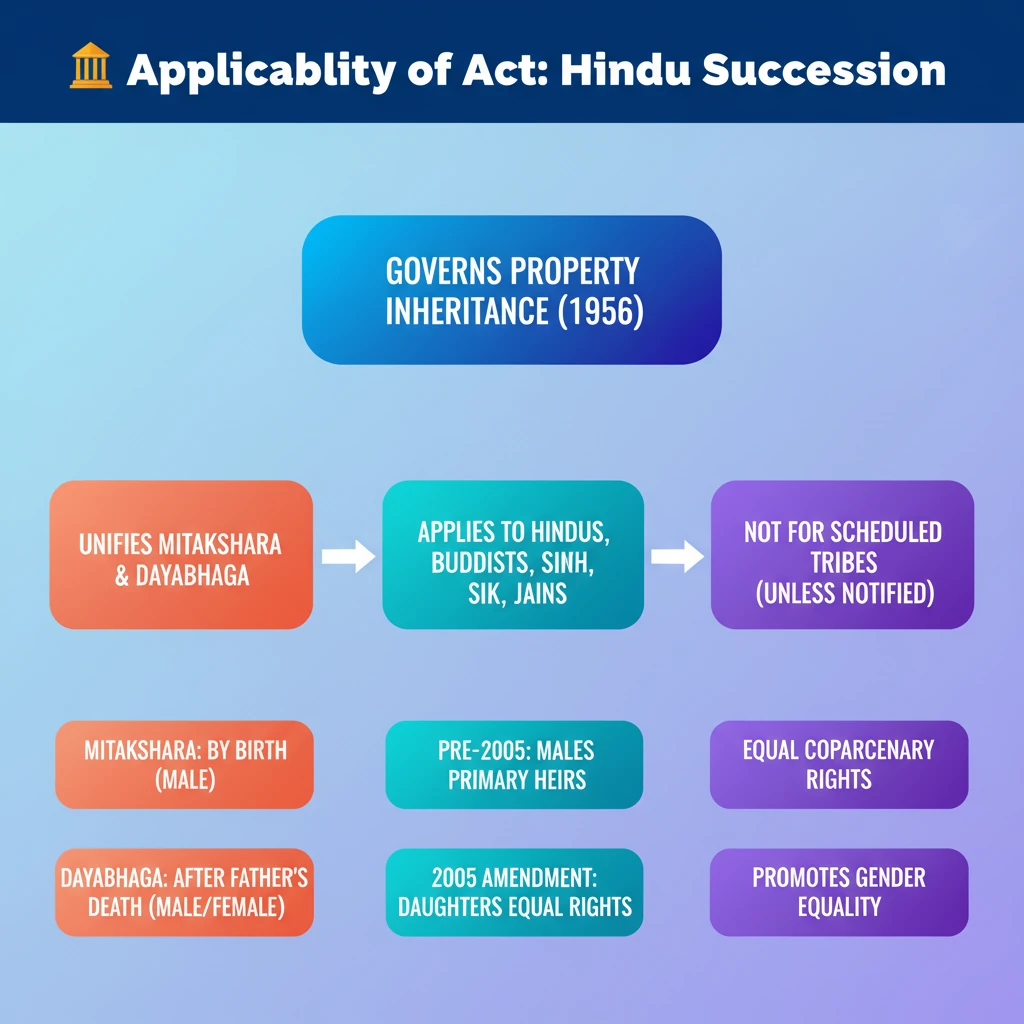
<h4>Introduction to the Hindu Succession Act</h4><p>The <strong>Hindu Succession Act</strong> establishes comprehensive rules for determining <strong>heirs</strong>, their respective <strong>rights</strong>, and the systematic <strong>division of property</strong>. This framework is crucial for ensuring clarity and fairness in inheritance matters.</p><p>It primarily governs the devolution of property based on the familial relationships of the deceased, aiming to create a uniform system across various communities.</p><h4>Applicability of the Act</h4><p>The Act's scope is broad, covering several religious groups within India. It is designed to provide a consistent legal framework for succession.</p><ul><li><strong>Hindus by religion</strong>, including specific sects such as <strong>Virashaivas</strong>, <strong>Lingayats</strong>, <strong>Brahmos</strong>, <strong>Prarthna Samajists</strong>, and <strong>Arya Samaj followers</strong>.</li><li><strong>Buddhists</strong>, <strong>Sikhs</strong>, and <strong>Jains by religion</strong> are also covered under the provisions of this Act.</li><li>The Act also applies to persons who are <strong>not Muslim, Christian, Parsi, or Jewish</strong>. However, this is conditional: it applies to them unless it can be proven that <strong>Hindu law or custom</strong> does not govern their inheritance.</li></ul><div class='info-box'><p>The <strong>Hindu Succession Act</strong> extends its jurisdiction <strong>across India</strong>. However, it does not automatically apply to <strong>Scheduled Tribes (STs)</strong> as per <strong>Article 366</strong> of the Constitution, unless specifically notified by the <strong>Central Government</strong>.</p></div><h4>Schools of Hindu Law and Unification</h4><p>Historically, Hindu law was governed by different schools, primarily <strong>Mitakshara</strong> and <strong>Dayabhaga</strong>. The Act plays a pivotal role in unifying these systems.</p><div class='key-point-box'><p>The <strong>Hindu Succession Act</strong> establishes a <strong>uniform system of inheritance</strong> and <strong>devolution of property</strong>. This system is equally applicable to areas traditionally governed by both the <strong>Mitakshara</strong> and <strong>Dayabhaga schools</strong> of Hindu Law, thereby harmonizing previous disparities.</p></div><h4>Distinction Between Mitakshara and Dayabhaga Schools</h4><p>Despite the unification, understanding the historical differences between these schools is crucial for contextualizing property rights.</p><ul><li>The <strong>Mitakshara Law</strong> traditionally applied to the <strong>whole of India</strong>, with the significant exceptions of <strong>West Bengal and Assam</strong>.</li><li>In contrast, the <strong>Dayabhaga Law</strong> was specifically applicable to the regions of <strong>West Bengal and Assam</strong>.</li></ul><div class='info-box'><p><strong>Key Differences:</strong></p><ul><li>Under <strong>Dayabhaga law</strong>, <strong>inheritance rights</strong> arise only <strong>after the father’s death</strong>.</li><li>Conversely, <strong>Mitakshara law</strong> grants <strong>property rights from birth</strong> itself.</li></ul></div><h4>Coparcenary Rights</h4><p>The concept of <strong>coparcenary</strong> is central to understanding property rights under these schools, particularly regarding ancestral property.</p><div class='info-box'><p>A <strong>coparcener</strong> is defined as a person who can claim a right over <strong>ancestral property</strong> by birth.</p></div><p>There is a significant distinction in coparcenary rights between the two schools:</p><ul><li>In the <strong>Dayabhaga system</strong>, both <strong>male and female family members</strong> can be <strong>coparceners</strong>.</li><li>However, the <strong>Mitakshara system</strong> traditionally restricted <strong>coparcenary rights</strong> exclusively to <strong>male members only</strong>. (Note: The 2005 amendment to the Hindu Succession Act significantly altered this for Mitakshara, granting equal rights to daughters).</li></ul><div class='exam-tip-box'><p>For <strong>UPSC Mains (GS-I/II)</strong>, understanding the historical context and the impact of the <strong>Hindu Succession Act, 1956</strong> (especially the <strong>2005 amendment</strong>) on <strong>gender equality</strong> in property rights is vital. Questions often focus on the evolution of personal laws and their social implications.</p></div>
💡 Key Takeaways
- •Hindu Succession Act, 1956, governs property inheritance for Hindus, Buddhists, Sikhs, and Jains.
- •It unifies inheritance rules previously governed by Mitakshara and Dayabhaga schools.
- •The Act does not automatically apply to Scheduled Tribes unless notified by the Central Government.
- •Mitakshara traditionally granted property rights by birth (males), Dayabhaga only after father's death (males/females as coparceners).
- •The 2005 amendment granted daughters equal coparcenary rights in ancestral property, significantly promoting gender equality.
🧠 Memory Techniques

98% Verified Content
📚 Reference Sources
•The Hindu Succession Act, 1956
•The Hindu Succession (Amendment) Act, 2005
•Constitution of India (Article 366)