What are the Key Highlights of the Study on Denotified, Nomadic, and Semi-Nomadic Tribes? - Social Issues | UPSC Learning
Topics
0 topics • 0 completed
🔍
No topics match your search
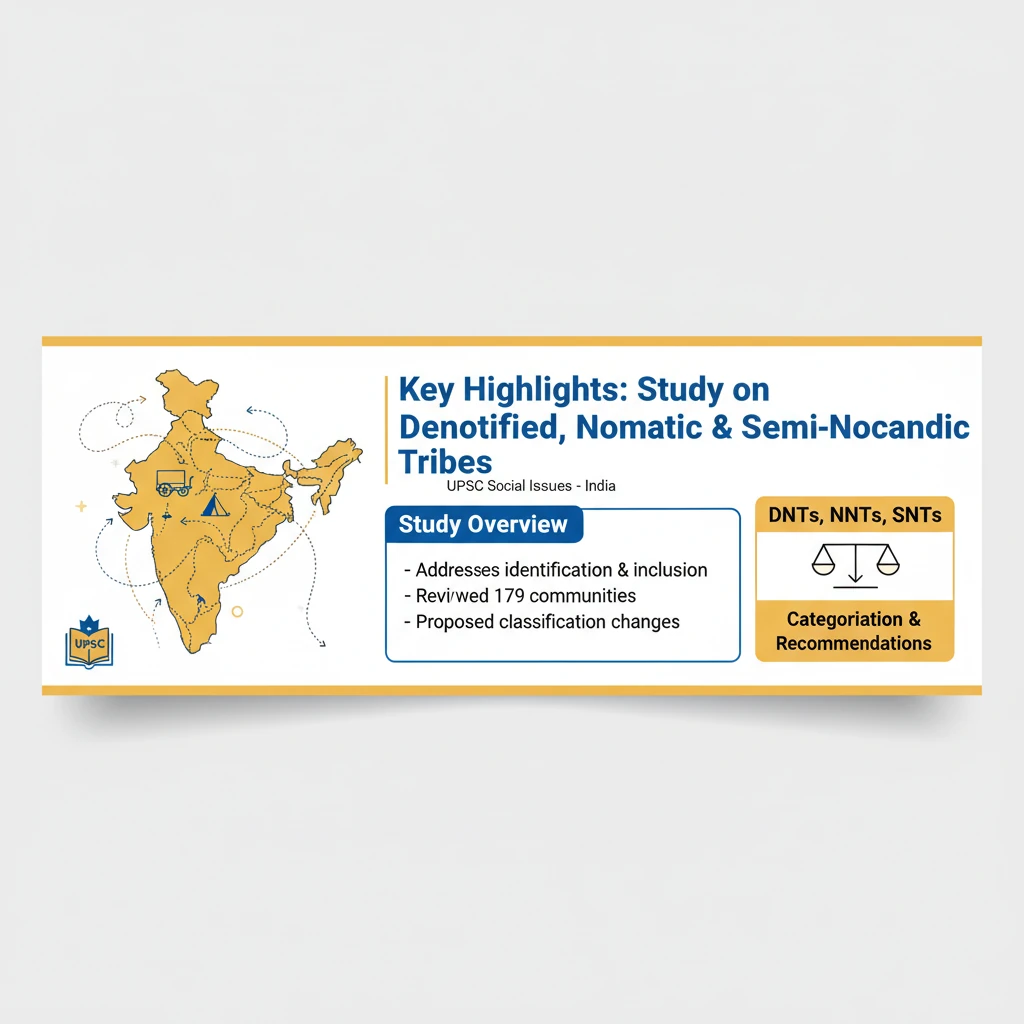
What are the Key Highlights of the Study on Denotified, Nomadic, and Semi-Nomadic Tribes?
Medium⏱️ 6 min read
social issues
📖 Introduction
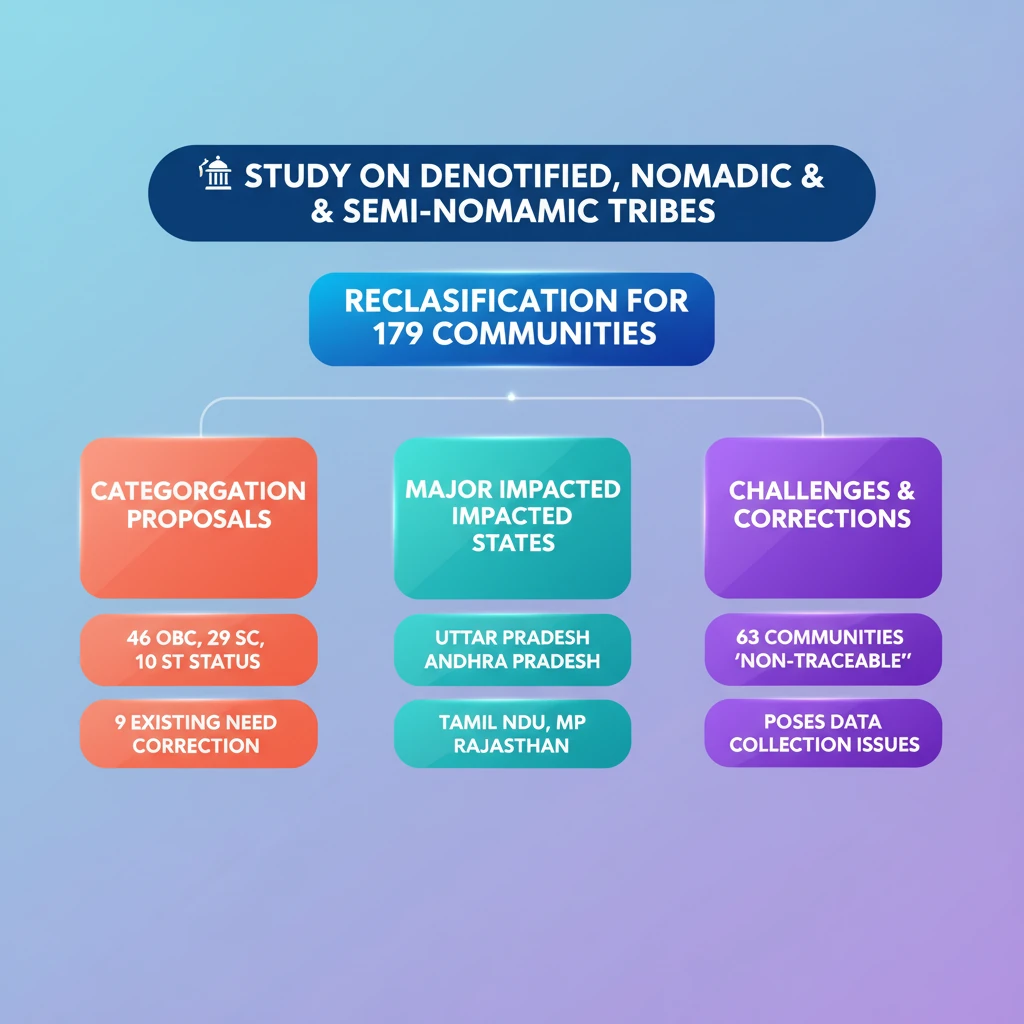
<h4>Introduction to Denotified, Nomadic, and Semi-Nomadic Tribes Study</h4><p>A recent study has shed light on the complex issues surrounding <strong>Denotified, Nomadic, and Semi-Nomadic Tribes (DNTs, NTs, SNTs)</strong> in India. This comprehensive analysis proposes significant changes to their categorization and addresses challenges in identification.</p><div class='key-point-box'><p>The study aims to ensure better social justice and welfare for these historically marginalized communities by updating their official status.</p></div><h4>New Additions and Categorization Proposals</h4><p>The study recommends the inclusion of <strong>179 new communities</strong> into various reservation categories. This is a crucial step towards recognizing and addressing their unique socio-economic disadvantages.</p><div class='info-box'><ul><li><strong>46 communities</strong> are proposed for <strong>Other Backward Classes (OBC)</strong> status.</li><li><strong>29 communities</strong> are proposed for <strong>Scheduled Caste (SC)</strong> status.</li><li><strong>10 communities</strong> are proposed for <strong>Scheduled Tribe (ST)</strong> status.</li></ul></div><p>These proposed additions reflect a detailed assessment of their current socio-economic conditions and historical marginalization.</p><h4>Geographical Impact of Proposed Changes</h4><p>The study highlights that certain states will experience a more significant impact due to these proposed changes. These states have a higher concentration of the identified communities.</p><div class='info-box'><p>The states most impacted include <strong>Uttar Pradesh, Andhra Pradesh, Tamil Nadu, Madhya Pradesh, and Rajasthan</strong>.</p><p><strong>Uttar Pradesh</strong> is identified as the state with the highest number of proposed changes, indicating a substantial shift in its demographic and social welfare landscape.</p></div><p>Understanding this geographical distribution is vital for effective policy implementation and resource allocation.</p><h4>Issues of Non-Traceability</h4><p>A significant challenge identified by the study is the <strong>non-traceability</strong> of certain communities. This issue complicates the process of accurate categorization and targeted welfare.</p><div class='key-point-box'><p>The study found that <strong>63 communities</strong> were deemed <strong>“non-traceable.”</strong> This suggests several possible scenarios for these groups.</p></div><p>Reasons for non-traceability include assimilation into dominant communities, changes in community names over time, or migration to different regions.</p><p>This finding poses a challenge to the existing categorization process and raises concerns about effectively identifying communities that have undergone significant social integration or dispersal.</p><h4>Correction of Existing Communities' Categorization</h4><p>Beyond new additions, the study also addresses inaccuracies in the existing official lists. This ensures that communities are correctly recognized and receive appropriate benefits.</p><div class='info-box'><p>The study suggests correcting the categorization of <strong>9 existing communities</strong>. These communities were either misclassified or inadequately listed in state or central lists.</p></div><p>Such corrections are essential for rectifying historical errors and ensuring that welfare schemes reach their intended beneficiaries.</p>
💡 Key Takeaways
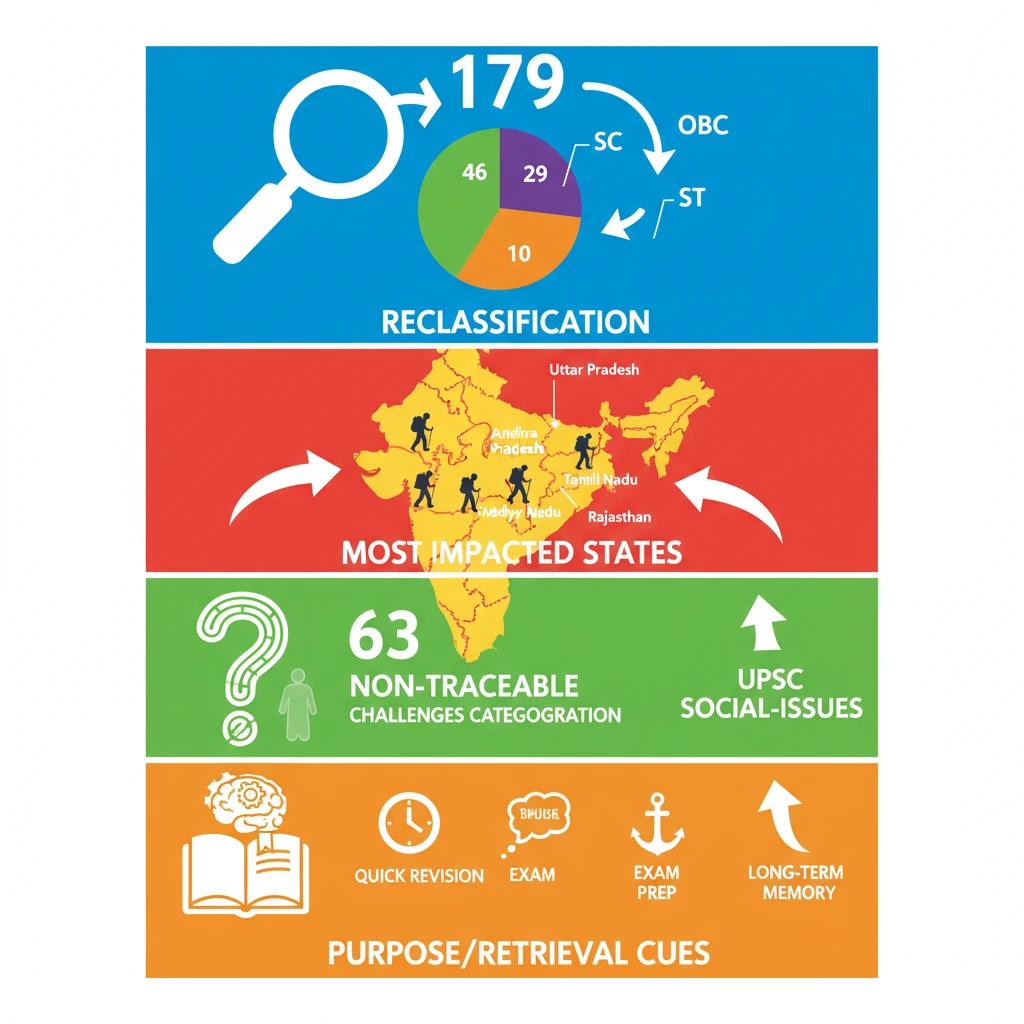
- •Study proposes 179 new community additions: 46 OBC, 29 SC, 10 ST.
- •Uttar Pradesh, Andhra Pradesh, Tamil Nadu, Madhya Pradesh, Rajasthan are most impacted states.
- •63 communities found 'non-traceable' due to assimilation, name change, or migration.
- •Study recommends correcting categorization of 9 existing misclassified communities.
- •Highlights ongoing challenges in identifying and ensuring welfare for DNTs, NTs, SNTs.
🧠 Memory Techniques
95% Verified Content
📚 Reference Sources
•Ministry of Social Justice and Empowerment (for general context on DNTs, NTs, SNTs)