Government Initiatives to Promote Gender Parity - Social Issues | UPSC Learning
Topics
0 topics • 0 completed
🔍
No topics match your search
Government Initiatives to Promote Gender Parity
Medium⏱️ 8 min read
social issues
📖 Introduction
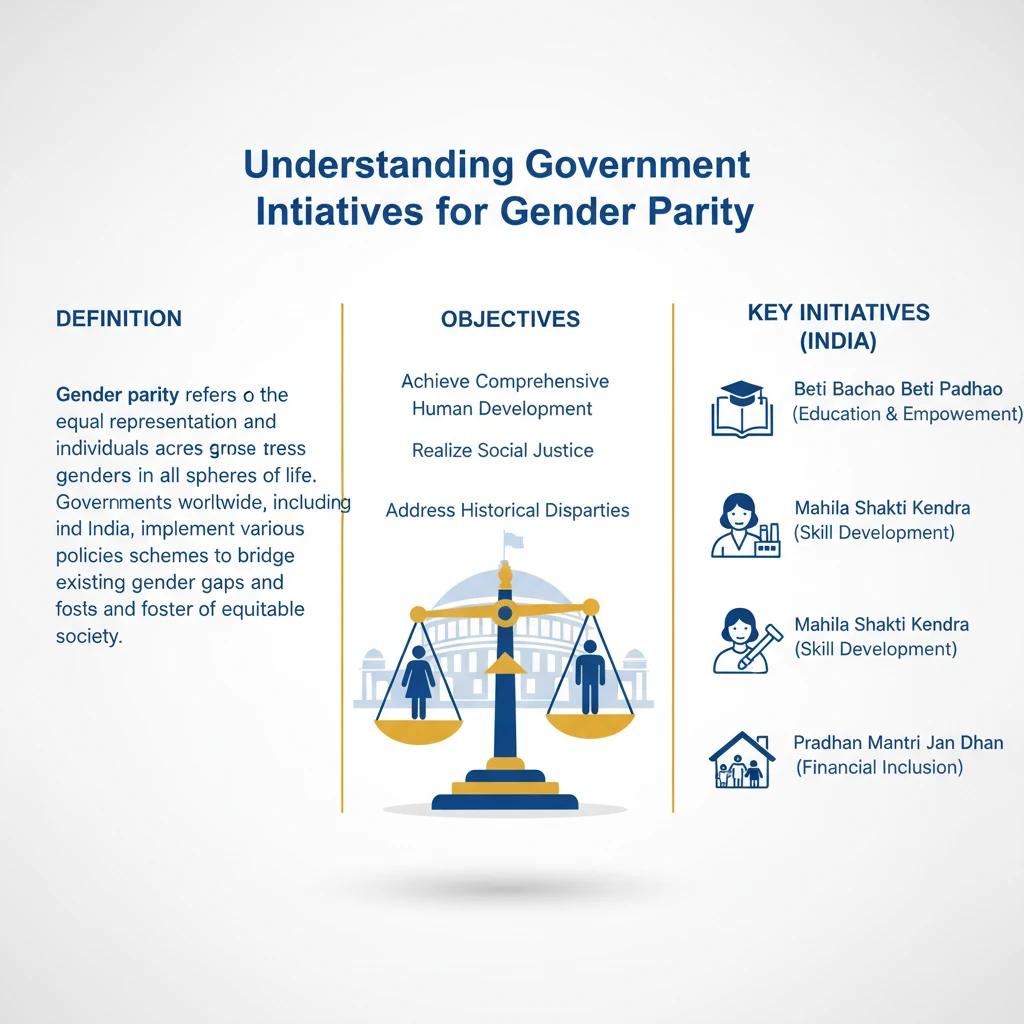
<h4>Understanding Government Initiatives for Gender Parity</h4><p><strong>Gender parity</strong> refers to the equal representation and treatment of individuals across genders in all spheres of life. Governments worldwide, including India, implement various policies and schemes to bridge existing gender gaps and foster an equitable society.</p><p>These initiatives are crucial for achieving comprehensive human development and realizing the goals of social justice. They aim to address historical disadvantages and systemic biases faced by women and girls.</p><div class='key-point-box'><p><strong>Key Concept:</strong> <strong>Gender Parity</strong> is about achieving equal opportunities, rights, and responsibilities for all genders. It's a fundamental aspect of inclusive development.</p></div><h4>Scheme for Adolescent Girls (SAG)</h4><p>The <strong>Scheme for Adolescent Girls (SAG)</strong> is a centrally sponsored program implemented by the <strong>Ministry of Women & Child Development</strong>. It targets out-of-school adolescent girls in the age group of <strong>11-14 years</strong> across India.</p><p>The primary objective is to empower these girls by improving their nutritional and health status, enhancing their education, and developing vocational skills. This holistic approach aims to facilitate their transition into adulthood as self-reliant citizens.</p><div class='info-box'><p><strong>Launch Year:</strong> <strong>2010</strong> (re-launched in 2014-15 with revised strategy)</p><p><strong>Target Group:</strong> Out-of-school girls, <strong>11-14 years</strong></p><p><strong>Implemented through:</strong> <strong>Anganwadi Centres (AWCs)</strong></p></div><p><strong>Key Services Provided under SAG:</strong></p><ul><li><strong>Nutritional Support:</strong> Providing supplementary nutrition to address malnutrition.</li><li><strong>Health Check-ups:</strong> Regular health assessments and referrals to public health services.</li><li><strong>Life Skill Education:</strong> Training in personal hygiene, health, and decision-making.</li><li><strong>Vocational Training:</strong> Skill development to enhance employability and economic independence.</li><li><strong>Mainstreaming into School:</strong> Efforts to bring out-of-school girls back into formal education.</li></ul><div class='exam-tip-box'><p><strong>UPSC Insight:</strong> SAG is relevant for <strong>GS-I (Society)</strong> and <strong>GS-II (Social Justice)</strong>. Focus on its multi-faceted approach to empower adolescent girls and its role in preventing child marriage and promoting education.</p></div><h4>Sukanya Samriddhi Yojana (SSY)</h4><p>The <strong>Sukanya Samriddhi Yojana (SSY)</strong> is a small savings scheme launched as part of the <strong>Beti Bachao Beti Padhao campaign</strong>. It is designed to promote the welfare of a girl child by ensuring her financial security.</p><p>This scheme encourages parents to build a fund for their daughter's future education and marriage expenses. It offers attractive interest rates and tax benefits, making it a popular choice for long-term savings.</p><div class='info-box'><p><strong>Launch Year:</strong> <strong>2015</strong></p><p><strong>Ministry:</strong> <strong>Ministry of Finance</strong></p><p><strong>Eligibility:</strong> A girl child below <strong>10 years of age</strong>. One account per girl, maximum two per family (with exceptions for twins/triplets).</p></div><p><strong>Key Features of SSY:</strong></p><ul><li><strong>High Interest Rate:</strong> Offers one of the highest interest rates among small savings schemes.</li><li><strong>Tax Benefits:</strong> Deposits are eligible for deduction under <strong>Section 80C</strong> of the Income Tax Act. Interest earned and maturity amount are also tax-exempt (<strong>EEE status</strong>).</li><li><strong>Long-term Savings:</strong> Deposits can be made for <strong>15 years</strong> from the date of account opening.</li><li><strong>Withdrawal Facility:</strong> Partial withdrawal allowed for higher education or marriage after the girl turns <strong>18 years old</strong>.</li><li><strong>Maturity:</strong> Account matures after <strong>21 years</strong> from opening or at the time of the girl's marriage after 18 years.</li></ul><div class='exam-tip-box'><p><strong>UPSC Insight:</strong> SSY is important for <strong>GS-II (Social Justice)</strong> and <strong>GS-III (Indian Economy)</strong>. Analyze its role in promoting financial inclusion, encouraging girl child education, and improving the child sex ratio indirectly.</p></div>
💡 Key Takeaways
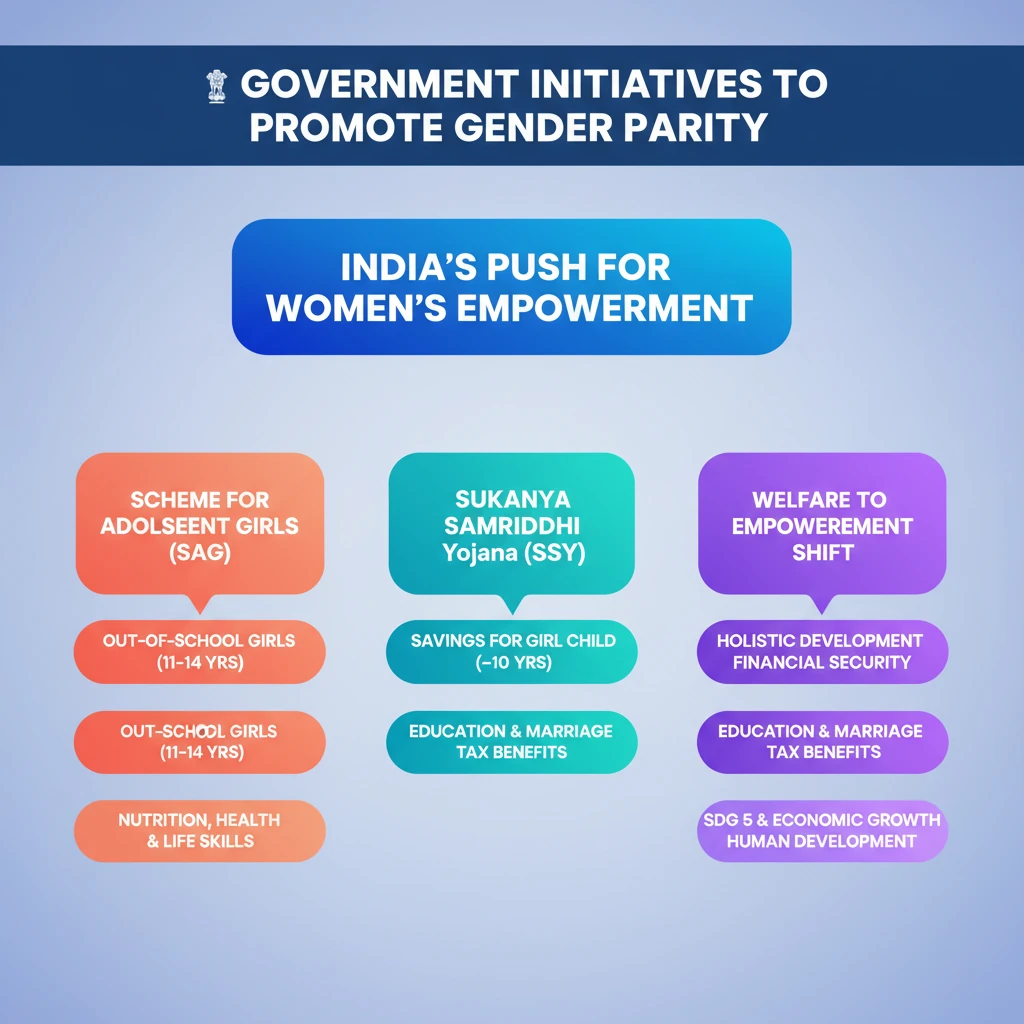
- •Government initiatives are crucial for achieving gender parity and women's empowerment in India.
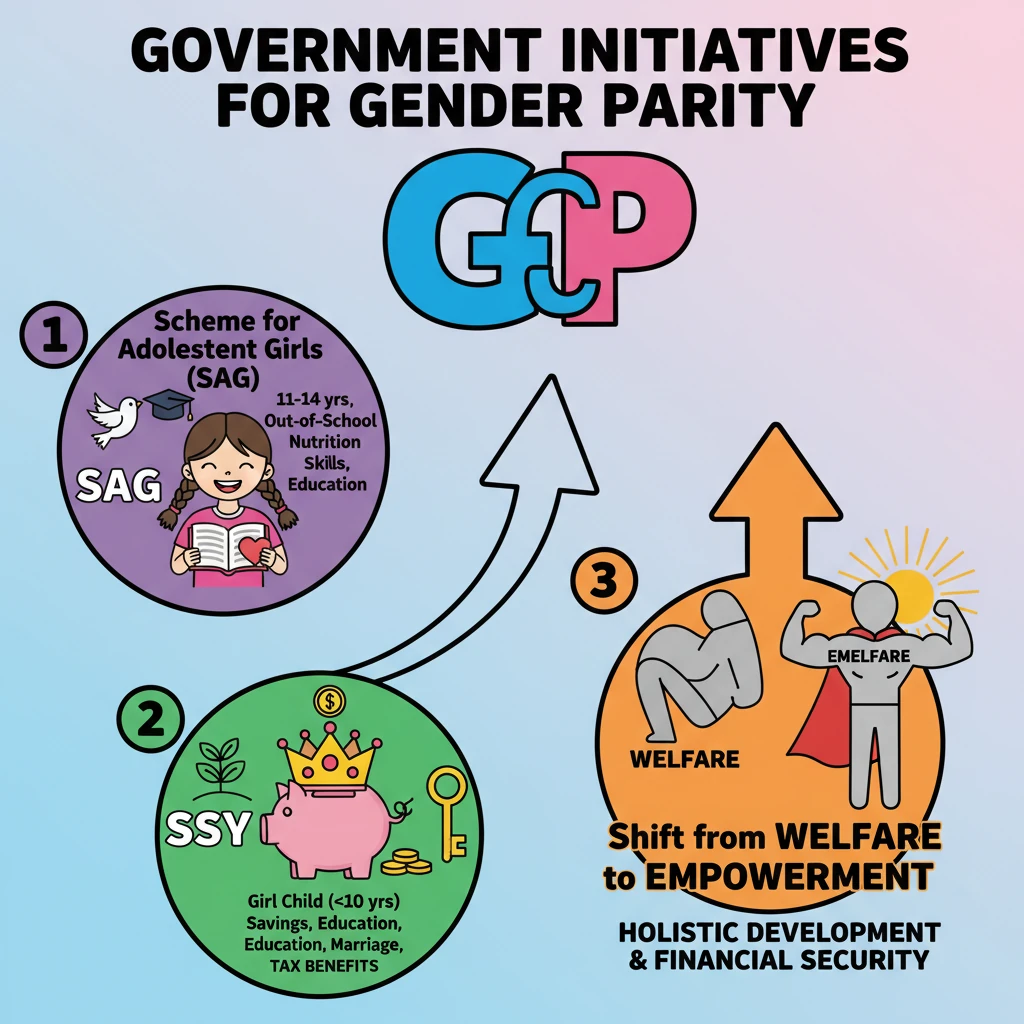
- •The Scheme for Adolescent Girls (SAG) targets out-of-school girls (11-14 years) with nutrition, health, education, and life skills.
- •Sukanya Samriddhi Yojana (SSY) is a savings scheme for girl children (under 10 years) for their education and marriage, offering tax benefits.
- •These schemes reflect a shift from welfare to empowerment, aiming for holistic development and financial security.
- •Gender parity initiatives are vital for India's economic growth, human development, and achieving SDG 5.
- •Historical context shows evolution from social reform to constitutional guarantees and targeted policies.
🧠 Memory Techniques
95% Verified Content
📚 Reference Sources
•Ministry of Finance - Official Website (for Sukanya Samriddhi Yojana details)
•NITI Aayog Reports on Women and Child Development
•Press Information Bureau (PIB) releases on government schemes
•The Constitution of India