Offence of ‘Abetment of Suicide’ - Social Issues | UPSC Learning
Topics
0 topics • 0 completed
🔍
No topics match your search
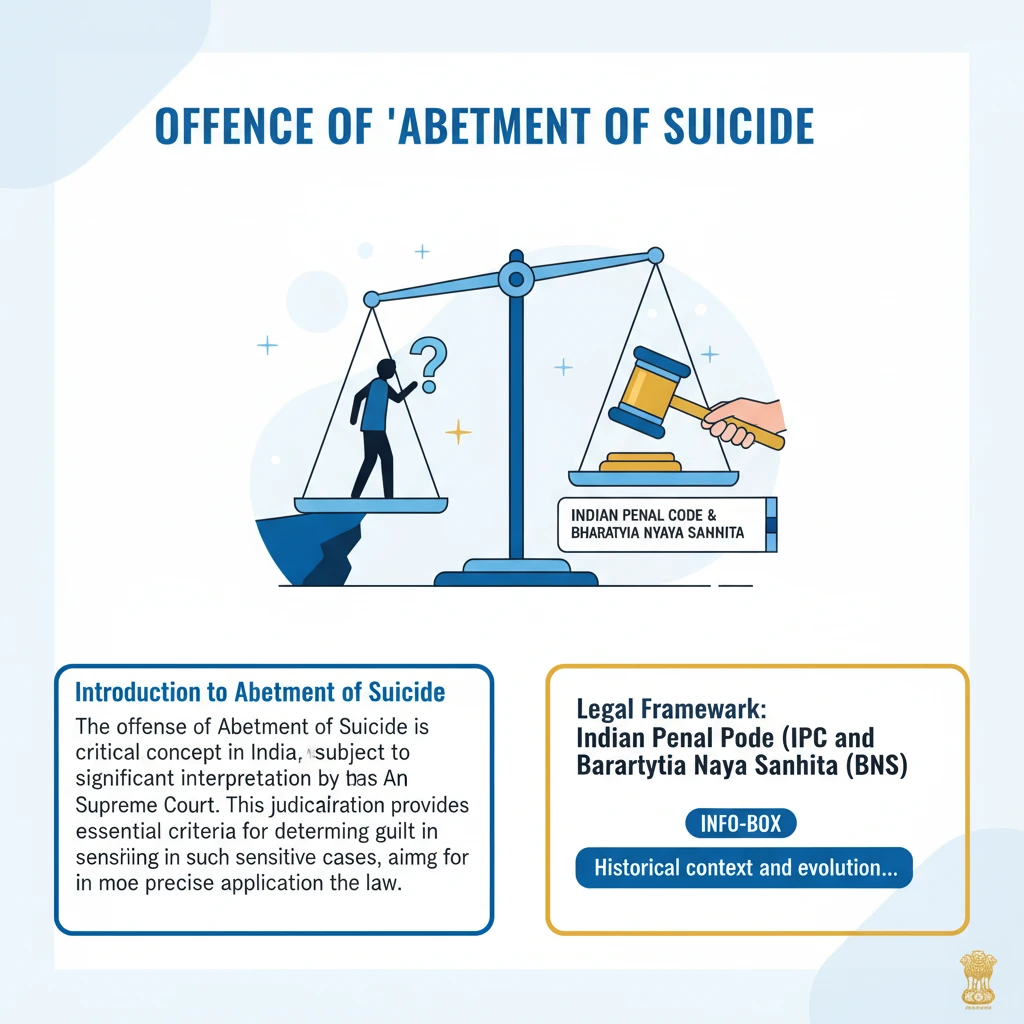
Offence of ‘Abetment of Suicide’
Medium⏱️ 6 min read
social issues
📖 Introduction
<h4>Introduction to Abetment of Suicide</h4><p>The offense of <strong>Abetment of Suicide</strong> is a critical legal concept in India, recently subject to significant interpretation by the <strong>Supreme Court</strong>.</p><p>This judicial clarification provides essential criteria for determining guilt in such sensitive cases, aiming for a more precise application of the law.</p><h4>Legal Framework: Indian Penal Code (IPC) and Bharatiya Nyaya Sanhita (BNS)</h4><div class='info-box'><p>Historically, <strong>Abetment of Suicide</strong> has been codified as an offense under <strong>Section 306</strong> of the <strong>Indian Penal Code (IPC)</strong>.</p></div><div class='info-box'><p>With the recent overhaul of criminal laws, this offense is now designated under <strong>Section 108</strong> of the newly enacted <strong>Bharatiya Nyaya Sanhita (BNS)</strong>.</p></div><p>The law prescribes stringent penalties for individuals found guilty of instigating or aiding someone to commit suicide.</p><div class='info-box'><p>The punishment for this crime can extend up to <strong>10 years of imprisonment</strong> and also includes the imposition of a <strong>fine</strong>.</p></div><h4>Defining Abetment under Bharatiya Nyaya Sanhita (BNS)</h4><p>The <strong>Bharatiya Nyaya Sanhita (BNS)</strong>, specifically in <strong>Section 45</strong>, offers a detailed definition of what constitutes <strong>abetment</strong>.</p><p>It outlines three primary modes through which a person can be deemed to have abetted the commission of an act, including suicide:</p><ul><li><strong>Instigation:</strong> When a person actively <strong>instigates</strong> or provokes another to commit suicide.</li><li><strong>Conspiracy:</strong> When a person <strong>conspires with others</strong> to engage in an act or omission that leads to the illegal act of suicide.</li><li><strong>Intentional Aid:</strong> When a person <strong>intentionally aids</strong>, by any act or illegal omission, in the commission of suicide.</li></ul><h4>Supreme Court's Interpretation of Abetment of Suicide</h4><p>The <strong>Supreme Court</strong> has provided a crucial interpretation, emphasizing the high threshold required to establish the offense of <strong>abetment of suicide</strong>.</p><div class='key-point-box'><p>The Court stated that the offense necessitates “<strong>direct and alarming encouragement or incitement</strong>” that is so overwhelming it leaves the victim with “<strong>no option but fatal step</strong>”.</p></div><p>This interpretation underscores that mere harassment or emotional distress, without a direct and proximate link to the deceased's decision, may not automatically constitute abetment.</p><h4>Guidelines for Determining Guilt</h4><p>To ensure fair judgment, the <strong>Supreme Court</strong> has laid down specific guidelines for assessing cases of alleged abetment.</p><p>These guidelines focus on identifying situations that involve <strong>unbearable harassment</strong> or profound <strong>emotional exploitation</strong>, directly compelling the deceased to take their own life.</p><div class='exam-tip-box'><p><strong>UPSC Insight:</strong> Understanding the <strong>Supreme Court's nuanced interpretation</strong> is vital for Mains answers, particularly in <strong>GS Paper II (Polity & Governance)</strong> and <strong>GS Paper IV (Ethics)</strong>, where judicial precedents and their societal implications are discussed.</p></div>
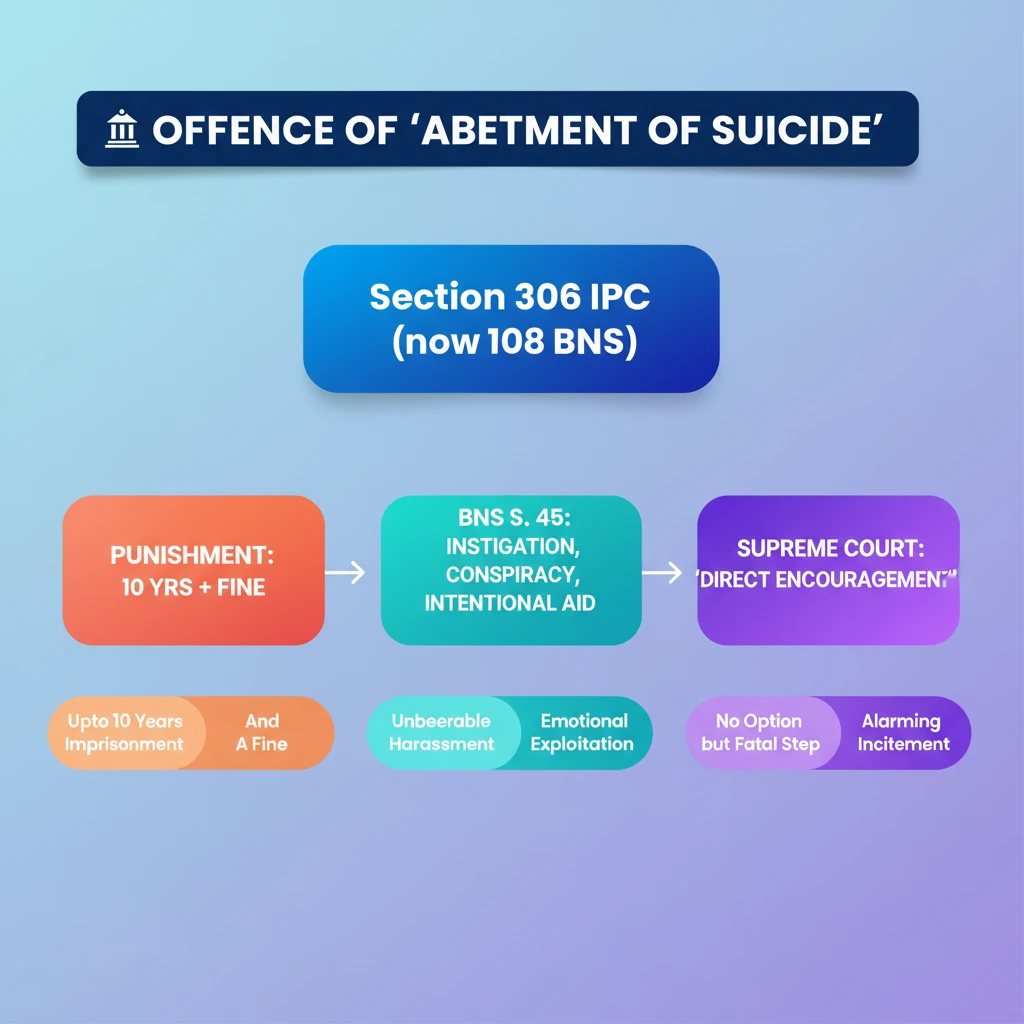
💡 Key Takeaways
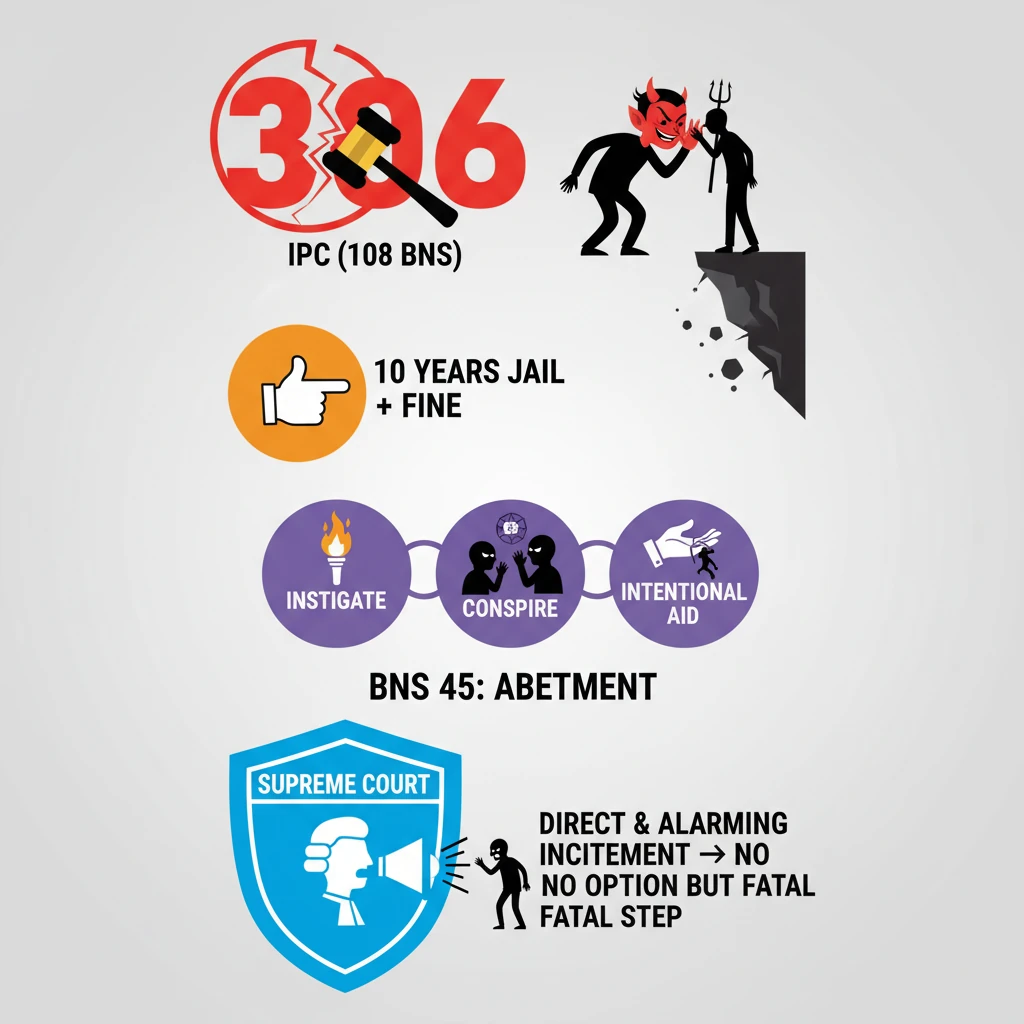
- •Abetment of Suicide is an offense under Section 306 IPC (now Section 108 BNS).
- •Punishment includes up to 10 years imprisonment and a fine.
- •BNS Section 45 defines abetment as instigation, conspiracy, or intentional aid.
- •Supreme Court requires 'direct and alarming encouragement or incitement' leaving 'no option but fatal step'.
- •Guidelines focus on 'unbearable harassment' or 'emotional exploitation' as direct drivers.
🧠 Memory Techniques
98% Verified Content
📚 Reference Sources
•The Indian Penal Code, 1860 (IPC)
•The Bharatiya Nyaya Sanhita, 2023 (BNS)
•Supreme Court of India judgments (general interpretation principles)