What are the Key Facts Related to World Cancer Day? - Social Issues | UPSC Learning
Topics
0 topics • 0 completed
🔍
No topics match your search
What are the Key Facts Related to World Cancer Day?
Medium⏱️ 8 min read
social issues
📖 Introduction
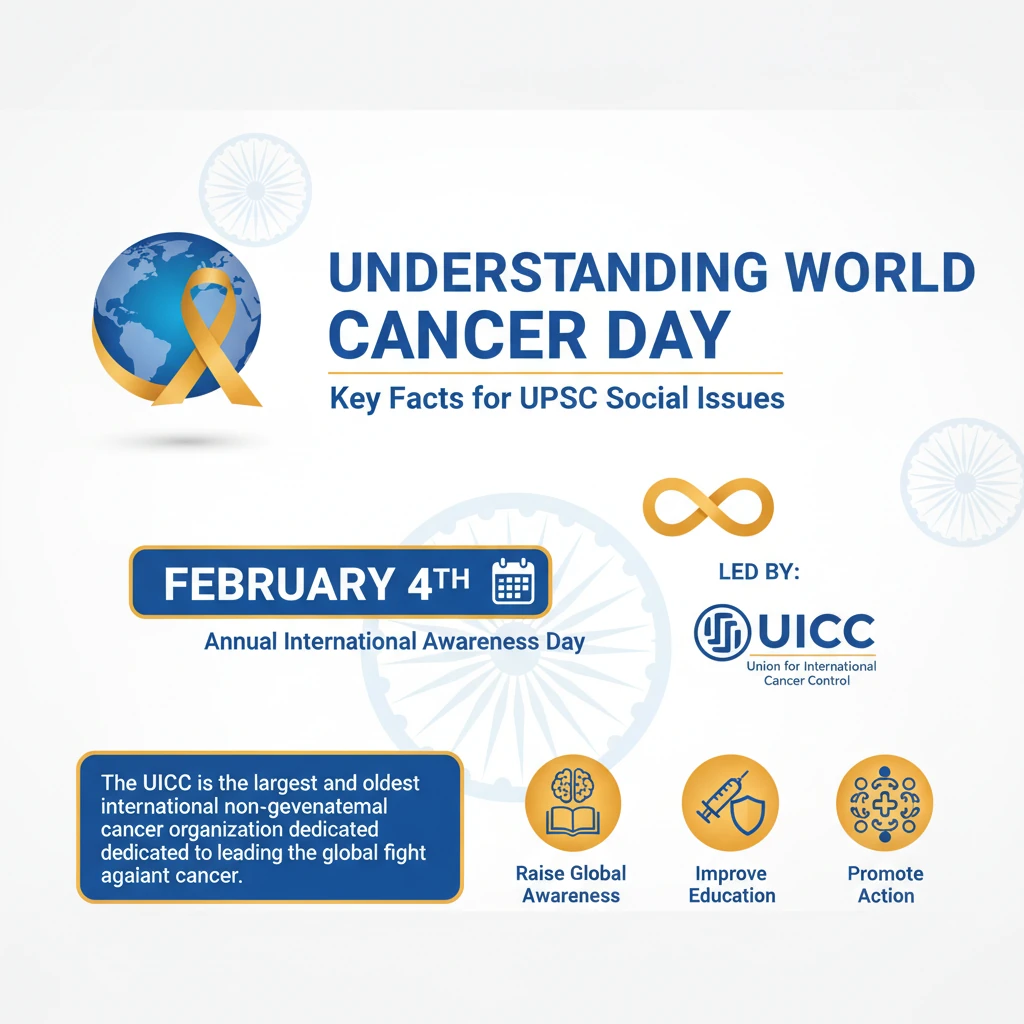
<h4>Understanding World Cancer Day</h4><p><strong>World Cancer Day</strong> is an international awareness day, observed annually on <strong>February 4th</strong>. It is led by the <strong>Union for International Cancer Control (UICC)</strong>.</p><div class='info-box'><p>The <strong>UICC</strong> is the largest and oldest international non-governmental cancer organization dedicated to leading the global fight against cancer.</p></div><p>The primary goal is to raise global awareness, improve education, and catalyze personal, collective, and government action against cancer.</p><h4>Origin and Mission</h4><p>The first <strong>World Cancer Day</strong> was celebrated on <strong>February 4th, 2000</strong>.</p><p>This inaugural event took place at the <strong>World Summit Against Cancer for the New Millennium in Paris</strong>.</p><div class='info-box'><p>The <strong>Paris Charter</strong>, adopted at the summit, outlines the mission of World Cancer Day. Its objectives include promoting research, preventing cancer, improving patient services, raising awareness, and mobilizing the global community to advance progress against cancer.</p></div><h4>What is Cancer?</h4><div class='key-point-box'><p><strong>Cancer</strong> is fundamentally caused by the <strong>uncontrolled, abnormal growth of cells</strong> within the body. This often leads to the formation of a <strong>lump or tumour</strong> in most cases.</p></div><h4>World Cancer Day 2024 Theme</h4><p>The theme for <strong>World Cancer Day 2024</strong> is <strong>"Close the Care Gap"</strong>.</p><p>This theme aims to address the significant disparities in cancer care access and outcomes globally.</p><div class='info-box'><p>The "Close the Care Gap" initiative seeks to mobilize attention and resources. It ensures that the rising burden of cancer is addressed equitably, guaranteeing access to systematic testing, early diagnosis, and effective treatment for all people worldwide.</p></div><h4>Cancer Burden in India: Key Statistics</h4><p>India faces a substantial cancer burden, with specific types showing alarming prevalence and mortality rates.</p><p>According to a <strong>WHO study</strong> published in <strong>The Lancet Regional Health</strong>, India contributed significantly to global cancer statistics in <strong>2019</strong>.</p><div class='info-box'><p>In <strong>2019</strong>, India accounted for <strong>32.9% of global deaths</strong> and <strong>28.1% of new cases</strong> of <strong>lip and oral cavity cancer</strong> worldwide.</p></div><h4>Prevalent Cancers in India</h4><p>Several cancer types are particularly prevalent in India, contributing to the overall disease burden.</p><ul><li><strong>Breast cancer</strong> is a leading concern.</li><li><strong>Lip and oral cavity cancer</strong> (<strong>143,759 new cases</strong>, <strong>10.2%</strong> of total new cases) follows closely.</li><li>Other significant cancers include <strong>cervix and uterine cancer</strong>, <strong>lung cancer</strong>, and <strong>oesophageal cancer</strong>.</li></ul><h4>Causes of Oral Cancer in India</h4><p>The high incidence of <strong>lip and oral cavity cancer</strong> in India is primarily attributed to specific lifestyle factors.</p><div class='key-point-box'><p>Widespread consumption of <strong>smokeless tobacco (SMT)</strong> is a major driver. This includes products like <strong>khaini, gutkha, betel quid, and paan masala</strong>, commonly used in South Asian countries such as <strong>India, Bangladesh, and Nepal</strong>.</p></div><p>Globally, <strong>SMT</strong> is responsible for approximately <strong>50% of the oral cancer burden</strong>.</p><h4>Cervical Cancer in India</h4><p><strong>Cervical cancer</strong> also presents a significant challenge in India, with high mortality rates.</p><div class='info-box'><p>As per <strong>The Lancet Global Health 2023</strong>, India was responsible for <strong>23% of global deaths</strong> due to <strong>cervical cancer</strong>.</p></div><p>The <strong>five-year survival rate</strong> for cervical cancer in India is <strong>61.7%</strong>.</p><div class='exam-tip-box'><p>It's important to note that survival rates in India are generally <strong>lower compared to high-income countries</strong> like the <strong>United States</strong>, highlighting disparities in healthcare access and treatment.</p></div>
💡 Key Takeaways
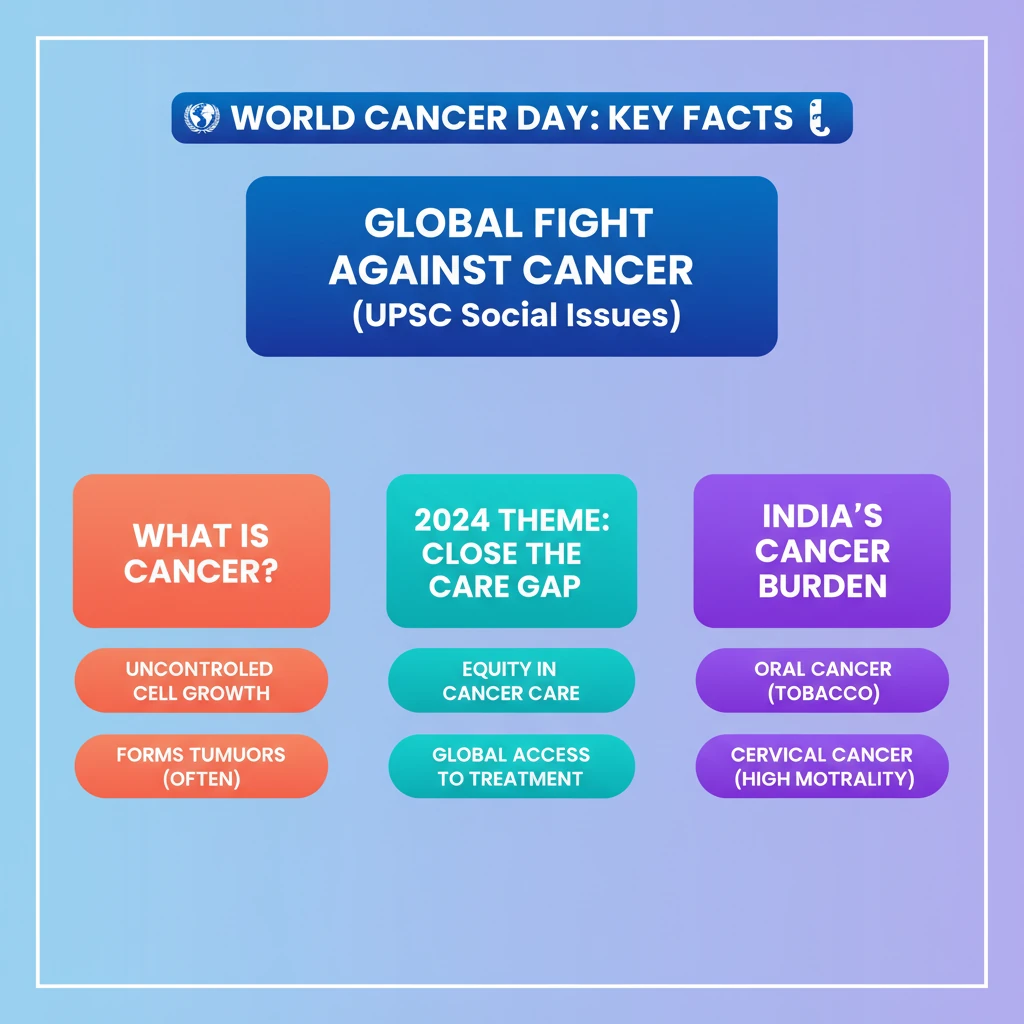
- •World Cancer Day is observed annually on February 4th, led by UICC, originating from the 2000 Paris Summit.
- •Cancer is defined by uncontrolled, abnormal cell growth, often forming tumours.
- •The 2024 theme, "Close the Care Gap," advocates for equitable access to cancer care globally.
- •India faces a severe cancer burden, particularly for lip and oral cavity (due to smokeless tobacco) and cervical cancers.
- •India accounts for 32.9% of global oral cancer deaths and 23% of global cervical cancer deaths.
- •Survival rates for cervical cancer in India (61.7%) are lower than in high-income countries, highlighting care disparities.
🧠 Memory Techniques
98% Verified Content
📚 Reference Sources
•WHO study published in The Lancet Regional Health
•The Lancet Global Health 2023
•Union for International Cancer Control (UICC)