What are the Other Provisions Related to Surrogacy in India? - Social Issues | UPSC Learning
Topics
0 topics • 0 completed
🔍
No topics match your search
What are the Other Provisions Related to Surrogacy in India?
Medium⏱️ 8 min read
social issues
📖 Introduction
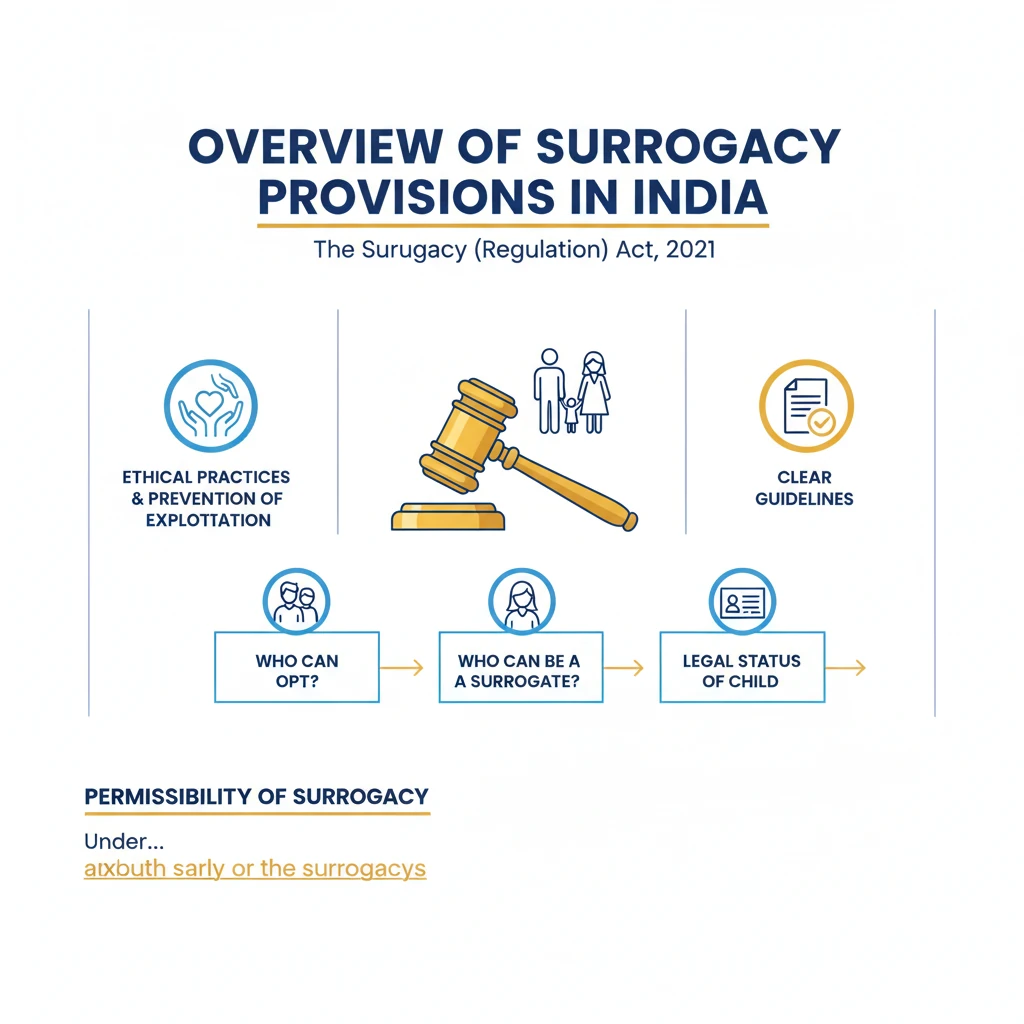
<h4>Overview of Surrogacy Provisions in India</h4><p>The <strong>Surrogacy (Regulation) Act, 2021</strong>, governs the practice of surrogacy in India. This legislation aims to regulate the procedure, ensuring ethical practices and preventing exploitation of surrogate mothers and children.</p><p>It establishes clear guidelines for who can opt for surrogacy, who can be a surrogate mother, and the legal status of the child born through this process.</p><h4>Permissibility of Surrogacy</h4><p>Under the <strong>Surrogacy (Regulation) Act, 2021</strong>, surrogacy is permitted strictly for <strong>altruistic purposes</strong>. This means that the surrogate mother cannot receive any monetary compensation beyond medical expenses and insurance coverage.</p><p>It is allowed only for couples who have <strong>proven infertility</strong> or a <strong>disease</strong> that prevents them from conceiving a child naturally or carrying a pregnancy to term.</p><div class='key-point-box'><p><strong>Commercial surrogacy</strong> is unequivocally <strong>prohibited</strong> in India. This includes any surrogacy arrangement involving payment, sale, or exploitation of the surrogate mother.</p></div><h4>Eligibility Criteria for Intending Couples</h4><p>Specific conditions must be met by couples wishing to opt for surrogacy. These criteria ensure that the process is undertaken by genuine cases of need and prevents misuse.</p><ul><li>The couple must be <strong>legally married</strong> for at least <strong>five years</strong>.</li><li>The <strong>wife's age</strong> must be between <strong>25 and 50 years</strong>.</li><li>The <strong>husband's age</strong> must be between <strong>26 and 55 years</strong>.</li></ul><div class='info-box'><p>A crucial provision states that the couple must <strong>not have any living child</strong>. This includes biological, adopted, or previously born through surrogacy. However, there is an important exception.</p></div><div class='key-point-box'><p>The 'no living child' rule has an exception: if the existing child suffers from a <strong>disability</strong> or a <strong>life-threatening disorder</strong>, the couple may still be eligible for surrogacy.</p></div><h4>Criteria for Surrogate Mother</h4><p>The Act lays down stringent requirements for a woman to be eligible as a surrogate mother, primarily to safeguard her health and prevent exploitation.</p><ul><li>She must be a <strong>close relative</strong> of the intending couple.</li><li>She must be a <strong>married woman</strong> and have at least <strong>one child of her own</strong>.</li><li>Her age must be between <strong>25 and 35 years</strong>.</li></ul><div class='info-box'><p>A woman can only be a surrogate mother <strong>once in her lifetime</strong>. This provision is designed to protect the health and well-being of the surrogate.</p></div><h4>Legal Parental Status of the Child</h4><p>Upon the birth of the child through surrogacy, the legal status is clear and unambiguous. The child is immediately recognized as belonging to the intending parents.</p><div class='highlight-box'><p>The child born out of a surrogacy procedure is legally recognized as the <strong>biological child of the intending couple</strong>. This ensures their parental rights and responsibilities are established from birth.</p></div>
💡 Key Takeaways
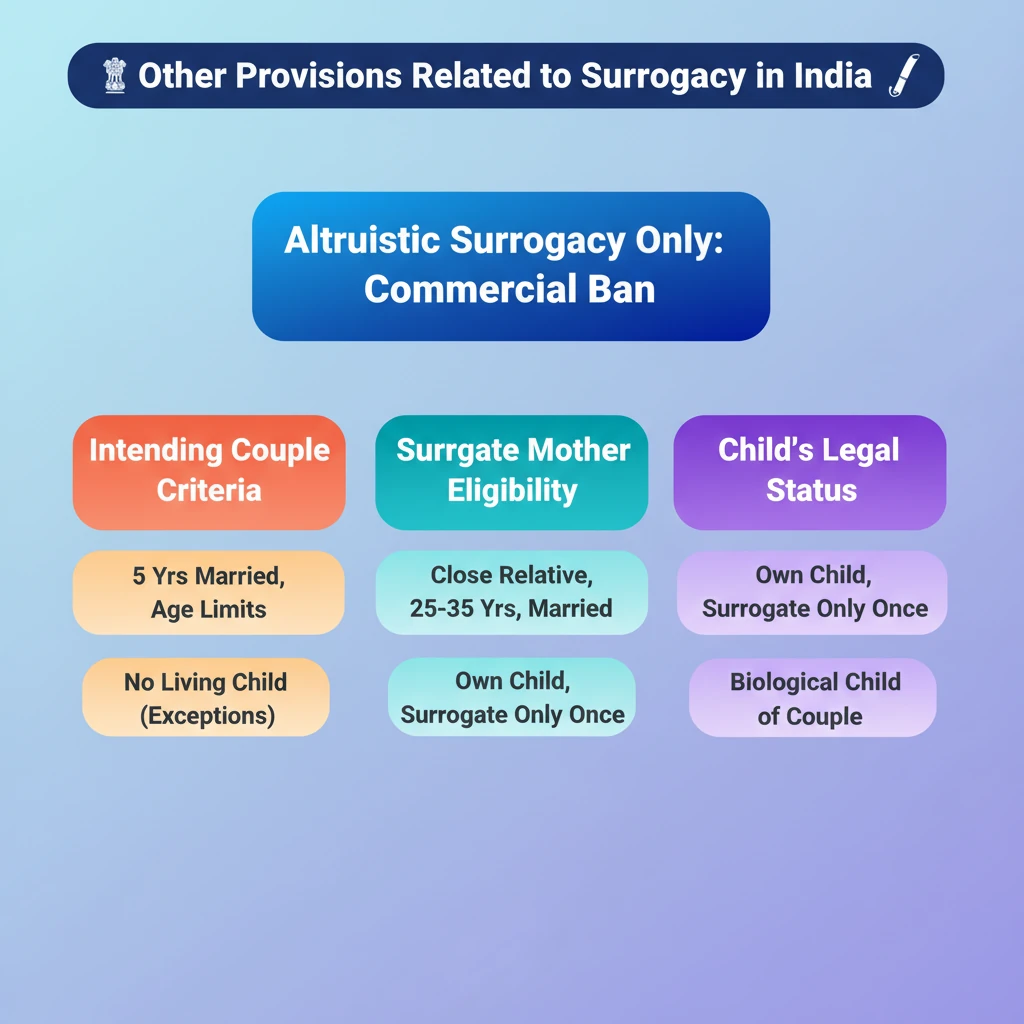
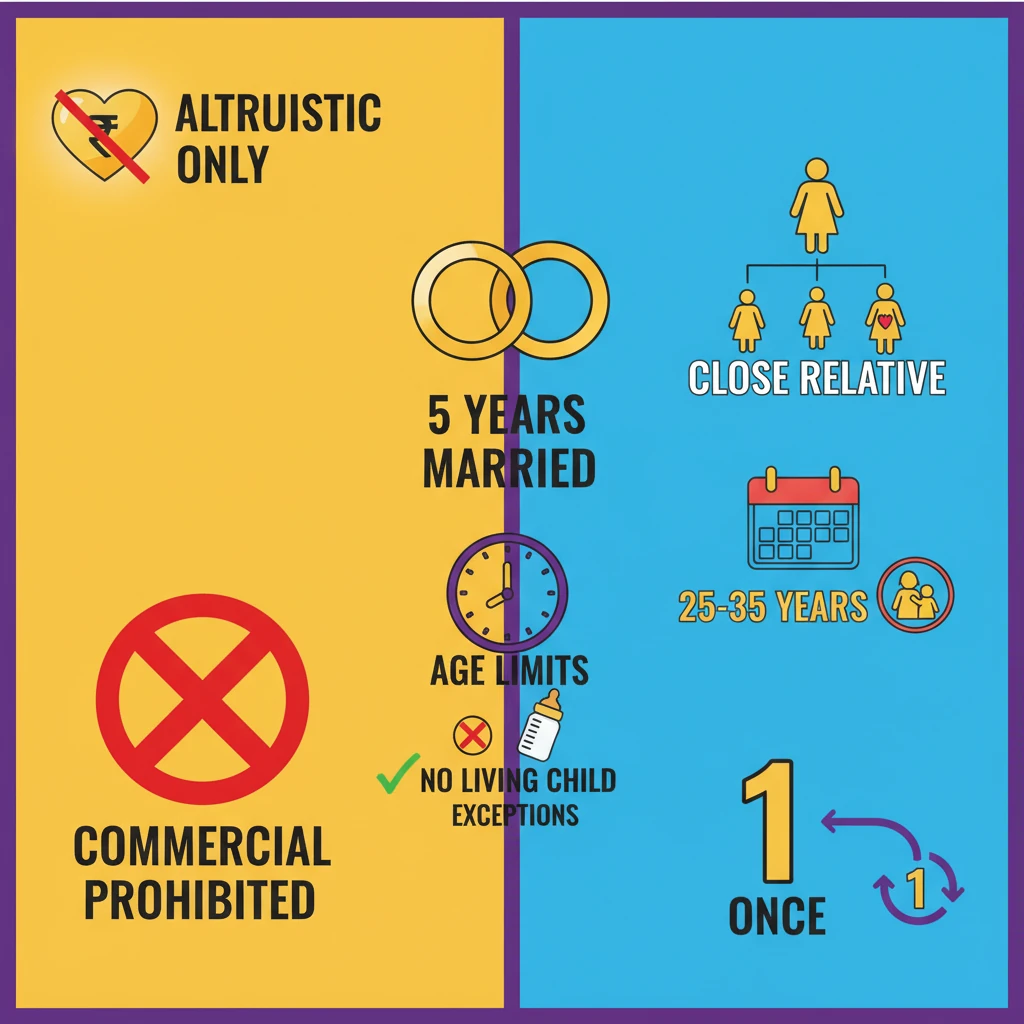
- •Surrogacy in India is strictly permitted only for <strong>altruistic purposes</strong> under the 2021 Act.
- •<strong>Commercial surrogacy</strong> is completely <strong>prohibited</strong> to prevent exploitation.
- •Intending couples must meet strict criteria: <strong>5 years married</strong>, specific <strong>age limits</strong>, and generally <strong>no living child</strong> (with exceptions).
- •Surrogate mothers must be a <strong>close relative</strong>, married, have their own child, be aged <strong>25-35 years</strong>, and can only be a surrogate <strong>once</strong>.
- •The child born through surrogacy is legally recognized as the <strong>biological child of the intending couple</strong>.
🧠 Memory Techniques
95% Verified Content
📚 Reference Sources
•The Surrogacy (Regulation) Act, 2021 (Official Gazette of India)