What are the Constitutional Provisions Related to SC, ST, and OBC in India? - Social Issues | UPSC Learning
Topics
0 topics • 0 completed
🔍
No topics match your search
What are the Constitutional Provisions Related to SC, ST, and OBC in India?
Medium⏱️ 8 min read
social issues
📖 Introduction
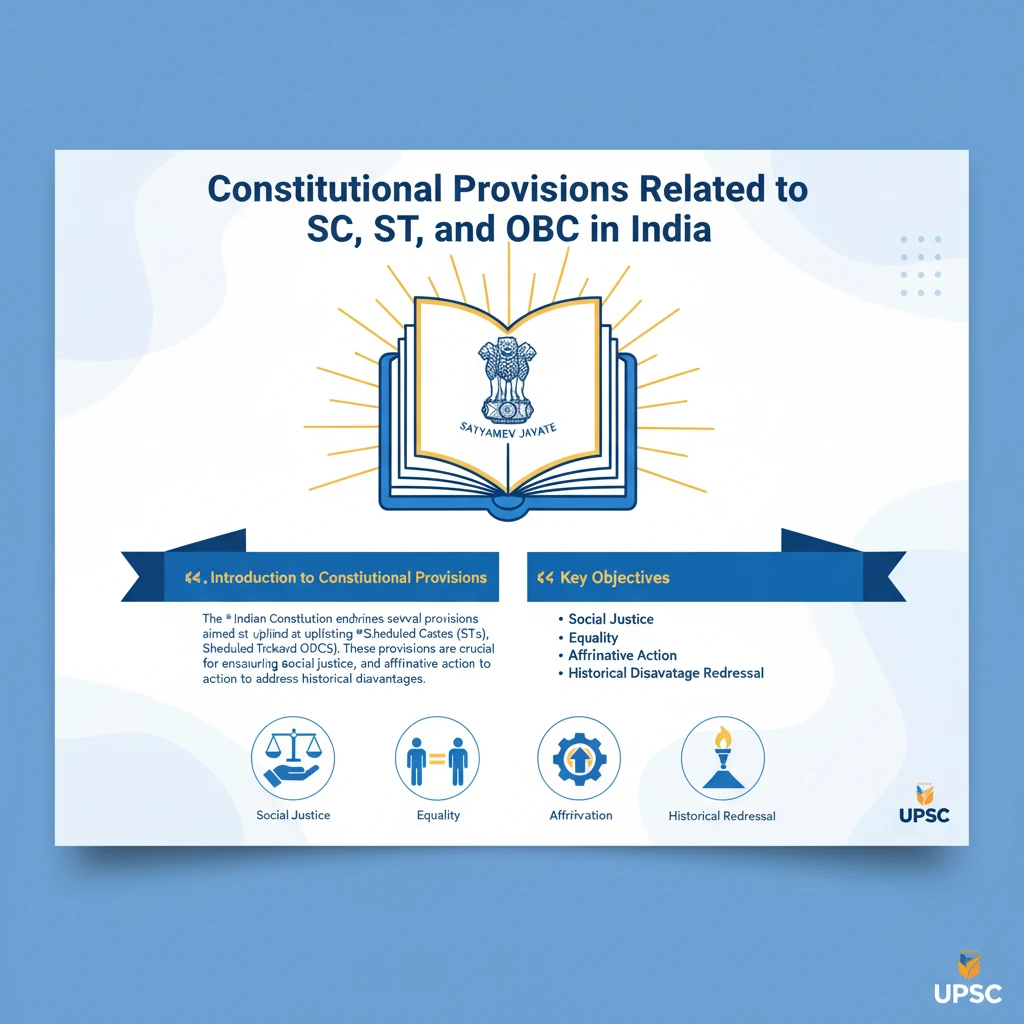
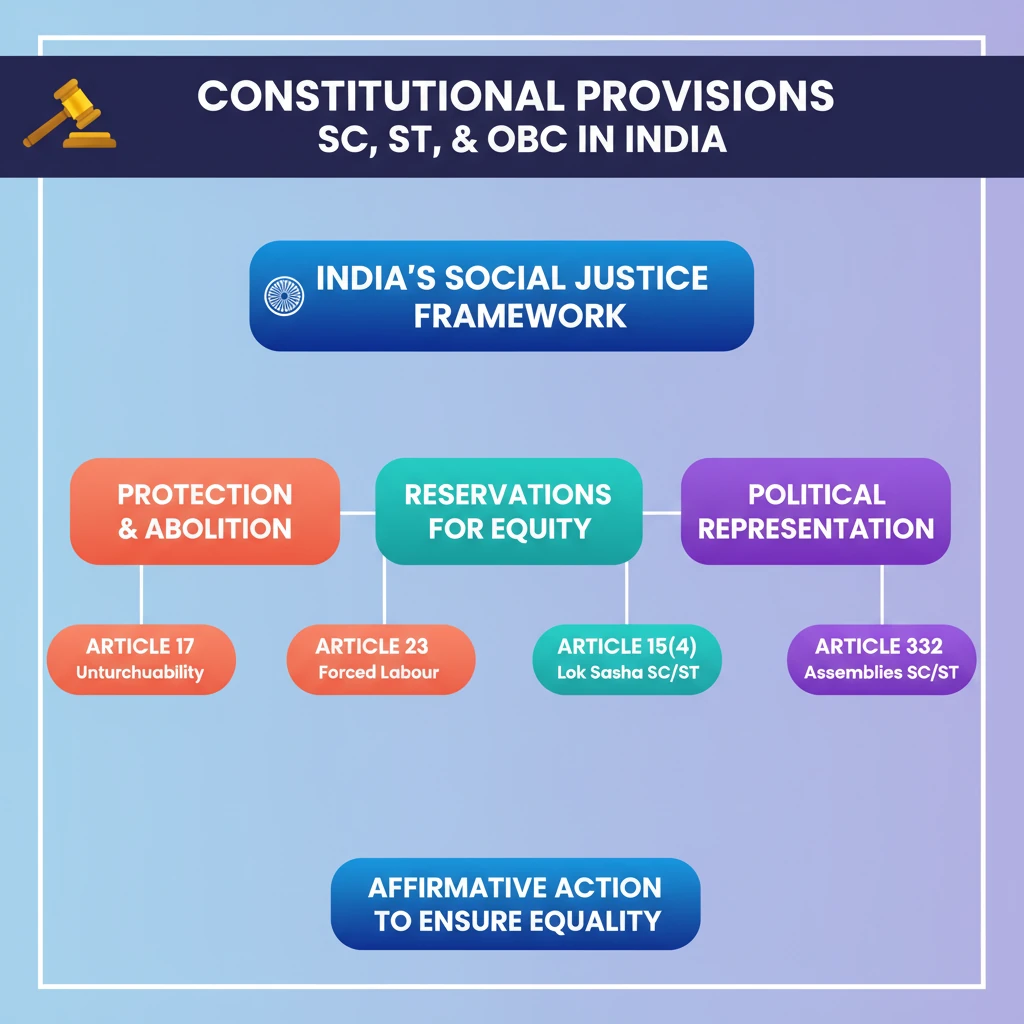
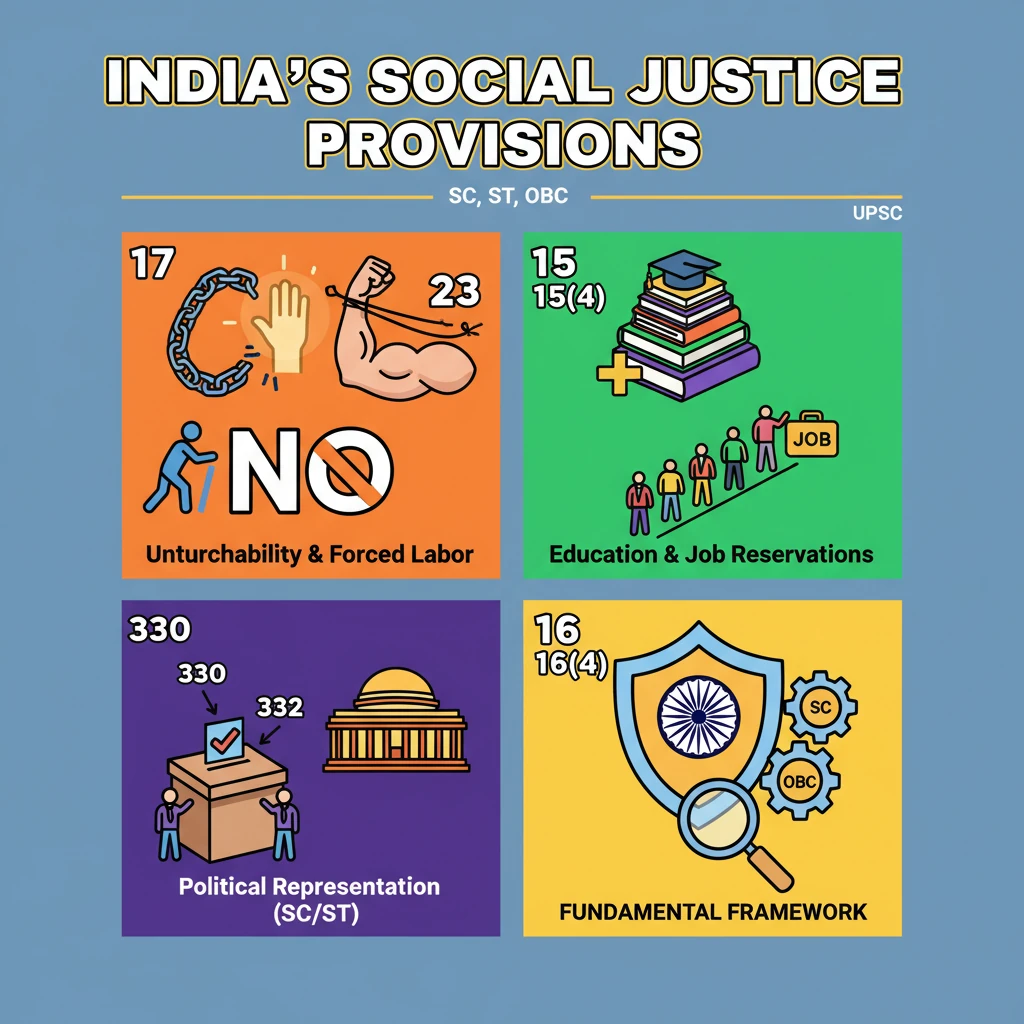
<h4>Introduction to Constitutional Provisions</h4><p>The <strong>Indian Constitution</strong> enshrines several provisions aimed at uplifting <strong>Scheduled Castes (SCs)</strong>, <strong>Scheduled Tribes (STs)</strong>, and <strong>Other Backward Classes (OBCs)</strong>. These provisions are crucial for ensuring <strong>social justice</strong>, <strong>equality</strong>, and <strong>affirmative action</strong> to address historical disadvantages.</p><p>These constitutional safeguards reflect the commitment of the Indian state to build an inclusive society where every citizen has equal opportunities and protection against discrimination.</p><div class='exam-tip-box'><p><strong>UPSC Insight:</strong> Understanding these articles is fundamental for <strong>GS Paper II (Polity & Governance)</strong>, especially for questions on social justice, affirmative action, and constitutional law. Remember the specific article numbers and their implications.</p></div><h4>Fundamental Rights and Protective Measures</h4><p>The Constitution includes specific articles under <strong>Fundamental Rights</strong> that provide protection and special provisions for SCs, STs, and OBCs.</p><div class='info-box'><p><strong>Article 17: Abolition of Untouchability</strong></p><ul><li>This article <strong>prohibits untouchability</strong> in any form.</li><li>Its enforcement is crucial for the dignity and rights of <strong>Scheduled Castes</strong>.</li><li>The practice of untouchability is declared an offence punishable by law.</li></ul></div><div class='info-box'><p><strong>Article 23: Prohibition of Human Trafficking and Forced Labour</strong></p><ul><li>This article <strong>prohibits human trafficking</strong> (begar) and other forms of <strong>forced labour</strong>.</li><li>It provides protection against exploitation, particularly benefiting vulnerable groups like <strong>SCs</strong> and <strong>STs</strong> who were historically subjected to such practices.</li></ul></div><div class='info-box'><p><strong>Article 15(4): Special Provisions for Advancement</strong></p><ul><li>This clause allows the state to make any special provision for the advancement of any <strong>socially and educationally backward classes of citizens</strong> or for the <strong>Scheduled Castes</strong> and the <strong>Scheduled Tribes</strong>.</li><li>It primarily enables <strong>reservations in educational institutions</strong>.</li></ul></div><div class='info-box'><p><strong>Article 16(4): Reservation in Public Employment</strong></p><ul><li>This article empowers the state to make any provision for the <strong>reservation of appointments or posts</strong> in favour of any backward class of citizens.</li><li>This is applicable if the state believes they are not adequately represented in the services under the state.</li><li>It forms the basis for <strong>reservation in public employment</strong> for SCs, STs, and OBCs.</li></ul></div><h4>Political Representation</h4><p>To ensure adequate representation and participation in the democratic process, the Constitution provides for reserved seats in legislative bodies for <strong>SCs</strong> and <strong>STs</strong>.</p><div class='info-box'><p><strong>Article 330: Reservation of Seats in the House of the People</strong></p><ul><li>This article provides for the <strong>reservation of seats</strong> for <strong>Scheduled Castes</strong> and <strong>Scheduled Tribes</strong> in the <strong>Lok Sabha</strong> (House of the People).</li><li>The number of seats reserved is based on their population ratio.</li></ul></div><div class='info-box'><p><strong>Article 332: Reservation of Seats in the Legislative Assemblies of the States</strong></p><ul><li>This article ensures <strong>reservation of seats</strong> for <strong>Scheduled Castes</strong> and <strong>Scheduled Tribes</strong> in the <strong>Legislative Assemblies of the States</strong>.</li><li>Similar to the Lok Sabha, the reservation is proportionate to their population in the state.</li></ul></div><div class='key-point-box'><p>These provisions collectively aim to correct historical injustices and facilitate the socio-economic and political empowerment of marginalized communities in India.</p></div>
💡 Key Takeaways
- •Constitutional provisions for SCs, STs, and OBCs are fundamental to India's social justice framework.
- •Articles 17 and 23 prohibit untouchability and forced labour, protecting vulnerable groups.
- •Articles 15(4) and 16(4) enable reservations in educational institutions and public employment respectively.
- •Articles 330 and 332 ensure political representation for SCs and STs in legislative bodies.
- •These provisions are a form of affirmative action to address historical discrimination and ensure equality of opportunity.
- •The implementation of these provisions is subject to ongoing debates and judicial scrutiny, reflecting their dynamic nature.
🧠 Memory Techniques
98% Verified Content
📚 Reference Sources
•Drishti IAS Study Material (provided source)
•Ministry of Social Justice and Empowerment, Government of India reports
•Reports of the National Commission for Scheduled Castes and Scheduled Tribes