World Leprosy Day - Social Issues | UPSC Learning
Topics
0 topics • 0 completed
🔍
No topics match your search
World Leprosy Day
Medium⏱️ 7 min read
social issues
📖 Introduction
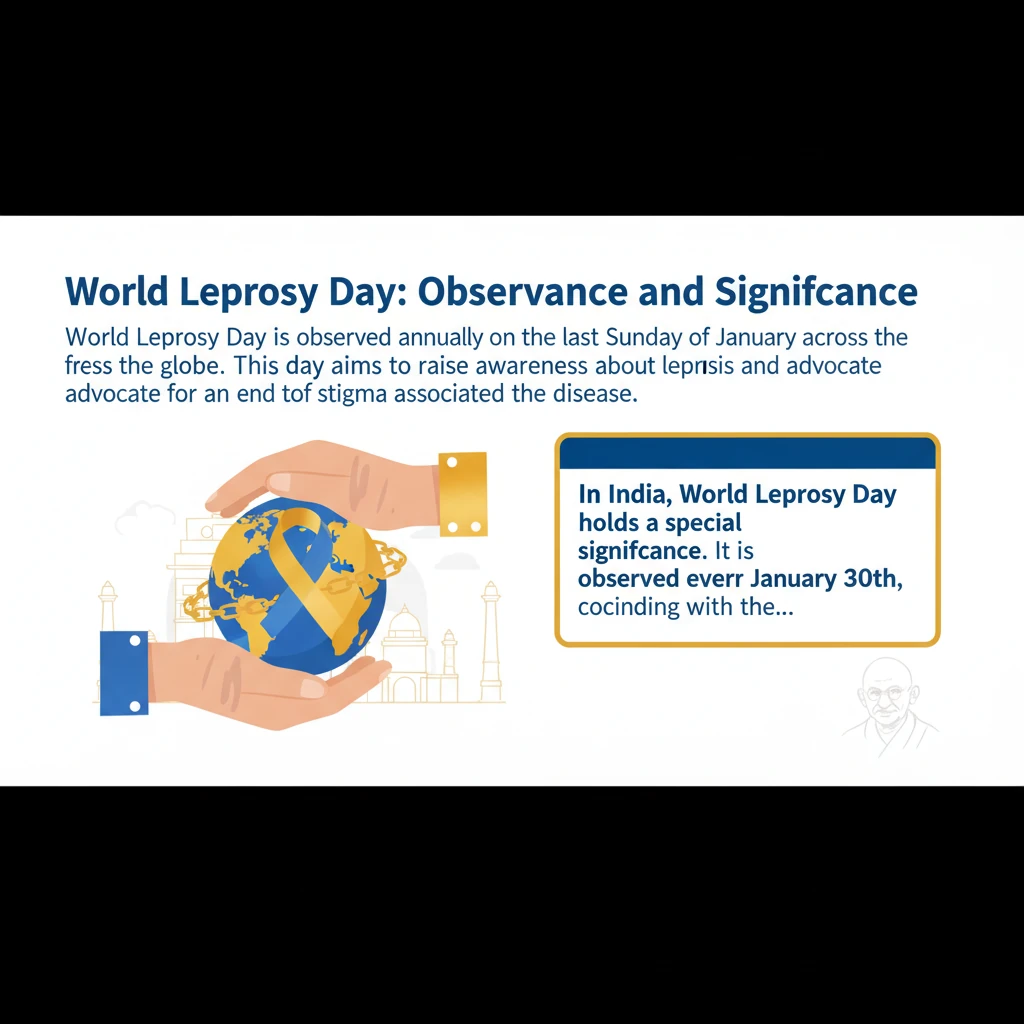
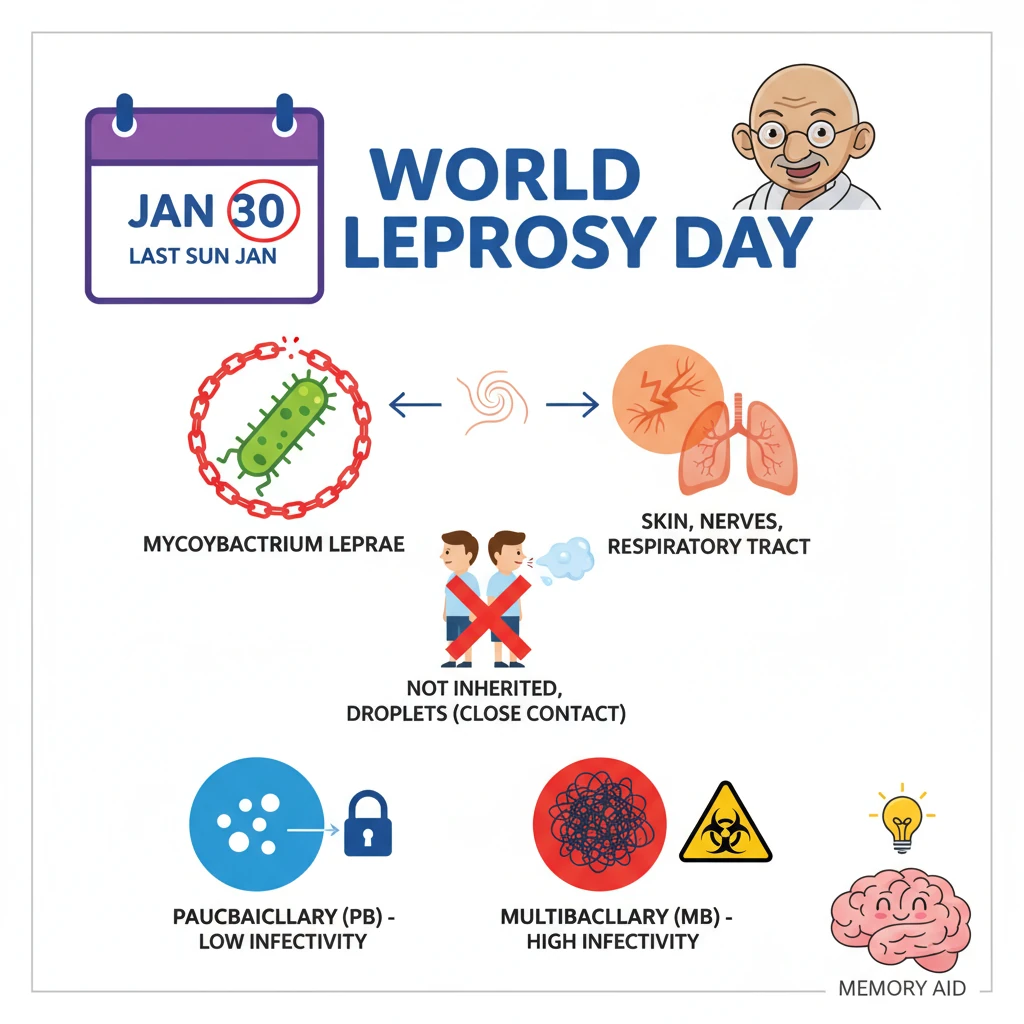
<h4>World Leprosy Day: Observance and Significance</h4><p><strong>World Leprosy Day</strong> is observed annually on the <strong>last Sunday of January</strong> across the globe. This day aims to raise awareness about leprosy and advocate for an end to the stigma associated with the disease.</p><div class='info-box'><p>In <strong>India</strong>, <strong>World Leprosy Day</strong> holds a special significance. It is observed every year on <strong>January 30th</strong>, coinciding with the <strong>death anniversary of Mahatma Gandhi</strong>. This date honors Gandhi's lifelong efforts to eliminate leprosy and the social stigma faced by those affected.</p></div><h4>Understanding Leprosy (Hansen's Disease)</h4><p><strong>Leprosy</strong>, also medically known as <strong>Hansen’s disease</strong>, is a chronic infectious disease. It is caused by a specific type of bacteria, <strong>Mycobacterium leprae</strong>.</p><div class='key-point-box'><p>This disease primarily affects several key areas of the human body. These include the <strong>skin</strong>, <strong>peripheral nerves</strong>, <strong>mucosal surfaces of the upper respiratory tract</strong>, and the <strong>eyes</strong>.</p></div><p>Leprosy can affect individuals across all age groups, from early childhood to old age. It is crucial to understand that leprosy is <strong>not inherited</strong>.</p><h4>Transmission of Leprosy</h4><p>The transmission of <strong>Mycobacterium leprae</strong> occurs through respiratory droplets. These droplets are expelled from the nose and mouth of untreated individuals with the disease.</p><div class='info-box'><p>Transmission typically requires <strong>close and frequent contact</strong> with untreated cases. It is not easily spread through casual contact.</p></div><h4>Classification of Leprosy</h4><p>Leprosy cases are primarily classified into two main types based on bacterial load:</p><ul><li><strong>Paucibacillary (PB) leprosy</strong>: This classification includes all cases that are <strong>smear-negative</strong>. These individuals have a smaller bacterial load and are generally less infectious.</li><li><strong>Multibacillary (MB) leprosy</strong>: This classification comprises all cases that are <strong>smear-positive</strong>. Individuals with MB leprosy have a higher bacterial load and are considered more infectious compared to PB cases.</li></ul><h4>Treatment and Cure for Leprosy</h4><p>A significant advancement in public health is that <strong>leprosy is curable</strong>. Early diagnosis and treatment are vital to prevent long-term disabilities associated with the disease.</p><div class='info-box'><p>The current recommended treatment regimen is known as <strong>Multi-Drug Therapy (MDT)</strong>. This therapy combines three specific drugs:</p><ul><li><strong>Dapsone</strong></li><li><strong>Rifampicin</strong></li><li><strong>Clofazimine</strong></li></ul></div><p>Since <strong>1995</strong>, the <strong>World Health Organization (WHO)</strong> has made <strong>MDT</strong> available free of cost to all patients worldwide. This global initiative has been instrumental in reducing the burden of leprosy.</p><div class='exam-tip-box'><p><strong>UPSC Insight:</strong> Understanding the components of <strong>MDT</strong> and the role of <strong>WHO</strong> in its global distribution is important for questions on public health initiatives and neglected tropical diseases in <strong>GS-II</strong>.</p></div><h4>Global Burden of Leprosy</h4><p>Despite being curable, <strong>leprosy</strong> remains a significant global health challenge. It is classified as a <strong>neglected tropical disease (NTD)</strong>.</p><div class='info-box'><p>The disease still occurs in more than <strong>120 countries</strong> globally. Over <strong>200,000 new cases</strong> are reported every year, highlighting the ongoing need for surveillance and treatment.</p></div><p>In <strong>2022</strong>, a total of <strong>182 countries</strong> reported over <strong>1.65 lakh cases</strong> of leprosy. This figure included <strong>774,087 new cases</strong>, indicating the persistent spread and detection of the disease.</p>
💡 Key Takeaways
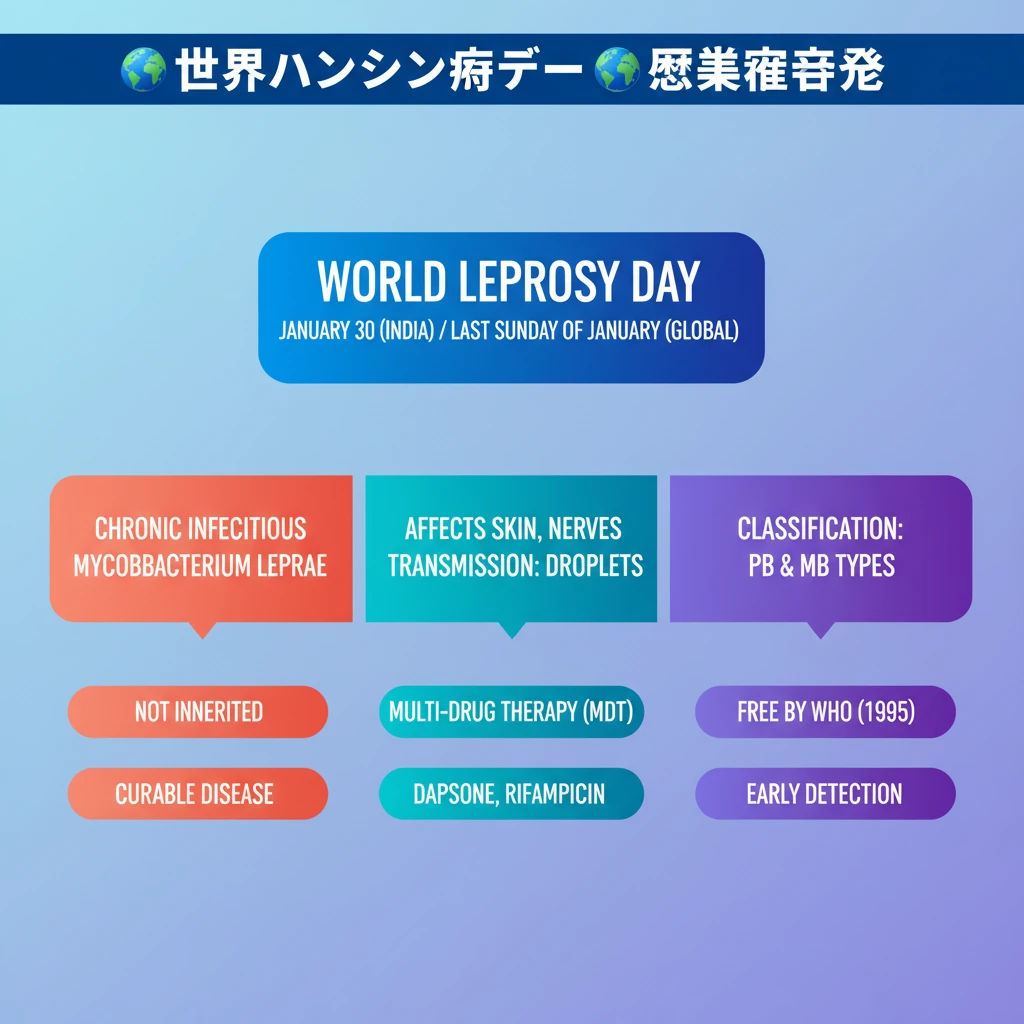
- •World Leprosy Day is observed globally on the last Sunday of January, and on January 30th in India (Gandhi's death anniversary).
- •Leprosy (Hansen's disease) is a chronic infectious disease caused by Mycobacterium leprae, affecting skin, nerves, and respiratory tract.
- •It is transmitted via droplets from untreated cases during close contact, not inherited.
- •Classified as Paucibacillary (PB) or Multibacillary (MB) based on bacterial load and infectivity.
- •Leprosy is curable with Multi-Drug Therapy (MDT – dapsone, rifampicin, clofazimine), provided free by WHO since 1995.
- •It remains a Neglected Tropical Disease (NTD) with over 200,000 new cases annually across 120+ countries.
🧠 Memory Techniques
98% Verified Content
📚 Reference Sources
•World Health Organization (WHO) fact sheets on Leprosy