What are Deccan High-Level Principles on Food Security and Nutrition 2023? - Social Issues | UPSC Learning
Topics
0 topics • 0 completed
🔍
No topics match your search
What are Deccan High-Level Principles on Food Security and Nutrition 2023?
Medium⏱️ 8 min read
social issues
📖 Introduction
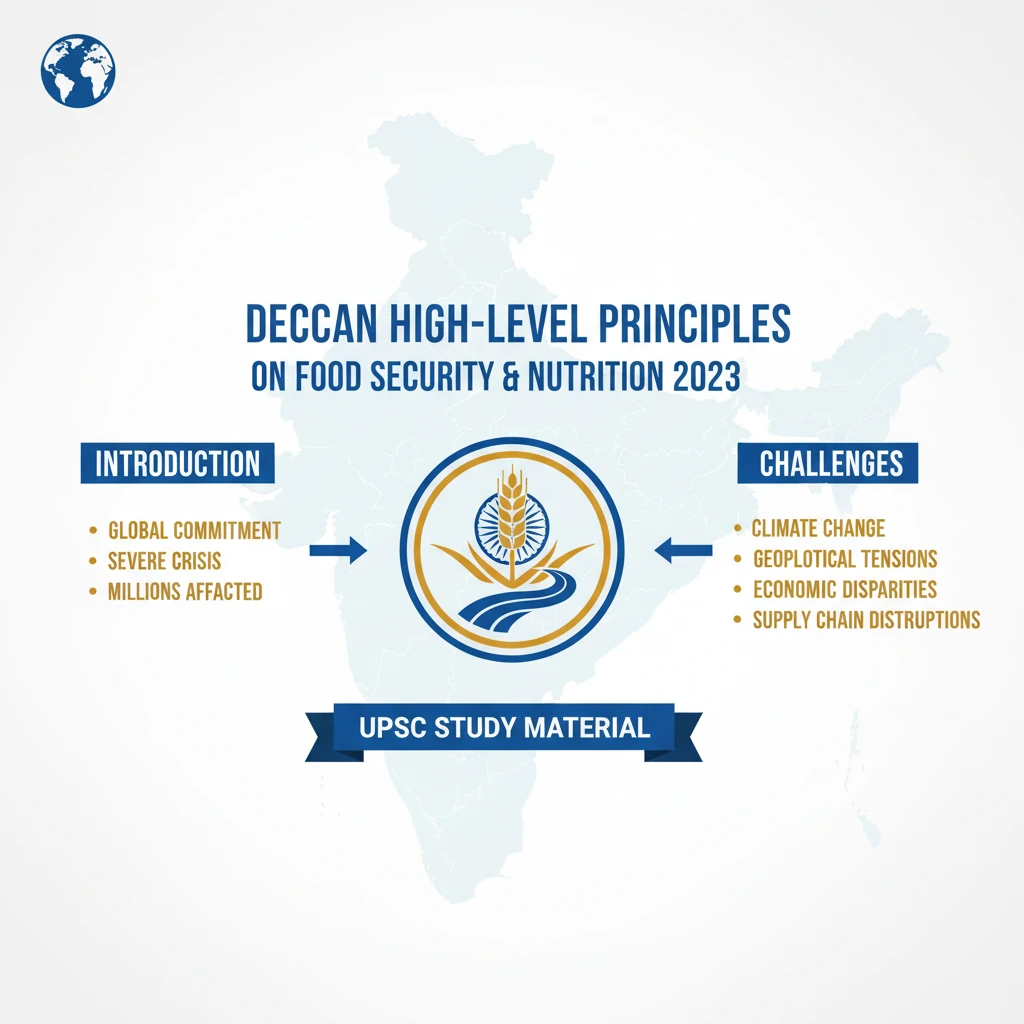
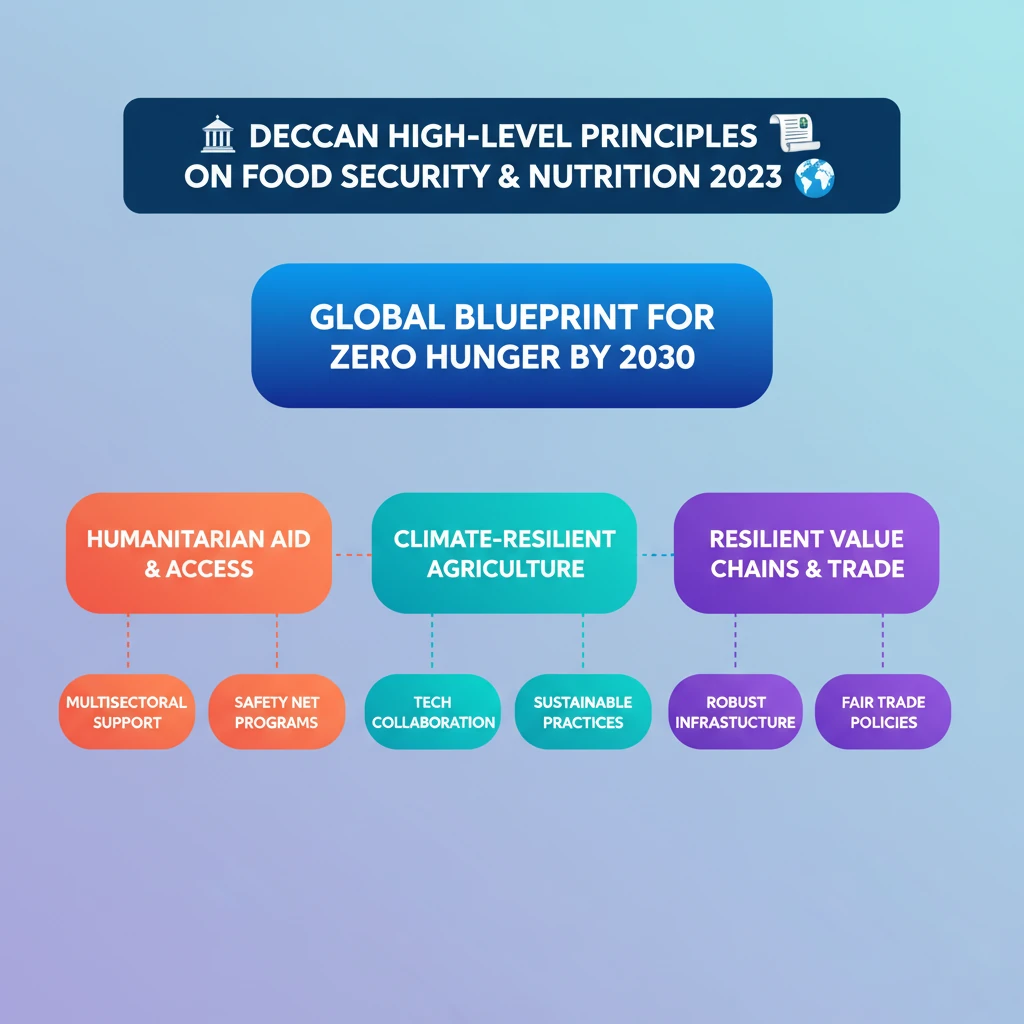
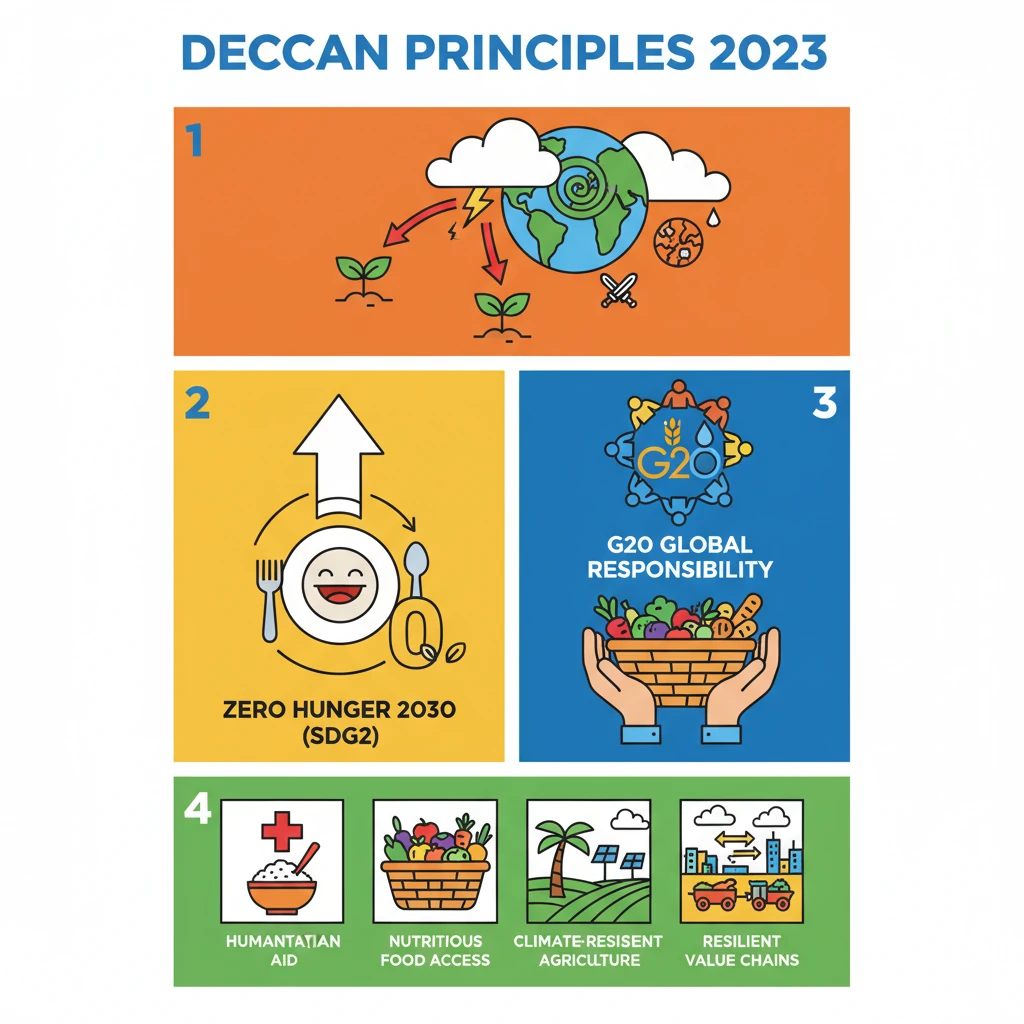
<h4>Introduction to Deccan High-Level Principles</h4><p>The <strong>Deccan High-Level Principles on Food Security and Nutrition 2023</strong> represent a crucial global commitment. They were formulated in recognition of the severe <strong>global food security crisis</strong> that impacts millions worldwide.</p><p>These principles acknowledge the multifaceted challenges contributing to this crisis. These include the profound effects of <strong>climate change</strong>, escalating <strong>geopolitical tensions</strong>, ongoing <strong>conflicts</strong>, and various <strong>systemic shocks</strong> that disrupt food systems.</p><div class='key-point-box'><p>A core objective of these principles is to underscore the urgent need for coordinated global actions. The ultimate aim is to achieve <strong>Zero Hunger (SDG2)</strong> by the target year of <strong>2030</strong>, aligning with the United Nations Sustainable Development Goals.</p></div><h4>G20's Crucial Role in Food Security</h4><p>The <strong>G20 members</strong> hold a significant position in the global food landscape. They are collectively major <strong>agricultural producers</strong>, substantial <strong>consumers</strong>, and key <strong>exporters</strong> of food products.</p><p>Given their economic influence and agricultural capacity, G20 nations bear a collective responsibility. Their role is to actively reinforce and contribute to global efforts aimed at enhancing <strong>food security and nutrition</strong> for all.</p><h4>The Seven Principles of Deccan</h4><p>The <strong>Deccan High-Level Principles</strong> are structured around <strong>seven core principles</strong> designed to guide international action. While the full list of seven is extensive, key principles highlighted include:</p><ul><li><strong>Humanitarian Assistance:</strong> This principle calls for increased <strong>multisectoral humanitarian aid</strong>. It also emphasizes the importance of improved coordination in delivering <strong>food assistance</strong> effectively during crises and conflicts globally.</li><li><strong>Availability and Access to Nutritious Food:</strong> This focuses on promoting robust <strong>food and cash-based safety net programs</strong>. It also encourages the sharing of <strong>best practices</strong> among nations for their efficient and impactful implementation.</li><li><strong>Climate-Resilient Agriculture:</strong> This principle advocates for enhanced collaboration on <strong>scalable technologies and innovations</strong>. The goal is to effectively tackle the challenges posed by <strong>climate change</strong> and the critical issue of <strong>biodiversity loss</strong> in agricultural systems.</li><li><strong>Resilience and Inclusivity in Value Chains:</strong> This aims to strengthen the overall resilience of <strong>agriculture value chains</strong>. Key actions include bolstering <strong>infrastructure</strong>, actively promoting the reduction of <strong>food waste</strong>, and implementing comprehensive <strong>risk management policies</strong> across the supply chain.</li></ul><div class='exam-tip-box'><p><strong>UPSC Insight:</strong> Understanding the specific principles is crucial for Mains GS-II (Social Justice) and GS-III (Agriculture, Economy). Focus on how each principle addresses a specific facet of food security challenges and potential solutions.</p></div>
💡 Key Takeaways
- •Deccan Principles 2023 address global food security crisis exacerbated by climate change, conflicts, and systemic shocks.
- •Primary goal is to achieve Zero Hunger (SDG2) by 2030 through concerted global actions.
- •G20 members, as major agricultural players, hold a collective responsibility to enhance food security.
- •Key principles include humanitarian assistance, access to nutritious food, climate-resilient agriculture, and resilient value chains.
- •The principles advocate for multisectoral aid, safety net programs, technological collaboration, and robust infrastructure to combat food insecurity.
🧠 Memory Techniques
95% Verified Content
📚 Reference Sources
•G20 India official documentation (where available for principles)
•Food and Agriculture Organization (FAO) reports on food security
•United Nations Sustainable Development Goals (SDG 2 documentation)