Fundamental Rights: Sex Workers' Rights - Gaurav Jain Case - Social Issues | UPSC Learning
Topics
0 topics • 0 completed
🔍
No topics match your search

Fundamental Rights: Sex Workers' Rights - Gaurav Jain Case
Medium⏱️ 4 min read
social issues
📖 Introduction
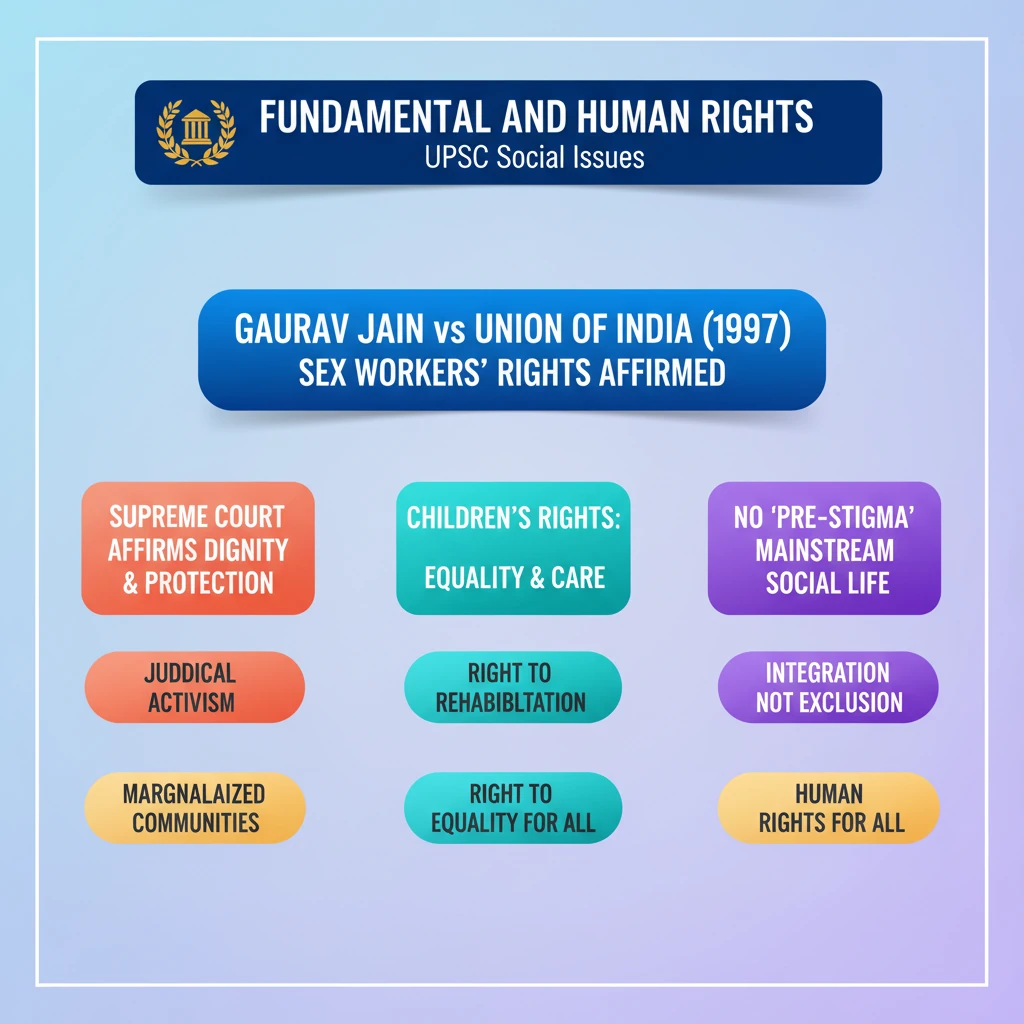
<h4>Introduction to Rights of Sex Workers</h4><p>The topic delves into the crucial intersection of <strong>Fundamental and Human Rights</strong> with the lives of <strong>sex workers</strong> and their families in India.</p><p>It highlights the judiciary's role in upholding the <strong>dignity</strong> and <strong>protection</strong> of often marginalized groups, ensuring their inclusion under the ambit of constitutional guarantees.</p><h4>Supreme Court's Landmark Ruling: Gaurav Jain vs Union Of India (1997)</h4><p>In a significant judgment delivered in <strong>1997</strong>, the <strong>Supreme Court of India</strong> addressed the rights of <strong>sex workers</strong>.</p><div class='info-box'><p>The specific case was titled <strong>Gaurav Jain vs Union Of India And Ors</strong>, which became a pivotal moment in recognizing the rights of this vulnerable community.</p></div><p>The Court unequivocally recognized the <strong>fundamental and human rights</strong> of <strong>sex workers</strong>, asserting their entitlement to <strong>dignity</strong> and <strong>protection under the law</strong>.</p><div class='key-point-box'><p>This ruling was crucial as it challenged societal prejudices and affirmed that constitutional rights extend to all individuals, irrespective of their profession or social standing.</p></div><h4>Rights of Children of Sex Workers</h4><p>Beyond the rights of adult <strong>sex workers</strong>, the Supreme Court's judgment also focused extensively on their <strong>children</strong>.</p><p>The Court emphasized that these <strong>children</strong> have a right to <strong>equality of opportunity</strong>, ensuring they are not discriminated against due to their parents' occupation.</p><p>Key rights recognized for the <strong>children of sex workers</strong> included:</p><ul><li><strong>Dignity</strong> and respect, free from societal judgment.</li><li>Adequate <strong>care</strong> and <strong>protection</strong> from exploitation.</li><li>Comprehensive <strong>rehabilitation</strong> to integrate them into society.</li></ul><div class='highlight-box'><p>A core directive was for these children to be part of the <strong>'mainstream of social life'</strong> without any attached <strong>'pre-stigma'</strong>, underscoring the need for social acceptance and non-discrimination.</p></div><div class='exam-tip-box'><p>This case is highly relevant for <strong>UPSC Mains GS-I (Social Issues)</strong> and <strong>GS-II (Polity & Governance)</strong>, particularly concerning <strong>vulnerable sections</strong>, <strong>judicial activism</strong>, and the interpretation of <strong>Fundamental Rights</strong>.</p></div>
💡 Key Takeaways
- •Gaurav Jain vs Union Of India (1997) recognized fundamental and human rights of sex workers.
- •The Supreme Court affirmed sex workers' rights to dignity and legal protection.
- •Children of sex workers have rights to equality, dignity, care, protection, and rehabilitation.
- •Crucially, children must be part of the 'mainstream of social life' without 'pre-stigma'.
- •The judgment exemplifies judicial activism in upholding rights for marginalized communities.
🧠 Memory Techniques

98% Verified Content
📚 Reference Sources
•Gaurav Jain vs Union Of India And Ors, 1997 (6 SCC 241) - Supreme Court of India judgment
•Indian Constitution (Articles 14, 15, 21)