First All-India Survey on AYUSH - Social Issues | UPSC Learning
Topics
0 topics • 0 completed
🔍
No topics match your search
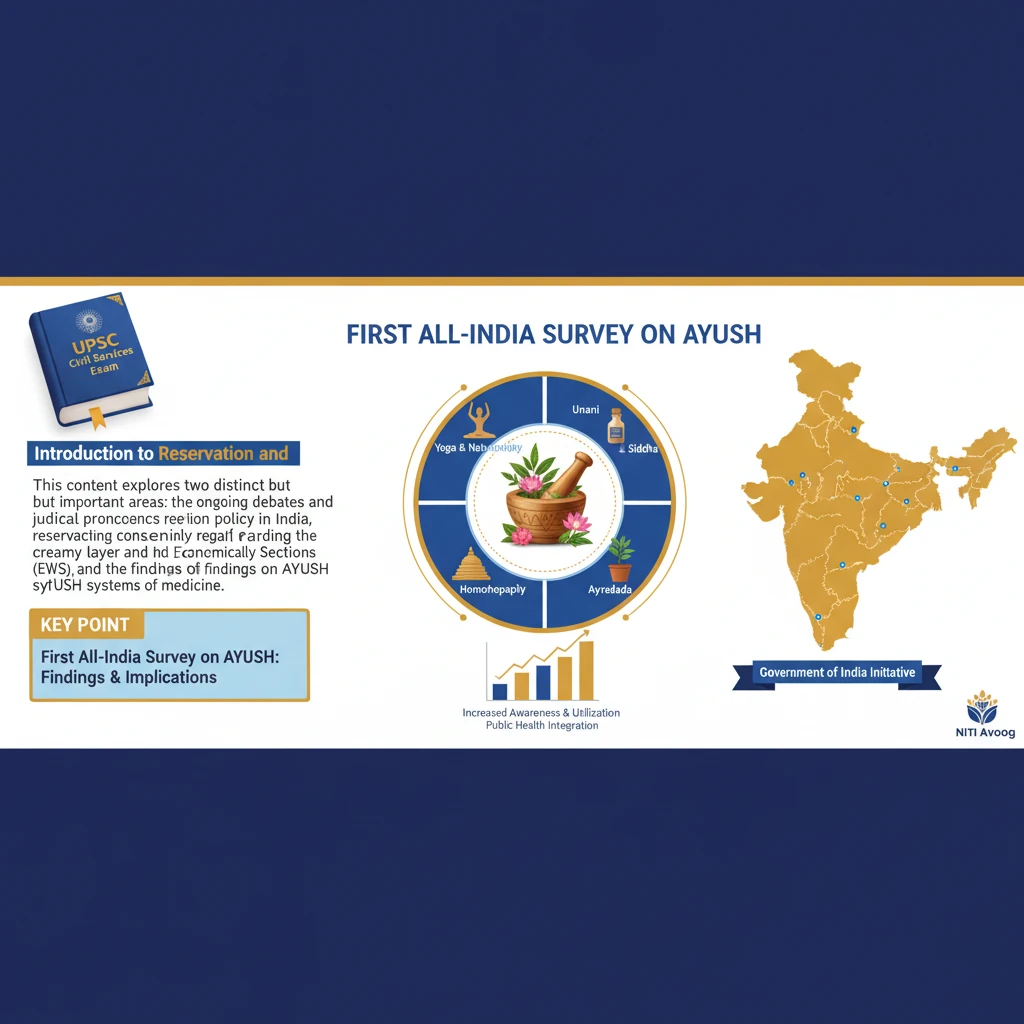
First All-India Survey on AYUSH
Medium⏱️ 12 min read
social issues
📖 Introduction
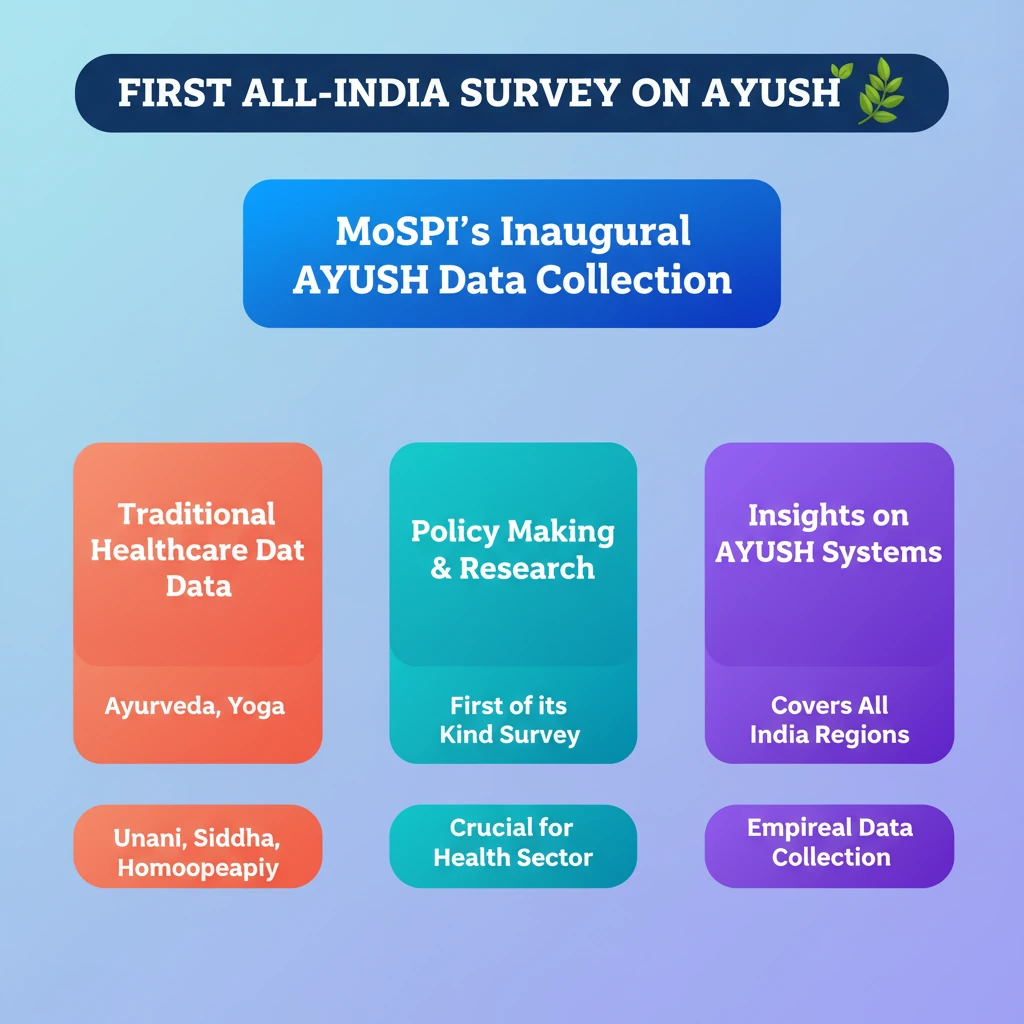
<h4>Introduction to Reservation and AYUSH</h4><p>This content explores two distinct but important areas for the <strong>UPSC Civil Services Exam</strong>: the ongoing debates and judicial pronouncements concerning <strong>reservation policy</strong> in India, particularly regarding the <strong>creamy layer</strong> and <strong>Economically Weaker Sections (EWS)</strong>, and the findings of the <strong>First All-India Survey on AYUSH</strong> systems of medicine.</p><div class='key-point-box'><p>Understanding these topics is crucial for <strong>General Studies Paper II (Polity and Governance)</strong> and <strong>General Studies Paper I (Social Issues)</strong>, as well as for essay writing.</p></div><h4>Creamy Layer Exclusion Principle</h4><p>The concept of the <strong>'creamy layer'</strong> refers to the affluent and advanced sections within <strong>Scheduled Castes (SCs)</strong> and <strong>Scheduled Tribes (STs)</strong>. The principle dictates that these individuals should be excluded from the benefits of reservation.</p><p>The rationale behind this exclusion is to ensure that reservation benefits reach the truly disadvantaged members of these communities, preventing their monopolization by the already well-off.</p><h4>Maintaining Administrative Efficiency</h4><p>A key consideration in implementing reservation policies is to ensure they do not adversely affect overall <strong>administrative efficiency</strong>. This balance is often debated in the context of promotions and appointments.</p><div class='info-box'><p>The Supreme Court has consistently emphasized the need to balance social justice with the imperative of maintaining a competent and efficient public administration.</p></div><h4>Jarnail Singh v. Union of India (2018) Verdict</h4><p>In this landmark case, the <strong>Supreme Court</strong> significantly altered its previous stance on the requirement for data collection in reservation for promotions. This verdict has major implications for states.</p><ul><li>The <strong>SC reversed its stance</strong> on the necessity of collecting quantifiable data.</li><li>States are <strong>no longer required to collect quantifiable data</strong> to prove the backwardness of a class or community when implementing reservation quotas for promotion.</li><li>This ruling facilitated the government's ability to implement <strong>'accelerated promotion with consequential seniority'</strong> for <strong>SC/ST members</strong> more easily.</li></ul><div class='exam-tip-box'><p>This case is vital for understanding the evolution of <strong>reservation in promotions</strong> and the judiciary's role. It's often asked in <strong>GS Paper II</strong>.</p></div><h4>103rd Constitutional Amendment Act, 2019 (EWS Reservation)</h4><p>The <strong>103rd Constitution (Amendment) Act, 2019</strong>, introduced a new category for reservation based on economic criteria, known as <strong>Economically Weaker Sections (EWS)</strong>.</p><ul><li>It provides for <strong>reservation to EWS</strong> in jobs in <strong>central government</strong> and <strong>government educational institutions</strong>.</li><li>The amendment was introduced by amending <strong>Articles 15 and 16</strong> of the Constitution.</li><li>It specifically inserted <strong>Article 15 (6)</strong> and <strong>Article 16 (6)</strong> to enable this reservation.</li></ul><p>The Act aims to promote the welfare of the poor who are not covered by the existing <strong>50% reservation policy</strong> for <strong>Scheduled Castes (SCs)</strong>, <strong>Scheduled Tribes (STs)</strong>, and <strong>Socially and Educationally Backward Classes (SEBCs)</strong>.</p><div class='info-box'><p>This amendment empowers both the <strong>Centre and the States</strong> to provide reservations to the <strong>EWS of society</strong>, addressing economic backwardness irrespective of caste.</p></div><h4>Janhit Abhiyan v. Union of India (2022) Verdict</h4><p>The constitutional validity of the <strong>103rd Constitutional Amendment Act</strong> was challenged in the <strong>Supreme Court</strong> in the case of <strong>Janhit Abhiyan v. Union of India, 2022</strong>.</p><p>In a significant <strong>3-2 verdict</strong>, the Court ultimately <strong>upheld the amendment</strong>. This ruling affirmed the government's power to provide reservation benefits based on economic standing.</p><div class='key-point-box'><p>The verdict confirmed that reservation based on <strong>economic criteria</strong> can exist alongside existing reservations for socially disadvantaged groups, marking a new direction in reservation policy.</p></div><h4>First All-India Survey on AYUSH Systems</h4><p>Moving to a different but equally important social issue, the <strong>Ministry of Statistics and Programme Implementation (MoSPI)</strong> recently released the findings of a national survey on <strong>AYUSH systems of medicine</strong>.</p><div class='info-box'><p><strong>AYUSH</strong> is an acronym for traditional and non-conventional systems of healthcare in India: <strong>Ayurveda, Yoga & Naturopathy, Unani, Siddha, and Homoeopathy</strong>.</p></div><p>This survey represents a significant step towards understanding the prevalence, infrastructure, and utilization of these traditional healthcare systems across the country. The findings are crucial for policy formulation in the health sector.</p>
💡 Key Takeaways
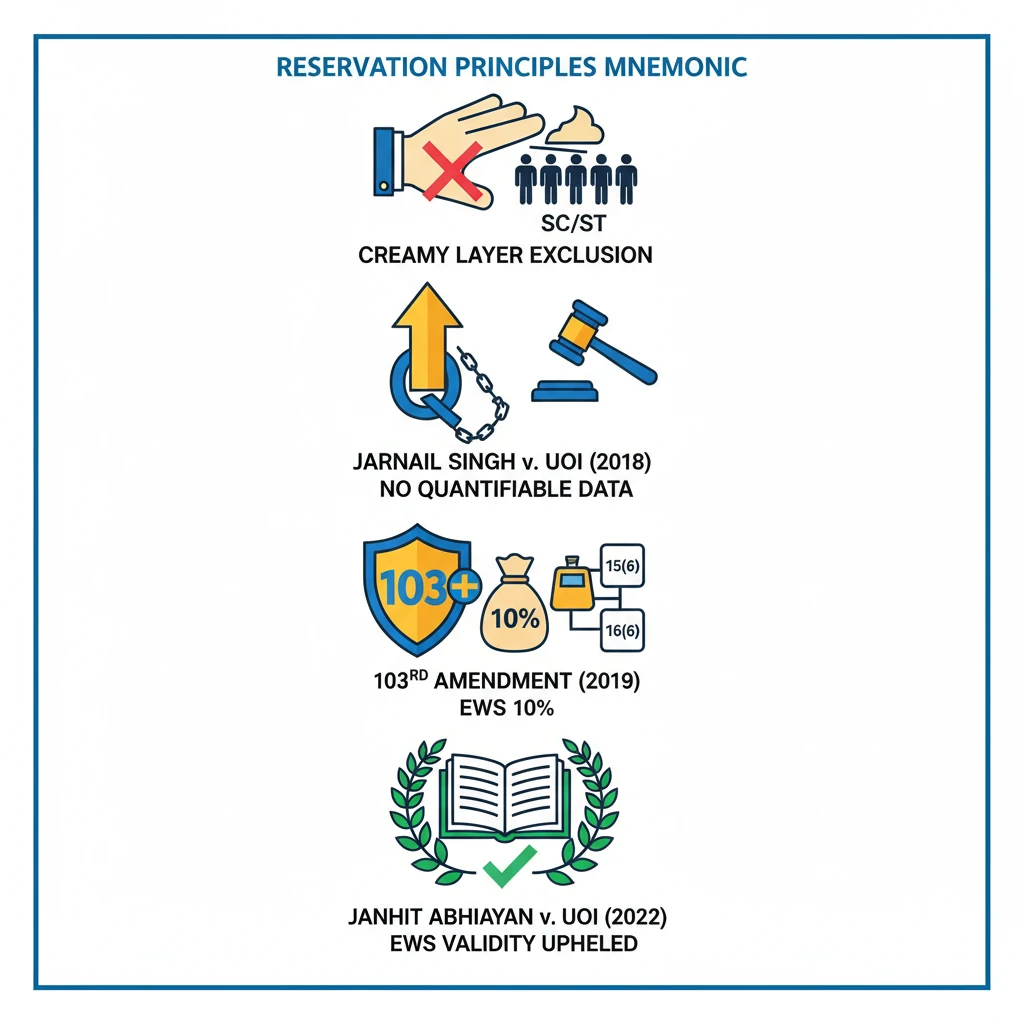
- •Creamy layer exclusion aims to ensure reservation benefits reach the truly disadvantaged within SC/STs.
- •Jarnail Singh v. Union of India (2018) removed the need for quantifiable data for backwardness in SC/ST promotion quotas.
- •The 103rd Constitutional Amendment Act (2019) introduced 10% reservation for Economically Weaker Sections (EWS) by inserting Articles 15(6) and 16(6).
- •Janhit Abhiyan v. Union of India (2022) upheld the constitutional validity of the EWS reservation.
- •The First All-India Survey on AYUSH by MoSPI provides crucial data on traditional Indian healthcare systems (Ayurveda, Yoga, Unani, Siddha, Homoeopathy) for policy making.
🧠 Memory Techniques
98% Verified Content
📚 Reference Sources
•Bare Act of 103rd Constitutional Amendment Act, 2019
•Supreme Court judgments: Jarnail Singh v. Union of India (2018), Janhit Abhiyan v. Union of India (2022)