Konda Dora Tribe - Social Issues | UPSC Learning
Topics
0 topics • 0 completed
🔍
No topics match your search
Konda Dora Tribe
Medium⏱️ 7 min read
social issues
📖 Introduction
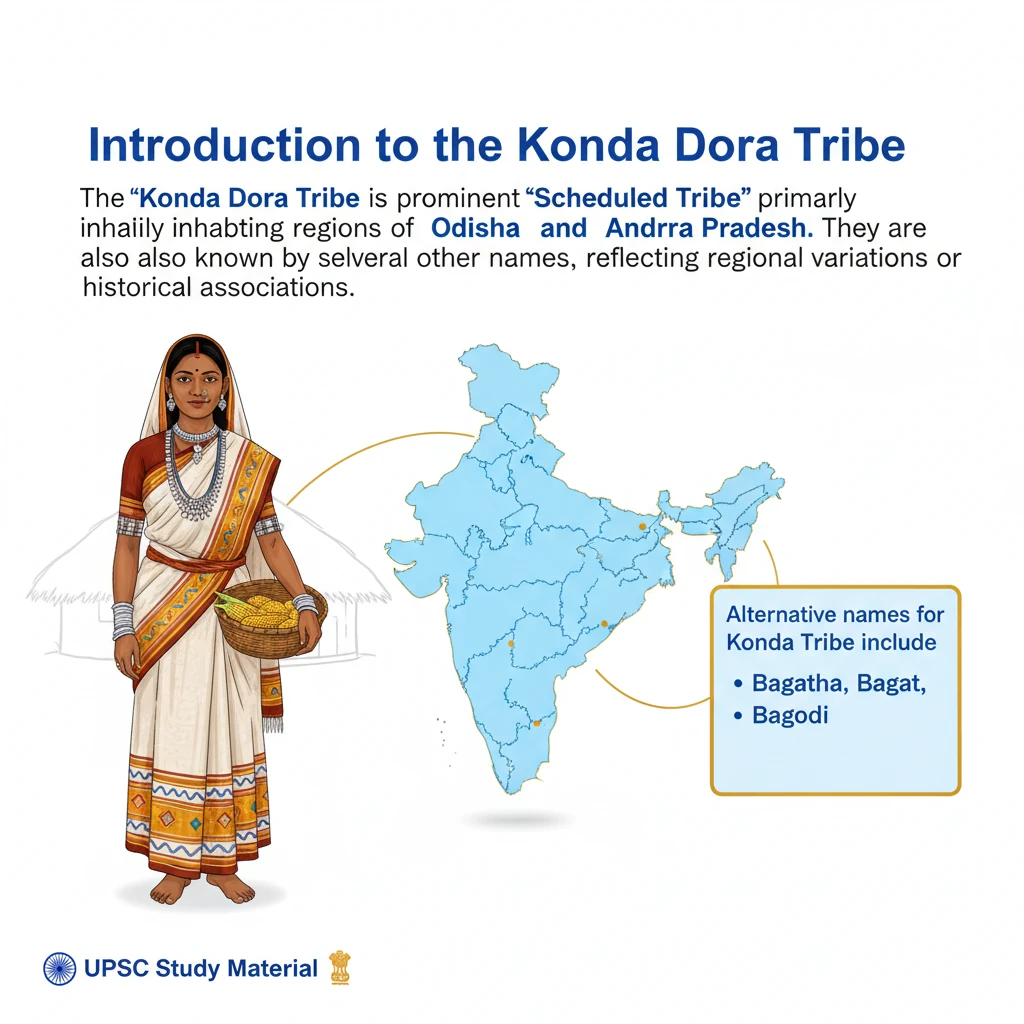
<h4>Introduction to the Konda Dora Tribe</h4><p>The <strong>Konda Dora Tribe</strong> is a prominent <strong>Scheduled Tribe</strong> primarily inhabiting regions of <strong>Odisha</strong> and <strong>Andhra Pradesh</strong>. They are also known by several other names, reflecting regional variations or historical associations.</p><div class='info-box'><p>Alternative names for the <strong>Konda Dora Tribe</strong> include <strong>Bagatha</strong>, <strong>Bagat</strong>, <strong>Bagodi</strong>, <strong>Bogad</strong>, and <strong>Bhakta</strong>.</p></div><h4>Geographical Distribution and Habitat</h4><p>This tribal community resides in the picturesque <strong>Konda Kamberu ranges</strong> of the <strong>Eastern Ghats</strong>. Their settlements span across southern <strong>Odisha</strong> and parts of <strong>Andhra Pradesh</strong>, showcasing a unique adaptation to hilly terrains.</p><h4>Etymology and Origin Myths</h4><p>The name <strong>‘Kondadora’</strong> itself is deeply rooted in their environment and social standing. It translates to <strong>‘Lords of the Hill’</strong>, derived from the words <strong>‘Konda’</strong> (hill) and <strong>‘Dora’</strong> (lord).</p><div class='info-box'><p>They are also identified as <strong>‘Konda Kapu’</strong>, <strong>‘Oja’</strong>, <strong>‘Pandava Raju’</strong>, and <strong>‘Pandava Dora’</strong>. A significant aspect of their identity is the belief that they are direct descendants of the mythological <strong>Pandavas</strong> from the Mahabharata epic.</p></div><h4>Social Structure and Settlement Patterns</h4><p><strong>Konda Dora</strong> settlements typically exhibit a <strong>homogeneous</strong> character, meaning they are primarily inhabited by members of their own tribe. This contributes to the preservation of their distinct cultural identity.</p><p>In multi-ethnic villages, the <strong>Konda Dora</strong> often live in separate wards. This practice helps them maintain social distance from other communities and reinforces their unique ethnic identity.</p><h4>Marriage Customs and Practices</h4><p>Their marriage patterns are guided by strict adherence to <strong>lineage exogamy</strong>, which mandates marrying outside one's own clan or kinship group. Marriages are typically arranged through <strong>negotiation</strong>, though <strong>elopement</strong> is also a recognized form.</p><p>The society permits both <strong>divorce</strong> and <strong>remarriage</strong>, reflecting a degree of flexibility in their marital customs. While <strong>polygyny</strong> (multiple wives) and <strong>child marriages</strong> are not strictly prohibited, they are not the norm.</p><div class='key-point-box'><p><strong>Adult marriage</strong> and <strong>monogamy</strong> are the most commonly practised forms of union among the <strong>Konda Dora</strong>. A distinctive preference is shown for <strong>cross-cousin marriages</strong>, while <strong>parallel-cousin marriages</strong> are strictly forbidden.</p></div><h4>Traditional Food Habits</h4><p>Historically, the staple diet of the <strong>Bagathas</strong> (a name often associated with Konda Dora) comprised various types of <strong>millets</strong>. Over time, this traditional food source has largely been replaced by <strong>rice</strong>, indicating a shift in agricultural practices and dietary preferences.</p><h4>Belief System and Spirituality</h4><p>The <strong>Konda Dora</strong> hold strong beliefs in <strong>supernaturalism</strong>, encompassing elements like <strong>magic</strong>, <strong>witchcraft</strong>, the <strong>evil eye</strong>, <strong>sorcery</strong>, <strong>luck</strong>, <strong>ghosts</strong>, and <strong>shapeless phantoms</strong>. Their spiritual practices are deeply connected to nature.</p><p>They engage in <strong>nature worship</strong>, often expressed through the veneration of <strong>totems</strong> and specific <strong>clans</strong>. This reverence for natural elements forms a core part of their religious and cultural identity.</p><h4>Traditional Governance and Dispute Resolution</h4><p>Their society maintains a well-defined system for governance and dispute resolution. A <strong>traditional tribal headman</strong> is responsible for settling disputes within families and between different tribal groups.</p><p>A <strong>village headman</strong> plays a crucial role in resolving inter-tribal issues and addressing violations of traditional customs. These leaders ensure social harmony and adherence to established norms.</p><div class='info-box'><p>The <strong>Konda Dora</strong> have a traditional village council known as <strong>Kulam Pancheyat</strong>, headed by a <strong>Kula Peda</strong>, who is assisted by a <strong>Pillaliduam</strong>. They also possess an <strong>inter-village community council</strong>, both responsible for customary affairs within their jurisdictions.</p></div><h4>Language and Linguistic Evolution</h4><p>The original language spoken by the <strong>Konda Dora</strong> was <strong>Kubi</strong> or <strong>Konda</strong>. However, this indigenous language has largely been supplanted over time.</p><p>Today, their primary language is <strong>Telugu</strong>, often mixed with elements of <strong>Odia</strong>. This linguistic shift reflects their interaction with surrounding dominant cultures in <strong>Andhra Pradesh</strong> and <strong>Odisha</strong>.</p>
💡 Key Takeaways
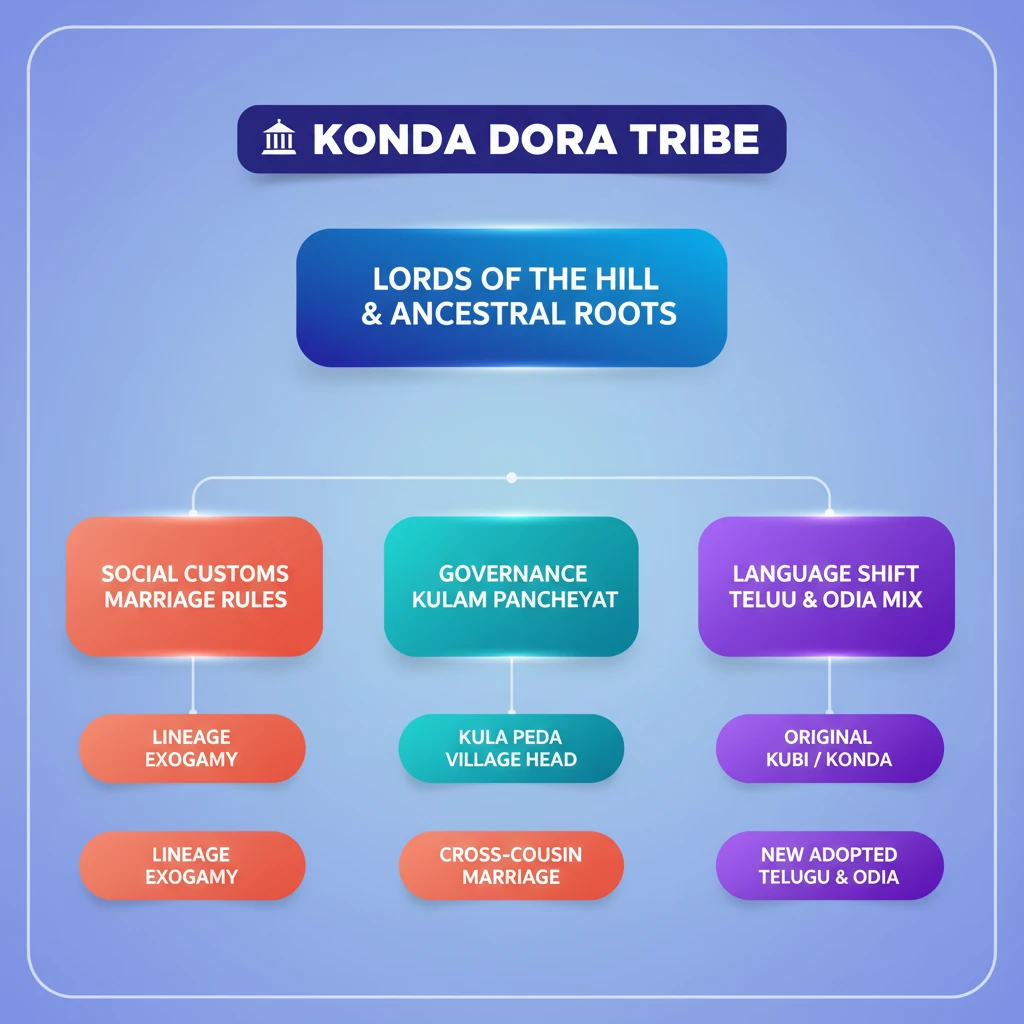
- •Konda Dora are a Scheduled Tribe primarily in Odisha and Andhra Pradesh, also known as Bagatha.
- •They are called 'Lords of the Hill' and claim mythological descent from the Pandavas.
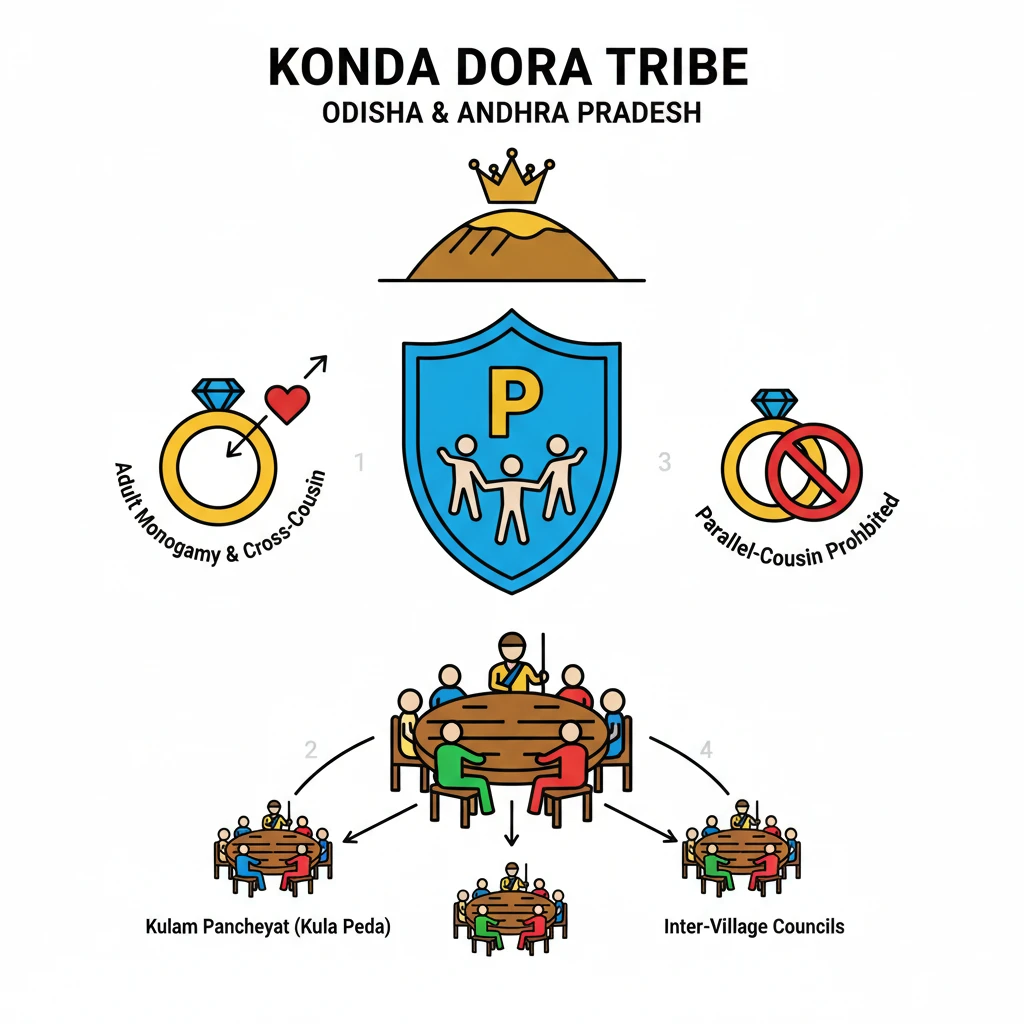
- •Key social customs include strict lineage exogamy, preference for adult monogamous and cross-cousin marriages, with parallel-cousin marriages prohibited.
- •Traditional governance is via the Kulam Pancheyat (headed by Kula Peda) and inter-village councils.
- •Their original language, Kubi/Konda, has largely been replaced by a mix of Telugu and Odia.
- •Beliefs include supernaturalism and nature worship through totems and clans.
🧠 Memory Techniques
95% Verified Content
📚 Reference Sources
•Ministry of Tribal Affairs, Government of India (for general context on Scheduled Tribes)