Multidimensional Poverty Index: NITI Aayog - Social Issues | UPSC Learning
Topics
0 topics • 0 completed
🔍
No topics match your search

Multidimensional Poverty Index: NITI Aayog
Medium⏱️ 7 min read
social issues
📖 Introduction
<h4>Introduction to Multidimensional Poverty Index (MPI) by NITI Aayog</h4><p>Recently, the <strong>NITI Aayog</strong>, a premier policy <strong>think tank of the Government of India</strong>, released a significant <strong>Discussion Paper</strong>. This paper focuses on the state of <strong>multidimensional poverty</strong> in India.</p><p>The title of this crucial document is “<strong>Multidimensional Poverty in India since 2005-06</strong>”. It provides a comprehensive overview of poverty trends over a substantial period.</p><div class="info-box"><strong>Key Publication:</strong> NITI Aayog's Discussion Paper titled “<strong>Multidimensional Poverty in India since 2005-06</strong>”.</div><h4>Key Findings of the Discussion Paper</h4><p>The <strong>Discussion Paper</strong> highlights a remarkable achievement in India's fight against poverty. It states that a staggering <strong>24.82 crore people</strong> have successfully escaped <strong>multidimensional poverty</strong>.</p><p>This significant reduction occurred over a period of <strong>nine years</strong>, demonstrating substantial progress in various social and economic indicators.</p><div class="key-point-box"><strong>Major Achievement:</strong> Approximately <strong>250 million people</strong> moved out of <strong>multidimensional poverty</strong> within the last decade.</div><h4>Data Sources and Methodology</h4><p>The analysis presented in the <strong>NITI Aayog Discussion Paper</strong> is based on robust data from the <strong>National Family Health Surveys (NFHS)</strong>. These surveys are instrumental in understanding demographic and health indicators.</p><p>Specifically, the paper utilized data from three distinct rounds of the <strong>NFHS</strong> to track long-term poverty trends and changes.</p><div class="info-box"><strong>NFHS Survey Rounds Utilized:</strong><ul><li><strong>NFHS 2005-06</strong>: Provided baseline data for long-term comparison.</li><li><strong>NFHS 2015-16</strong>: Offered an interim assessment of poverty reduction.</li><li><strong>NFHS 2019-21</strong>: Captured the most recent trends and progress.</li></ul></div><div class="exam-tip-box">Understanding the <strong>source data (NFHS)</strong> and the <strong>timeframe (2005-06 to 2019-21)</strong> is crucial for Mains answers, especially in <strong>GS Paper I (Social Issues)</strong> and <strong>GS Paper II (Government Policies)</strong>.</div>
💡 Key Takeaways
- •NITI Aayog's Discussion Paper: "Multidimensional Poverty in India since 2005-06" released.
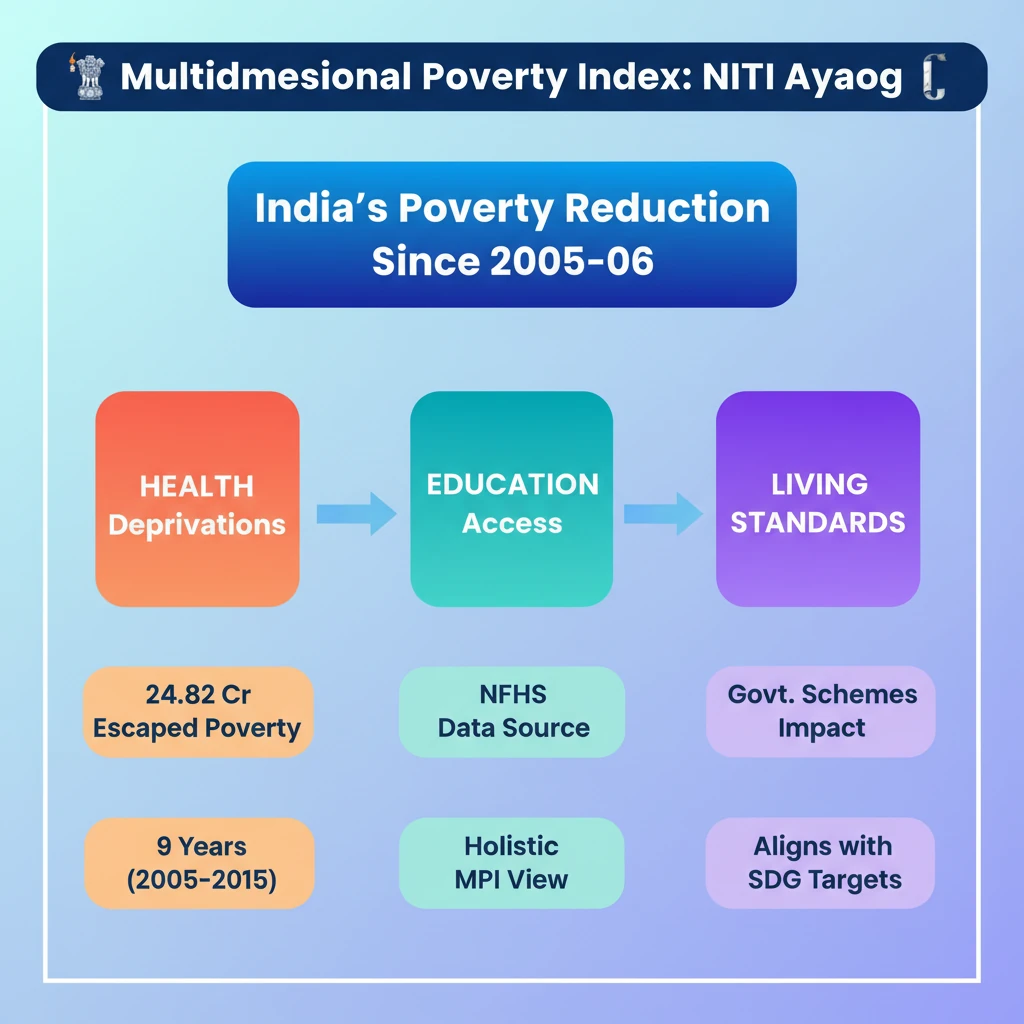
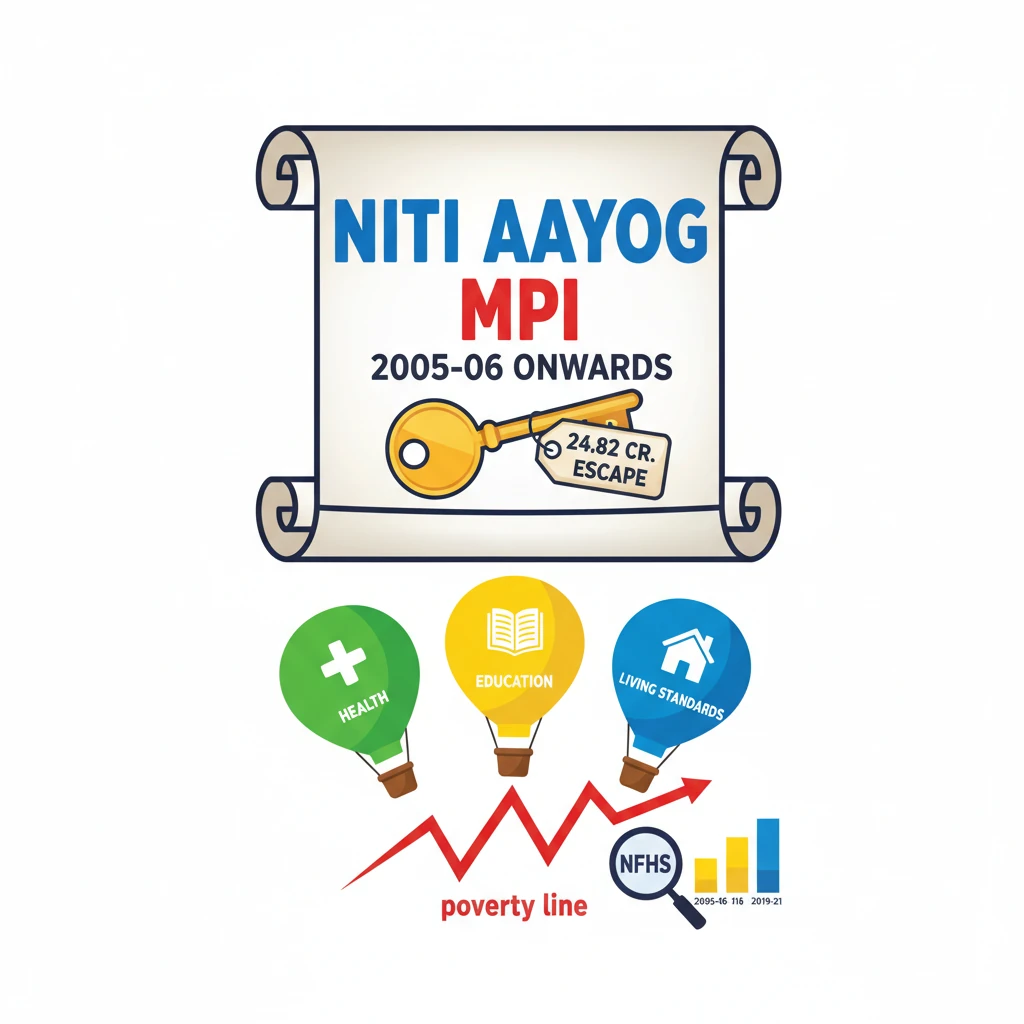
- •Key finding: 24.82 crore people escaped multidimensional poverty in 9 years.
- •Data source: National Family Health Surveys (NFHS) 2005-06, 2015-16, 2019-21.
- •MPI measures deprivations in health, education, and living standards, offering a holistic view of poverty.
- •The report validates the impact of government welfare schemes and aligns with SDG targets.
- •Uttar Pradesh recorded the largest decline in the number of poor people (5.94 crore).
🧠 Memory Techniques
98% Verified Content
📚 Reference Sources
•National Family Health Survey (NFHS) data (2005-06, 2015-16, 2019-21)
•Press Information Bureau (PIB) releases on NITI Aayog reports
•United Nations Development Programme (UNDP) & Oxford Poverty and Human Development Initiative (OPHI) publications on Global MPI