Equality in Business: Judicial Interpretations & Article 21 - Social Issues | UPSC Learning
Topics
0 topics • 0 completed
🔍
No topics match your search

Equality in Business: Judicial Interpretations & Article 21
Medium⏱️ 7 min read
social issues
📖 Introduction
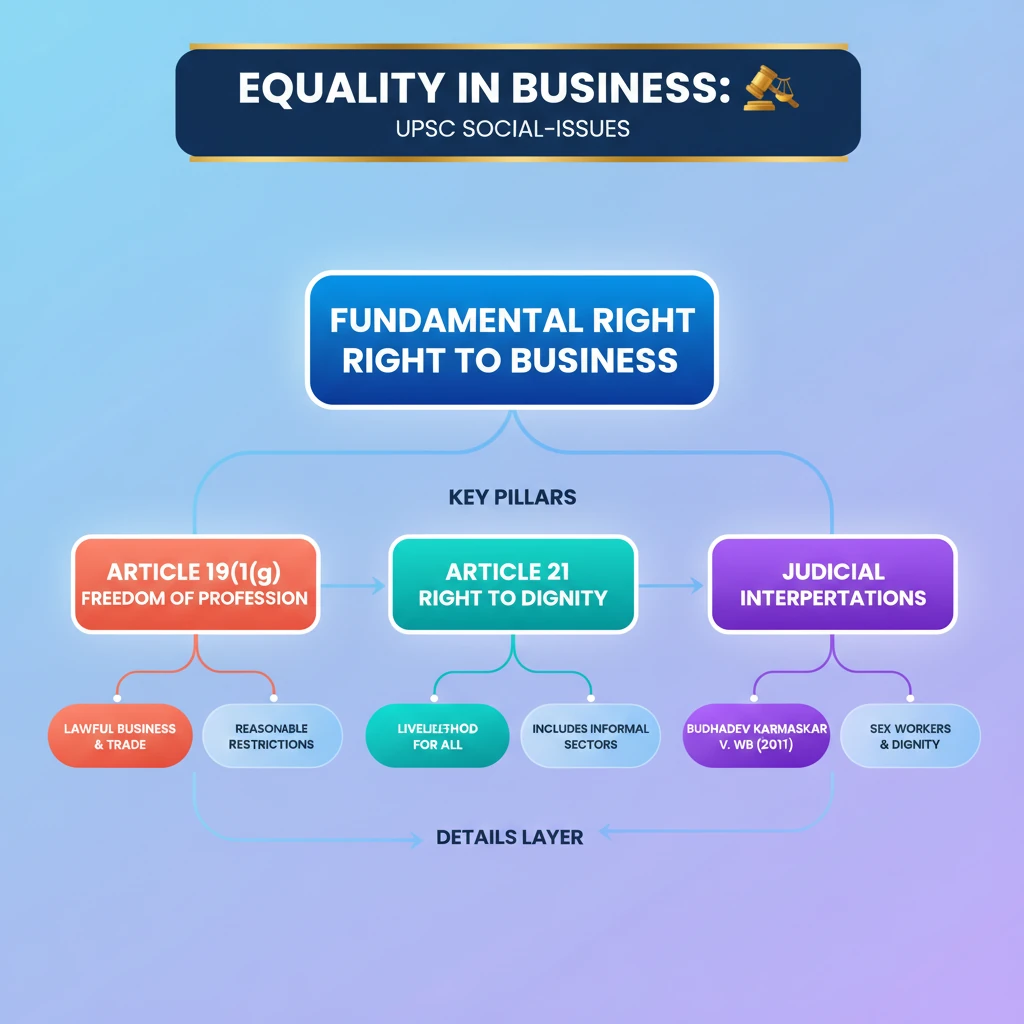
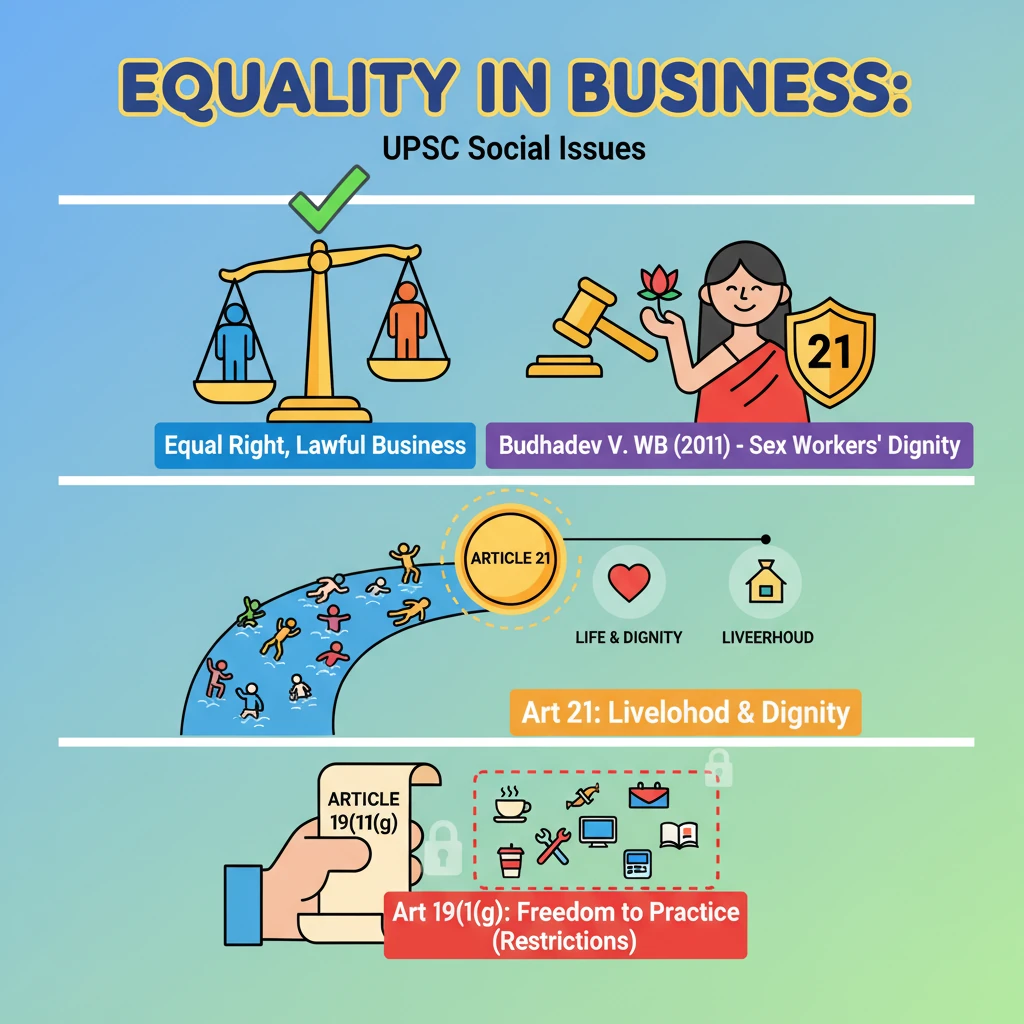
<h4>The Principle of Equality in Business</h4><p>In India, the legal framework upholds the fundamental principle that all <strong>individuals</strong> possess an <strong>equal right</strong> to pursue any chosen <strong>profession</strong> or engage in any <strong>business</strong>. This right is enshrined within the <strong>Indian Constitution</strong>, ensuring that no citizen is arbitrarily denied the opportunity to earn a livelihood.</p><div class='key-point-box'><p>The core idea is <strong>non-discrimination</strong> and <strong>equal opportunity</strong> in economic pursuits, safeguarding the ability of every person to participate in the economy without undue restrictions.</p></div><h4>Landmark Judgment: Budhadev Karmaskar V. State of West Bengal (2011)</h4><p>A pivotal moment in affirming these rights came with the <strong>Supreme Court of India's</strong> ruling in <strong>Budhadev Karmaskar V. State of West Bengal (2011)</strong>. This case specifically addressed the rights of <strong>sex workers</strong>, a highly marginalized community.</p><p>The Court recognized that even individuals in professions traditionally viewed with social stigma are entitled to <strong>constitutional protection</strong>. This judgment underscored the expansive interpretation of fundamental rights.</p><div class='info-box'><p><strong>Case Name:</strong> <strong>Budhadev Karmaskar V. State of West Bengal</strong></p><p><strong>Year:</strong> <strong>2011</strong></p><p><strong>Key Outcome:</strong> Secured the <strong>rights of sex workers</strong>, emphasizing their entitlement to a life of dignity.</p></div><h4>Protection Under Article 21</h4><p>The Supreme Court, in the <strong>Budhadev Karmaskar</strong> case, heavily relied on <strong>Article 21</strong> of the <strong>Indian Constitution</strong>. <strong>Article 21</strong> guarantees <strong>"Protection of Life and Personal Liberty"</strong>, which has been interpreted broadly by the judiciary.</p><p>This includes the right to live with <strong>human dignity</strong>, the right to a <strong>livelihood</strong>, and protection from exploitation. The judgment highlighted that dignity is not exclusive to certain professions but is inherent to every individual.</p><div class='exam-tip-box'><p><strong>UPSC Insight:</strong> Understanding how the judiciary interprets broad constitutional provisions like <strong>Article 21</strong> to protect marginalized groups is crucial for <strong>GS-II (Polity and Social Justice)</strong>. Be prepared to cite landmark judgments.</p></div>
💡 Key Takeaways
- •Every individual has an equal fundamental right to carry on any lawful business or profession.
- •The Supreme Court's ruling in Budhadev Karmaskar V. State of West Bengal (2011) affirmed the rights and dignity of sex workers under Article 21.
- •Article 21 (Right to Life and Personal Liberty) has a broad scope, encompassing the right to livelihood and dignity for all.
- •Article 19(1)(g) directly grants the freedom to practice any profession or business, subject to reasonable restrictions.
- •Judicial interpretations are crucial in extending constitutional protections to marginalized groups and informal sectors.
- •Government policies like Stand-Up India aim to promote inclusive entrepreneurship, aligning with the principle of equality in business.
🧠 Memory Techniques
95% Verified Content
📚 Reference Sources
•The Constitution of India
•Supreme Court of India judgments (Budhadev Karmaskar V. State of West Bengal, 2011)
•Academic articles on Fundamental Rights and Social Justice in India