What are Key Facts About Transgender Persons Act, 2019? - Social Issues | UPSC Learning
Topics
0 topics • 0 completed
🔍
No topics match your search
What are Key Facts About Transgender Persons Act, 2019?
Medium⏱️ 10 min read
social issues
📖 Introduction
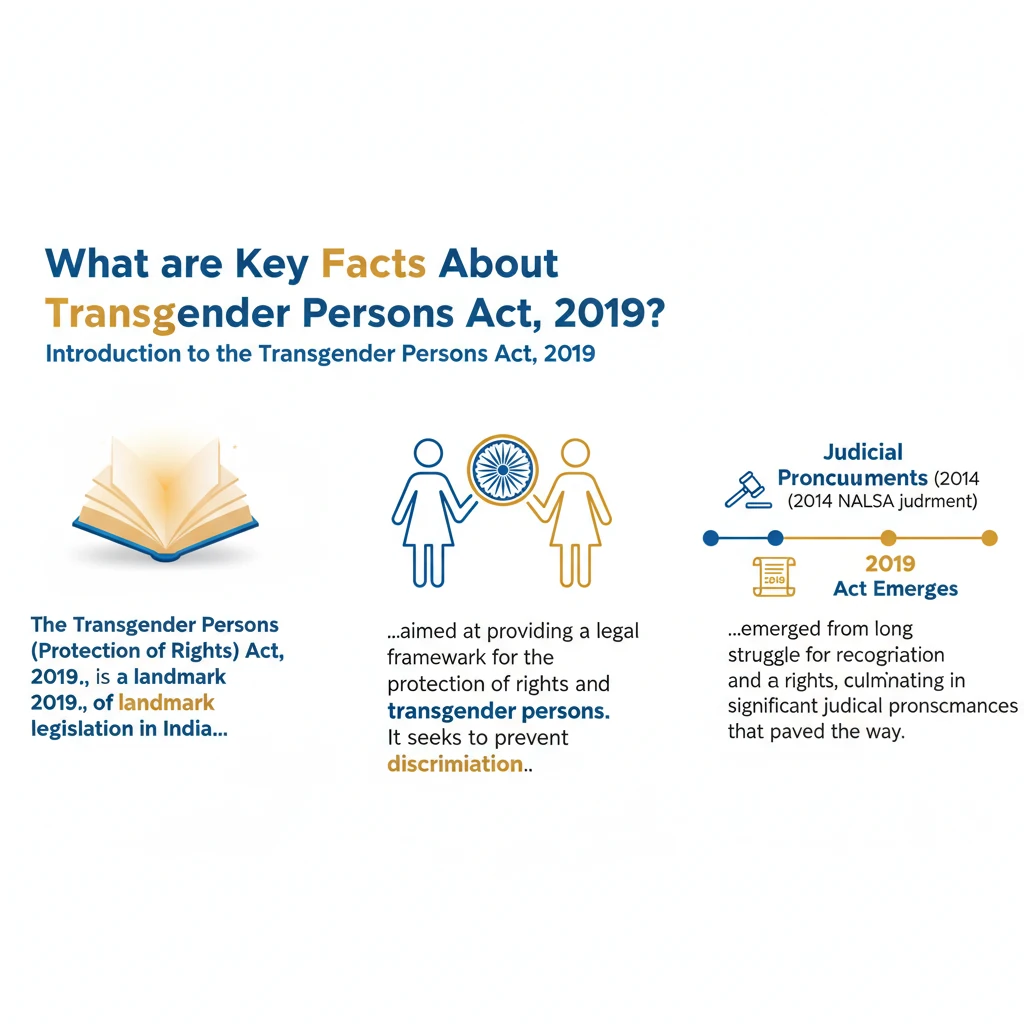
<h4>Introduction to the Transgender Persons Act, 2019</h4><p>The <strong>Transgender Persons (Protection of Rights) Act, 2019</strong>, is a landmark legislation in India aimed at providing a legal framework for the protection of rights and welfare of <strong>transgender persons</strong>. It seeks to prevent discrimination and ensure their inclusion in society.</p><p>This Act emerged from a long struggle for recognition and rights, culminating in significant judicial pronouncements that paved the way for legislative action.</p><h4>Defining a Transgender Person</h4><p>The Act provides a clear definition of a <strong>transgender person</strong>. It states that a transgender person is someone whose <strong>gender does not match with the gender assigned to that person at birth</strong>.</p><div class='info-box'><p><strong>Definition:</strong> A <strong>transgender person</strong> is an individual whose gender identity differs from the sex they were assigned at birth.</p></div><p>This definition emphasizes <strong>self-perceived gender identity</strong>, a crucial aspect of transgender rights globally.</p><h4>Clarification of Key Terms</h4><p>The Act further clarifies various related terms to ensure comprehensive coverage. It explicitly includes <strong>trans men</strong> and <strong>trans women</strong> within its ambit.</p><div class='info-box'><p><strong>Inclusions:</strong> The Act covers individuals with <strong>intersex variations</strong> and explicitly includes <strong>trans men</strong> and <strong>trans women</strong>.</p></div><p>Crucially, this inclusion is irrespective of whether a person has undergone any <strong>surgery or therapy</strong> for gender affirmation. This reinforces the principle of self-identification.</p><h4>Prohibition of Discrimination</h4><p>A cornerstone of the Act is its strong stance against discrimination. It prohibits discrimination against transgender persons in various spheres of life.</p><div class='key-point-box'><p><strong>Non-Discrimination Areas:</strong> The Act prohibits discrimination in:</p><ul><li><strong>Education</strong> (admission, facilities)</li><li><strong>Employment</strong> (recruitment, promotion)</li><li><strong>Healthcare</strong> (access to services)</li><li><strong>Access to public facilities</strong> (transport, housing)</li></ul></div><p>Beyond these, the Act also affirms their fundamental rights to <strong>movement</strong>, to <strong>property ownership</strong>, and to hold <strong>public office</strong>, ensuring their full participation in civic life.</p><h4>Right to Self-Perceived Gender Identity and Certificate</h4><p>The Act grants every transgender person the fundamental right to <strong>self-perceived gender identity</strong>. This is a significant step towards affirming individual autonomy.</p><p>To formalize this right, the Act mandates a process for obtaining a <strong>Certificate of Identity</strong>. This certificate is crucial for legal recognition of their gender identity.</p><div class='info-box'><p><strong>Certificate of Identity Process:</strong></p><ul><li>A transgender person can apply to the <strong>District Magistrate</strong> for a certificate of identity.</li><li>The application is based on their <strong>self-perceived gender identity</strong>.</li><li>Crucially, no <strong>medical examination</strong> or surgical proof is required for the initial certificate.</li></ul></div><div class='exam-tip-box'><p><strong>UPSC Insight:</strong> The emphasis on <strong>self-perceived gender identity</strong> and the absence of mandatory medical examination for the initial certificate are key features to highlight in answers related to social justice and human rights (<strong>GS Paper I & II</strong>).</p></div>
💡 Key Takeaways
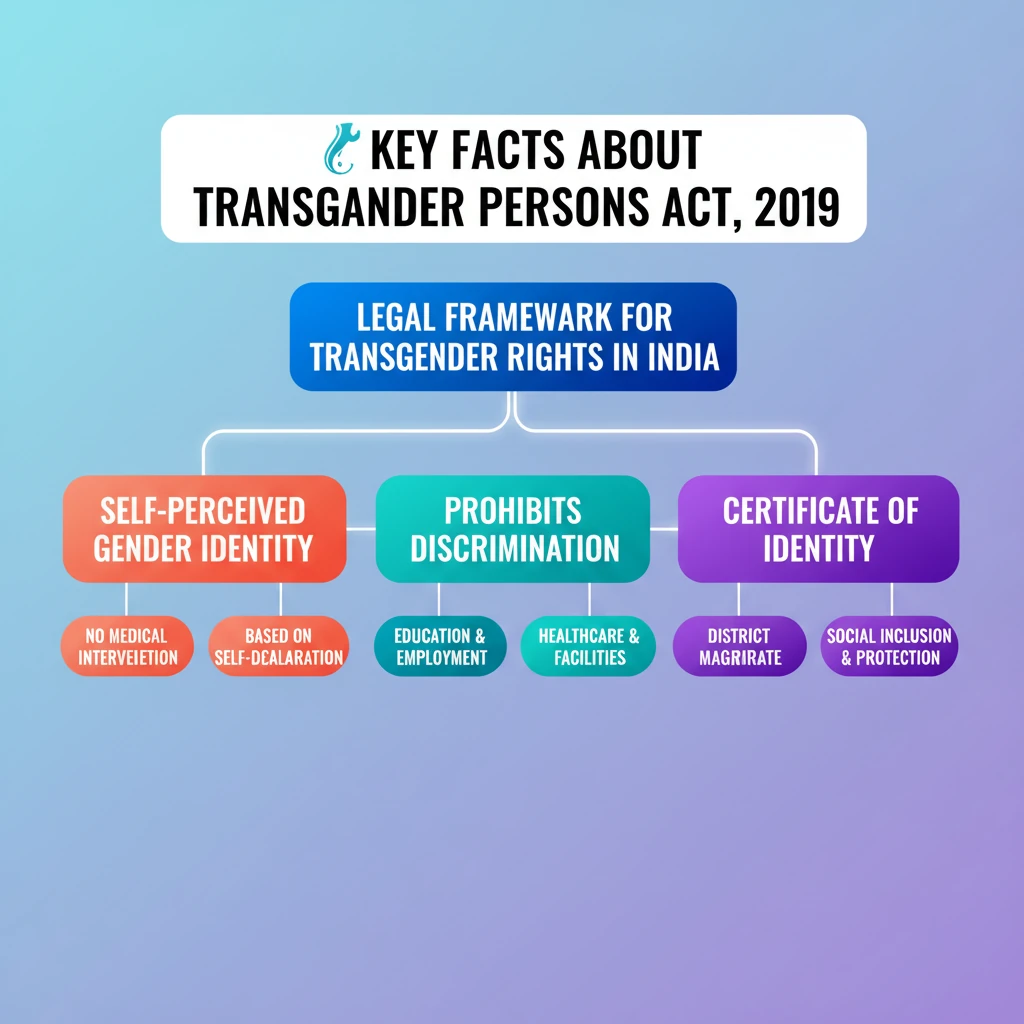
- •The Transgender Persons Act, 2019, provides a legal framework for transgender rights in India.
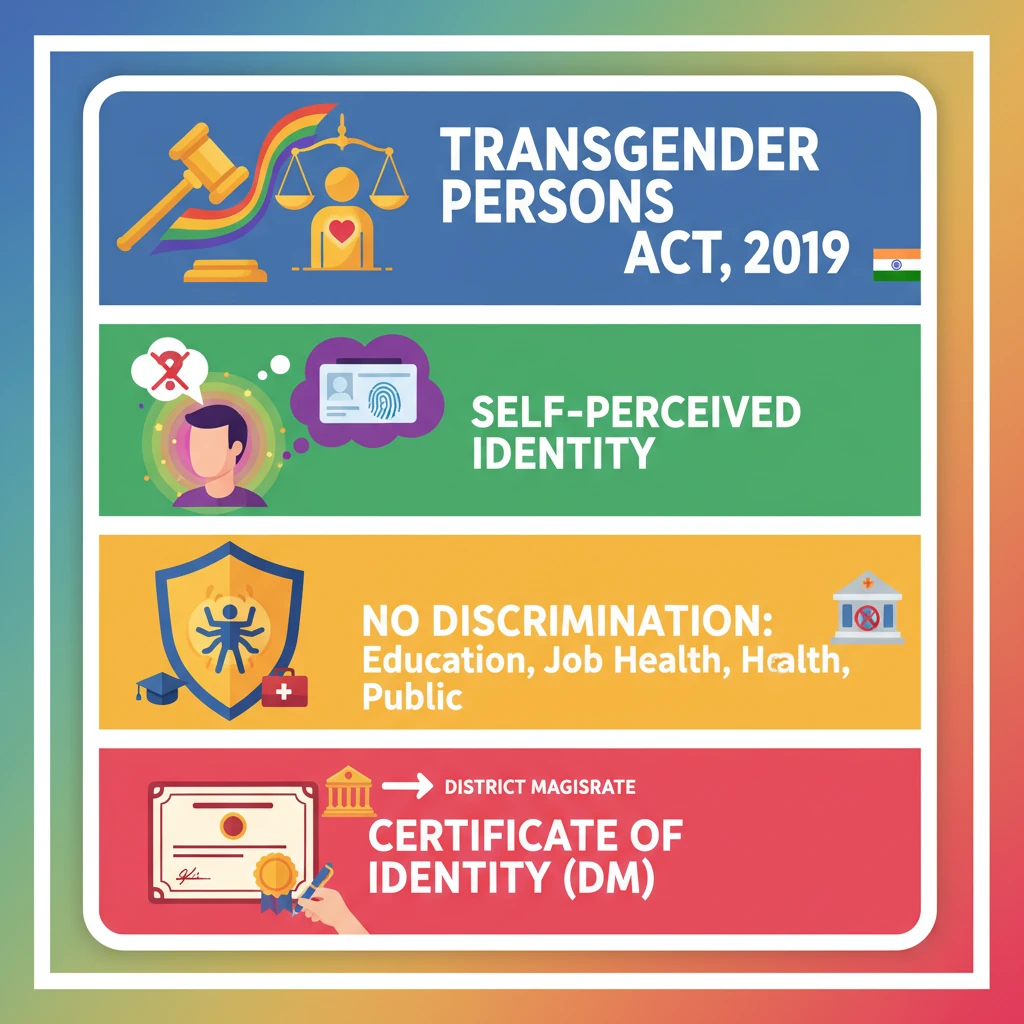
- •It defines a transgender person based on self-perceived gender identity, not medical intervention.
- •The Act prohibits discrimination in education, employment, healthcare, and public facilities.
- •It grants the right to a Certificate of Identity from the District Magistrate based on self-declaration.
- •The Act aims to ensure social inclusion and protection of fundamental rights for transgender persons.
🧠 Memory Techniques
95% Verified Content
📚 Reference Sources
•National Legal Services Authority v. Union of India (NALSA Judgment), 2014, Supreme Court of India
•Ministry of Social Justice and Empowerment, Government of India