Lymphatic Filariasis - Social Issues | UPSC Learning
Topics
0 topics • 0 completed
🔍
No topics match your search
Lymphatic Filariasis
Medium⏱️ 8 min read
social issues
📖 Introduction
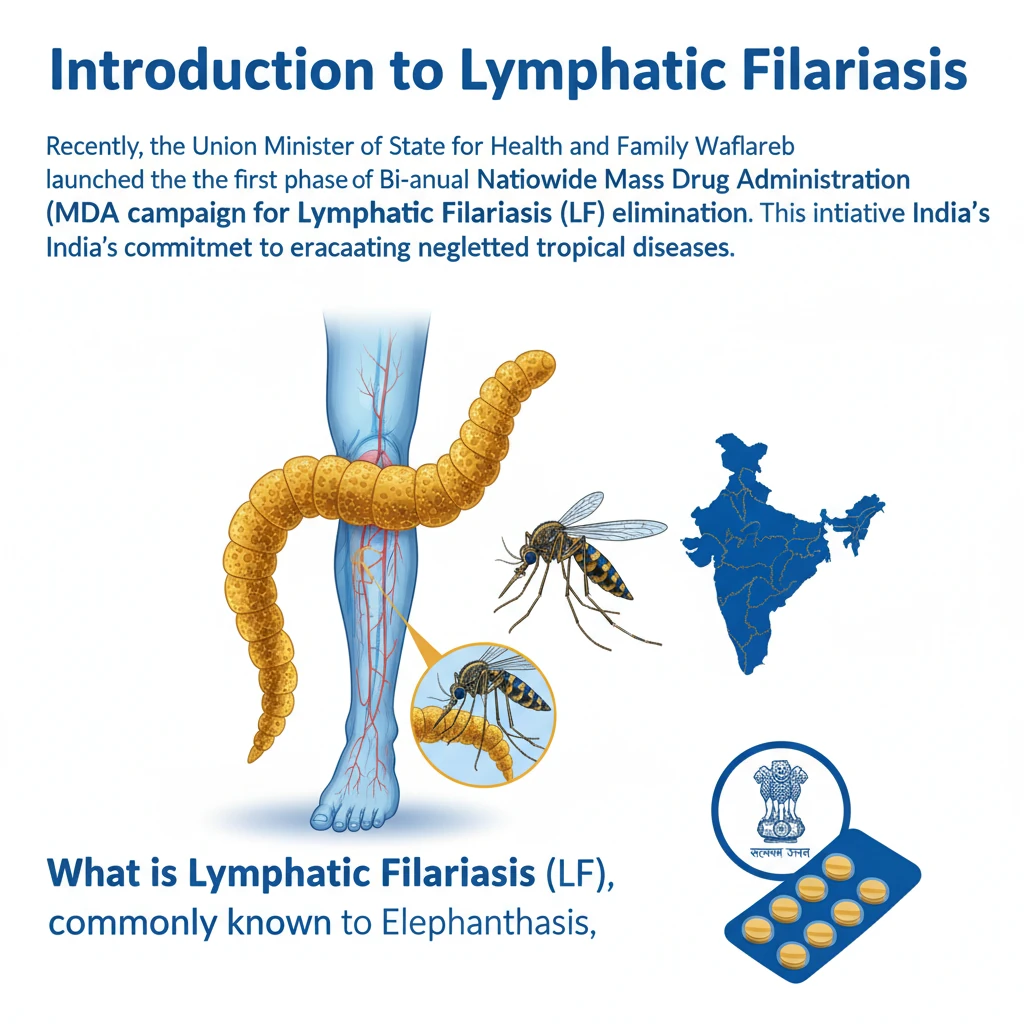
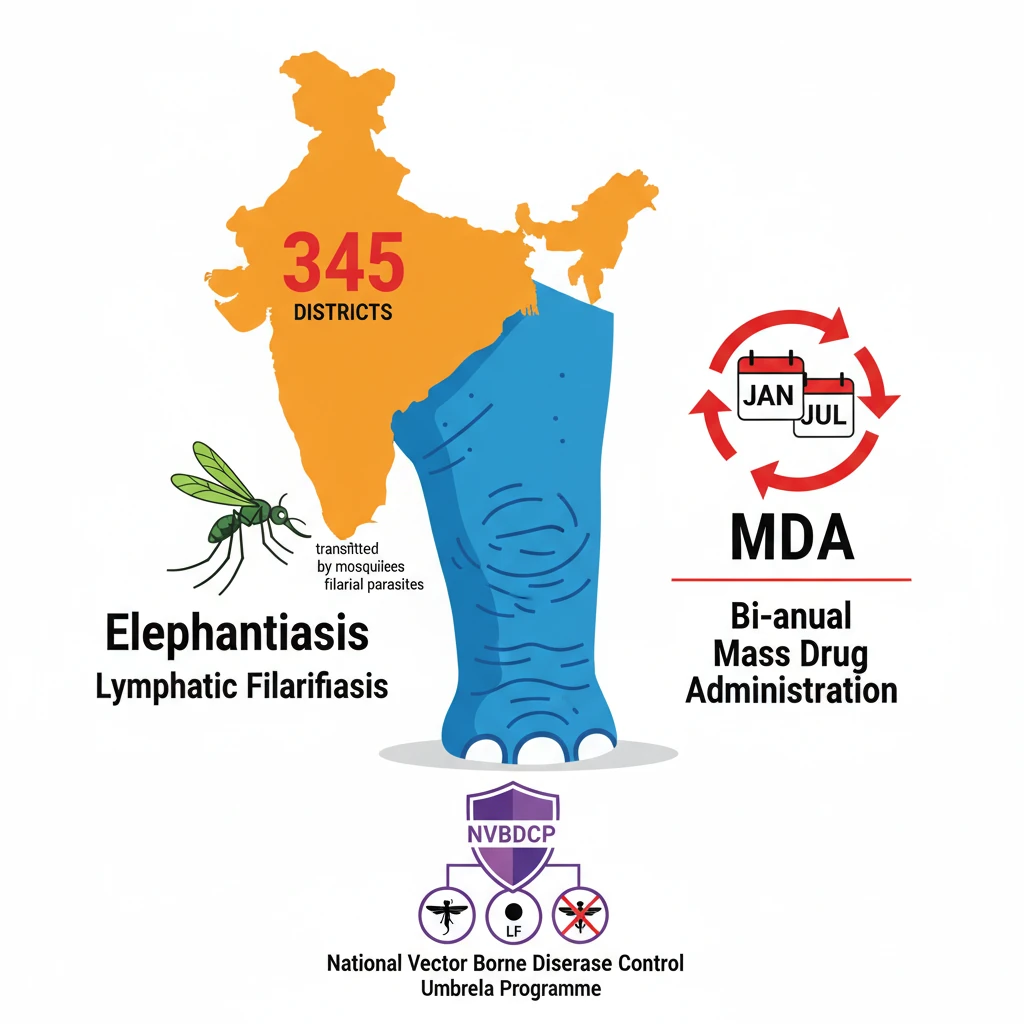
<h4>Introduction to Lymphatic Filariasis (LF)</h4><p>Recently, the <strong>Union Minister of State for Health and Family Welfare</strong> inaugurated the first phase of the <strong>Bi-annual Nationwide Mass Drug Administration (MDA) campaign</strong>. This significant initiative aims at the elimination of <strong>Lymphatic Filariasis (LF)</strong> across affected regions in India.</p><div class='info-box'><p>The <strong>MDA campaign</strong> is designed to halt disease transmission by offering free preventive medications. It targets residents in areas where the disease is prevalent and will encompass <strong>92 districts</strong> across <strong>11 states</strong> in its initial phase.</p></div><h4>Understanding Lymphatic Filariasis</h4><p><strong>Lymphatic Filariasis</strong>, commonly known as <strong>elephantiasis</strong>, is categorized as a <strong>neglected tropical disease (NTD)</strong>. It is caused by an infection with specific <strong>filarial parasites</strong>, which are transmitted to humans through <strong>mosquito bites</strong>.</p><div class='key-point-box'><p>The infection typically begins in <strong>childhood</strong> and progressively worsens throughout adulthood. This accumulation often leads to <strong>irreversible chronic disease conditions</strong>, making early intervention crucial.</p></div><h4>Global and National Prevalence</h4><p>In <strong>2021</strong>, an estimated <strong>882.5 million people</strong> residing in <strong>44 countries</strong> required preventive chemotherapy to control the spread of <strong>Lymphatic Filariasis</strong>. This highlights the disease's significant global burden.</p><p>In <strong>India</strong>, <strong>LF</strong> remains a serious public health challenge. Currently, there are <strong>345 Lymphatic Filariasis endemic districts</strong> spread across <strong>20 states and union territories</strong>.</p><div class='info-box'><p>A significant concentration of <strong>MDA districts</strong>, approximately <strong>75%</strong>, are located in five key states: <strong>Bihar, Jharkhand, Uttar Pradesh, Odisha</strong>, and <strong>Telangana</strong>. The disease disproportionately affects the <strong>urban poor</strong> and impacts all segments of the <strong>rural population</strong>.</p></div><h4>Impact of Lymphatic Filariasis</h4><p>The disease carries a profound societal and economic burden. It inflicts severe <strong>stigma</strong> and considerable <strong>mental suffering</strong> on affected individuals.</p><p>Beyond health, <strong>LF</strong> leads to significant <strong>social deprivation</strong> and substantial <strong>economic loss</strong>. It is recognized as a major contributing factor to <strong>poverty</strong> within affected communities.</p><h4>Causes and Transmission Cycle</h4><p><strong>Lymphatic Filariasis</strong> is caused by an infection with <strong>parasites</strong> belonging to the <strong>nematodes (roundworms)</strong> family, specifically <strong>Filariodidea</strong>. There are three primary types of these thread-like filarial worms responsible for the disease:</p><ul><li><strong>Wuchereria bancrofti</strong>: Responsible for approximately <strong>90%</strong> of all <strong>LF cases</strong>.</li><li><strong>Brugia malayi</strong>: Accounts for most of the remaining cases.</li><li><strong>Brugia timori</strong>: Also a known cause of the disease.</li></ul><div class='info-box'><p>The adult worms reside in the <strong>lymphatic vessels</strong> of infected individuals, where they produce microscopic larvae known as <strong>microfilariae</strong>. These <strong>microfilariae</strong> then circulate in the bloodstream.</p></div><p>The transmission cycle continues when <strong>mosquitoes</strong> bite an infected host and ingest the <strong>microfilariae</strong>. These larvae develop within the mosquito and are subsequently transmitted to healthy humans during another mosquito bite, thus perpetuating the infection.</p><h4>Symptoms and Complications</h4><p>A significant challenge with <strong>LF</strong> is that the majority of infections are initially <strong>asymptomatic</strong>, meaning individuals show no outward signs of the disease for a long period.</p><p>However, chronic conditions can develop, leading to severe and disfiguring symptoms:</p><ul><li><strong>Lymphoedema</strong>: Characterized by painful swelling of the limbs.</li><li><strong>Elephantiasis</strong>: Involves the extreme thickening of the skin and underlying tissues, leading to gross enlargement of body parts.</li><li><strong>Hydrocele</strong>: Manifests as swelling of the scrotum in males.</li></ul><p>These chronic conditions not only cause severe <strong>physical disfigurement</strong> but also profound <strong>psychological distress</strong> for those affected.</p><div class='key-point-box'><p>In addition to chronic conditions, individuals often experience <strong>acute inflammatory episodes</strong>. These episodes are debilitating, causing intense pain and leading to a significant loss of productivity among infected individuals.</p></div><h4>Treatment and Prevention Strategies</h4><p>The primary global strategy for controlling and eliminating <strong>Lymphatic Filariasis</strong> is <strong>preventive chemotherapy</strong>. This involves <strong>Mass Drug Administration (MDA)</strong>.</p><div class='exam-tip-box'><p>The <strong>World Health Organization (WHO)</strong> recommends annual doses of specific medicines to the entire at-risk population in endemic areas. This approach aims to reduce the parasite load in the community and interrupt transmission.</p></div>
💡 Key Takeaways
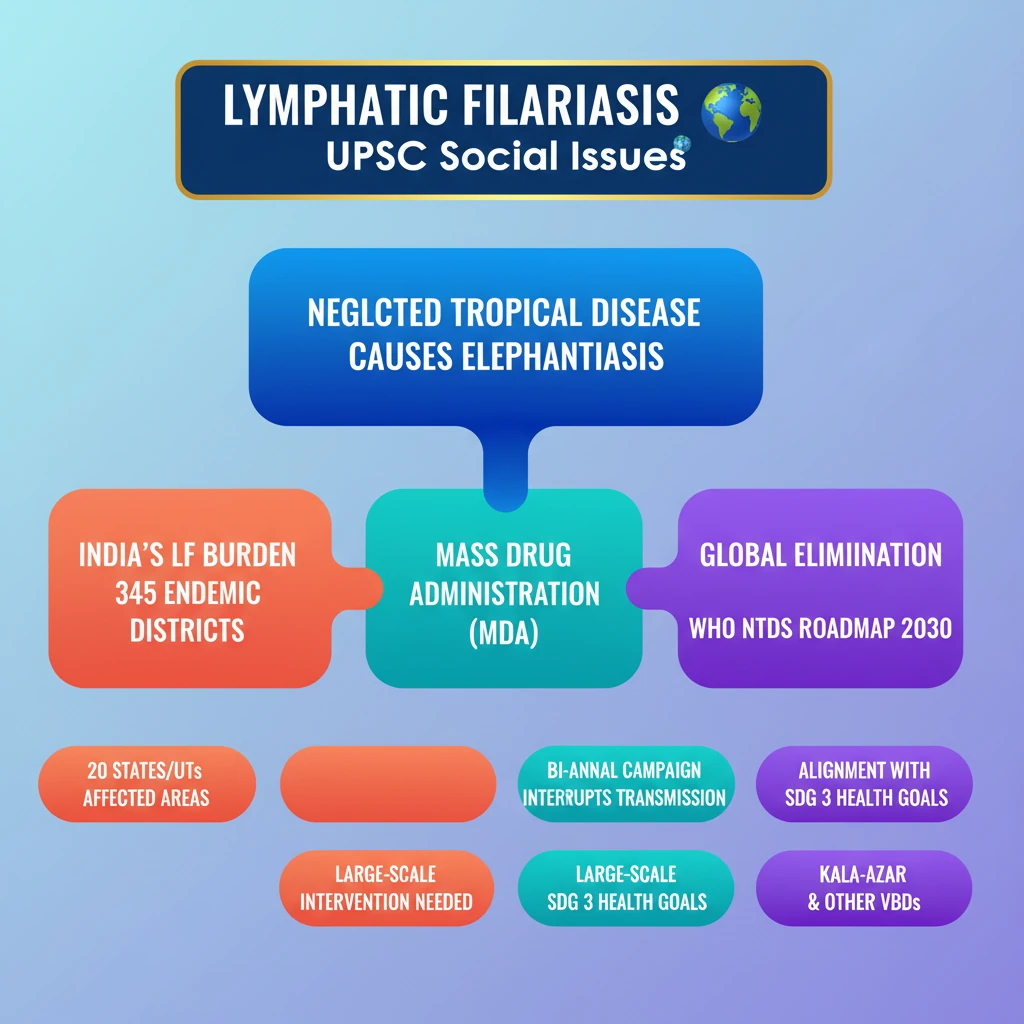
- •Lymphatic Filariasis (LF), or elephantiasis, is a Neglected Tropical Disease (NTD) caused by filarial parasites transmitted by mosquitoes.
- •It leads to irreversible chronic conditions like lymphoedema, elephantiasis, and hydrocele, causing physical disfigurement and significant socio-economic burden.
- •India launched a Bi-annual Nationwide Mass Drug Administration (MDA) campaign, covering 92 districts in 11 states, to eliminate LF by providing free preventive medications.
- •Wuchereria bancrofti causes 90% of cases; the adult worms reside in lymphatic vessels, producing microfilariae that circulate in the blood.
- •Preventive chemotherapy via annual MDA is the WHO-recommended strategy to interrupt transmission and eliminate the disease.
🧠 Memory Techniques
98% Verified Content
📚 Reference Sources
•World Health Organization (WHO) fact sheets on Lymphatic Filariasis
•Ministry of Health & Family Welfare, Government of India press releases on MDA campaigns