Kala Azar Elimination Progress in India: Status and Challenges - Social Issues | UPSC Learning
Topics
0 topics • 0 completed
🔍
No topics match your search
Kala Azar Elimination Progress in India: Status and Challenges
Medium⏱️ 8 min read
social issues
📖 Introduction
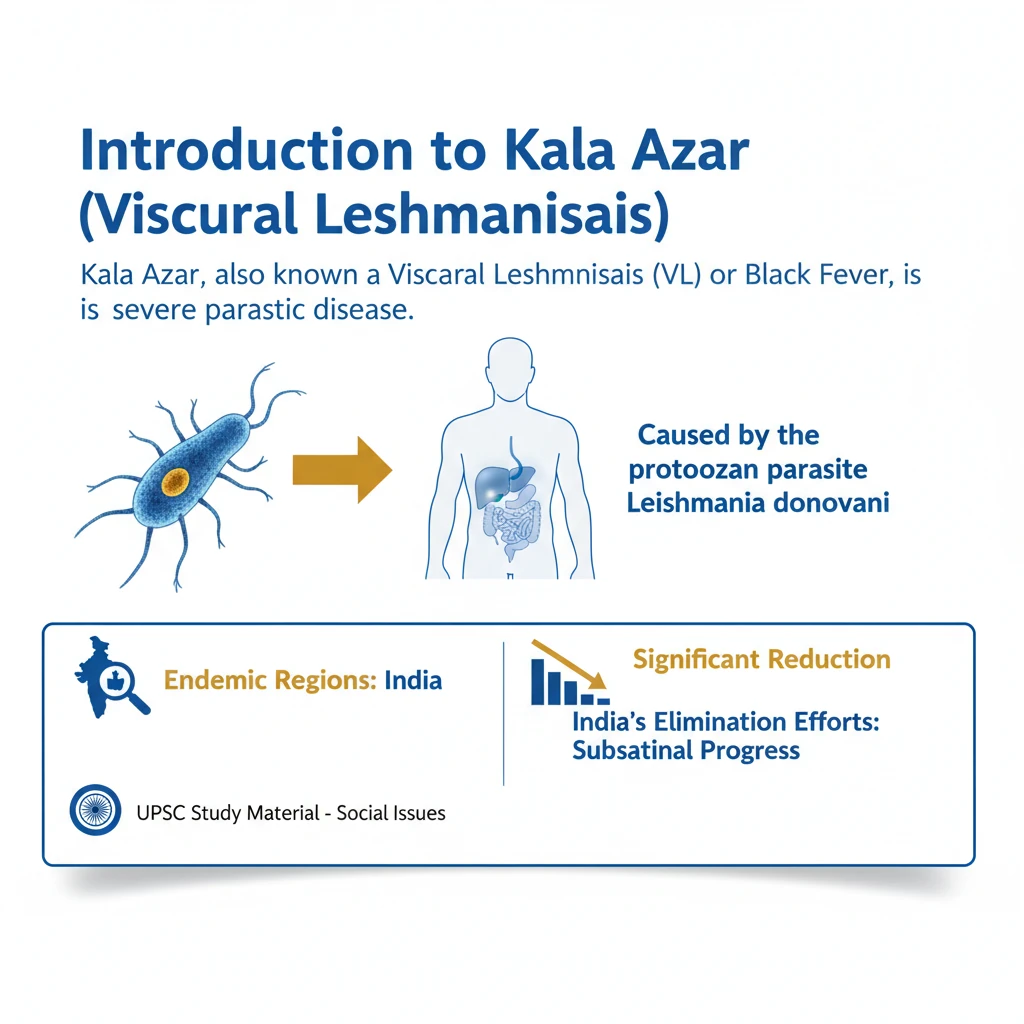
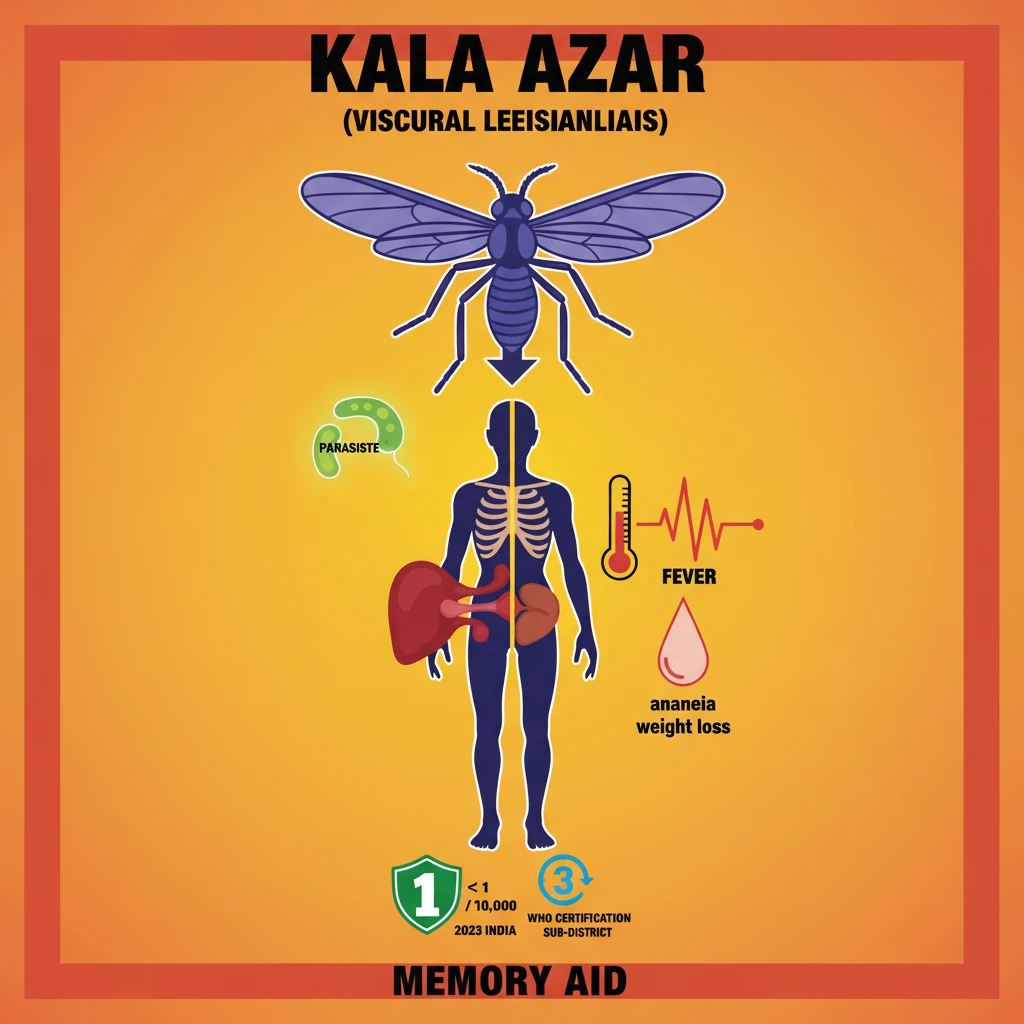
<h4>Introduction to Kala Azar (Visceral Leishmaniasis)</h4><p><strong>Kala Azar</strong>, also known as <strong>Visceral Leishmaniasis (VL)</strong> or <strong>Black Fever</strong>, is a severe parasitic disease. It is caused by the <strong>protozoan parasite Leishmania donovani</strong>, making it a significant public health concern, especially in endemic regions.</p><p>India has demonstrated substantial progress in its efforts to eliminate Kala Azar. Recent data indicates a significant reduction in case numbers, moving closer to the national elimination target.</p><h4>India's Progress in Kala Azar Elimination</h4><p>India reported less than <strong>one case per 10,000 population in 2023</strong>, marking a notable improvement compared to previous years. This achievement reflects dedicated public health interventions and sustained efforts.</p><div class='info-box'><p>The <strong>National Vector Borne Disease Control Programme</strong> data shows a decline in cases:</p><ul><li><strong>2023: 595 cases</strong> and <strong>four deaths</strong></li><li><strong>2022: 891 cases</strong> and <strong>three deaths</strong></li></ul></div><p>While significant progress has been made, India has not yet achieved formal elimination of Kala Azar. The country continues to work towards this crucial public health goal.</p><h4>WHO Elimination Criteria and India's Targets</h4><p>The <strong>World Health Organization (WHO)</strong> defines elimination for Kala Azar as having fewer than <strong>one case per 10,000 people</strong> at the sub-district (block Primary Health Centres) level.</p><p>Once this threshold is met, the elimination status must be sustained for <strong>three consecutive years</strong> to receive official <strong>WHO certification</strong>.</p><div class='exam-tip-box'><p>India's initial target year for Kala Azar elimination was <strong>2010</strong>. This target was subsequently extended multiple times to <strong>2015</strong>, <strong>2017</strong>, and then <strong>2020</strong>. The country now needs to sustain its current momentum for three years to achieve certification.</p></div><h4>Global Context: Bangladesh's Achievement</h4><p>In <strong>October 2023</strong>, <strong>Bangladesh</strong> made history by becoming the <strong>first country globally</strong> to be officially validated by the WHO for eliminating Kala Azar as a public health problem. This serves as a significant benchmark and inspiration for other endemic nations, including India.</p><h4>Key Facts About Kala Azar</h4><p>Understanding the fundamental characteristics of Kala Azar is crucial for both prevention and control strategies.</p><h5>About Kala Azar</h5><div class='info-box'><p><strong>Kala Azar</strong> is medically known as <strong>Visceral Leishmaniasis (VL)</strong>. It is caused by the <strong>protozoan parasite Leishmania donovani</strong> and is often referred to as <strong>Black Fever</strong> due to some of its characteristic symptoms.</p></div><h5>Symptoms of Kala Azar</h5><p>The disease manifests with a range of debilitating symptoms that can severely impact an individual's health.</p><ul><li><strong>Irregular bouts of fever</strong>: A primary and persistent symptom.</li><li><strong>Weight loss</strong>: Significant and often unexplained reduction in body mass.</li><li><strong>Enlargement of the spleen and liver</strong>: These organs become noticeably swollen.</li><li><strong>Anaemia</strong>: A reduction in red blood cells, leading to fatigue and weakness.</li></ul><h5>Prevalence and Global Burden</h5><p>Kala Azar remains a global health challenge, with a high concentration of cases in specific regions.</p><div class='info-box'><p>Most cases of Kala Azar occur in <strong>Brazil</strong>, <strong>East Africa</strong>, and <strong>India</strong>. Globally, an estimated <strong>50,000 to 90,000 new cases of VL</strong> occur annually, but only <strong>25-45%</strong> are reported to the WHO. The disease has significant outbreak and mortality potential.</p></div><h5>Transmission of Kala Azar</h5><p>The parasite responsible for Kala Azar is transmitted through a specific vector.</p><p><strong>Leishmania parasites</strong> are spread through the bites of infected female <strong>sandflies</strong>. These sandflies feed on blood for egg production, acquiring and transmitting the parasite in the process. Over <strong>70 animal species</strong>, including humans, can act as carriers for these parasites.</p><h5>Major Risk Factors for Kala Azar</h5><p>Several socio-economic and environmental factors contribute to the spread and severity of Kala Azar.</p><ul><li><strong>Poverty</strong>: Limited access to healthcare and resources.</li><li><strong>Poor housing and sanitation</strong>: Creates favourable breeding grounds for sandflies.</li><li><strong>Diets lacking essential nutrients</strong>: Weakens the immune system, making individuals more susceptible.</li></ul>
💡 Key Takeaways
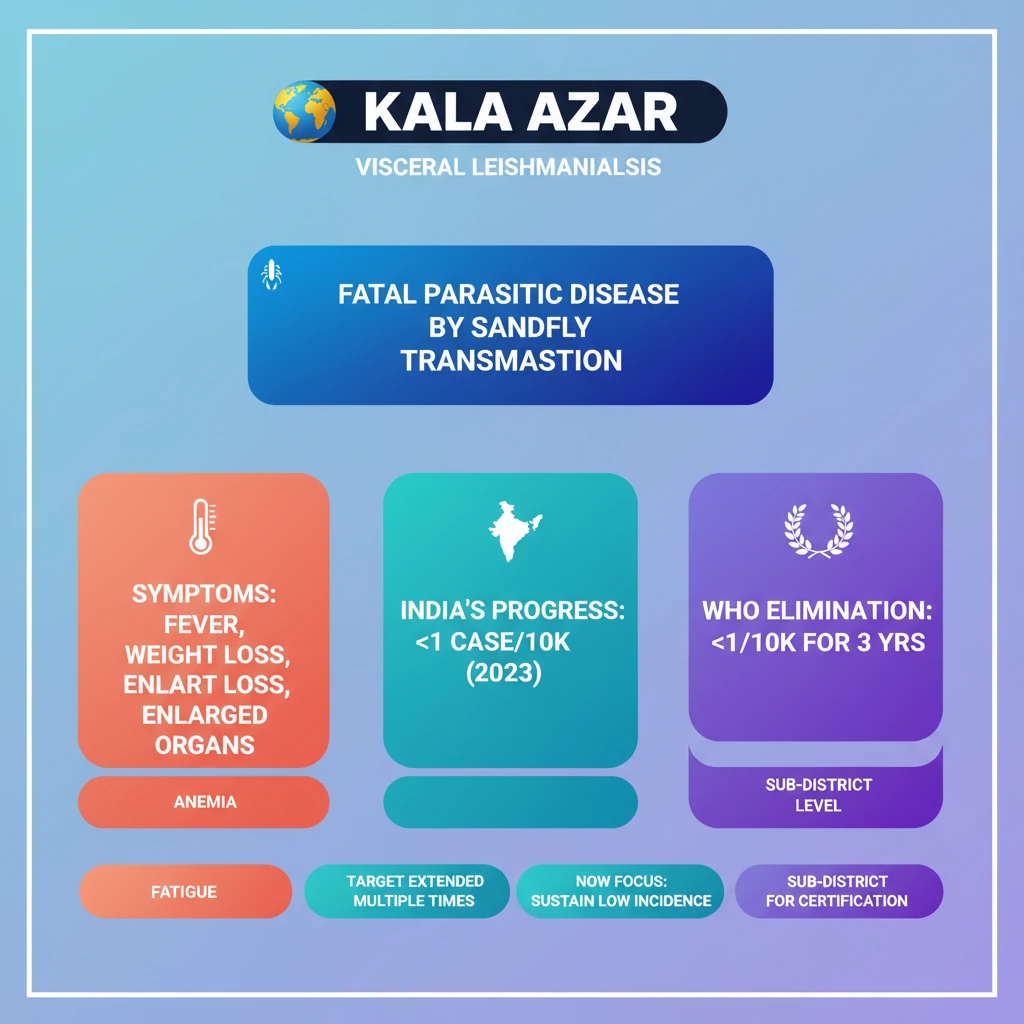
- •Kala Azar (Visceral Leishmaniasis) is a fatal parasitic disease caused by Leishmania donovani, transmitted by sandflies.
- •Symptoms include irregular fever, weight loss, enlarged spleen/liver, and anaemia.
- •India achieved less than one case per 10,000 population in 2023, showing significant progress towards elimination.
- •WHO defines elimination as <1 case per 10,000 at sub-district level, sustained for 3 years for certification.
- •India's elimination target was extended multiple times (2010, 2015, 2017, 2020) and is now focused on sustaining current low incidence.
- •Bangladesh became the first country validated by WHO for Kala Azar elimination in October 2023.
- •Poverty, poor housing, sanitation, and malnutrition are major risk factors for Kala Azar.
🧠 Memory Techniques
95% Verified Content
📚 Reference Sources
•World Health Organization (WHO) reports on Visceral Leishmaniasis