What Measures Have Been Taken to Address the Underrepresentation of Women in Indian Politics? - Social Issues | UPSC Learning
Topics
0 topics • 0 completed
🔍
No topics match your search
What Measures Have Been Taken to Address the Underrepresentation of Women in Indian Politics?
Medium⏱️ 7 min read
social issues
📖 Introduction
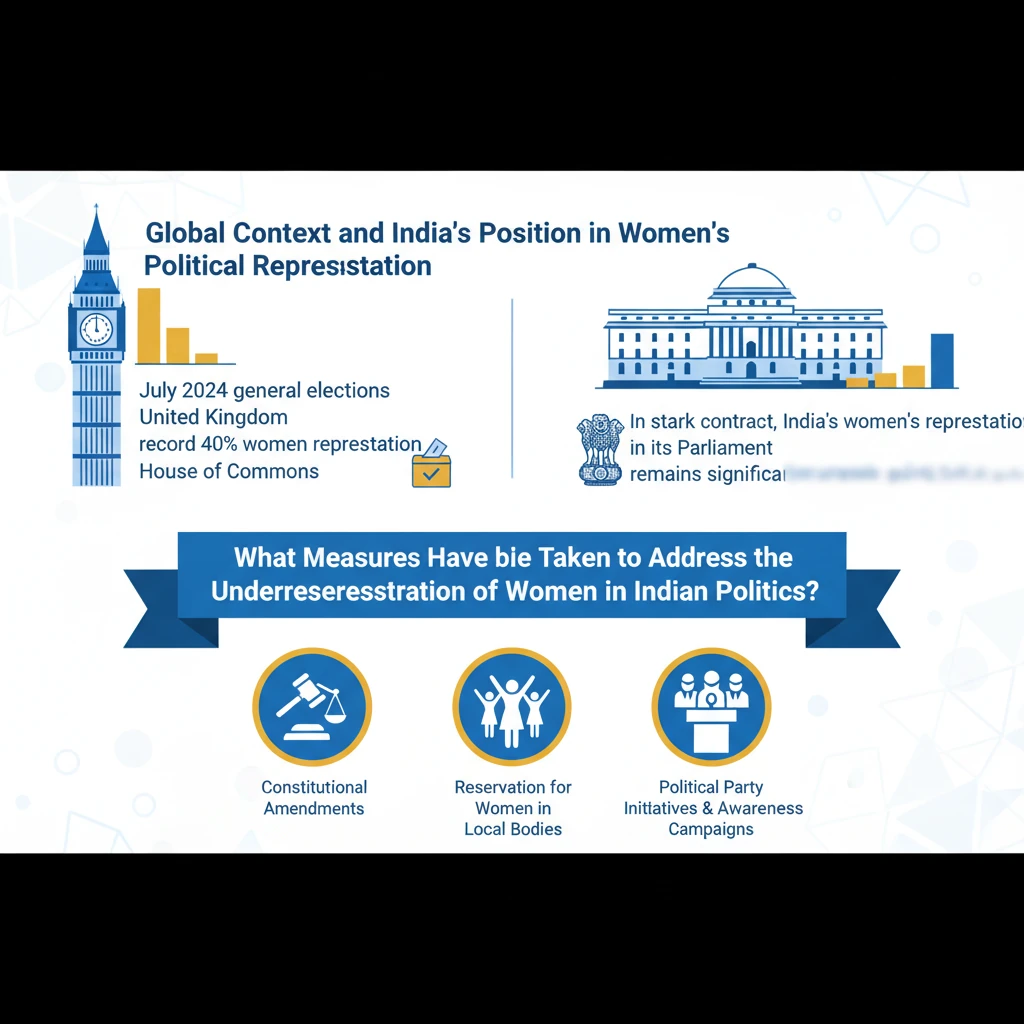
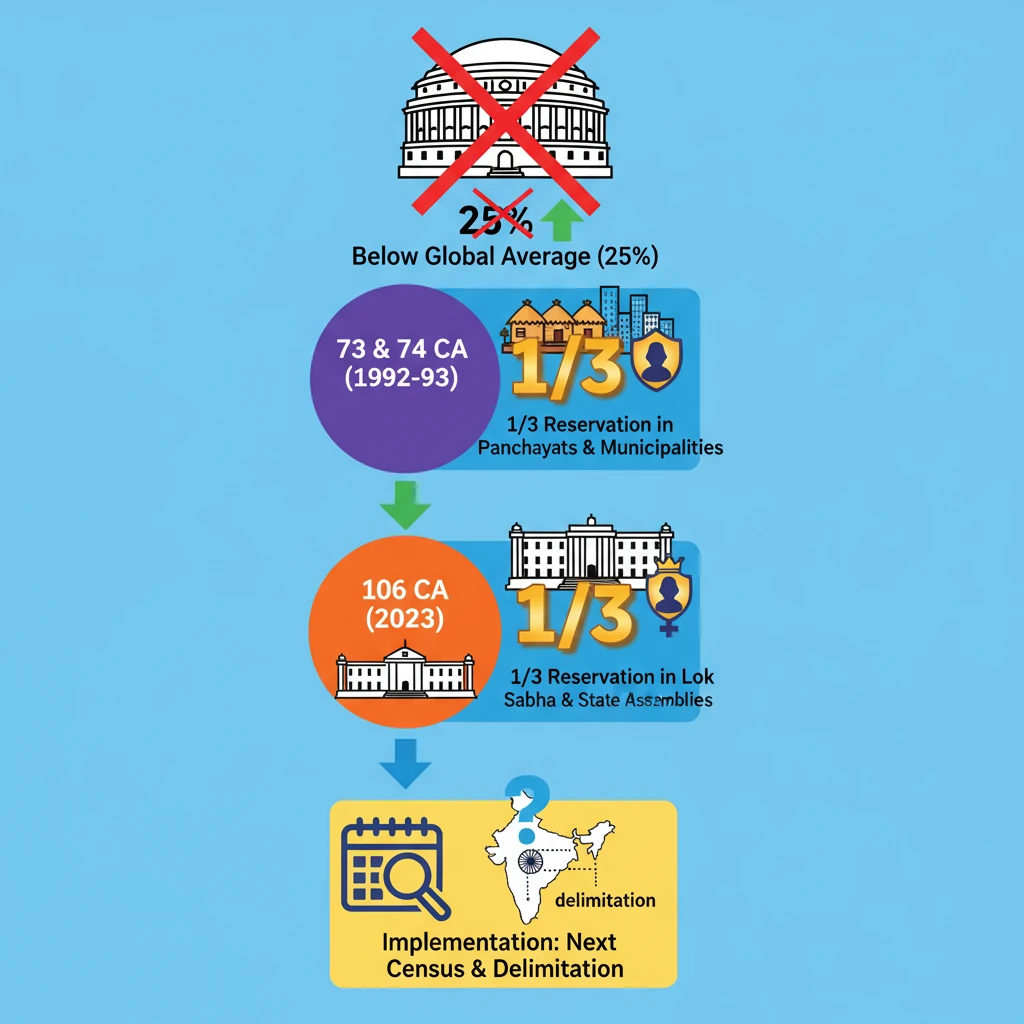
<h4>Global Context and India's Position in Women's Political Representation</h4><p>The global landscape shows significant progress in enhancing women's political participation. For instance, the <strong>July 2024 general elections</strong> in the <strong>United Kingdom</strong> saw a record <strong>40% women representation</strong> in the <strong>House of Commons</strong>.</p><p>In stark contrast, <strong>India's women's representation</strong> in its <strong>Parliament</strong> remains significantly lower. It is well below the <strong>global average of 25%</strong>, highlighting a critical area for democratic reform.</p><div class='info-box'><p><strong>Key Statistics:</strong></p><ul><li><strong>UK House of Commons (July 2024):</strong> 40% women representation</li><li><strong>Global Average for Women in Parliament:</strong> 25%</li><li><strong>India's Women Representation in Parliament:</strong> Below 25% global average</li></ul></div><h4>Constitutional Measures to Address Underrepresentation</h4><p>India has taken significant constitutional steps to address the historical underrepresentation of women in politics, primarily through reservations at different levels of governance.</p><h4>73rd and 74th Constitutional Amendments (1992-1993)</h4><p>These landmark amendments were pivotal in empowering women at the grassroots level. They mandated a specific reservation for women in local self-governing bodies.</p><div class='key-point-box'><p>The <strong>73rd</strong> and <strong>74th Constitutional Amendments (1992/1993)</strong> provided for <strong>one-third reservation of seats for women</strong> in <strong>Panchayats</strong> and <strong>Municipalities</strong>. This measure significantly increased their participation in local governance, bringing women into decision-making roles at the village and urban local body levels.</p></div><h4>106th Constitutional Amendment (2023): Women's Reservation Bill</h4><p>Building on the success of local body reservations, a more ambitious step was taken to ensure women's representation at the national and state levels. The <strong>106th Constitutional Amendment (2023)</strong>, also known as the <strong>Nari Shakti Vandan Adhiniyam</strong>, was passed to address the underrepresentation in higher legislative bodies.</p><div class='info-box'><p>The <strong>106th Constitutional Amendment (2023)</strong> proposes a <strong>one-third reservation of seats for women</strong> in the <strong>Lok Sabha</strong> (the lower house of India's Parliament) and all <strong>state legislative assemblies</strong>.</p></div><h4>Implementation of the 106th Amendment</h4><p>While the <strong>106th Amendment Act</strong> has been passed, its actual implementation is not immediate. It is contingent upon specific administrative and demographic exercises.</p><div class='exam-tip-box'><p><strong>UPSC Insight: Implementation Timeline</strong></p><p>The reservation under the <strong>106th Amendment Act</strong> will be implemented only after the <strong>first census</strong> following the commencement of the Act. This census will be followed by a comprehensive <strong>delimitation exercise</strong>, which involves redrawing electoral constituencies based on population data. Candidates should note that the implementation is <strong>not immediate</strong> and depends on these future processes.</p></div>
💡 Key Takeaways
- •India's women representation in Parliament is below the global average of 25%.
- •The 73rd and 74th CAs (1992-93) mandated one-third reservation for women in Panchayats and Municipalities.
- •The 106th CA (2023) proposes one-third reservation for women in Lok Sabha and State Assemblies.
- •Implementation of the 106th CA is contingent on the next census and subsequent delimitation exercise.
- •Enhancing women's political participation is crucial for inclusive governance and democratic deepening in India.
🧠 Memory Techniques
98% Verified Content
📚 Reference Sources
•The Constitution of India (73rd, 74th, 106th Amendments)
•PRS Legislative Research (for details on the 106th Constitutional Amendment Bill/Act)
•Election Commission of India reports (for representation statistics)