What are the Constitutional Provisions Related to Reservations in India? - Social Issues | UPSC Learning
Topics
0 topics • 0 completed
🔍
No topics match your search
What are the Constitutional Provisions Related to Reservations in India?
Medium⏱️ 7 min read
social issues
📖 Introduction
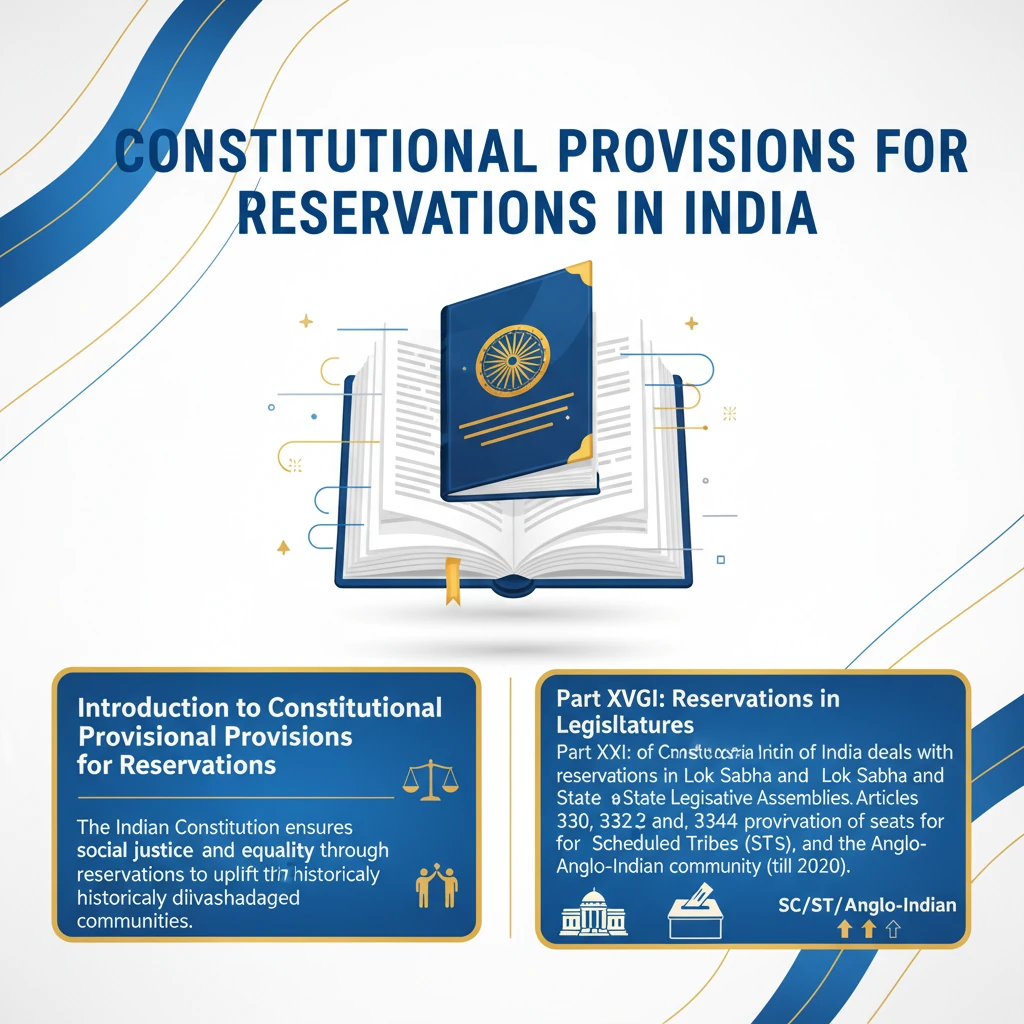
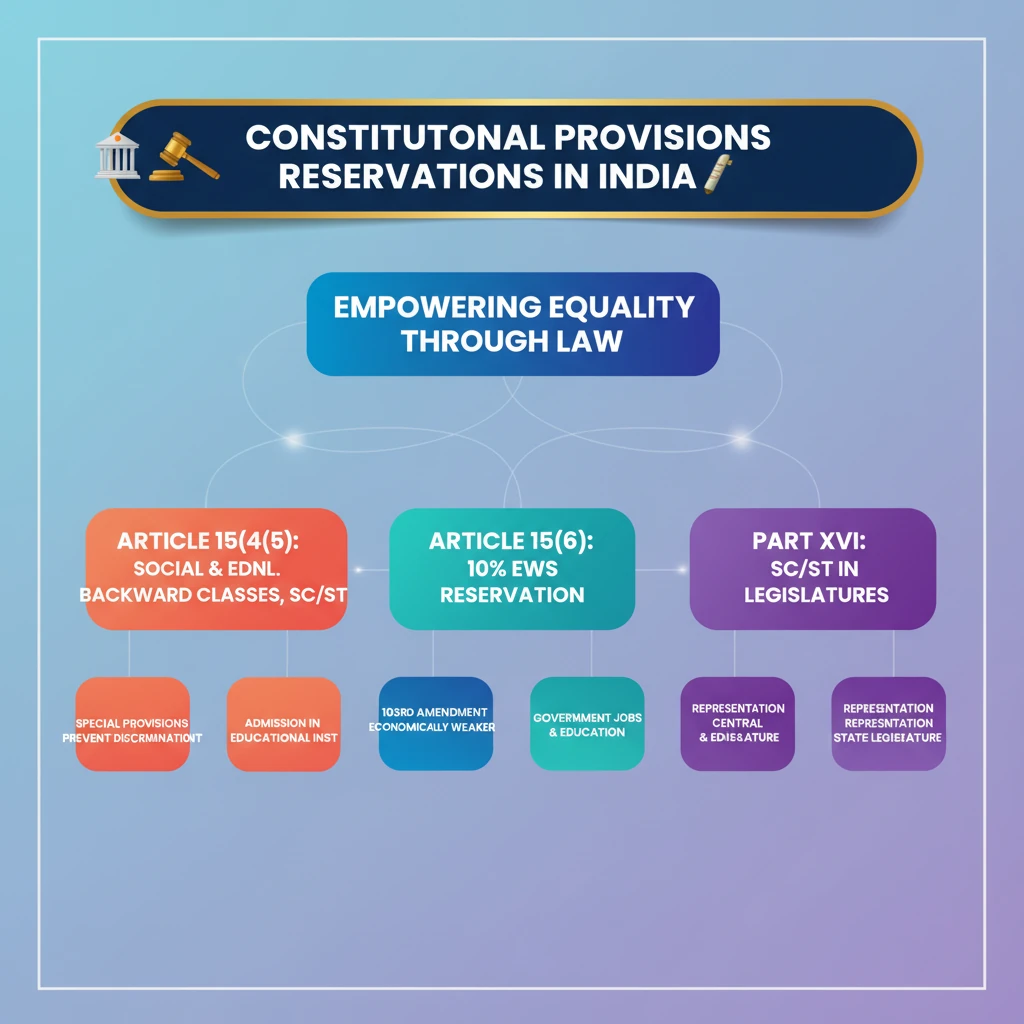
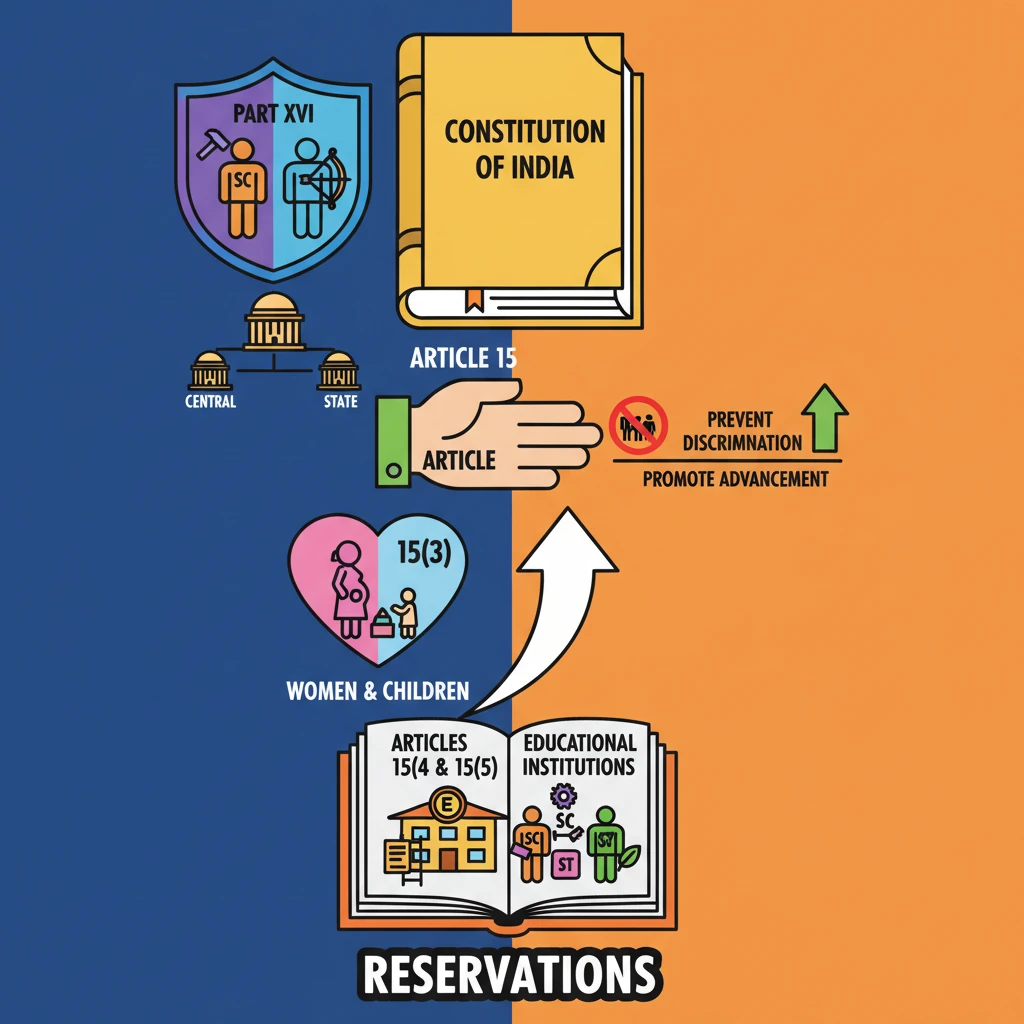
<h4>Introduction to Constitutional Provisions for Reservations</h4><p>The Indian Constitution includes specific provisions to ensure <strong>social justice</strong> and <strong>equality</strong> through the mechanism of <strong>reservations</strong>. These provisions are designed to uplift historically disadvantaged communities and ensure their representation in various spheres.</p><h4>Part XVI: Reservations in Legislatures</h4><div class='info-box'><p><strong>Part XVI</strong> of the <strong>Constitution of India</strong> is dedicated to addressing the reservation of seats for <strong>Scheduled Castes (SC)</strong> and <strong>Scheduled Tribes (ST)</strong>. This applies to both the <strong>Central</strong> (Parliament) and <strong>State legislatures</strong> (Vidhan Sabhas).</p></div><p>These provisions aim to ensure adequate political representation for these communities, allowing their voices to be heard in the law-making process.</p><h4>Article 15: State's Power to Make Special Provisions</h4><p><strong>Article 15</strong> of the Constitution is a fundamental right that prohibits discrimination on grounds of religion, race, caste, sex, or place of birth. However, it also empowers the <strong>State</strong> to make certain <strong>special provisions</strong>.</p><div class='key-point-box'><p>This empowerment allows the State to implement policies of <strong>affirmative action</strong>, ensuring that the principle of equality is not merely formal but substantive.</p></div><h4>Article 15(3): Special Provisions for Women and Children</h4><div class='info-box'><p><strong>Article 15(3)</strong> specifically permits the State to make <strong>special provisions</strong> for the welfare and advancement of <strong>women and children</strong>. This clause recognizes their unique vulnerabilities and needs.</p></div><p>Examples include reservations in local bodies for women or special educational schemes for children.</p><h4>Articles 15(4) & 15(5): Advancement of Backward Classes, SCs, and STs</h4><p><strong>Article 15(4)</strong> and <strong>Article 15(5)</strong> are crucial for the advancement of <strong>socially and educationally backward classes of citizens</strong>, as well as for <strong>Scheduled Castes (SCs)</strong> and <strong>Scheduled Tribes (STs)</strong>.</p><p>These clauses enable the State to make special provisions, including those related to their <strong>admission to educational institutions</strong>. This power extends to admissions in <strong>private educational institutions</strong>, whether aided or unaided by the State, except for minority educational institutions.</p><div class='exam-tip-box'><p><strong>Article 15(4)</strong> was added by the <strong>First Constitutional Amendment Act, 1951</strong>, in response to the <strong>Champakam Dorairajan case</strong>, highlighting the dynamic nature of constitutional interpretation.</p></div><h4>Article 15(6): Provisions for Economically Weaker Sections (EWS)</h4><div class='info-box'><p>Introduced by the <strong>103rd Constitutional Amendment Act, 2019</strong>, <strong>Article 15(6)</strong> allows the State to make <strong>special provisions</strong> for the advancement of <strong>Economically Weaker Sections (EWS)</strong> of citizens.</p></div><p>This provision applies to sections other than those already covered under clauses <strong>(4) and (5)</strong>. It allows for reservations based purely on <strong>economic criteria</strong>, typically up to 10% in educational institutions and public employment.</p>
💡 Key Takeaways
- •Part XVI deals with SC/ST reservation in Central and State legislatures.
- •Article 15 empowers the State to make special provisions to prevent discrimination and promote advancement.
- •Article 15(3) allows special provisions for women and children.
- •Articles 15(4) and 15(5) enable reservations for socially and educationally backward classes, SCs, and STs in educational institutions.
- •Article 15(6) provides for 10% reservation for Economically Weaker Sections (EWS), introduced by the 103rd Amendment.
🧠 Memory Techniques
98% Verified Content
📚 Reference Sources
•Ministry of Law and Justice, Government of India publications
•Reports of the Law Commission of India
•Supreme Court of India judgments on reservation cases