What are the Provisions Related to Undertrial Prisoners in India? - Social Issues | UPSC Learning
Topics
0 topics • 0 completed
🔍
No topics match your search
What are the Provisions Related to Undertrial Prisoners in India?
Medium⏱️ 8 min read
social issues
📖 Introduction
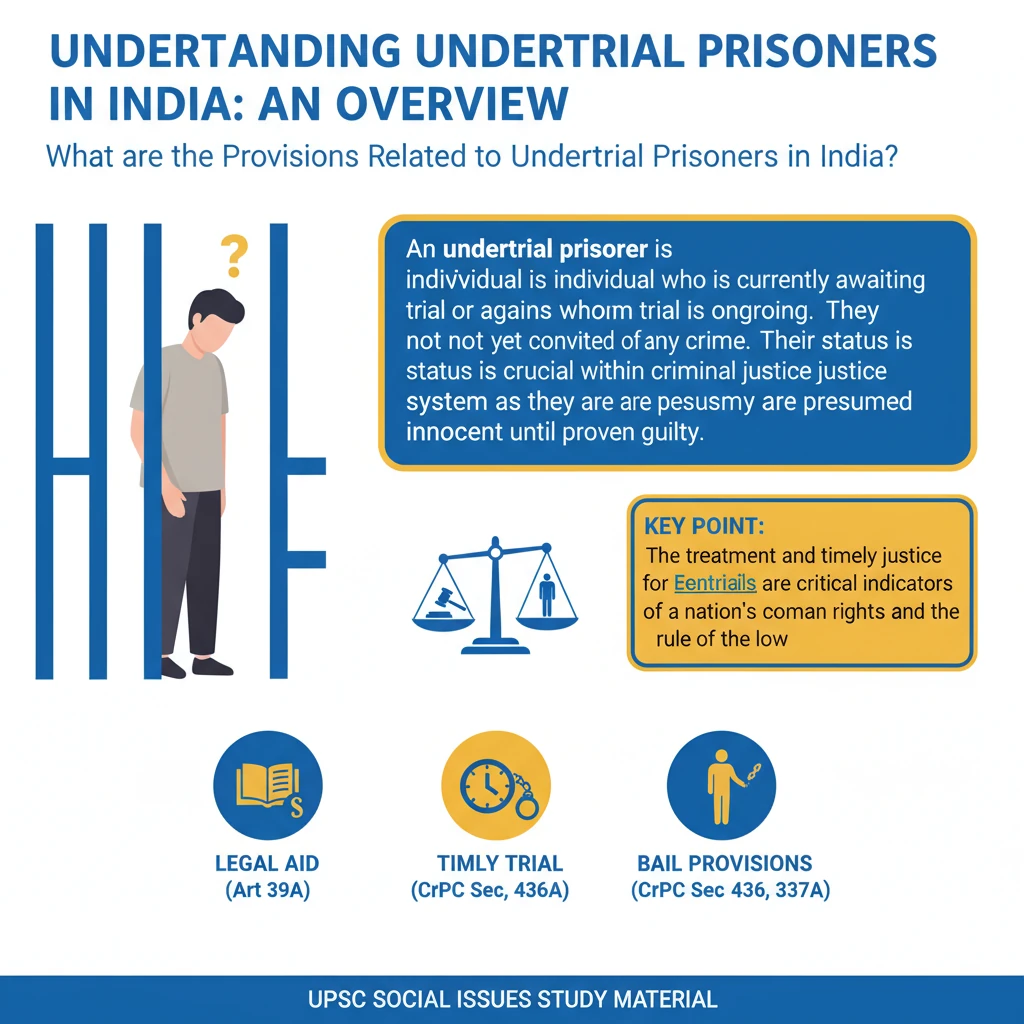
<h4>Understanding Undertrial Prisoners in India: An Overview</h4><p>An <strong>undertrial prisoner</strong> is an individual who is currently awaiting trial or against whom a trial is ongoing. They have not yet been convicted of any crime. Their status is crucial within the <strong>criminal justice system</strong> as they are presumed innocent until proven guilty.</p><div class='key-point-box'><p>The treatment and timely justice for <strong>undertrials</strong> are critical indicators of a nation's commitment to <strong>human rights</strong> and <strong>rule of law</strong>.</p></div><h4>The Challenge of Overcrowding in Indian Prisons</h4><p>Indian prisons face a severe issue of <strong>overcrowding</strong>, largely due to the high number of <strong>undertrial prisoners</strong>. This situation strains resources and impacts the living conditions of inmates.</p><div class='info-box'><p>According to a report by the <strong>Supreme Court’s Centre for Research and Planning</strong>, Indian prisons operate at <strong>131% occupancy</strong>. This means they house <strong>573,220 inmates</strong> against a capacity of <strong>436,266</strong>.</p></div><p>A significant majority of these inmates, approximately <strong>75.7%</strong>, are <strong>undertrials</strong>. This high percentage reflects a substantial <strong>judicial backlog</strong> and slow trial processes.</p><h4>Lack of Adequate Legal Representation</h4><p>Many <strong>undertrial prisoners</strong> suffer from a lack of access to proper <strong>legal representation</strong>. This significantly hinders their ability to defend themselves effectively in court.</p><p>Despite <strong>Article 39A</strong> of the Indian Constitution guaranteeing <strong>free legal aid</strong>, the practical implementation is often insufficient. There is an inadequate <strong>lawyer-to-prisoner ratio</strong>, which limits the availability of legal assistance for those who need it most.</p><h4>Provisions under the Bharatiya Nagarik Suraksha Sanhita (BNSS), 2023</h4><p>The <strong>Bharatiya Nagarik Suraksha Sanhita (BNSS), 2023</strong>, aims to streamline the criminal justice system and reduce prolonged detention, particularly for certain categories of offenders.</p><h5>Section 479 of BNSS: Reducing Prolonged Detention</h5><p><strong>Section 479 of BNSS</strong> is specifically designed to address the issue of prolonged detention by focusing on <strong>first-time offenders</strong>. It introduces provisions for their timely release on bail.</p><h6>Relaxed Standards for First-Time Offenders</h6><p>Under <strong>Section 479 of BNSS</strong>, <strong>first-time offenders</strong> are defined as individuals without any prior convictions. These individuals must be released on <strong>bond</strong> after serving <strong>one-third of the maximum sentence</strong> prescribed for the alleged offense.</p><h6>General Rule for Bail for Non-Capital Offenses</h6><p>For <strong>undertrials</strong> accused of <strong>non-capital offenses</strong> (crimes not punishable by death or life imprisonment), a general rule for bail applies. They are eligible for bail after serving <strong>half of the maximum sentence</strong>.</p><div class='key-point-box'><p>This provision in <strong>BNSS</strong> builds upon and replaces <strong>Section 436A of the Criminal Procedure Code (CrPC)</strong>, which had similar provisions for release after serving half the sentence.</p></div><h6>Exceptions to BNSS Provisions</h6><p>It is important to note that the provisions under <strong>Section 479 of BNSS</strong> do not apply universally. There are specific exceptions:</p><ul><li>Cases involving <strong>multiple offenses</strong> where the cumulative sentence might be higher.</li><li>Situations where <strong>ongoing investigations</strong> for other crimes are still underway against the undertrial.</li></ul><h4>Section 436A of the Criminal Procedure Code (CrPC), 1973</h4><p>Prior to the enactment of <strong>BNSS</strong>, <strong>Section 436A of the CrPC, 1973</strong>, was the primary legal framework addressing the release of undertrial prisoners who had spent a significant period in custody.</p><h5>Eligibility for Bail under CrPC 436A</h5><p>Under <strong>Section 436A CrPC</strong>, <strong>undertrials</strong> who had served <strong>half of the maximum imprisonment period</strong> for their alleged offense were eligible for release. This release could be on a <strong>personal bond</strong>, either with or without sureties.</p><h5>Exclusion from CrPC 436A</h5><p>Similar to the <strong>BNSS</strong> provisions, <strong>Section 436A CrPC</strong> did not extend to all offenses. It specifically excluded cases involving offenses punishable by <strong>death or life imprisonment</strong>.</p><h4>Judicial Directives and Interventions</h4><p>The judiciary has consistently played a crucial role in highlighting and addressing the issues faced by <strong>undertrial prisoners</strong>, issuing directives to ensure their rights are protected.</p><h5>Supreme Court’s PIL on Prison Conditions (2013)</h5><p>In a landmark Public Interest Litigation (PIL) titled <strong>“In Re: Inhuman Conditions in 1382 Prisons (2013)”</strong>, the <strong>Supreme Court of India</strong> took suo motu cognizance of the deplorable state of prisons.</p><p>The Court highlighted critical issues such as severe <strong>overcrowding</strong>, excessively <strong>delayed trials</strong>, and the prolonged detention of <strong>undertrial prisoners</strong>.</p><div class='exam-tip-box'><p>This PIL is a significant example of <strong>judicial activism</strong> in safeguarding fundamental rights. It's crucial for understanding the judiciary's role in prison reforms for <strong>UPSC Mains GS-II</strong>.</p></div><p>Following this, the Supreme Court issued clear directions to <strong>state governments</strong>. These directives mandated ensuring the <strong>timely identification and release</strong> of eligible <strong>undertrials</strong> under the provisions of <strong>Section 436A CrPC</strong> (now replaced by <strong>BNSS Section 479</strong>).</p>
💡 Key Takeaways
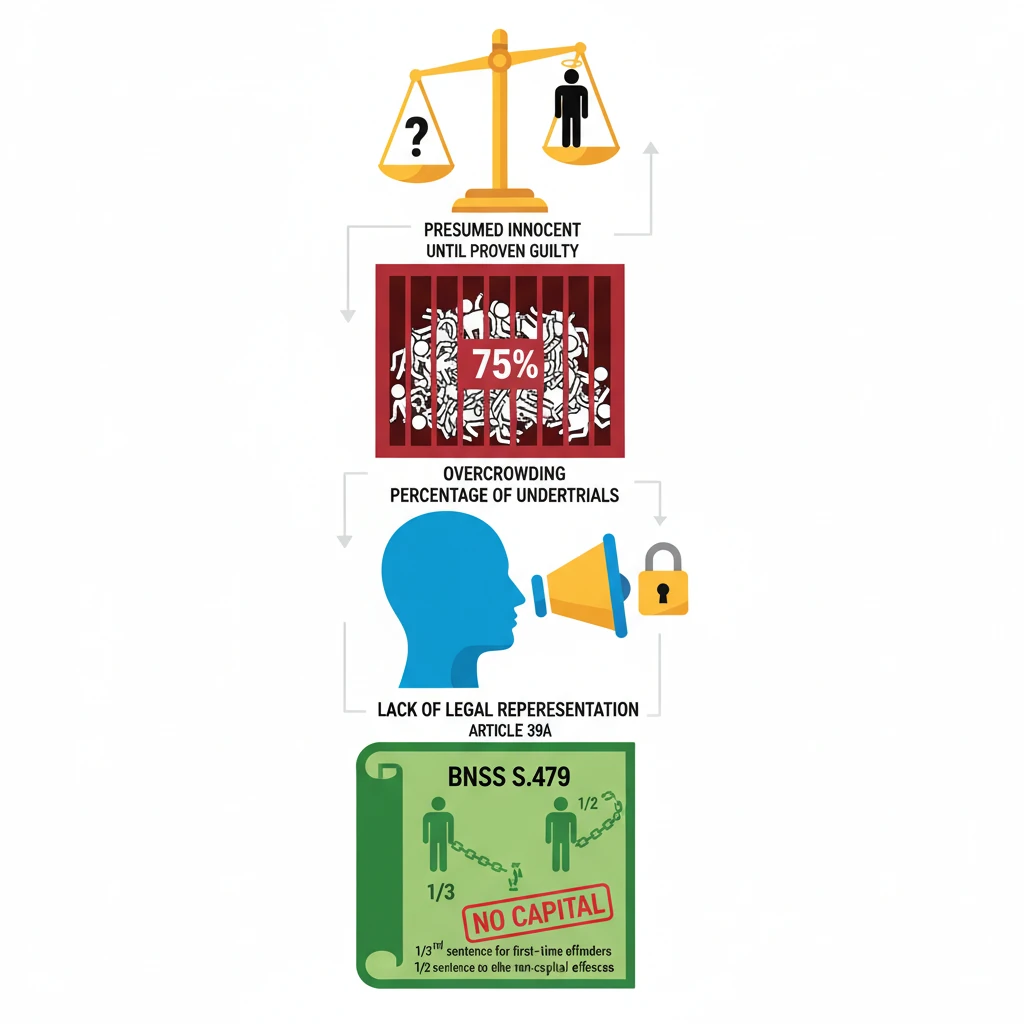
- •Undertrial prisoners are individuals awaiting trial, presumed innocent until proven guilty.
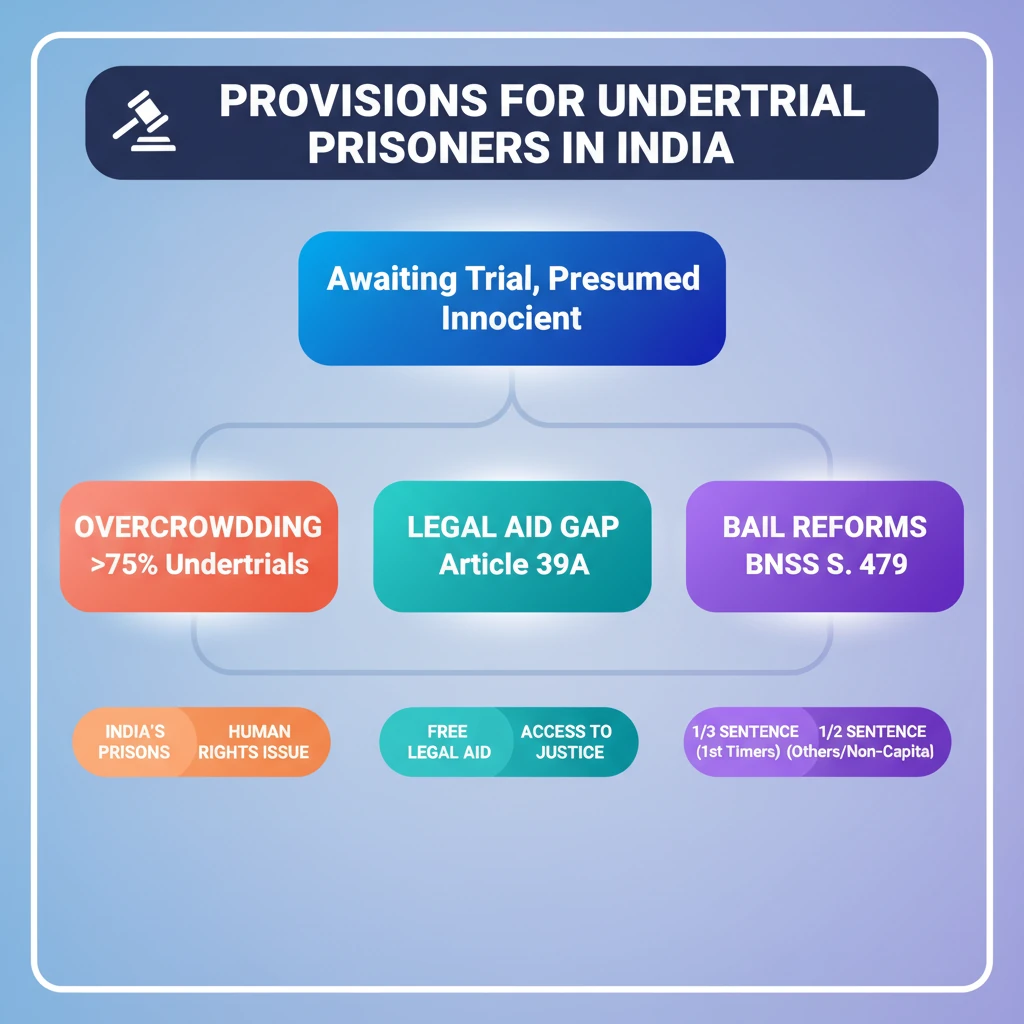
- •Indian prisons suffer from severe overcrowding, with undertrials constituting over 75% of inmates.
- •Lack of legal representation despite Article 39A is a major challenge for undertrials.
- •BNSS Section 479 (replacing CrPC 436A) allows release on bond for first-time offenders after 1/3rd sentence and others after 1/2 sentence for non-capital offenses.
- •Supreme Court has consistently directed states to ensure timely release of eligible undertrials to uphold human rights.
🧠 Memory Techniques
95% Verified Content
📚 Reference Sources
•Supreme Court of India’s Centre for Research and Planning reports
•The Criminal Procedure Code (CrPC), 1973
•The Bharatiya Nagarik Suraksha Sanhita (BNSS), 2023
•Indian Constitution (Article 39A)