What are the WHO’s Important Guiding Principles Related to Organ Donation? - Social Issues | UPSC Learning
Topics
0 topics • 0 completed
🔍
No topics match your search
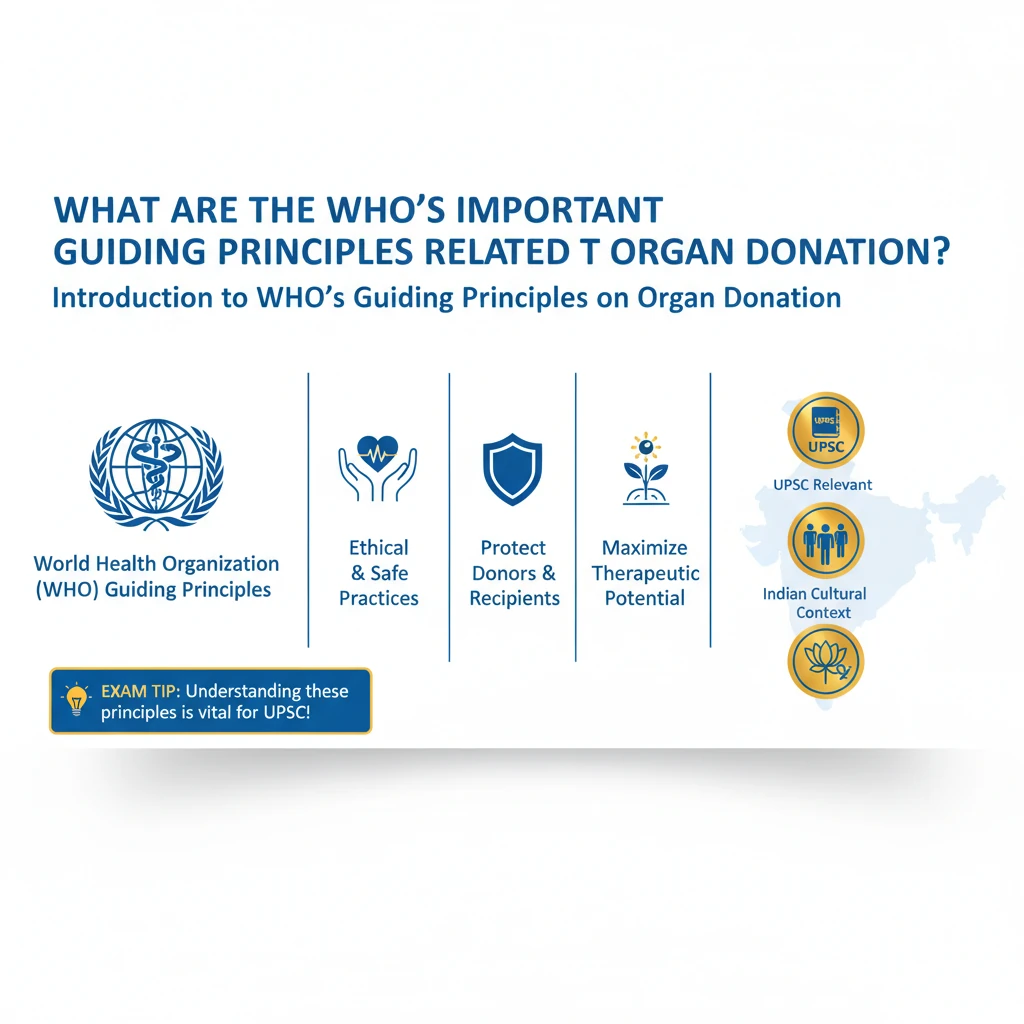
What are the WHO’s Important Guiding Principles Related to Organ Donation?
Medium⏱️ 10 min read
social issues
📖 Introduction
<h4>Introduction to WHO's Guiding Principles on Organ Donation</h4><p>The <strong>World Health Organization (WHO)</strong> has established crucial <strong>Guiding Principles</strong> to ensure ethical and safe practices in <strong>organ, tissue, and cell donation and transplantation</strong>. These principles aim to protect donors and recipients, prevent exploitation, and maximize the therapeutic potential of donations.</p><div class='exam-tip-box'><p>Understanding these principles is vital for <strong>UPSC Mains GS-II (Social Justice)</strong> and <strong>GS-IV (Ethics)</strong>, especially for questions on health policy, medical ethics, and human rights.</p></div><h4>Guiding Principle 1: Consent for Deceased Donation</h4><div class='key-point-box'><p><strong>Cells, tissues, and organs</strong> can be removed from <strong>deceased persons</strong> for transplantation only if <strong>legal consent</strong> has been obtained. This also requires that there is <strong>no evidence of the deceased's objection</strong> to such a donation.</p></div><p>This principle underscores the importance of respecting individual autonomy, even after death, through explicit or presumed consent mechanisms established by national laws.</p><h4>Guiding Principle 2: Separation of Medical Roles</h4><div class='key-point-box'><p><strong>Physicians</strong> responsible for determining a potential donor's death must maintain a clear separation of roles. They should <strong>not be directly involved</strong> in the subsequent procedures of <strong>cell, tissue, or organ removal</strong> from the donor.</p></div><p>Furthermore, these physicians should <strong>not be responsible for the care of any intended recipient</strong>. This strict separation prevents conflicts of interest and ensures that the declaration of death is impartial and solely based on medical criteria.</p><h4>Guiding Principle 3: Maximizing Therapeutic Potential and Living Donor Connection</h4><div class='key-point-box'><p><strong>Deceased donation</strong> should always aim to <strong>maximise therapeutic potential</strong>, ensuring that valuable organs are utilized effectively to save lives.</p></div><p>For <strong>living adult donors</strong>, compliance with <strong>domestic regulations</strong> is paramount. Typically, such donors should have a <strong>genetic, legal, or emotional connection</strong> to their recipient to mitigate potential coercion and ensure altruism.</p><h4>Guiding Principle 4: Safeguarding Minors and Legally Incompetent Individuals</h4><div class='key-point-box'><p>Generally, <strong>no organs should be taken from living minors</strong> for transplantation. Limited exceptions may be allowed only if explicitly permitted by <strong>national law</strong>.</p></div><p>When exceptions exist, <strong>special measures</strong> must be implemented to <strong>safeguard minors</strong>. Whenever possible, their <strong>consent</strong> should be obtained before donation, respecting their developing autonomy.</p><p>The <strong>same principles</strong> of stringent safeguards and consent considerations also apply to <strong>legally incompetent individuals</strong> who are unable to testify or stand trial.</p><h4>Guiding Principle 5: Voluntary Donation and Prohibition of Commercialization</h4><div class='key-point-box'><p>All donations of <strong>cells, tissues, and organs</strong> must be strictly <strong>voluntary</strong> and made <strong>without monetary compensation</strong>. This is a foundational ethical tenet.</p></div><p>The <strong>sale or purchase</strong> of these items for transplantation purposes is unequivocally <strong>prohibited</strong> under WHO guidelines. This principle aims to prevent organ trafficking and the exploitation of vulnerable populations.</p>
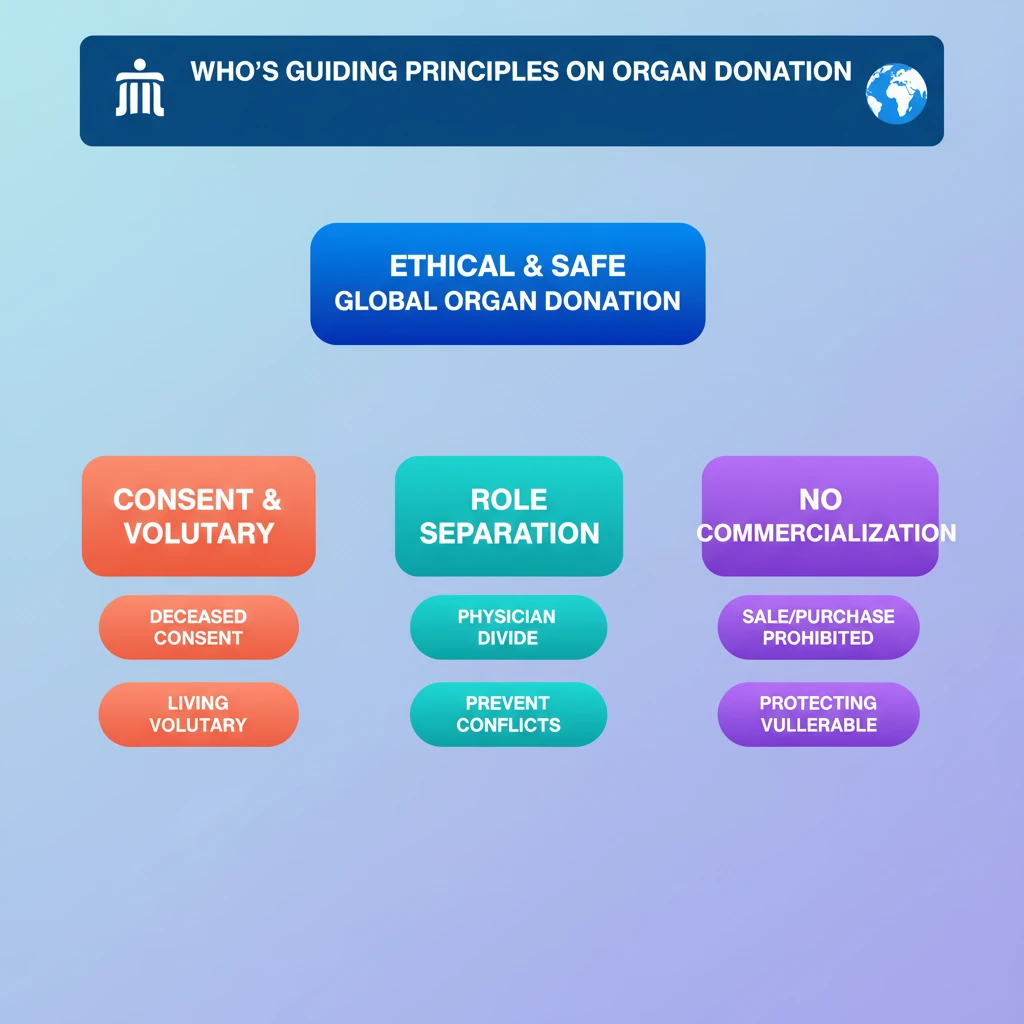
💡 Key Takeaways
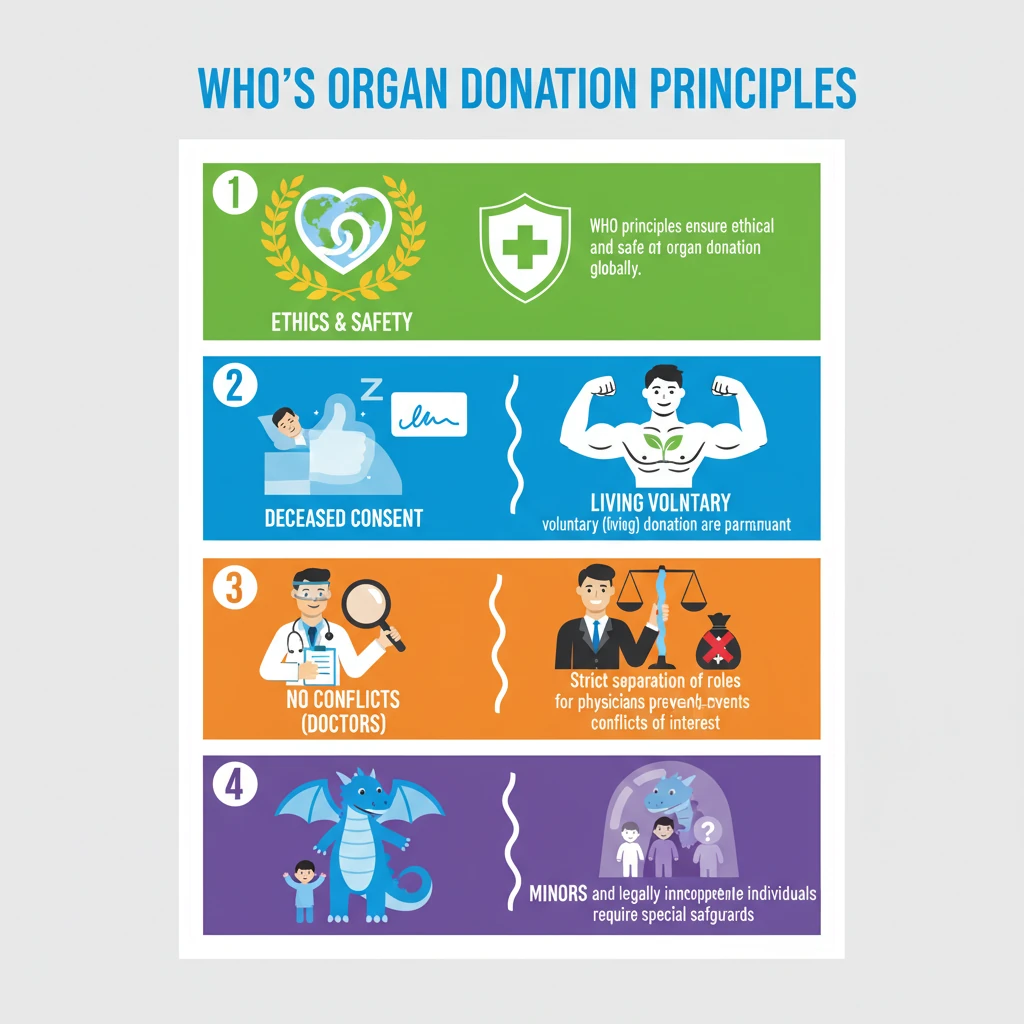
- •WHO principles ensure ethical and safe organ donation globally.
- •Consent (deceased) and voluntary (living) donation are paramount.
- •Strict separation of roles for physicians prevents conflicts of interest.
- •Minors and legally incompetent individuals require special safeguards.
- •Commercialization (sale/purchase) of organs is strictly prohibited.
- •Principles aim to maximize therapeutic potential while upholding human rights.
🧠 Memory Techniques
98% Verified Content
📚 Reference Sources
•World Health Organization (WHO) Guiding Principles on Human Organ Transplantation (General Knowledge)