What is Surrogacy? - Social Issues | UPSC Learning
Topics
0 topics • 0 completed
🔍
No topics match your search
What is Surrogacy?
Medium⏱️ 7 min read
social issues
📖 Introduction
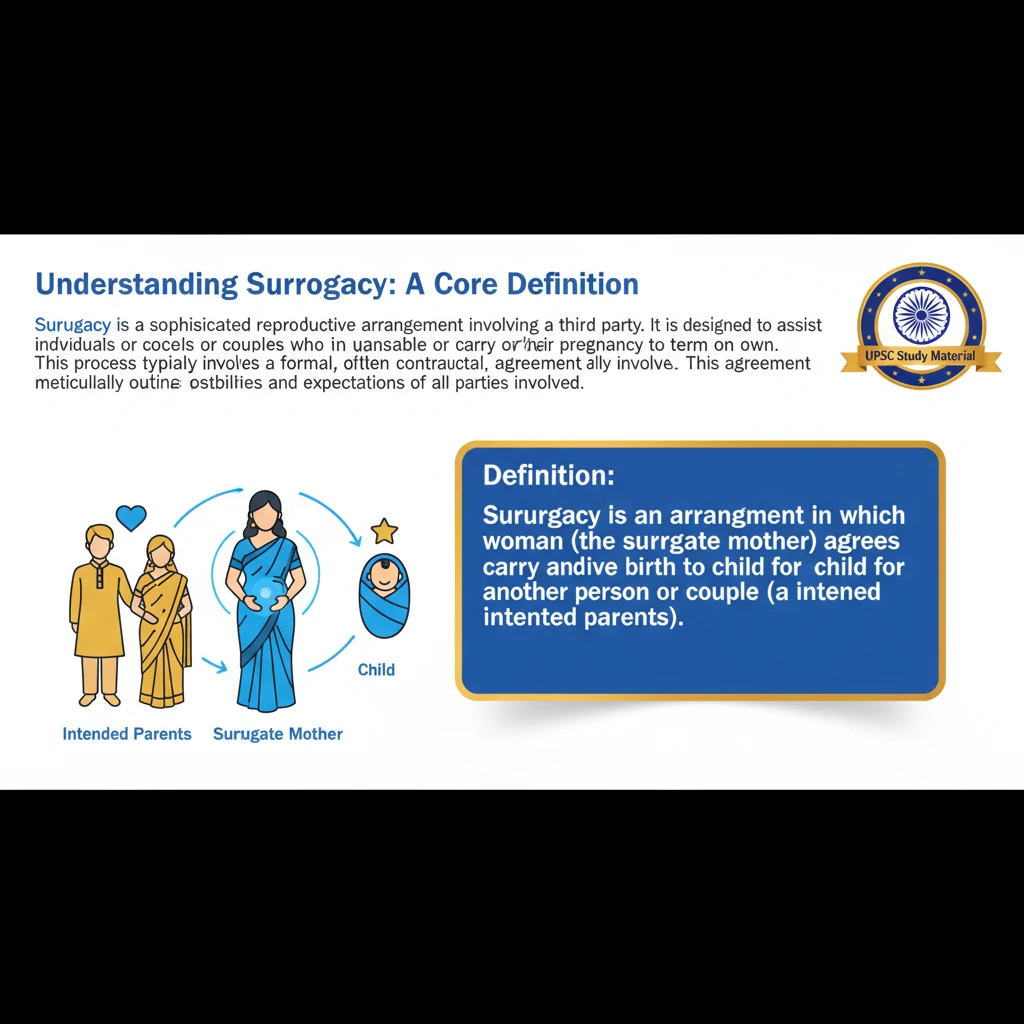
<h4>Understanding Surrogacy: A Core Definition</h4><p><strong>Surrogacy</strong> is a sophisticated reproductive arrangement involving a third party. It is designed to assist individuals or couples who are unable to conceive or carry a pregnancy to term on their own.</p><p>This process typically involves a formal, often contractual, agreement. This agreement meticulously outlines the responsibilities and expectations of all parties involved.</p><div class='info-box'><p><strong>Definition:</strong> <strong>Surrogacy</strong> is an arrangement where a woman, known as the <strong>surrogate mother</strong>, agrees to carry and deliver a baby for another individual or couple, referred to as the <strong>intended parents</strong>.</p></div><h4>Key Parties in a Surrogacy Arrangement</h4><p>A surrogacy arrangement fundamentally involves two primary sets of parties, each with distinct roles and legal standing.</p><ul><li><strong>Surrogate Mother:</strong> This is the woman who physically carries the pregnancy to term and delivers the baby. She is sometimes simply called the <strong>surrogate</strong> or <strong>gestational carrier</strong>.</li><li><strong>Intended Parents:</strong> These are the individual or couple for whom the baby is being carried. They are the ones who will assume legal parenthood of the child immediately after birth.</li></ul><div class='key-point-box'><p>The essence of surrogacy lies in this <strong>agreement</strong>: a woman voluntarily undertakes gestation for others, thereby enabling them to achieve parenthood.</p></div><h4>The Process of Carrying and Delivering</h4><p>The role of the surrogate mother is paramount, as she undergoes the entire physical and often emotional journey of pregnancy and childbirth.</p><p>Modern surrogacy typically relies on <strong>Assisted Reproductive Technologies (ART)</strong>. This often includes <strong>In Vitro Fertilization (IVF)</strong>, where embryos are created externally and then transferred to the surrogate's uterus.</p><div class='exam-tip-box'><p>For UPSC, it is vital to grasp the <strong>ethical</strong>, <strong>legal</strong>, and <strong>social dimensions</strong> of surrogacy, beyond just the medical procedure. Questions frequently focus on policy implications and societal impact.</p></div>
💡 Key Takeaways
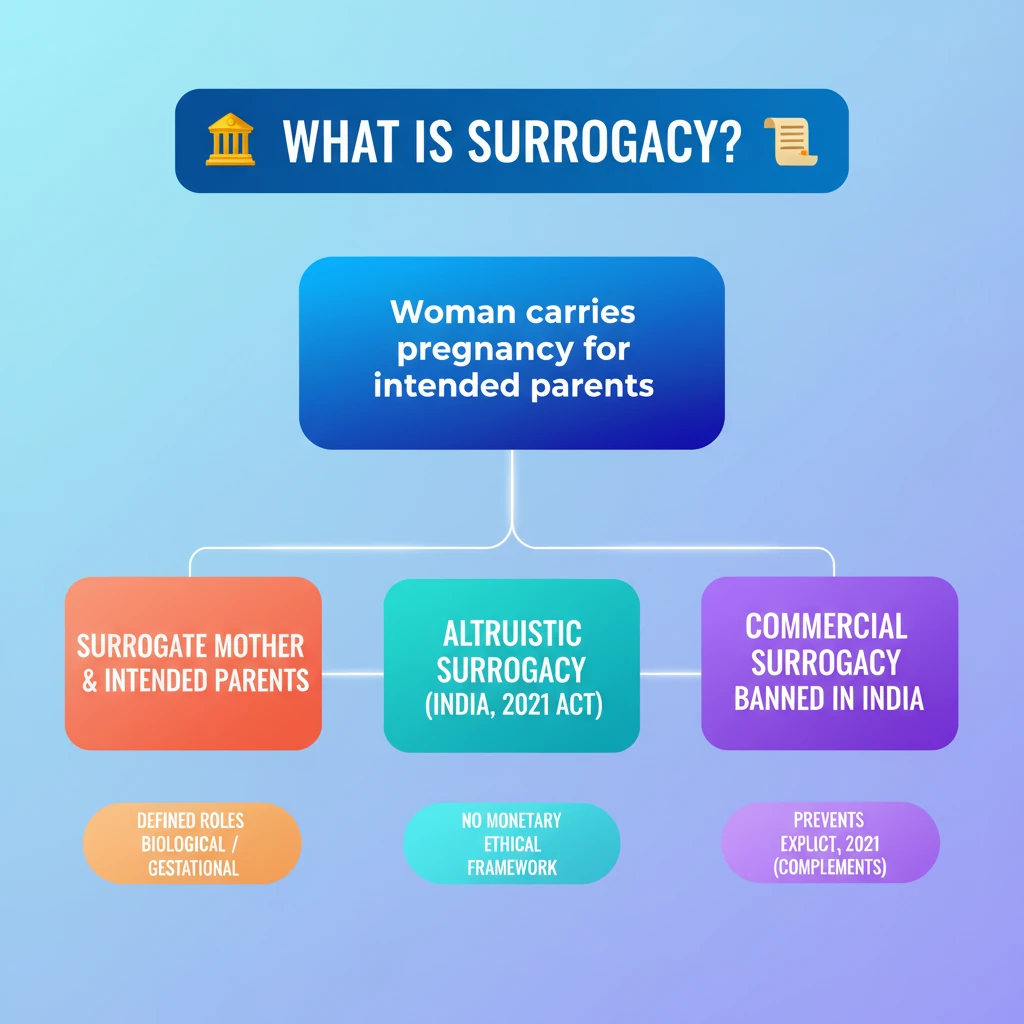
- •Surrogacy is an arrangement where a woman carries a pregnancy for intended parents.
- •It involves a surrogate mother and intended parents, defined by their roles.
- •In India, only altruistic surrogacy is permitted under the Surrogacy (Regulation) Act, 2021.
- •Commercial surrogacy is banned in India to prevent exploitation and commodification.
- •The ART (Regulation) Act, 2021, complements surrogacy laws by regulating fertility clinics and practices.
🧠 Memory Techniques

98% Verified Content
📚 Reference Sources
•The Assisted Reproductive Technology (Regulation) Act, 2021, Government of India
•Ministry of Health and Family Welfare, Government of India official documents
•Parliamentary Debates and Standing Committee Reports on Surrogacy Legislation
•Academic and Legal Journals on Reproductive Rights and Bioethics in India