What are the Key Findings of the Study on Nicobarese Tribe? - Social Issues | UPSC Learning
Topics
0 topics • 0 completed
🔍
No topics match your search
What are the Key Findings of the Study on Nicobarese Tribe?
Medium⏱️ 8 min read
social issues
📖 Introduction
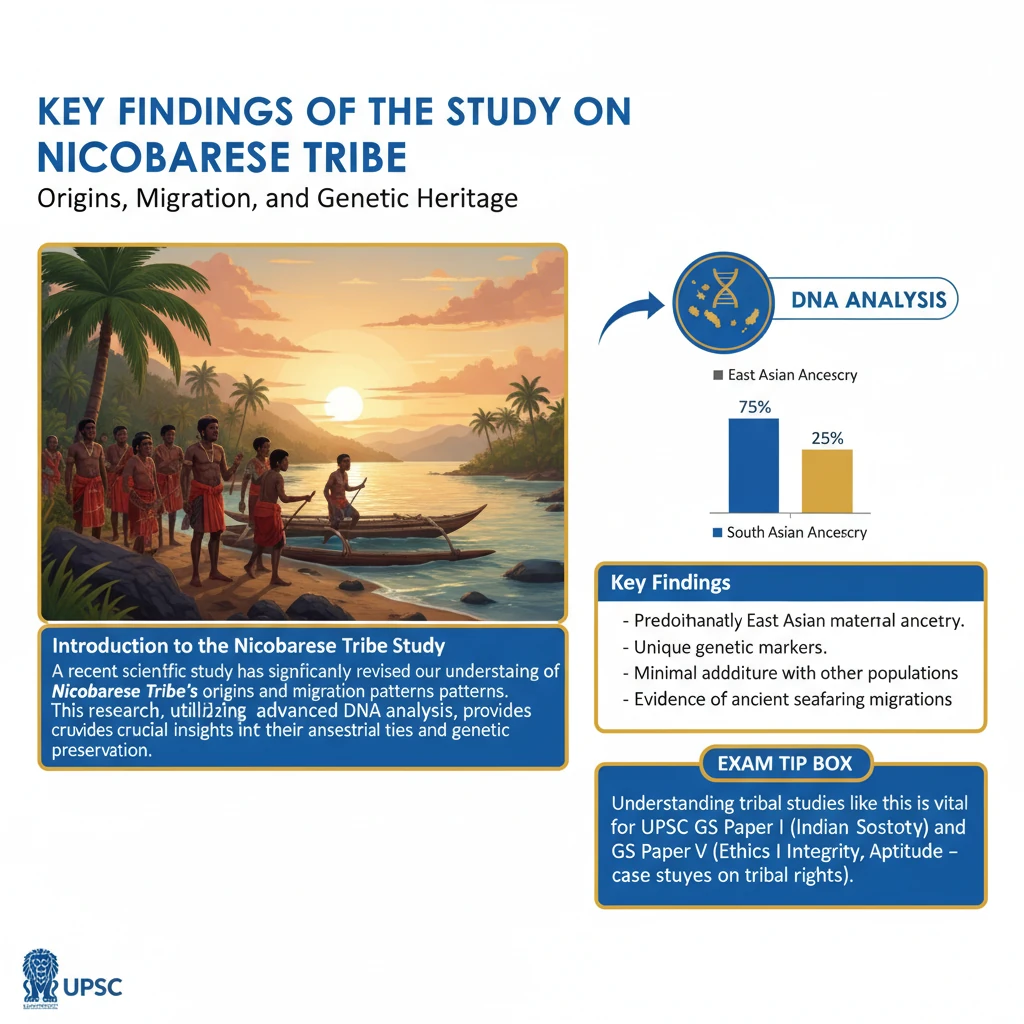
<h4>Introduction to the Nicobarese Tribe Study</h4><p>A recent scientific study has significantly revised our understanding of the <strong>Nicobarese Tribe's</strong> origins and migration patterns. This research, utilizing advanced <strong>DNA analysis</strong>, provides crucial insights into their ancestral ties and genetic preservation.</p><div class='exam-tip-box'><p>Understanding tribal studies like this is vital for <strong>UPSC GS Paper I (Indian Society, History)</strong> and <strong>GS Paper II (Social Justice, Vulnerable Sections)</strong>. Focus on methodological advancements and implications for indigenous populations.</p></div><h4>Revised Migration Timeline</h4><p>Previous anthropological studies had estimated that the <strong>Austroasiatic ancestors</strong> of the <strong>Nicobarese</strong> arrived in the <strong>Nicobar Islands</strong> over <strong>11,000 years ago</strong>.</p><p>The new study, leveraging sophisticated <strong>deoxyribonucleic acid (DNA) analysis</strong>, has recalibrated this timeline. It suggests a much more recent migration.</p><div class='info-box'><p><strong>New Estimate:</strong> The ancestors of the Nicobarese are now estimated to have arrived approximately <strong>5,000 years ago</strong>.</p></div><h4>Genetic Link to Southeast Asia</h4><p>The research established a clear <strong>genetic link</strong> between the <strong>Nicobarese</strong> and the <strong>Htin Mai community</strong>, an ethnic group indigenous to the <strong>Laos-Thailand region</strong>.</p><p>This finding strongly supports the hypothesis that the ancestors of the <strong>Nicobarese</strong> migrated from <strong>Southeast Asia</strong>. It refutes earlier theories suggesting a migration from <strong>South Asia</strong>.</p><div class='key-point-box'><p>The genetic evidence points definitively towards a <strong>Southeast Asian origin</strong> for the Nicobarese, highlighting the importance of genetic studies in tracing human migration paths.</p></div><h4>Preservation of Genetic Identity</h4><p>A significant finding is the remarkable preservation of the <strong>Nicobarese's genetic identity</strong>. This is primarily attributed to their prolonged <strong>geographical isolation</strong>.</p><p>Minimal external genetic influence has allowed researchers to trace their ancestry with greater precision and confidence.</p><div class='info-box'><p><strong>Impact of Isolation:</strong> The isolation of the <strong>Nicobar Islands</strong> acted as a natural barrier, limiting intermingling and thus preserving a unique genetic signature.</p></div><h4>Linguistic Continuity</h4><p>Despite the long period since migration, the <strong>Nicobarese</strong> have maintained their <strong>Austroasiatic language roots</strong>. Specifically, their language belongs to the <strong>Khmuic branch</strong>.</p><p>This linguistic continuity further reinforces their connection to other populations in <strong>Southeast Asia</strong>, complementing the genetic evidence.</p><div class='key-point-box'><p>The consistency between <strong>genetic ties</strong> and <strong>linguistic heritage</strong> provides a robust understanding of the Nicobarese's origins and cultural trajectory.</p></div>
💡 Key Takeaways
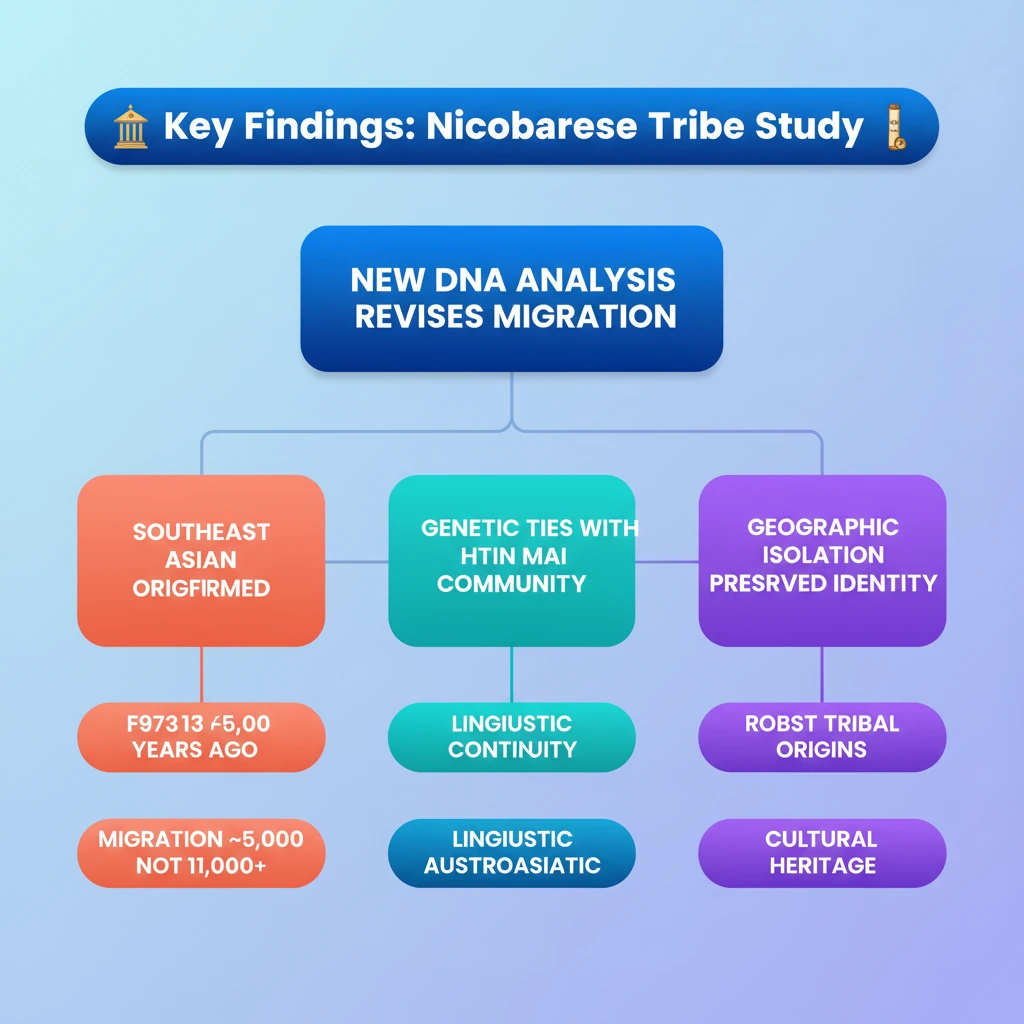
- •New DNA analysis revises Nicobarese migration to ~5,000 years ago, not 11,000+.
- •Nicobarese share genetic ties with Laos-Thailand's Htin Mai community, confirming Southeast Asian origin.
- •Geographical isolation preserved Nicobarese genetic identity, aiding precise ancestral tracing.
- •Linguistic continuity (Austroasiatic, Khmuic branch) reinforces Southeast Asian connection.
- •Genetic and linguistic evidence combined offers a robust understanding of tribal origins and cultural heritage.
🧠 Memory Techniques

95% Verified Content