India currently does not have a standard definition - Social Issues | UPSC Learning
Topics
0 topics • 0 completed
🔍
No topics match your search
India currently does not have a standard definition
Medium⏱️ 8 min read
social issues
📖 Introduction
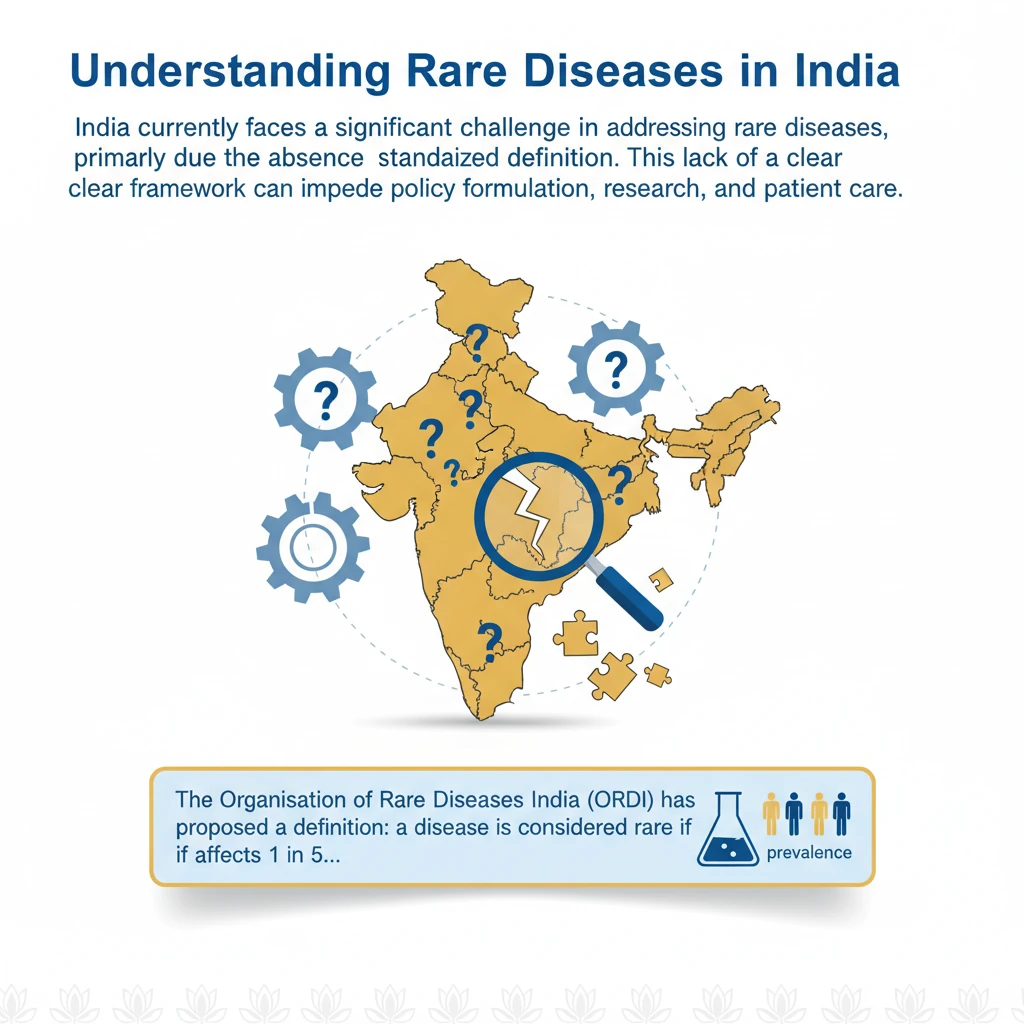
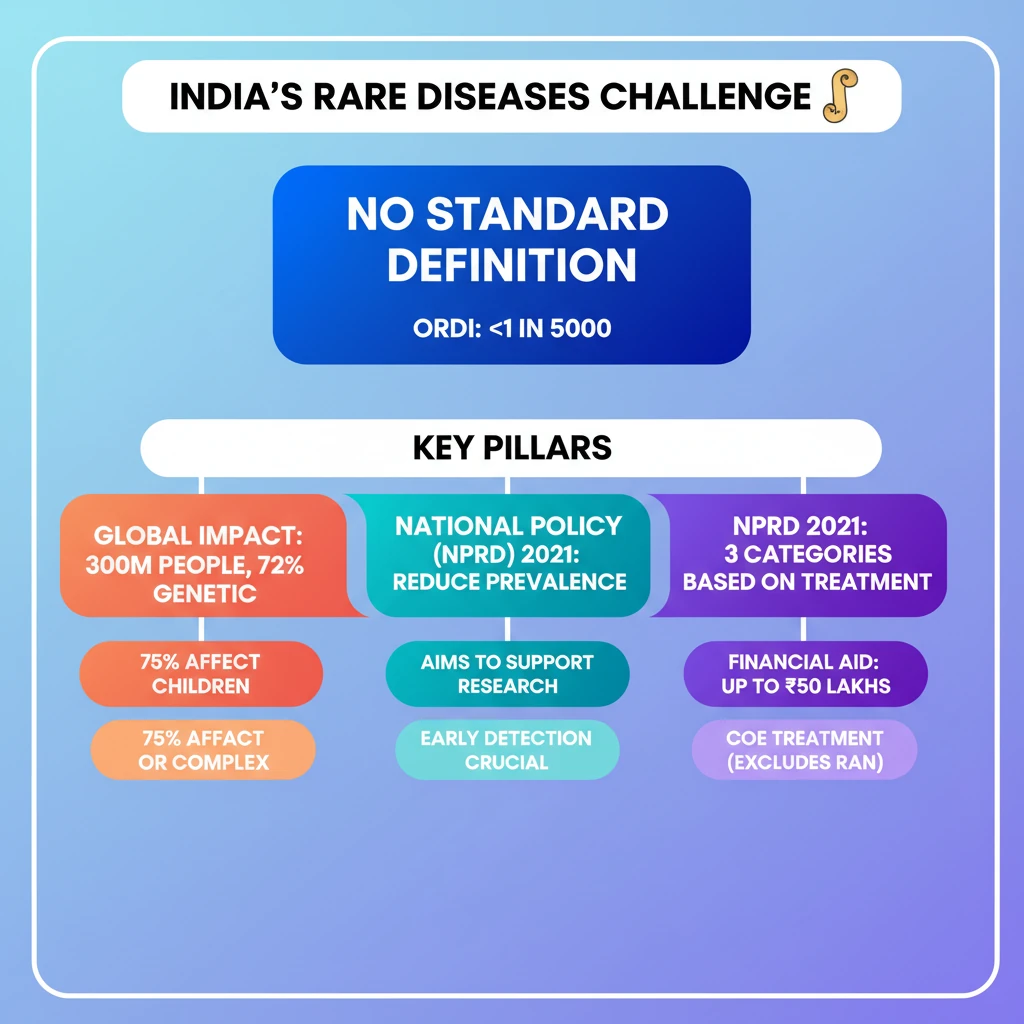
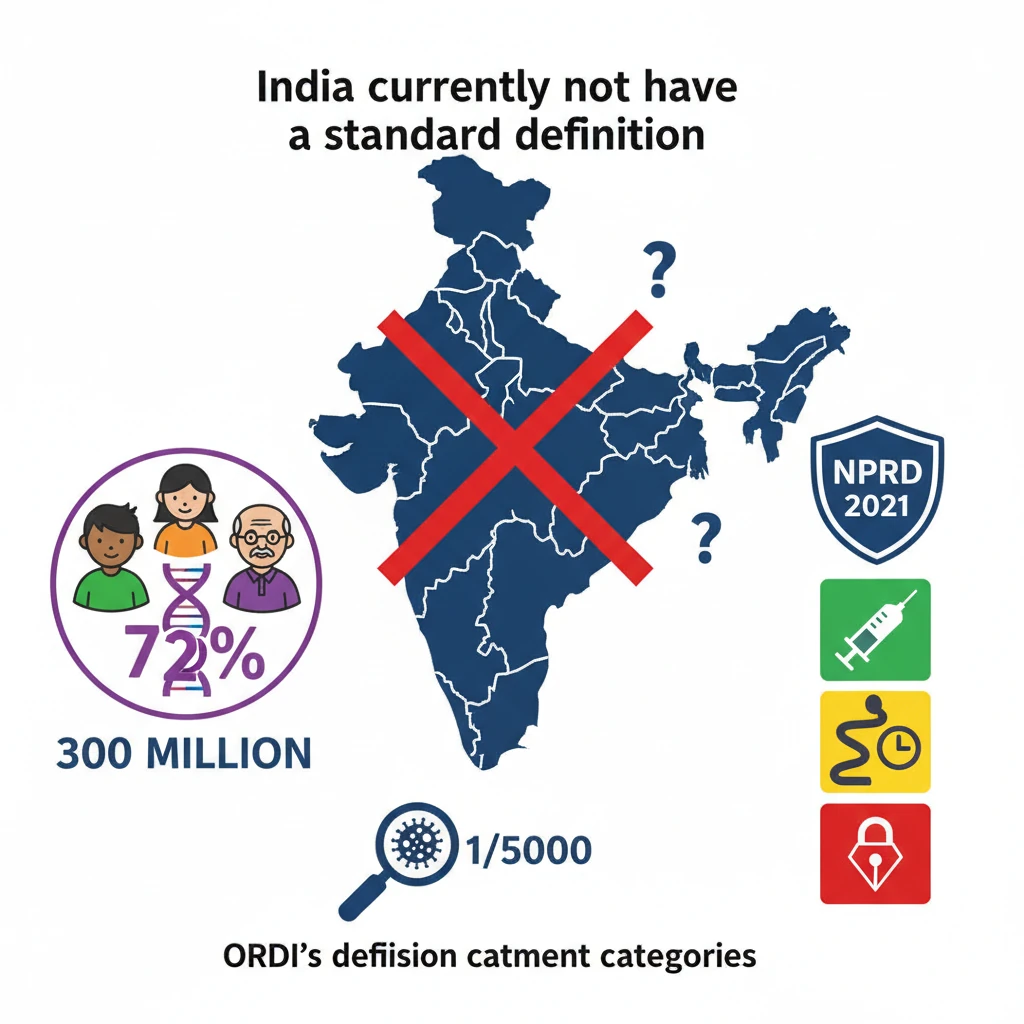
<h4>Understanding Rare Diseases in India</h4><p>India currently faces a significant challenge in addressing <strong>rare diseases</strong>, primarily due to the absence of a <strong>standardized definition</strong>. This lack of a clear framework can impede policy formulation, research, and patient care.</p><div class='info-box'><p>The <strong>Organisation of Rare Diseases India (ORDI)</strong> has proposed a definition: a disease is considered <strong>rare</strong> if it affects <strong>1 in 5,000 people or less</strong>. This benchmark helps in identifying and categorizing such conditions.</p></div><h4>Global Burden of Rare Diseases</h4><p>The impact of rare diseases extends globally, affecting a substantial portion of the world's population. These conditions present unique diagnostic and therapeutic challenges.</p><div class='info-box'><ul><li>Approximately <strong>300 million people worldwide</strong> are affected by rare diseases.</li><li>They impact roughly <strong>3.5% to 5.9% of the global population</strong>.</li><li>A staggering <strong>72% of rare diseases are genetic</strong> in origin, encompassing over <strong>7,000 distinct disorders</strong> with diverse symptoms.</li><li>Notably, <strong>75% of rare diseases affect children</strong>, with <strong>70% having their onset during childhood</strong>.</li></ul></div><h4>National Policy for Rare Diseases (NPRD), 2021</h4><p>Recognizing the urgent need for a structured approach, the Indian government introduced the <strong>National Policy for Rare Diseases (NPRD), 2021</strong>. This policy aims to streamline efforts in managing and treating rare conditions.</p><div class='key-point-box'><p>The primary objective of the <strong>NPRD, 2021</strong> is to <strong>reduce the prevalence and incidence of rare diseases</strong> in India, thereby improving patient outcomes and quality of life.</p></div><h4>Categorization of Rare Diseases under NPRD, 2021</h4><p>The policy categorizes rare diseases into three distinct groups based on their treatment requirements and associated costs. This classification helps in tailoring appropriate interventions and financial support.</p><div class='info-box'><ol><li><strong>Group 1:</strong> Disorders amenable to <strong>one-time curative treatment</strong>. These conditions often require a single, definitive medical intervention.</li><li><strong>Group 2:</strong> Diseases requiring <strong>long-term/lifelong treatment</strong>, typically associated with relatively <strong>lower treatment costs</strong>. Management often involves continuous medication or therapy.</li><li><strong>Group 3:</strong> Diseases for which <strong>definitive treatment is available</strong>, but significant challenges persist in <strong>patient selection</strong> and are characterized by <strong>high treatment costs</strong>.</li></ol></div><h4>Financial Support under NPRD, 2021</h4><p>To alleviate the financial burden on patients and their families, the <strong>NPRD, 2021</strong> includes provisions for substantial financial assistance. This support is crucial given the often exorbitant costs associated with rare disease treatments.</p><div class='info-box'><p>The policy provides <strong>financial support of up to Rs. 50 lakhs</strong> for patients suffering from any category of rare diseases. This assistance is specifically for treatment received in designated <strong>Centres of Excellence (CoE)</strong> mentioned in the <strong>NPRD-2021</strong>.</p><p>It is important to note that this financial aid is provided <strong>outside the umbrella scheme of Rashtriya Arogya Nidhi (RAN)</strong>, indicating a distinct allocation for rare diseases.</p></div><h4>Rashtriya Arogya Nidhi (RAN)</h4><p>Prior to or alongside NPRD, <strong>Rashtriya Arogya Nidhi (RAN)</strong> has also played a role in providing financial assistance for certain medical conditions, including some rare diseases.</p><div class='info-box'><p>Under <strong>RAN</strong>, a maximum financial assistance of <strong>Rs. 20 lakh</strong> is offered to patients suffering from specified rare diseases. This scheme serves as another avenue for support for those in need.</p></div><div class='exam-tip-box'><p><strong>UPSC Insight:</strong> Differentiate between the financial provisions of <strong>NPRD, 2021</strong> (up to <strong>Rs. 50 lakhs</strong> for treatment in CoE, outside RAN) and <strong>RAN</strong> (up to <strong>Rs. 20 lakhs</strong> for specified rare diseases). Understanding these nuances is crucial for Mains answers, especially in <strong>GS Paper 2: Social Justice</strong>.</p></div>
💡 Key Takeaways
- •India lacks a standard definition for rare diseases; ORDI suggests affecting 1 in 5,000 people or less.
- •Globally, rare diseases affect 300 million people, with 72% being genetic and 75% affecting children.
- •The National Policy for Rare Diseases (NPRD), 2021, aims to reduce prevalence and incidence.
- •NPRD, 2021 categorizes rare diseases into three groups based on treatment requirements (one-time, long-term, high-cost with selection challenges).
- •NPRD, 2021 provides up to Rs. 50 lakhs financial support for treatment in designated Centres of Excellence (CoE), outside RAN.
- •Rashtriya Arogya Nidhi (RAN) offers a maximum financial assistance of Rs. 20 lakhs for specified rare diseases.
- •Key challenges include diagnostic delays, high treatment costs, limited awareness, and the need for robust R&D.
🧠 Memory Techniques
95% Verified Content