Manual Scavenging: Legal Framework & Rehabilitation Efforts - Social Issues | UPSC Learning
Topics
0 topics • 0 completed
🔍
No topics match your search
Manual Scavenging: Legal Framework & Rehabilitation Efforts
Medium⏱️ 7 min read
social issues
📖 Introduction
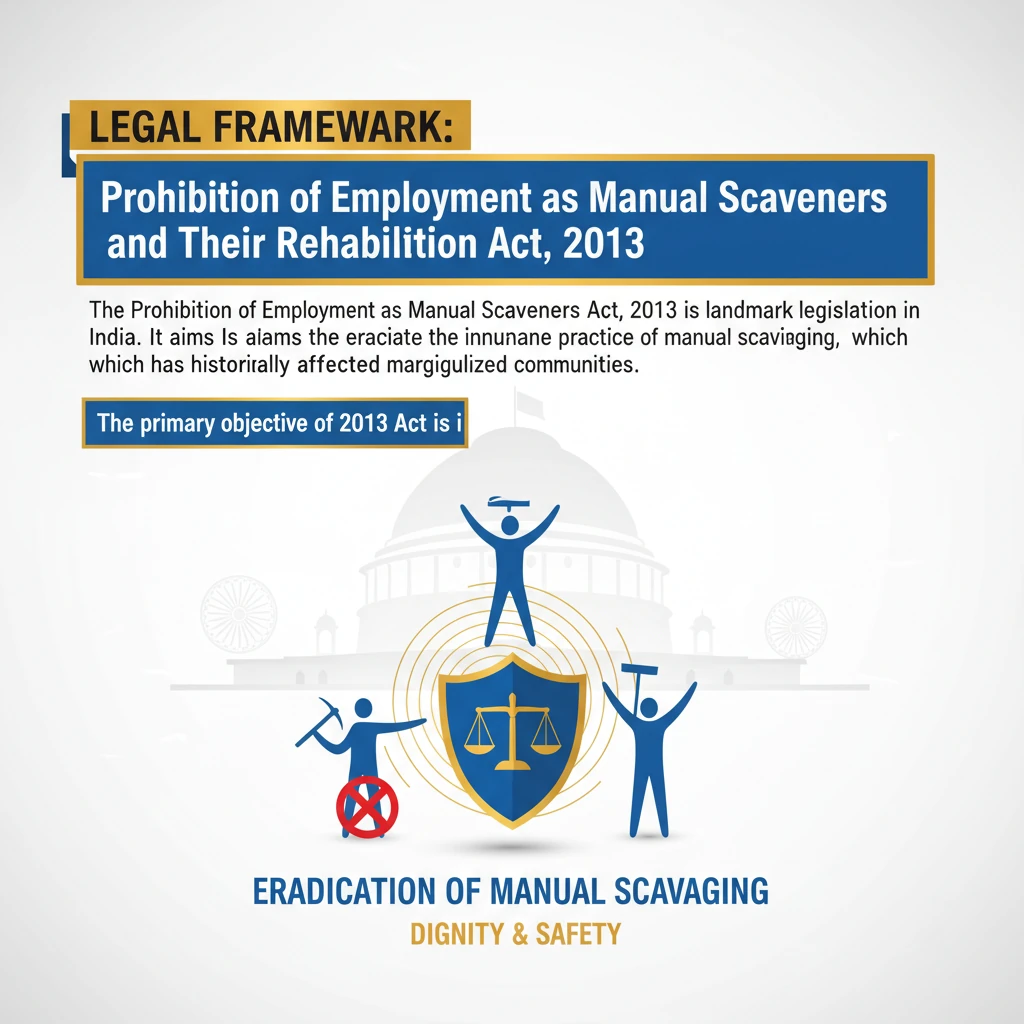
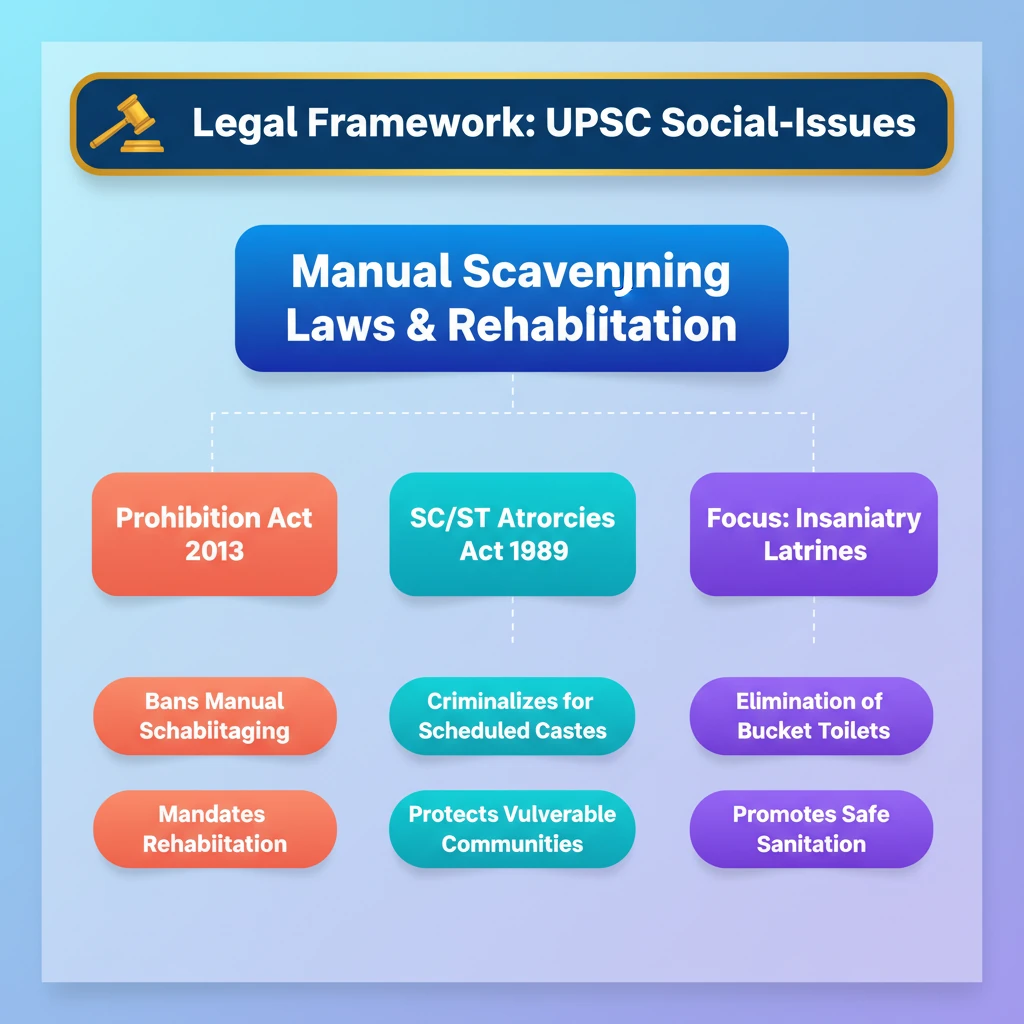
<h4>Prohibition of Employment as Manual Scavengers and Their Rehabilitation Act, 2013</h4><p>The <strong>Prohibition of Employment as Manual Scavengers and Their Rehabilitation Act, 2013</strong> is a landmark legislation in India. It aims to eradicate the inhumane practice of <strong>manual scavenging</strong>, which has historically affected marginalized communities.</p><div class='key-point-box'><p>The primary objective of the <strong>2013 Act</strong> is to ensure the dignity and safety of individuals by strictly prohibiting the employment of manual scavengers across the country.</p></div><p>A key provision of the Act is the outright prohibition of <strong>manual scavenging</strong>. This includes not only the direct cleaning of human excreta but also the construction and maintenance of <strong>insanitary latrines</strong>.</p><div class='info-box'><p>The Act mandates the demolition of existing <strong>insanitary latrines</strong> or their conversion into sanitary ones. This is a crucial step towards eliminating the root cause of manual scavenging.</p></div><p>Beyond prohibition, the Act emphasizes the <strong>rehabilitation</strong> of identified manual scavengers. This comprehensive approach aims to integrate them into mainstream society with dignity.</p><ul><li><strong>Skill Development:</strong> Provides opportunities for manual scavengers to acquire new skills for alternative livelihoods.</li><li><strong>Financial Assistance:</strong> Offers monetary support to aid in their transition and resettlement.</li><li><strong>Alternative Employment:</strong> Facilitates access to other forms of employment, moving away from hazardous work.</li></ul><div class='exam-tip-box'><p>For UPSC Mains, understanding the dual focus of <strong>prohibition</strong> and <strong>rehabilitation</strong> in the <strong>2013 Act</strong> is vital. Questions often revolve around its effectiveness and challenges in implementation (<strong>GS Paper I - Social Issues, GS Paper II - Governance & Social Justice</strong>).</p></div><h4>Scheduled Castes and Scheduled Tribes (Prevention of Atrocities) Act, 1989</h4><p>The <strong>Scheduled Castes and Scheduled Tribes (Prevention of Atrocities) Act, 1989</strong>, commonly known as the <strong>SC/ST (PoA) Act</strong>, plays a significant role in protecting the rights and dignity of these communities.</p><p>This Act specifically criminalizes various atrocities committed against <strong>Scheduled Castes</strong> and <strong>Scheduled Tribes</strong>. Its scope extends to practices that perpetuate social discrimination and exploitation.</p><div class='info-box'><p>Under the <strong>SC/ST (PoA) Act, 1989</strong>, the employment of <strong>Scheduled Castes</strong> in <strong>manual scavenging</strong> is explicitly recognized as a criminal offense. This adds another layer of legal protection.</p></div><div class='key-point-box'><p>The inclusion of manual scavenging under the <strong>SC/ST (PoA) Act</strong> highlights the intersection of caste discrimination with this dehumanizing practice, recognizing it as an atrocity.</p></div><div class='exam-tip-box'><p>When discussing manual scavenging, linking it to the <strong>SC/ST (PoA) Act</strong> demonstrates a nuanced understanding of the social and legal dimensions, crucial for <strong>GS Paper I & II</strong> answers. It underscores the caste-based nature of the issue.</p></div>
💡 Key Takeaways
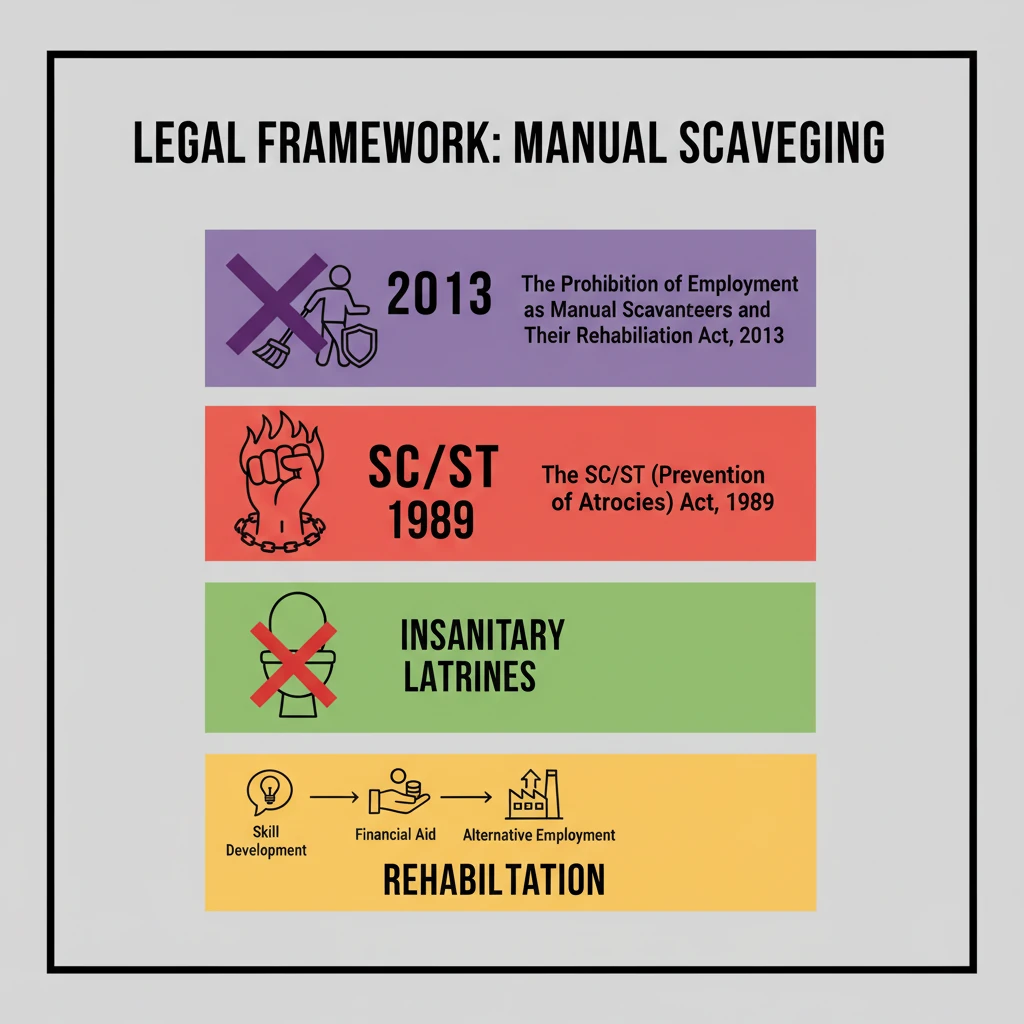
- •The Prohibition of Employment as Manual Scavengers and Their Rehabilitation Act, 2013, bans manual scavenging and mandates rehabilitation.
- •The SC/ST (Prevention of Atrocities) Act, 1989, criminalizes manual scavenging when imposed on Scheduled Castes.
- •"Insanitary latrines" are a key focus for elimination under the 2013 Act.
- •Rehabilitation includes skill development, financial aid, and alternative employment.
- •Despite laws, manual scavenging persists due to socio-economic factors and implementation gaps.
- •Government initiatives like NAMASTE and Swachh Bharat aim to address the issue through mechanization and improved sanitation.
🧠 Memory Techniques
95% Verified Content
📚 Reference Sources
•The Prohibition of Employment as Manual Scavengers and Their Rehabilitation Act, 2013 (Official Text)
•The Scheduled Castes and Scheduled Tribes (Prevention of Atrocities) Act, 1989 (Official Text)
•Ministry of Social Justice and Empowerment, Government of India - Schemes and Initiatives