What are the Government Initiatives Related to HIV? - Social Issues | UPSC Learning
Topics
0 topics • 0 completed
🔍
No topics match your search
What are the Government Initiatives Related to HIV?
Medium⏱️ 6 min read
social issues
📖 Introduction
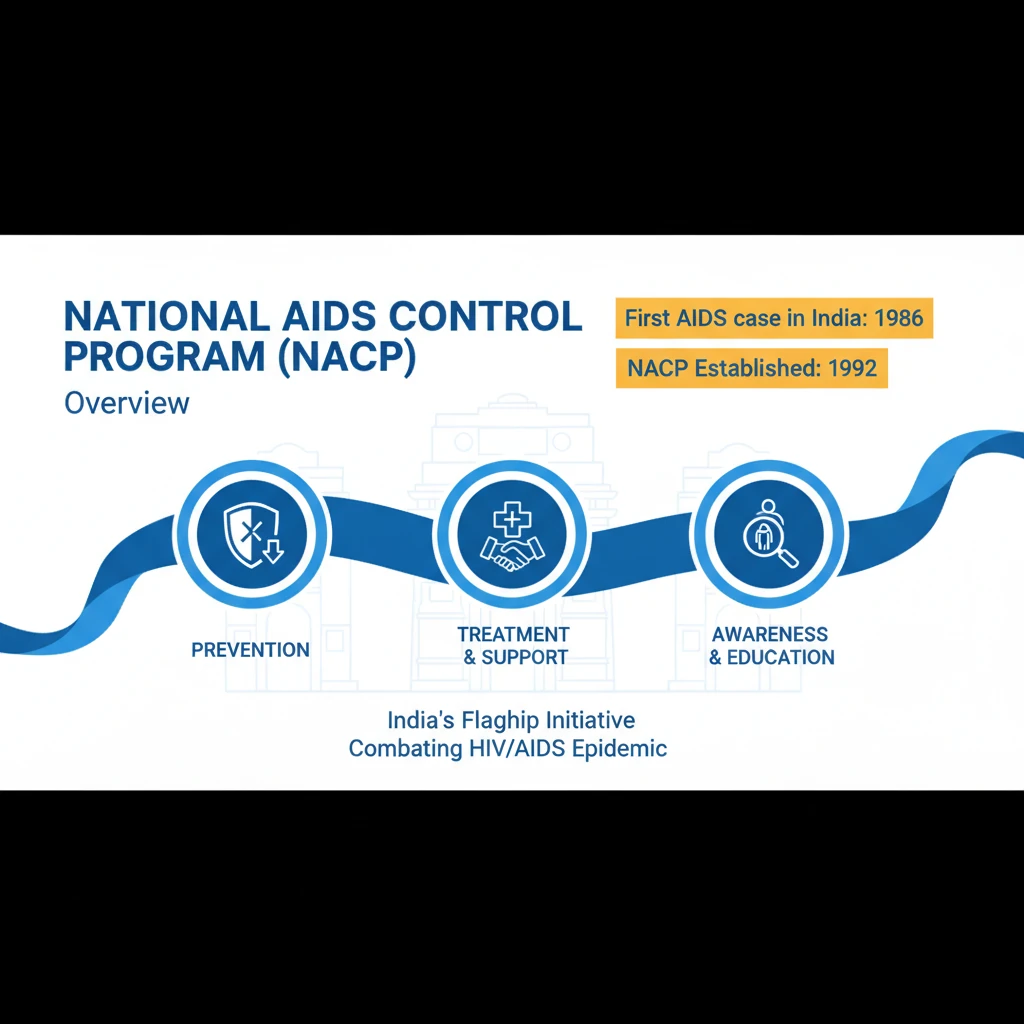
<h4>National AIDS Control Program (NACP): Overview</h4><p>The <strong>National AIDS Control Program (NACP)</strong> is India's flagship initiative to combat the HIV/AIDS epidemic. It was established shortly after the <strong>first AIDS case</strong> was reported in India in <strong>1986</strong>.</p><p>Since its inception in <strong>1992</strong>, NACP has undergone significant evolution through multiple phases. The program's core focus remains on the crucial areas of <strong>prevention</strong>, <strong>treatment</strong>, and <strong>care</strong> for people living with <strong>HIV/AIDS</strong>.</p><div class='info-box'><p>The <strong>first AIDS case</strong> in India was reported in <strong>1986</strong>, prompting the need for a national response.</p></div><h4>Phases of NACP: A Chronological Evolution</h4><p>The NACP has systematically addressed the epidemic through distinct phases, adapting strategies to emerging challenges and knowledge.</p><ol><li><strong>Phase I (1992-1999):</strong> This phase primarily focused on <strong>awareness generation</strong>, ensuring <strong>blood safety</strong>, and establishing robust <strong>surveillance systems</strong> across the country.</li><li><strong>Phase II (1999-2006):</strong> During this period, the program significantly <strong>expanded targeted interventions</strong> for <strong>high-risk populations</strong>. It also marked increased involvement of <strong>NGOs</strong> in the implementation process.</li><li><strong>Phase III (2007-2012):</strong> This phase saw a dramatic <strong>scaling up of targeted interventions</strong> and further <strong>strengthening of surveillance</strong> mechanisms. There was a strong emphasis on partnerships with <strong>civil society organizations</strong> to enhance community involvement.</li><li><strong>Phase IV (2012-2021):</strong> The objective of Phase IV was to <strong>consolidate gains</strong> made in previous phases and further <strong>integrate HIV services</strong> into the broader public health system. It focused on providing <strong>comprehensive care, support, and treatment</strong> for people living with HIV.</li><li><strong>Phase V (2021-2026):</strong> The current phase aims to achieve ambitious targets, specifically to <strong>reduce new HIV infections</strong> and <strong>AIDS-related deaths by 80%</strong> by the end of <strong>2025-26</strong>, compared to <strong>2010 levels</strong>.</li></ol><div class='info-box'><p><strong>NACP Phase V (2021-2026)</strong> targets an <strong>80% reduction</strong> in new HIV infections and AIDS-related deaths by <strong>2025-26</strong> (relative to 2010).</p></div><h4>Legislative Framework: The HIV/AIDS Act</h4><p>India's commitment to protecting the rights of individuals affected by HIV/AIDS is enshrined in law. The <strong>HIV/AIDS Prevention and Control Act (2017)</strong> provides a vital legal framework.</p><p>This Act ensures access to <strong>treatment</strong> without facing <strong>stigma or discrimination</strong>, safeguarding the dignity and rights of people living with HIV/AIDS.</p><div class='key-point-box'><p>The <strong>HIV/AIDS Prevention and Control Act (2017)</strong> is crucial for protecting the rights of people living with HIV, ensuring <strong>non-discrimination</strong> and <strong>access to treatment</strong>.</p></div><h4>International Collaboration and Support</h4><p>India's fight against HIV/AIDS is bolstered by significant international collaboration. The country receives both <strong>technical assistance</strong> and crucial <strong>funding</strong> from various global partners.</p><ul><li><strong>UNAIDS</strong></li><li><strong>WHO (World Health Organization)</strong></li><li>The <strong>World Bank</strong></li><li>Private foundations such as the <strong>Bill & Melinda Gates Foundation</strong></li></ul>
💡 Key Takeaways
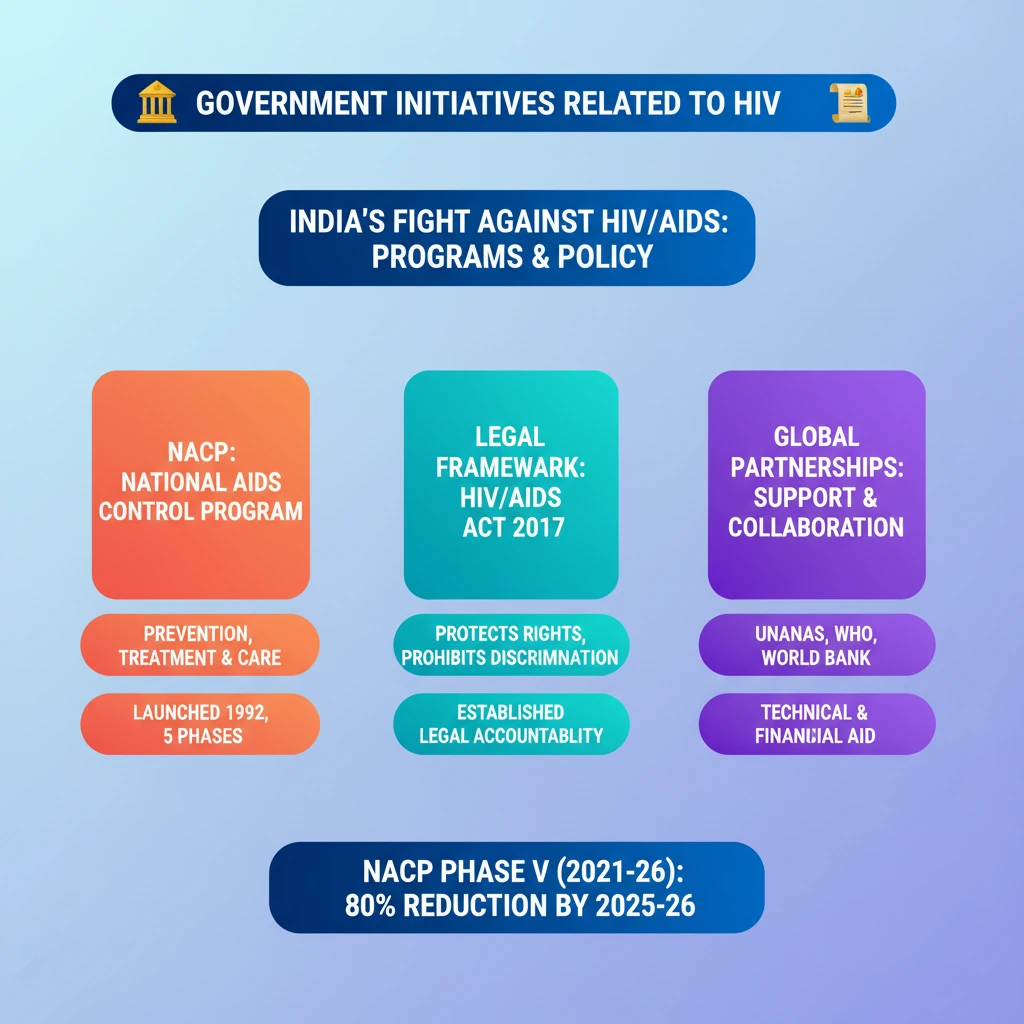
- •NACP is India's primary program for HIV/AIDS, launched in 1992 and evolving through five phases.
- •The program focuses on prevention, treatment, and care, adapting strategies over time.
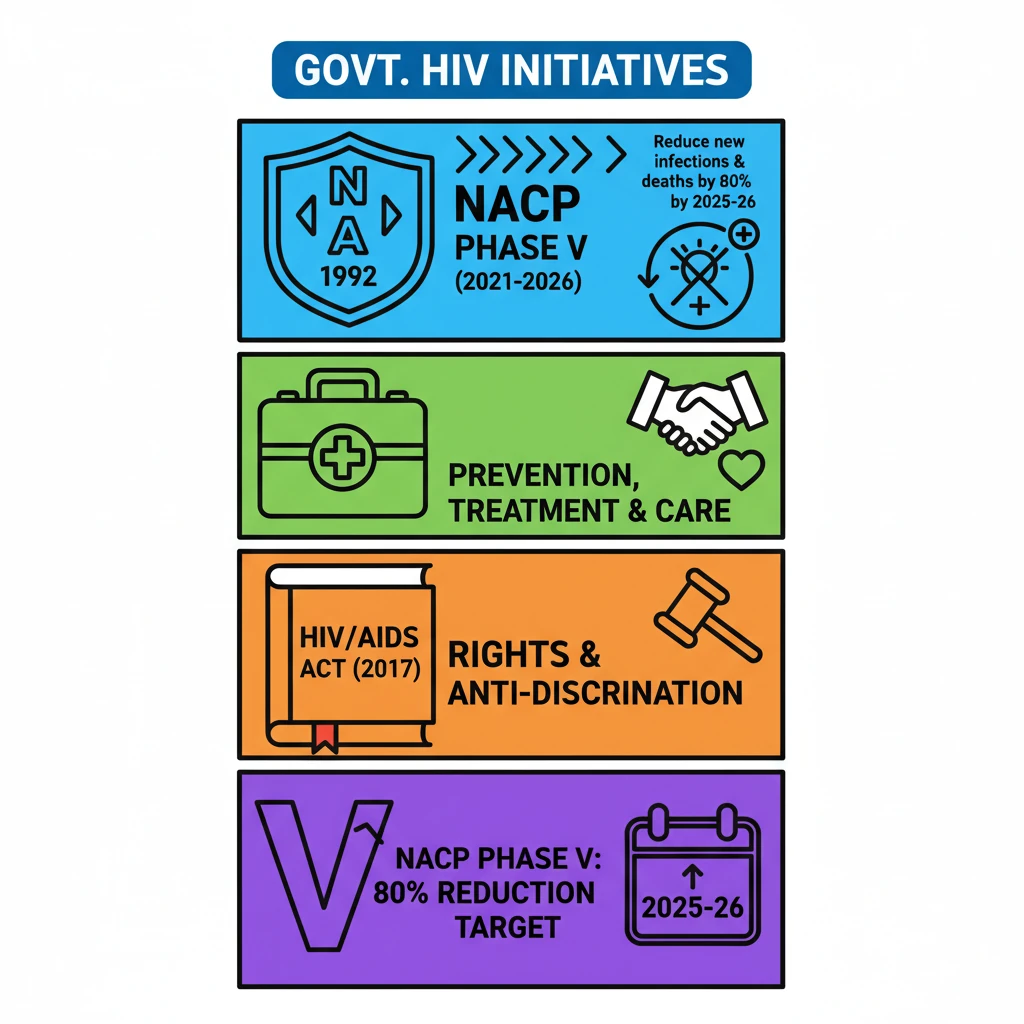
- •The HIV/AIDS Prevention and Control Act (2017) provides a legal framework to protect rights and prevent discrimination.
- •NACP Phase V (2021-2026) aims to reduce new infections and AIDS-related deaths by 80% by 2025-26.
- •International partners like UNAIDS, WHO, and the World Bank provide crucial technical and financial support.
🧠 Memory Techniques
98% Verified Content
📚 Reference Sources
•National AIDS Control Organization (NACO) official website
•Ministry of Health and Family Welfare, Government of India