What is the Special Marriage Act (SMA), 1954? - Social Issues | UPSC Learning
Topics
0 topics • 0 completed
🔍
No topics match your search
What is the Special Marriage Act (SMA), 1954?
Medium⏱️ 7 min read
social issues
📖 Introduction
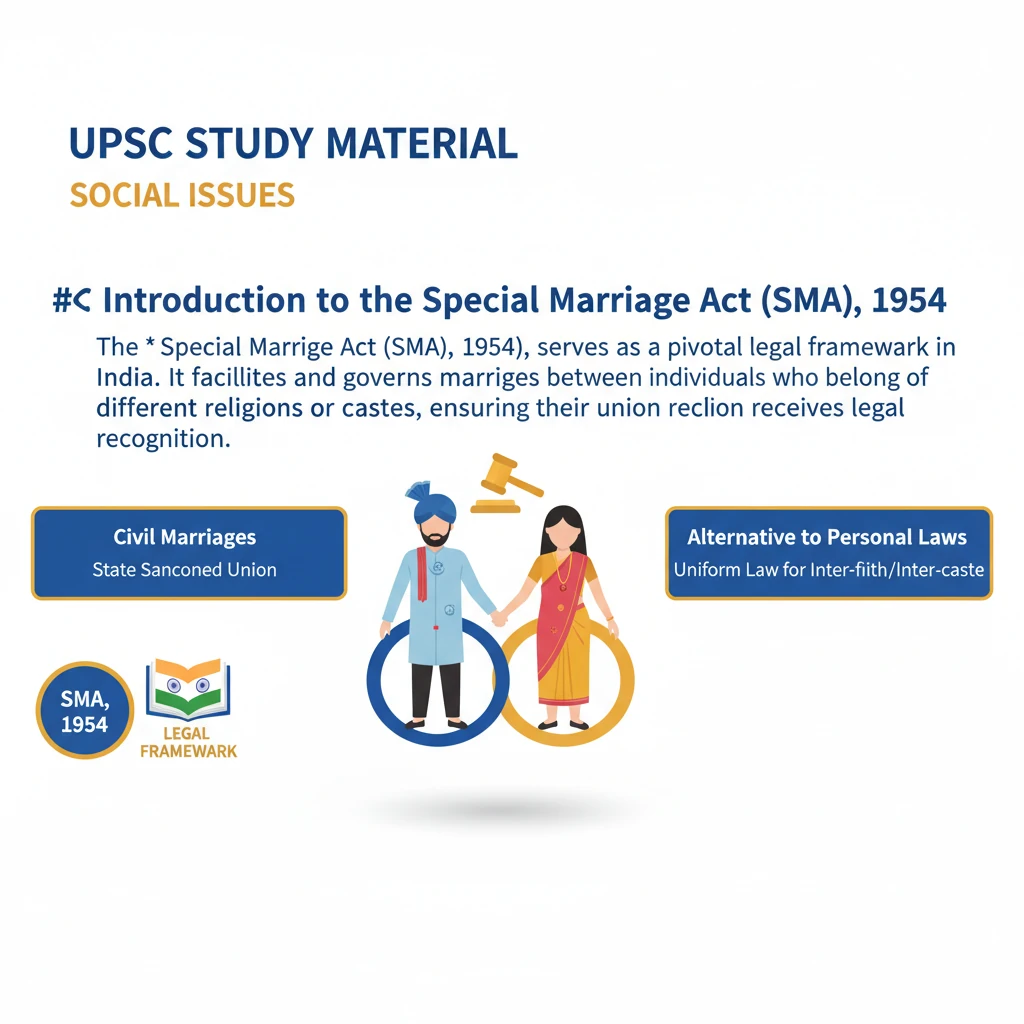
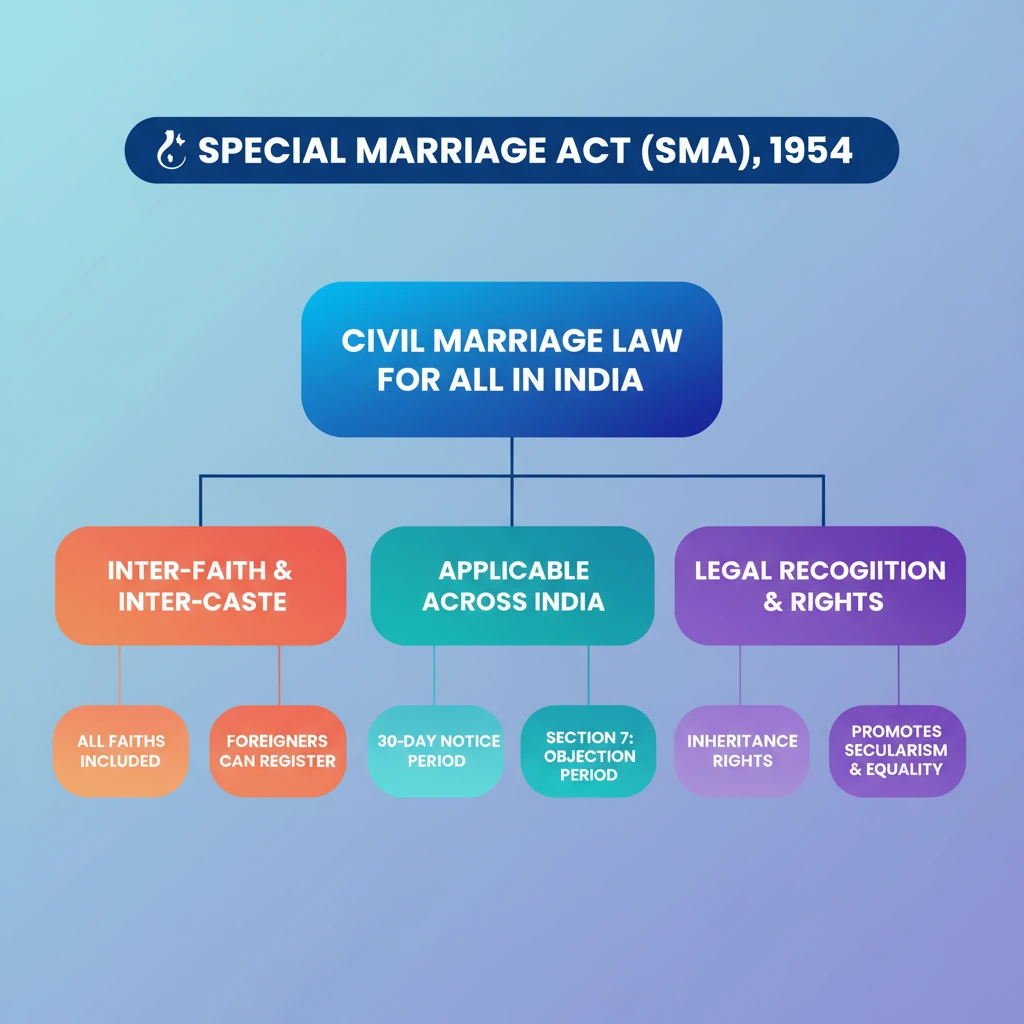
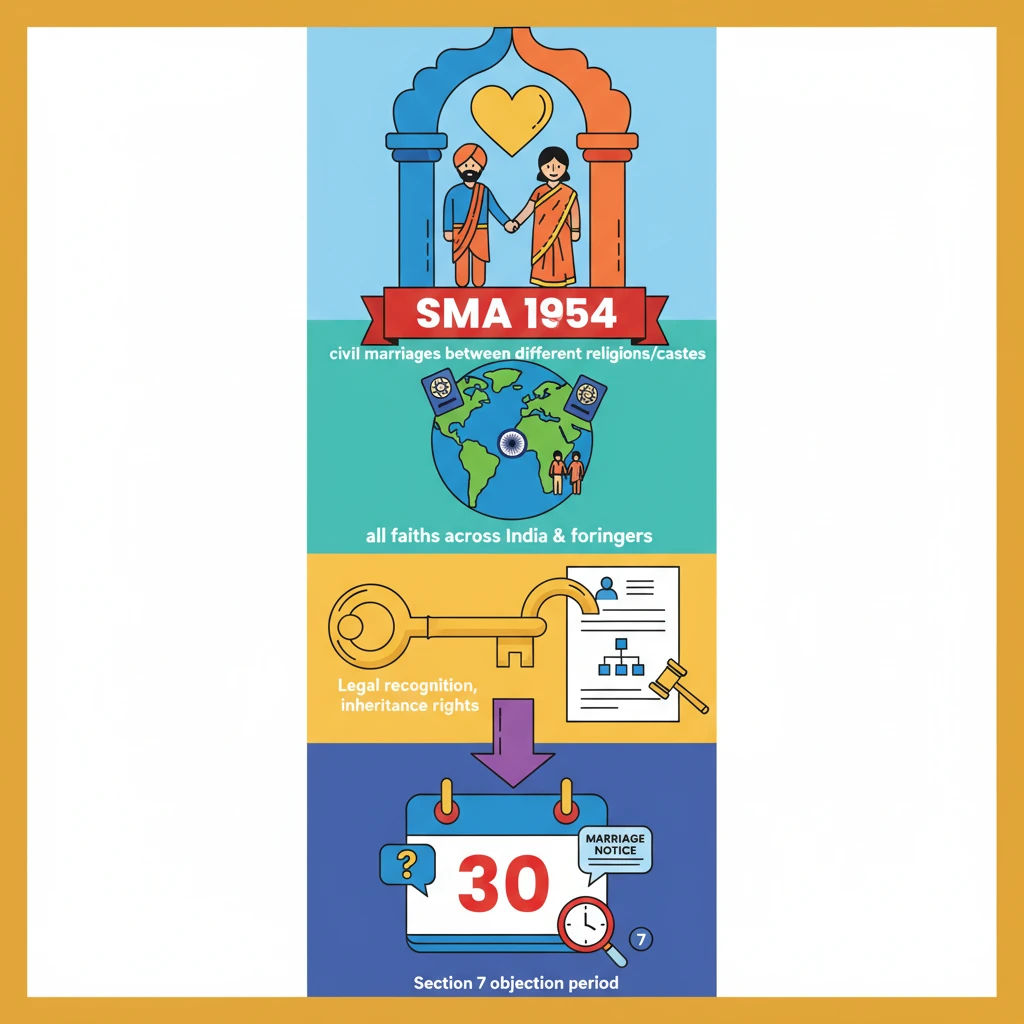
<h4>Introduction to the Special Marriage Act (SMA), 1954</h4><p>The <strong>Special Marriage Act (SMA), 1954</strong>, serves as a pivotal legal framework in India. It facilitates and governs marriages between individuals who belong to different religions or castes, ensuring their union receives legal recognition.</p><p>This Act specifically deals with <strong>civil marriages</strong>, where the state, rather than religious authorities, sanctions the marital bond. It provides an alternative to personal religious laws for those seeking an inter-faith or inter-caste union.</p><div class='key-point-box'><p>The <strong>SMA, 1954</strong>, is a secular law designed to uphold individual choice and promote social harmony by enabling marriages irrespective of religious or caste affiliations.</p></div><h4>Applicability of the Special Marriage Act</h4><p>The <strong>SMA</strong> extends its provisions to people of all faiths across India. This includes adherents of <strong>Hinduism, Islam, Sikhism, Christianity, Jainism, and Buddhism</strong>, among others. It ensures a uniform legal process for civil marriages for all citizens.</p><p>Significantly, the Act also allows <strong>foreigners</strong> to register their marriage in India under specific conditions. This provision makes India a viable location for civil marriages involving international couples.</p><div class='info-box'><p>For foreigners to register their marriage under SMA, 1954, both parties must possess <strong>valid passports</strong>. Additionally, at least one of the parties must have resided in India for a minimum period of <strong>30 days</strong> immediately preceding the filing of the marriage notice.</p></div><h4>Key Provisions of the SMA, 1954</h4><ul><li><p><strong>Marriage Recognition:</strong> The Act provides for the legal registration of marriages, which is crucial for establishing the legal validity of the union. This recognition grants couples various essential rights and benefits.</p></li><li><p>These rights include entitlements related to <strong>inheritance, succession, and social security benefits</strong>, ensuring legal protection and stability for the married couple and their offspring.</p></li><li><p><strong>Notice Requirement (Section 5):</strong> A fundamental provision under the SMA mandates that parties intending to marry must provide a <strong>written notice</strong> to the Marriage Officer of the district. This notice formally declares their intention to marry.</p></li><li><p>Crucially, at least one of the parties must have resided in that specific district for a minimum period of <strong>30 days</strong> immediately before the date on which the notice is given.</p></li><li><p><strong>Objection Period (Section 7):</strong> Following the publication of the marriage notice, <strong>Section 7</strong> of the Act allows for a period during which objections to the intended marriage can be raised. This period is set at <strong>30 days</strong> from the date the notice is published.</p></li><li><p>If valid objections are raised, the Marriage Officer is required to inquire into them before proceeding with the marriage registration.</p></li></ul><div class='exam-tip-box'><p>Understanding the <strong>30-day notice period</strong> and <strong>30-day objection period</strong> is vital for UPSC Prelims. These timelines are frequently tested factual details related to the <strong>Special Marriage Act</strong>.</p></div>
💡 Key Takeaways
- •The Special Marriage Act (SMA), 1954, provides a legal framework for civil marriages between individuals of different religions or castes in India.
- •It applies to people of all faiths across India and allows foreigners to register their marriage under specific conditions.
- •Key provisions include legal recognition of marriages, granting rights like inheritance, and requiring a 30-day notice period to the Marriage Officer.
- •Section 7 allows for a 30-day objection period after the marriage notice is published.
- •The SMA promotes secularism, individual choice, and equality by offering an alternative to religion-specific personal laws.
🧠 Memory Techniques
98% Verified Content
📚 Reference Sources
•The Special Marriage Act, 1954 (Bare Act)