What is the Supreme Court Guideline on Manual Scavenging? - Social Issues | UPSC Learning
Topics
0 topics • 0 completed
🔍
No topics match your search
What is the Supreme Court Guideline on Manual Scavenging?
Medium⏱️ 7 min read
social issues
📖 Introduction
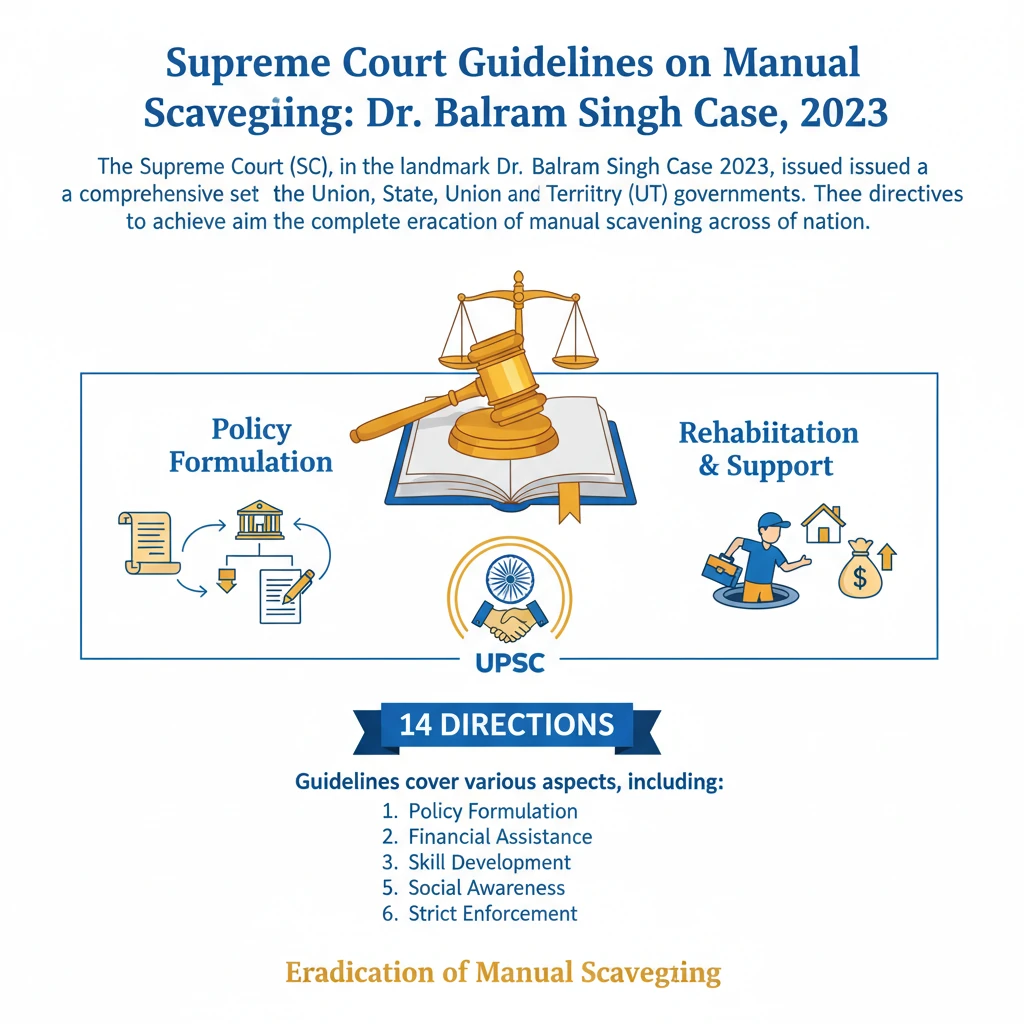
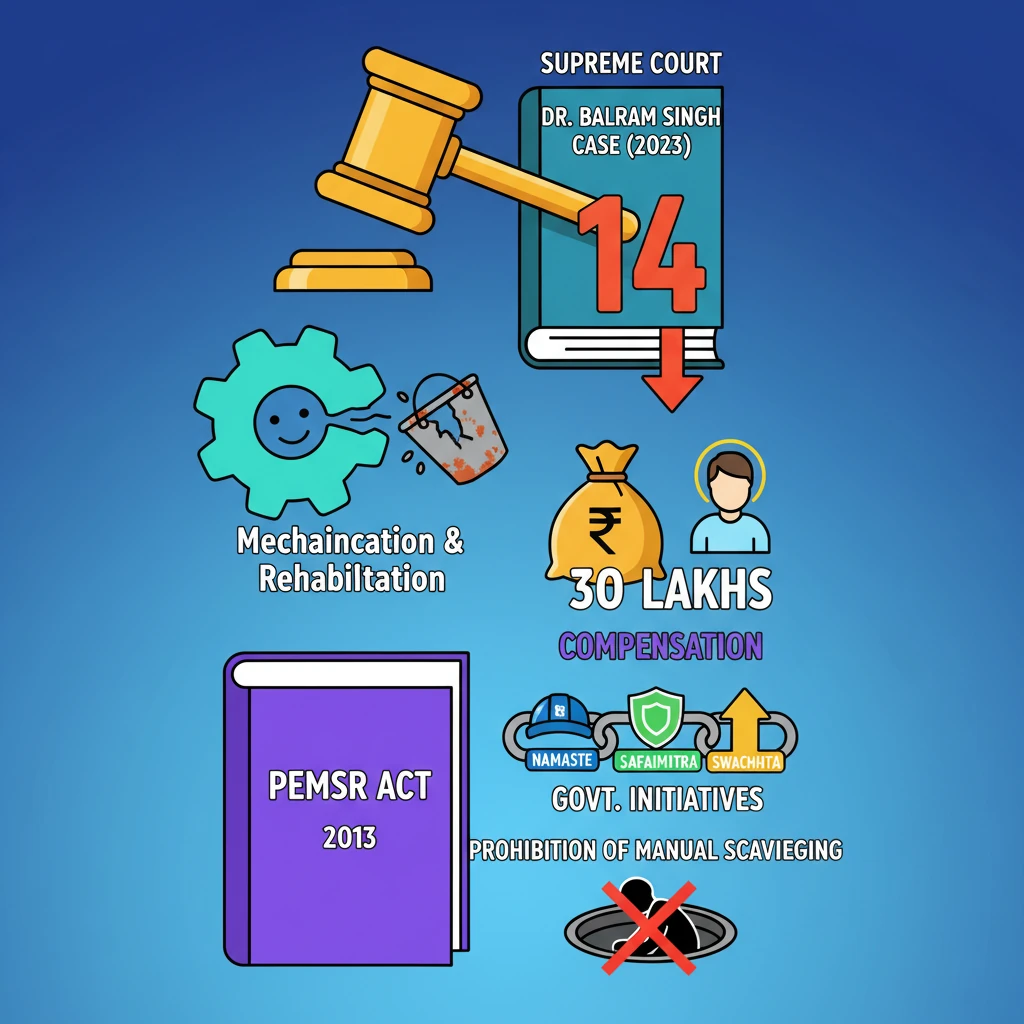
<h4>Supreme Court Guidelines on Manual Scavenging: Dr. Balram Singh Case, 2023</h4><p>The <strong>Supreme Court (SC)</strong>, in the landmark <strong>Dr. Balram Singh Case of 2023</strong>, issued a comprehensive set of <strong>14 directions</strong> to the Union, State, and Union Territory (UT) governments. These directives aim to achieve the complete eradication of <strong>manual scavenging</strong> across the nation.</p><p>The guidelines cover various aspects, including policy formulation, rehabilitation measures, and compensation for victims. The overarching goal is to ensure dignity and safety for all sanitation workers.</p><div class='key-point-box'><p><strong>Key Directives from the Dr. Balram Singh Case, 2023:</strong></p><ul><li><strong>Eradication of Manual Sewer Cleaning:</strong> Implement phased measures to completely eliminate the practice of manual cleaning of sewers and septic tanks.</li><li><strong>Rehabilitation of Sewage Workers:</strong> Ensure comprehensive rehabilitation packages for affected workers and their families.</li><li><strong>Accountability for Outsourced Work:</strong> Establish robust accountability mechanisms for outsourced sanitation work, including penalties and contract cancellations for non-compliance.</li><li><strong>NALSA Involvement in Compensation:</strong> The <strong>National Legal Services Authority (NALSA)</strong> is tasked with managing the disbursement of compensation and developing effective models for the same.</li><li><strong>Monitoring and Transparency:</strong> Develop and maintain a dedicated online portal to track deaths, compensation disbursement, and rehabilitation progress of sanitation workers.</li></ul></div><div class='info-box'><p><strong>Compensation Standards Set by SC:</strong></p><ul><li><strong>₹30 lakhs</strong> for death of a sanitation worker.</li><li><strong>₹10-20 lakhs</strong> for disabilities incurred during work.</li><li><strong>Employment</strong> for the next of kin of deceased workers.</li><li><strong>Education</strong> for dependents of affected workers.</li></ul></div><h4>India’s Initiatives to Curb Manual Scavenging</h4><p>The Government of India has launched several initiatives and schemes to address the issue of <strong>manual scavenging</strong> and promote mechanised sanitation.</p><ul><li><strong>Safaimitra Suraksha Challenge:</strong> Aims to mechanise all sewer and septic tank cleaning operations by April 2021, promoting safe and dignified sanitation work.</li><li><strong>Swachhta Abhiyan App:</strong> A mobile application designed to identify and geo-tag manual scavengers and insanitary latrines, facilitating their rehabilitation.</li><li><strong>Rashtriya Garima Abhiyan:</strong> A national campaign focused on eradicating manual scavenging and rehabilitating manual scavengers.</li><li><strong>National Commission for Safai Karamcharis (NCSK):</strong> A statutory body established to safeguard the interests and rights of <strong>Safai Karamcharis</strong>, including manual scavengers.</li><li><strong>Swachhta Udyami Yojana (SUY):</strong> Provides financial assistance for viable sanitation-related projects, promoting entrepreneurship among <strong>Safai Karamcharis</strong>.</li><li><strong>Recognition of Prior Learning (RPL):</strong> A component of the <strong>Pradhan Mantri Kaushal Vikas Yojana (PMKVY)</strong>, it certifies existing skills of sanitation workers, improving their employability.</li></ul><div class='key-point-box'><p><strong>NAMASTE Scheme: National Action for Mechanised Sanitation Ecosystem</strong></p><p>The <strong>NAMASTE scheme</strong> is a joint initiative of the Ministry of Housing and Urban Affairs and the Ministry of Social Justice and Empowerment. Its primary objective is to create a professional, well-trained, and adequately equipped workforce for mechanised sanitation operations. It aims to eliminate human entry into hazardous cleaning tasks.</p></div><div class='info-box'><p><strong>Emergency Response Sanitation Units (ERSUs):</strong></p><p>Under the <strong>NAMASTE scheme</strong>, <strong>ERSUs</strong> are being developed to provide rapid and skilled response for sanitation emergencies, ensuring that human intervention in dangerous situations is replaced by trained professionals and advanced equipment.</p></div><h4>Technological Initiatives Against Manual Scavenging</h4><p>Technology plays a crucial role in eliminating the need for human intervention in hazardous sanitation work. Several innovations are being promoted.</p><div class='info-box'><p><strong>Bandicoot Robot:</strong></p><p>The <strong>Bandicoot Robot</strong> is an autonomous or remotely operated robot designed for cleaning, inspecting, and removing blockages in sewer lines. Its deployment significantly reduces the risk to human lives and promotes mechanised sanitation.</p></div><div class='exam-tip-box'><p><strong>UPSC Insight:</strong> The <strong>Dr. Balram Singh Case, 2023</strong>, and the <strong>NAMASTE scheme</strong> are critical topics for <strong>GS-II (Social Justice & Governance)</strong>. Be prepared to discuss the SC's directions, government initiatives, and the role of technology in eradicating manual scavenging.</p></div>
💡 Key Takeaways
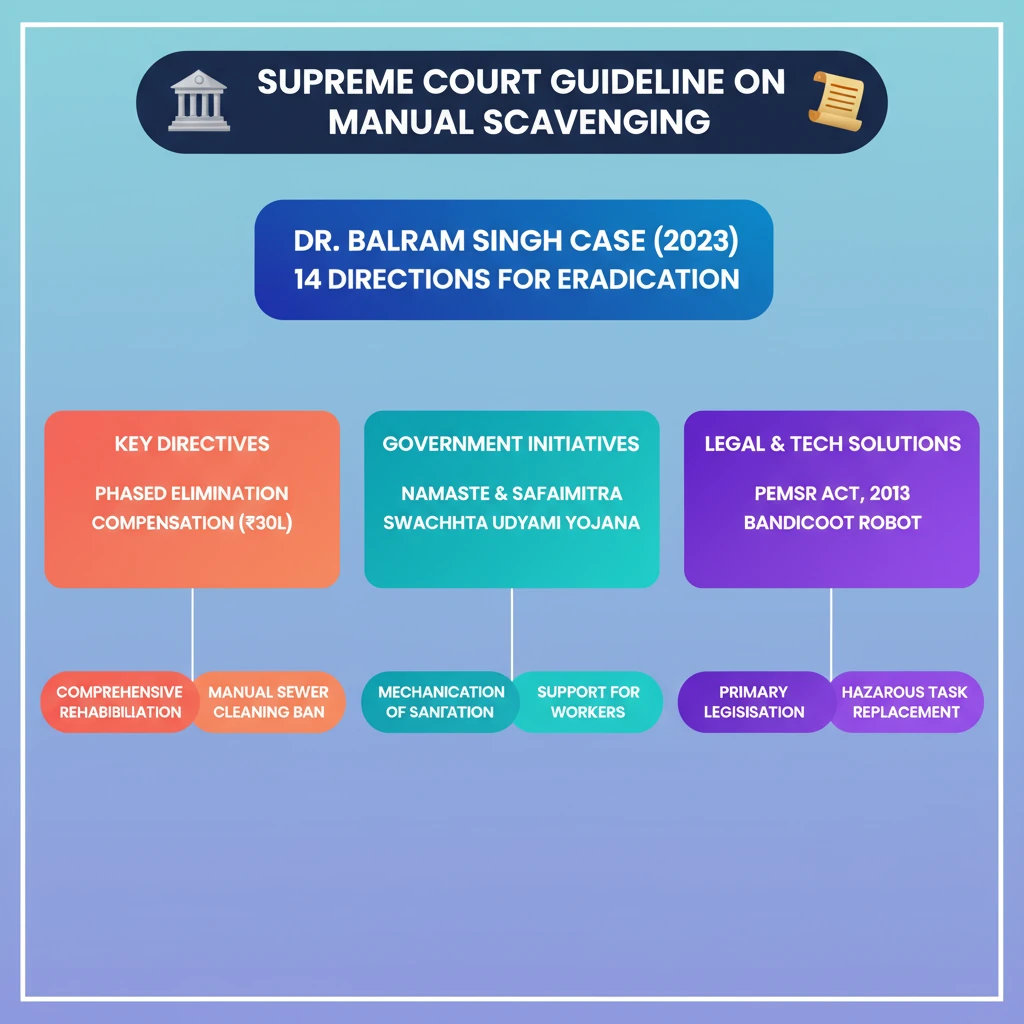
- •Supreme Court's Dr. Balram Singh Case (2023) issued 14 directions for complete eradication of manual scavenging.
- •Key directives include phased elimination of manual sewer cleaning, comprehensive rehabilitation, and significant compensation (₹30L for death).
- •Government initiatives like NAMASTE, Safaimitra Suraksha Challenge, and Swachhta Udyami Yojana aim for mechanisation and rehabilitation.
- •The Prohibition of Employment as Manual Scavengers and their Rehabilitation Act, 2013 (PEMSR Act) is the primary legislation.
- •Technological solutions like the Bandicoot Robot are crucial for replacing human intervention in hazardous sanitation tasks.
- •The issue highlights persistent social injustice, requiring strong political will, effective implementation, and societal change.
🧠 Memory Techniques
95% Verified Content
📚 Reference Sources
•The Prohibition of Employment as Manual Scavengers and their Rehabilitation Act, 2013 (PEMSR Act)
•Supreme Court Judgment in Dr. Balram Singh Case, 2023 (reference for directions)
•Ministry of Social Justice and Empowerment, Government of India (for schemes like NAMASTE, SUY)
•Ministry of Housing and Urban Affairs, Government of India (for Safaimitra Suraksha Challenge)