What are the Procedure for Altering the SC/ST/OBC List in India? - Social Issues | UPSC Learning
Topics
0 topics • 0 completed
🔍
No topics match your search
What are the Procedure for Altering the SC/ST/OBC List in India?
Medium⏱️ 8 min read
social issues
📖 Introduction
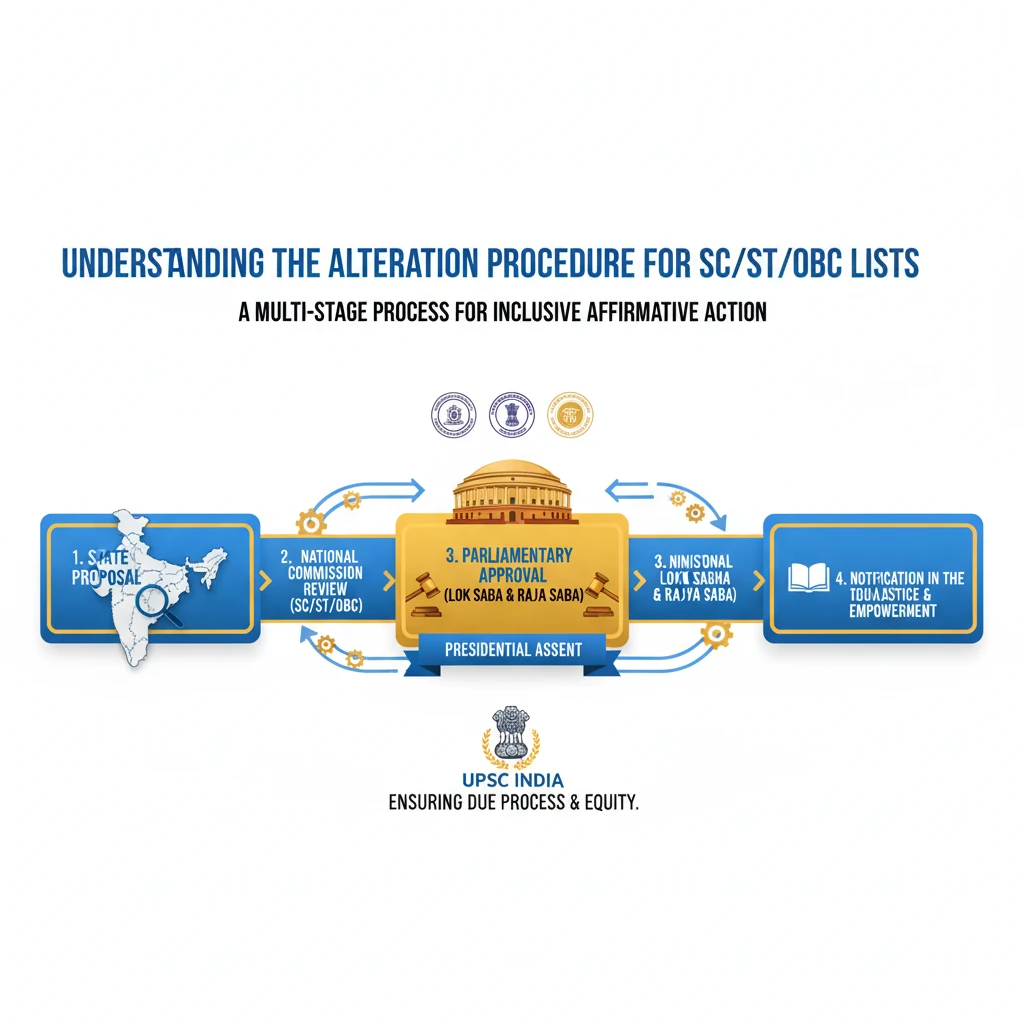
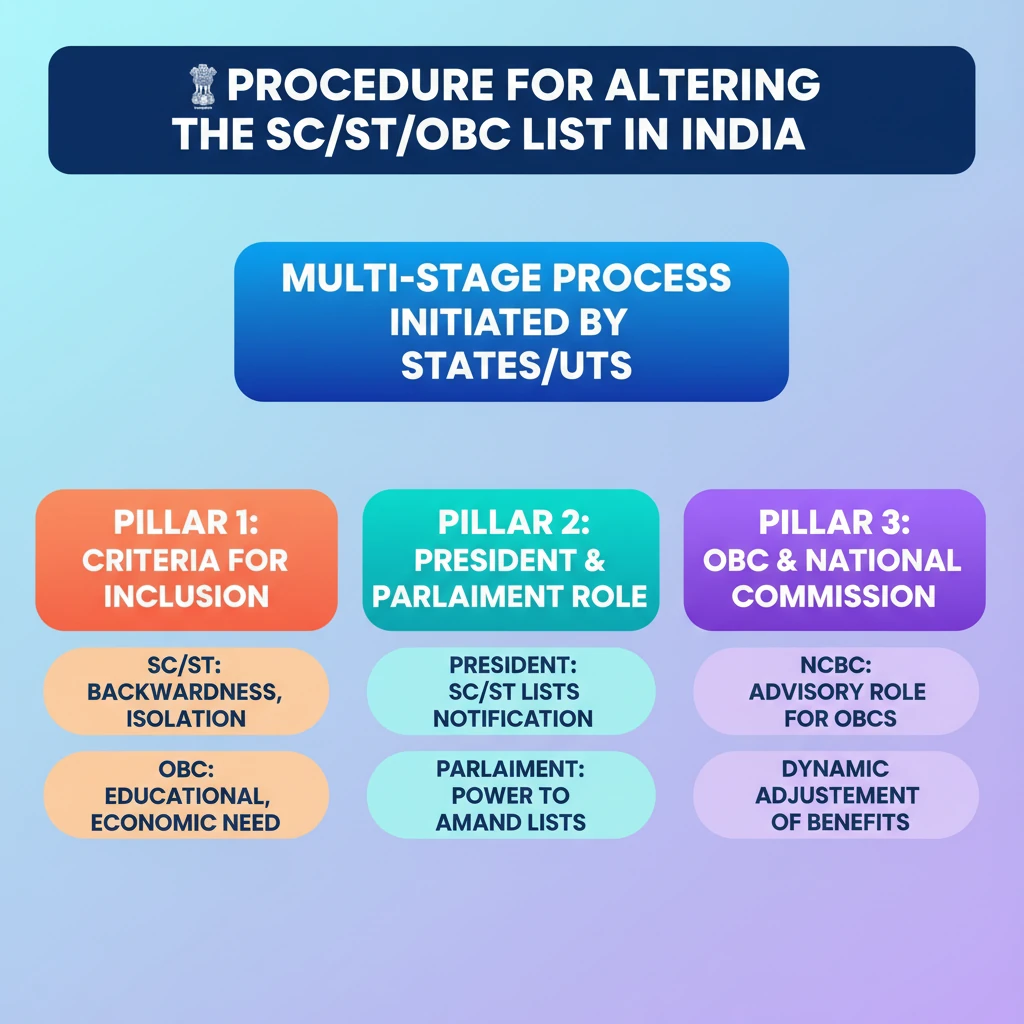
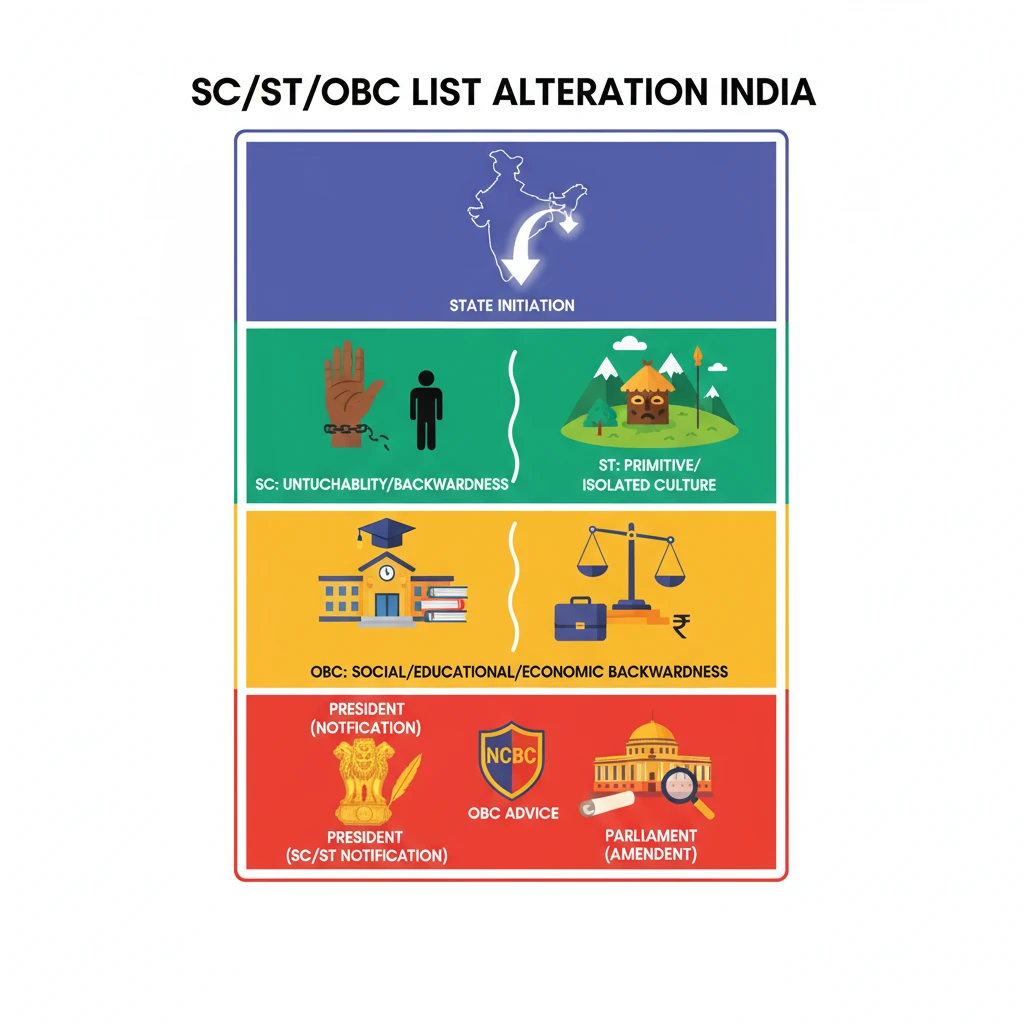
<h4>Inclusion Criteria for Reserved Categories</h4><p>The identification of communities for inclusion in the <strong>Scheduled Castes (SCs)</strong>, <strong>Scheduled Tribes (STs)</strong>, and <strong>Other Backward Classes (OBCs)</strong> lists is based on specific criteria designed to address historical disadvantages.</p><p>These criteria ensure that only genuinely backward and underrepresented communities receive the benefits of affirmative action.</p><ul><li><strong>Scheduled Castes (SCs):</strong> Inclusion is based on extreme <strong>social, educational, and economic backwardness</strong>. This is often intrinsically linked to the historical practice of <strong>untouchability</strong> and the discrimination faced by these communities.</li><li><strong>Scheduled Tribes (STs):</strong> Communities are identified as STs based on indications of <strong>primitive traits</strong>, distinct <strong>cultural practices</strong>, <strong>geographical isolation</strong>, and a general state of <strong>backwardness</strong>.</li><li><strong>Other Backward Classes (OBCs):</strong> Criteria for OBCs include significant <strong>social, educational, and economic backwardness</strong>, coupled with <strong>inadequate representation in government services</strong>.</li></ul><div class='key-point-box'><p>Each category has distinct identification parameters, reflecting the unique challenges faced by these groups in Indian society.</p></div><h4>Procedure for Altering the Lists</h4><p>The process of altering the <strong>SC/ST/OBC lists</strong> is a multi-stage procedure involving various governmental and constitutional bodies, culminating in parliamentary approval.</p><h5>Initiation and Scrutiny</h5><p>The process typically begins with a proposal initiated by <strong>State Governments</strong> or <strong>Union Territories (UTs)</strong> for the inclusion or exclusion of a community.</p><p>This proposal is then supported by the <strong>Registrar General of India (RGI)</strong> and the respective National Commissions – the <strong>National Commission for Scheduled Castes (NCSC)</strong> or the <strong>National Commission for Scheduled Tribes (NCST)</strong>.</p><div class='info-box'><p>For inclusion in the <strong>Central OBC list</strong>, recommendations from the <strong>National Commission for Backward Classes (NCBC)</strong> are mandatory, as per <strong>Section 9 of the NCBC Act, 1993</strong>.</p></div><div class='key-point-box'><p>The procedure for inclusion in the <strong>SC/ST category</strong> is governed by specific constitutional articles: <strong>Article 341</strong> for SCs and <strong>Article 342</strong> for STs.</p></div><p>The proposal undergoes rigorous scrutiny by the <strong>Ministry of Social Justice and Empowerment</strong>. This evaluation considers socio-economic factors and historical data, with crucial inputs from the <strong>Registrar General of India (RGI)</strong>.</p><p>Ultimately, any amendments to these lists are subject to review and approval by the <strong>Union Cabinet</strong> before proceeding to the legislative stage.</p><h5>Parliamentary Process</h5><p>To formally enact the proposed changes to the <strong>SC/ST/OBC list</strong>, a <strong>Constitutional Amendment Bill</strong> is introduced in <strong>Parliament</strong>.</p><div class='info-box'><p>The Bill requires passage by a <strong>special majority</strong> in both Houses of Parliament. This means a <strong>two-thirds majority</strong> of members present and voting, along with the support of <strong>more than 50%</strong> of the total strength of the respective House.</p></div><h5>Presidential Assent and Implementation</h5><p>After successfully being passed by both Houses of Parliament, the <strong>Constitutional Amendment Bill</strong> is sent to the <strong>President of India</strong> for assent.</p><p>Once the <strong>President</strong> grants assent, the amendments to the <strong>SC/ST/OBC list</strong> are officially enacted and become law, thereby altering the respective lists.</p><h4>Role of Registrar General of India (RGI)</h4><p>The <strong>Registrar General of India (RGI)</strong> plays a pivotal role in providing essential demographic data and support for the process of altering these lists.</p><div class='info-box'><p>The <strong>RGI</strong> was established in <strong>1961</strong> under the <strong>Ministry of Home Affairs</strong>. It is responsible for overseeing the demographic surveys of India.</p></div><p>These surveys include the decennial <strong>Census of India</strong> and the <strong>Linguistic Survey of India</strong>, providing crucial statistical information necessary for evaluating the backwardness and representation of communities.</p>
💡 Key Takeaways
- •Inclusion criteria vary for SCs (untouchability-linked backwardness), STs (primitive traits, isolation), and OBCs (social, educational, economic backwardness, inadequate representation).
- •The alteration procedure begins with State/UT proposals, supported by RGI and respective National Commissions (NCSC/NCST/NCBC).
- •For Central OBC list, NCBC recommendation (Section 9, NCBC Act, 1993) is mandatory.
- •SC/ST list changes are governed by Articles 341 and 342, requiring a Constitutional Amendment Bill in Parliament.
- •Parliamentary approval requires a special majority (2/3 present & voting + >50% total strength), followed by Presidential assent.
- •RGI (est. 1961, MHA) provides crucial demographic data for these alterations.
🧠 Memory Techniques
100% Verified Content
📚 Reference Sources
•The Constitution of India (Articles 341, 342)
•National Commission for Backward Classes Act, 1993