OTHER VULNERABLE SECTIONS: SCs, STs, MINORITIES AND DISABLED - Social Issues | UPSC Learning
Topics
0 topics • 0 completed
🔍
No topics match your search
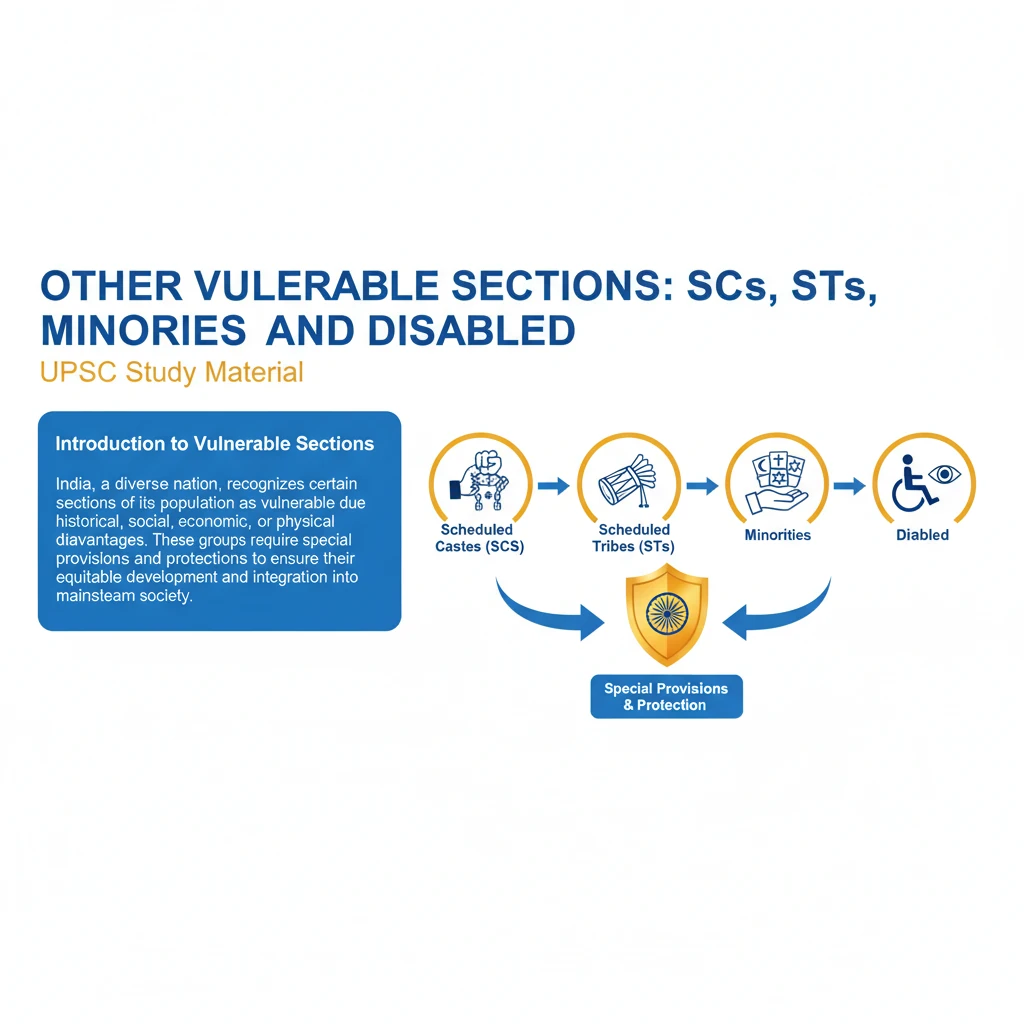
OTHER VULNERABLE SECTIONS: SCs, STs, MINORITIES AND DISABLED
Medium⏱️ 15 min read
social issues
📖 Introduction
<h4>Introduction to Vulnerable Sections</h4><p>India, a diverse nation, recognizes certain sections of its population as <strong>vulnerable</strong> due to historical, social, economic, or physical disadvantages. These groups require special provisions and protections to ensure their equitable development and integration into mainstream society.</p><p>The primary vulnerable sections identified for specific state intervention include <strong>Scheduled Castes (SCs)</strong>, <strong>Scheduled Tribes (STs)</strong>, <strong>Minorities</strong>, and <strong>Persons with Disabilities (PwDs)</strong>. Addressing their challenges is central to India's vision of <strong>social justice</strong> and <strong>inclusive growth</strong>.</p><div class='key-point-box'><p><strong>Key Concept: Vulnerability</strong> refers to the susceptibility of individuals or groups to harm, disadvantage, or discrimination, often stemming from systemic inequalities and lack of access to resources or opportunities.</p></div><h4>Scheduled Castes (SCs)</h4><p><strong>Scheduled Castes (SCs)</strong> are groups historically subjected to <strong>untouchability</strong> and severe social discrimination. They are listed in the Schedule of the Indian Constitution, as per <strong>Article 341</strong>.</p><p>Their historical marginalization has led to significant socio-economic backwardness. The Constitution aims to rectify these historical injustices through various protective and promotional measures.</p><div class='info-box'><p><strong>Constitutional Provisions for SCs:</strong><ul><li><strong>Article 17:</strong> Abolition of <strong>Untouchability</strong>.</li><li><strong>Article 46:</strong> Promotion of educational and economic interests.</li><li><strong>Article 330, 332, 334:</strong> Reservation of seats in Lok Sabha and State Legislative Assemblies.</li><li><strong>Article 335:</strong> Claims of SCs and STs to services and posts.</li></ul></p></div><p>Despite progress, SCs continue to face issues like discrimination, landlessness, and unequal access to education and employment.</p><h4>Scheduled Tribes (STs)</h4><p><strong>Scheduled Tribes (STs)</strong> are indigenous communities characterized by distinctive culture, geographical isolation, shyness of contact with the community at large, and backwardness. They are listed under <strong>Article 342</strong> of the Constitution.</p><p>These communities often reside in remote forest and hilly areas, maintaining unique traditions and lifestyles. Their vulnerability arises from isolation, exploitation, and threats to their traditional land and resources.</p><div class='info-box'><p><strong>Constitutional Provisions for STs:</strong><ul><li><strong>Article 15(4):</strong> Special provisions for their advancement.</li><li><strong>Article 244:</strong> Administration of <strong>Scheduled Areas</strong> and <strong>Tribal Areas</strong> (Fifth and Sixth Schedules).</li><li><strong>Article 275(1):</strong> Grants from the Union to certain states for tribal welfare.</li><li><strong>Article 338A:</strong> Establishment of <strong>National Commission for Scheduled Tribes</strong>.</li></ul></p></div><p>Challenges for STs include displacement due to development projects, loss of traditional livelihoods, lack of access to basic services, and cultural erosion.</p><h4>Minorities</h4><p>The term <strong>Minority</strong> is not explicitly defined in the Indian Constitution but refers to communities numerically less than 50% of the total population, based on religion or language. The <strong>National Commission for Minorities Act, 1992</strong>, identifies five religious minorities: <strong>Muslims, Christians, Sikhs, Buddhists, and Zoroastrians (Parsis)</strong>. Jains were added in 2014.</p><p>Constitutional safeguards aim to protect their distinct identity and prevent discrimination. These provisions ensure their cultural and educational rights.</p><div class='info-box'><p><strong>Constitutional Provisions for Minorities:</strong><ul><li><strong>Article 29:</strong> Protection of interests of minorities (culture, language, script).</li><li><strong>Article 30:</strong> Right of minorities to establish and administer educational institutions.</li><li><strong>Article 350A:</strong> Instruction in mother tongue at primary stage.</li><li><strong>Article 350B:</strong> Special Officer for Linguistic Minorities.</li></ul></p></div><p>Minorities often face challenges related to identity, security, equitable access to opportunities, and representation in various sectors.</p><h4>Persons with Disabilities (PwDs)</h4><p><strong>Persons with Disabilities (PwDs)</strong> are individuals with long-term physical, mental, intellectual, or sensory impairments which, in interaction with various barriers, may hinder their full and effective participation in society on an equal basis with others.</p><p>India has moved from a charity-based approach to a rights-based approach for PwDs, recognizing their right to equality, dignity, and full inclusion.</p><div class='info-box'><p><strong>Legal Framework for PwDs:</strong><ul><li><strong>Rights of Persons with Disabilities Act, 2016 (RPwD Act):</strong> Replaced the 1995 Act, increased types of disabilities from 7 to 21, mandated 4% reservation in government jobs.</li><li><strong>United Nations Convention on the Rights of Persons with Disabilities (UNCRPD):</strong> India is a signatory and ratified this convention.</li></ul></p></div><p>Key challenges for PwDs include inaccessible infrastructure, discrimination in employment and education, lack of adequate healthcare, and social stigma. The government focuses on creating an <strong>inclusive and accessible environment</strong>.</p><div class='exam-tip-box'><p><strong>UPSC Insight:</strong> Questions on vulnerable sections often focus on <strong>constitutional provisions</strong>, <strong>government schemes</strong>, <strong>challenges faced</strong>, and <strong>policy recommendations</strong>. A multi-dimensional approach covering social, economic, and political aspects is crucial.</p></div>

💡 Key Takeaways
- •India's Constitution mandates special provisions for SCs, STs, Minorities, and PwDs to ensure social justice and equality.
- •SCs faced historical untouchability; STs are indigenous, often isolated communities; Minorities are numerically smaller religious/linguistic groups; PwDs have long-term impairments.
- •Key constitutional articles (e.g., 17, 46, 244, 29, 30) and acts (e.g., PoA Act, FRA, RPwD Act) protect their rights.
- •Challenges include discrimination, economic disparities, lack of access to education/healthcare, and inadequate representation.
- •Government initiatives focus on education, employment, infrastructure development, and ensuring an inclusive environment.
- •A rights-based approach and effective implementation of laws are crucial for their holistic empowerment.
🧠 Memory Techniques

95% Verified Content
📚 Reference Sources
•Ministry of Social Justice and Empowerment, Government of India
•Ministry of Tribal Affairs, Government of India
•Ministry of Minority Affairs, Government of India
•Rights of Persons with Disabilities Act, 2016
•Scheduled Tribes and Other Traditional Forest Dwellers (Recognition of Forest Rights) Act, 2006
•National Commission for Minorities Act, 1992
•Drishti IAS Study Material (as base topic)