What are the Key Facts Related to India? - Social Issues | UPSC Learning
Topics
0 topics • 0 completed
🔍
No topics match your search
What are the Key Facts Related to India?
Medium⏱️ 8 min read
social issues
📖 Introduction
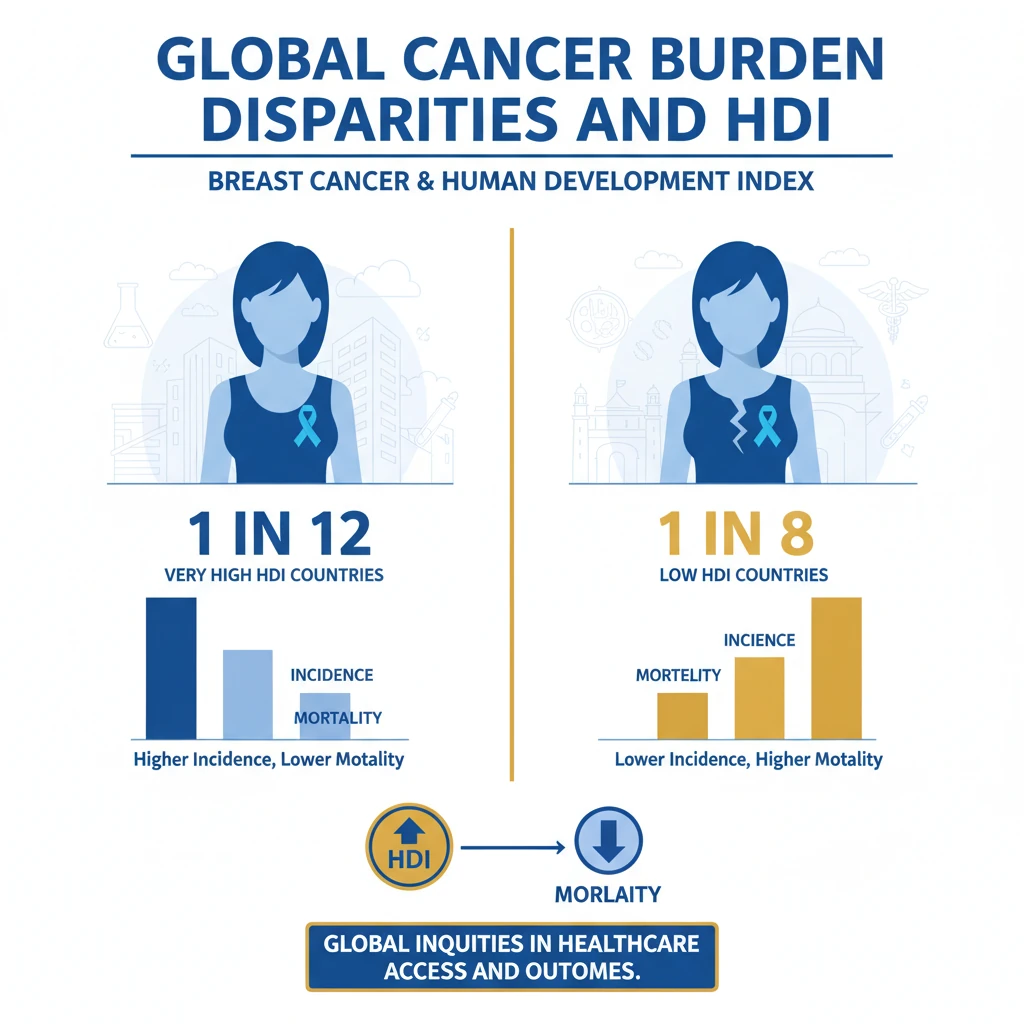
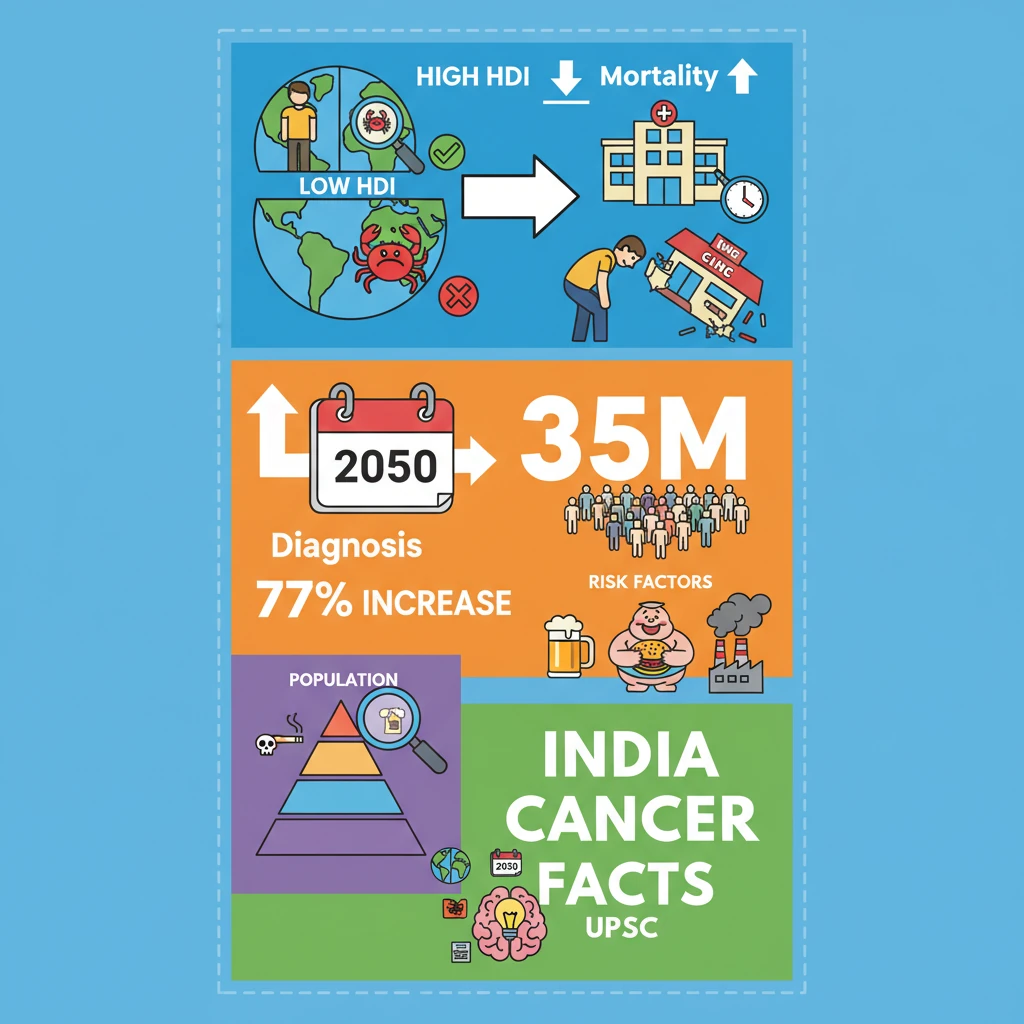
<h4>Global Cancer Burden Disparities and HDI</h4><p>The incidence and mortality rates of <strong>breast cancer</strong> show significant disparities based on a country's <strong>Human Development Index (HDI)</strong>. These differences highlight global inequities in healthcare access and outcomes.</p><div class='info-box'><p>In countries with a <strong>very high HDI</strong>, approximately <strong>1 in 12 women</strong> are diagnosed with <strong>breast cancer</strong> in their lifetime. The mortality rate is about <strong>1 in 71 women</strong>.</p></div><div class='info-box'><p>Conversely, in countries with a <strong>low HDI</strong>, only about <strong>1 in 27 women</strong> are diagnosed with <strong>breast cancer</strong>. However, the mortality rate is significantly higher, with <strong>1 in 48 women</strong> dying from the disease.</p></div><div class='key-point-box'><p>Women in <strong>lower HDI countries</strong> are <strong>50% less likely</strong> to be diagnosed with <strong>breast cancer</strong>. Despite this lower incidence, they face a <strong>much higher risk of dying</strong> due to factors like <strong>late diagnosis</strong> and <strong>inadequate access to quality treatment</strong>.</p></div><h4>Projected Global Cancer Burden Increase</h4><p>The global cancer burden is projected to increase substantially in the coming decades. This rise is attributed to a combination of demographic shifts and changing risk factor exposures.</p><div class='info-box'><p>Over <strong>35 million new cancer cases</strong> are predicted globally by <strong>2050</strong>. This represents a substantial <strong>77% increase</strong> from the estimated <strong>20 million cases in 2022</strong>.</p></div><p>The rapidly growing burden reflects both <strong>population ageing</strong> and <strong>growth</strong>. Additionally, changes in people’s exposure to various <strong>risk factors</strong>, often associated with <strong>socioeconomic development</strong>, play a crucial role.</p><h4>Key Risk Factors for Cancer</h4><p>Several factors contribute significantly to the increasing incidence of cancer worldwide. These include lifestyle choices and environmental exposures.</p><ul><li><strong>Tobacco</strong> use is a major contributor to cancer development.</li><li><strong>Alcohol consumption</strong> is another significant risk factor.</li><li><strong>Obesity</strong> is increasingly recognized as a key driver of cancer incidence.</li><li><strong>Air pollution</strong> remains a critical environmental risk factor, contributing to various cancers.</li></ul><p>In terms of absolute burden, <strong>high HDI countries</strong> are expected to experience the greatest increase. An additional <strong>4.8 million new cases</strong> are predicted in these nations by <strong>2050</strong> compared to <strong>2022</strong> estimates.</p><h4>Call for Global Action</h4><p>Addressing the escalating global cancer burden requires concerted international efforts. A focus on equity and access to care is paramount.</p><div class='exam-tip-box'><p><strong>UPSC Mains GS-II (Health)</strong>: Questions on health inequities and global health initiatives often link to such data. Emphasize the need for policy interventions.</p></div><p>There is an urgent need for significant <strong>investments</strong> to tackle <strong>global inequities in cancer outcomes</strong>. Ensuring access to <strong>affordable, quality cancer care</strong> for all individuals is crucial.</p><p>This access must be universal, regardless of an individual's <strong>geographical location</strong> or <strong>socioeconomic status</strong>.</p><h4>Key Findings Related to India's Cancer Burden</h4><p>India contributes significantly to the global cancer burden, with specific patterns observed in its population.</p><div class='info-box'><p><strong>India</strong> reported <strong>1,413,316 new cancer cases</strong> in <strong>2022</strong>. There was a slightly higher proportion of <strong>female patients</strong> (<strong>722,138 women</strong>) compared to <strong>men</strong> (<strong>691,178 men</strong>).</p></div><div class='highlight-box'><p><strong>Breast cancer</strong> had the highest proportion in India, accounting for <strong>192,624 new cases</strong>. This represents <strong>13.6% of all cancer patients</strong> and over <strong>26% of all cancer cases in women</strong>.</p></div>
💡 Key Takeaways
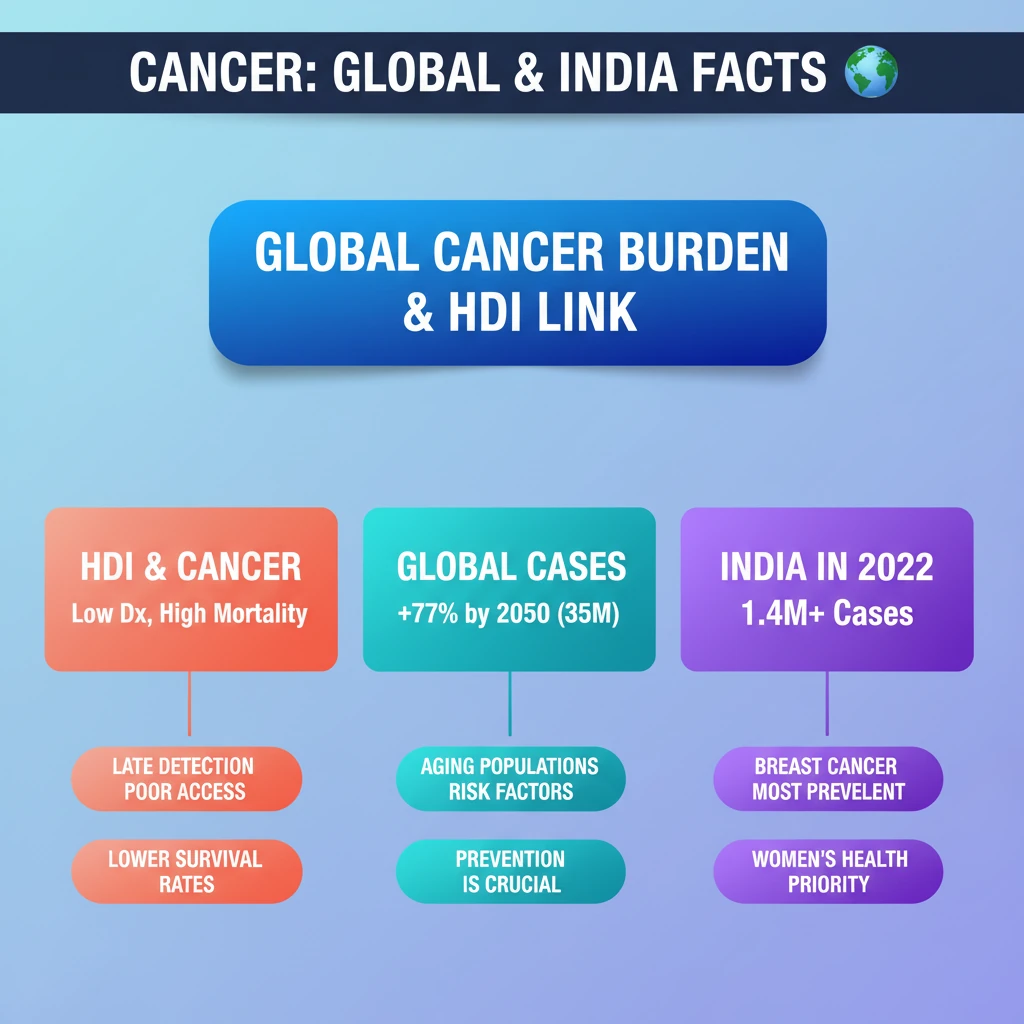
- •Cancer incidence and mortality vary significantly with a country's HDI.
- •Lower HDI countries have lower diagnosis rates but higher mortality due to late detection and poor access to care.
- •Global cancer cases are projected to increase by 77% by 2050 (35M cases), driven by aging populations and risk factors.
- •Key risk factors include tobacco, alcohol, obesity, and air pollution.
- •India reported over 1.4 million new cases in 2022, with breast cancer being the most prevalent, especially among women.
- •Urgent global investment is needed to address inequities in cancer care access.
🧠 Memory Techniques
95% Verified Content
📚 Reference Sources
•World Health Organization (WHO) reports on cancer burden and NCDs
•International Agency for Research on Cancer (IARC) data