Leprosy in India: Status, Initiatives, and Global Strategies - Social Issues | UPSC Learning
Topics
0 topics • 0 completed
🔍
No topics match your search
Leprosy in India: Status, Initiatives, and Global Strategies
Medium⏱️ 6 min read
social issues
📖 Introduction
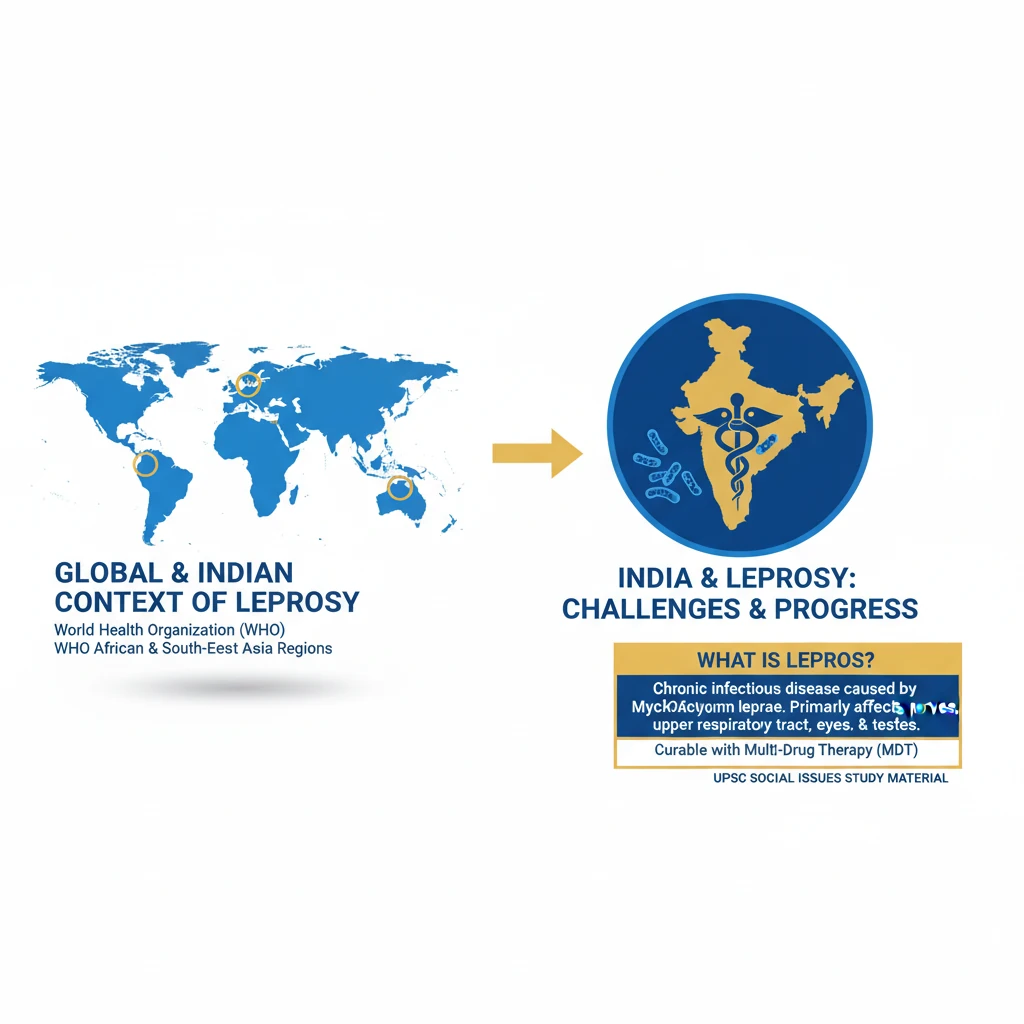
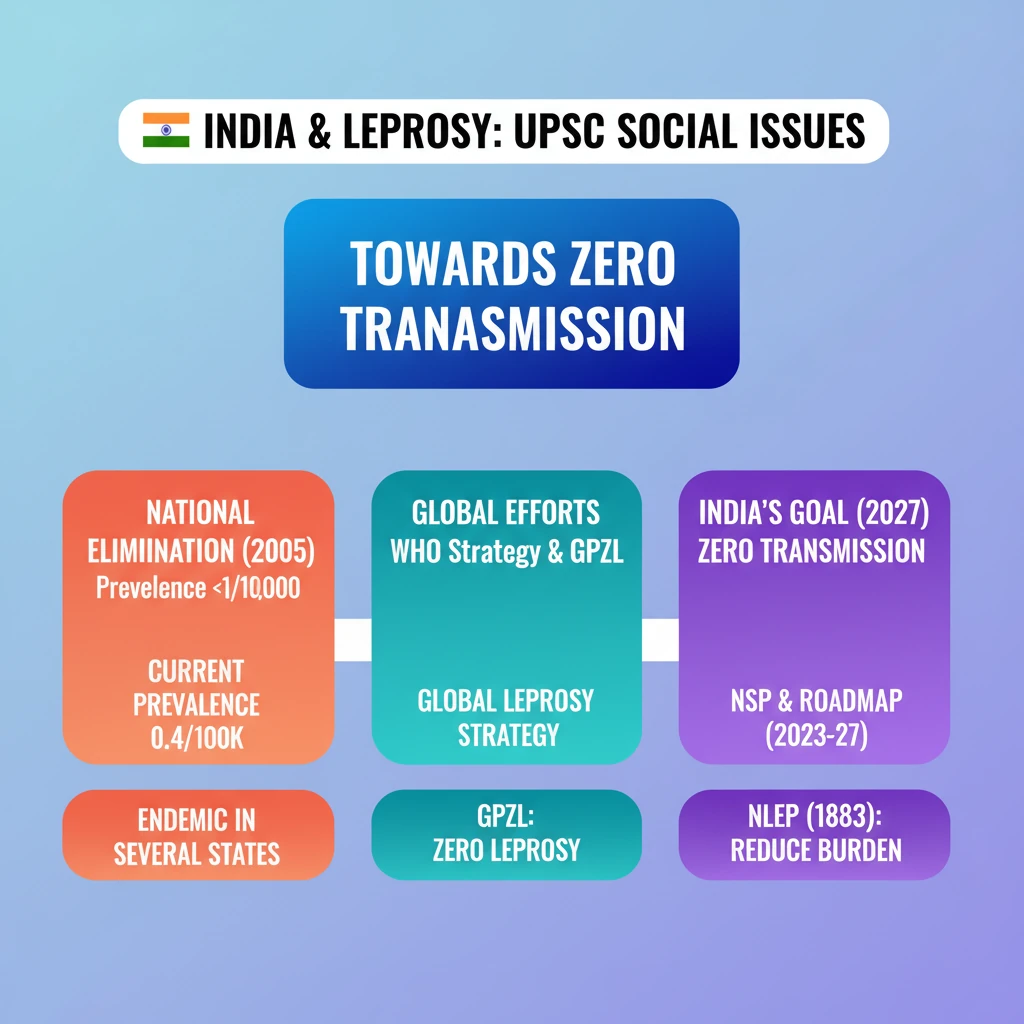
<h4>Global and Indian Context of Leprosy</h4><p>The <strong>World Health Organization (WHO)</strong> identifies several countries with high rates of new <strong>leprosy</strong> cases, predominantly located in the <strong>WHO African</strong> and <strong>South-East Asia Regions</strong>. This highlights the continued global challenge posed by the disease.</p><div class='info-box'><p><strong>Leprosy</strong> is a chronic infectious disease caused by <strong>Mycobacterium leprae</strong>, primarily affecting the skin, peripheral nerves, upper respiratory tract, eyes, and testes.</p></div><h4>India's Achievement and Current Status</h4><p><strong>India</strong> successfully achieved the <strong>elimination of leprosy as a public health problem</strong> in <strong>2005</strong>. This milestone was reached according to <strong>WHO criteria</strong>, which defines elimination as a prevalence rate of less than <strong>1 case per 10,000 population</strong> at the national level.</p><p>Despite this national achievement, <strong>leprosy</strong> remains <strong>endemic</strong> in several states and union territories across <strong>India</strong>. This indicates pockets where the disease still poses a significant health challenge.</p><div class='info-box'><p>The current <strong>prevalence rate of leprosy</strong> in <strong>India</strong> is recorded at <strong>0.4 per 10,000 population</strong>. This figure underscores the ongoing need for targeted interventions.</p></div><h4>Global Initiatives Against Leprosy</h4><p>International bodies and partnerships play a crucial role in the global fight against <strong>leprosy</strong>. These initiatives aim to coordinate efforts, provide strategic direction, and mobilize resources.</p><ul><li><strong>The Global Leprosy Strategy (2016–2020)</strong>: Launched by <strong>WHO</strong>, this strategy aimed to revitalize efforts in <strong>leprosy control</strong> and prevent disabilities, especially among children in endemic countries.</li><li><strong>Global Partnership for Zero Leprosy (GPZL)</strong>: This is a collaborative coalition of individuals and organizations dedicated to achieving the ultimate goal of ending <strong>leprosy</strong> worldwide.</li><li><strong>World Leprosy Day</strong>: An annual observance that raises awareness about <strong>leprosy</strong> and calls for an end to the stigma and discrimination associated with the disease.</li></ul><h4>India's National Initiatives Against Leprosy</h4><p><strong>India</strong> has implemented robust national programs and strategic plans to further reduce the burden of <strong>leprosy</strong> and move towards complete eradication.</p><ul><li><strong>National Strategic Plan (NSP) & Roadmap for Leprosy (2023-27)</strong>: This ambitious plan was launched with the specific goal of achieving <strong>zero transmission of leprosy by 2027</strong>. This target is set three years ahead of the relevant <strong>Sustainable Development Goal (SDG)</strong>.</li></ul><div class='info-box'><p><strong>SDG 3.3</strong> aims to end the epidemics of <strong>AIDS, tuberculosis, malaria, and neglected tropical diseases</strong> by <strong>2030</strong>, and combat <strong>hepatitis, water-borne diseases</strong>, and other communicable diseases.</p></div><ul><li><strong>National Leprosy Eradication Programme (NLEP)</strong>: Introduced in <strong>1983</strong>, the <strong>NLEP</strong> is a <strong>Centrally Sponsored Health Scheme</strong>. Its primary objectives include reducing disease burden, preventing disabilities, and enhancing public awareness about <strong>leprosy</strong> and its curability.</li></ul><div class='exam-tip-box'><p>For UPSC, understanding the distinction between <strong>'elimination as a public health problem'</strong> and <strong>'zero transmission'</strong> is crucial. Also, note the alignment of national goals with global <strong>SDGs</strong>.</p></div>
💡 Key Takeaways
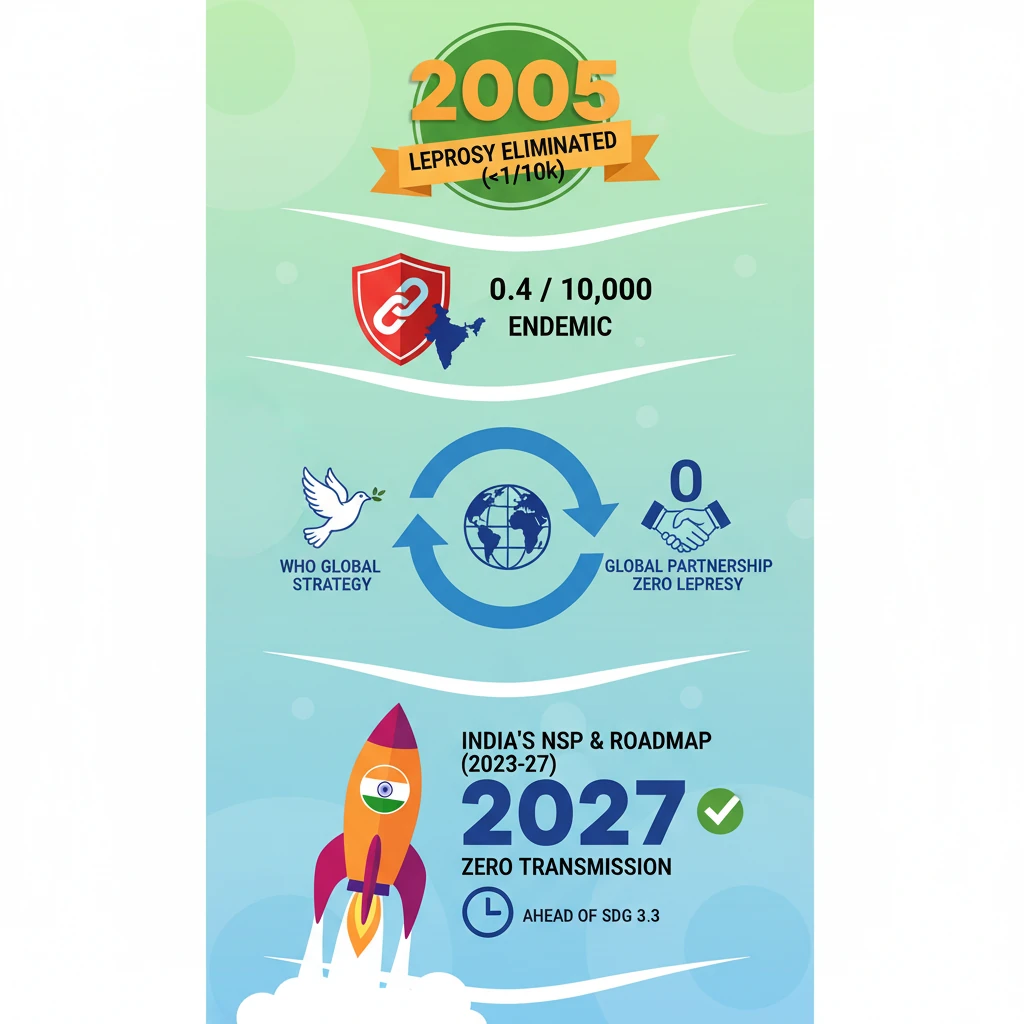
- •India achieved national leprosy elimination (prevalence <1/10,000) in 2005.
- •Leprosy remains endemic in several Indian states/UTs, with a current prevalence of 0.4 per 10,000.
- •Global initiatives include WHO's Global Leprosy Strategy and Global Partnership for Zero Leprosy (GPZL).
- •India's National Strategic Plan (NSP) & Roadmap (2023-27) aims for zero transmission by 2027, ahead of SDG 3.3.
- •The National Leprosy Eradication Programme (NLEP), launched in 1983, focuses on reducing disease burden, preventing disability, and raising awareness.
🧠 Memory Techniques
95% Verified Content