What is the Universal Immunisation Programme (UIP)? - Social Issues | UPSC Learning
Topics
0 topics • 0 completed
🔍
No topics match your search
What is the Universal Immunisation Programme (UIP)?
Medium⏱️ 7 min read
social issues
📖 Introduction
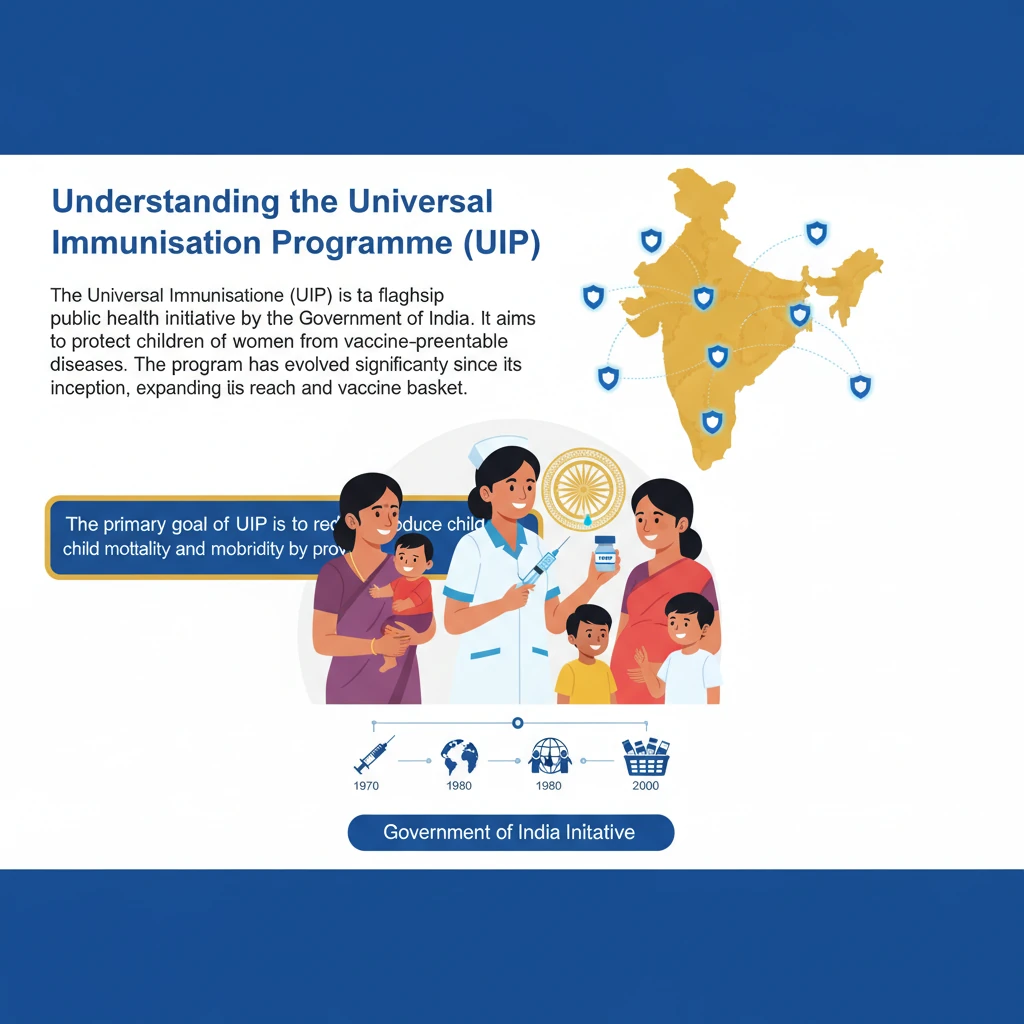
<h4>Understanding the Universal Immunisation Programme (UIP)</h4><p>The <strong>Universal Immunisation Programme (UIP)</strong> is a flagship public health initiative by the Government of India. It aims to protect children and pregnant women from vaccine-preventable diseases. The program has evolved significantly since its inception, expanding its reach and vaccine basket.</p><div class='key-point-box'><p>The primary goal of <strong>UIP</strong> is to reduce child mortality and morbidity by providing free vaccination against <strong>12 vaccine-preventable diseases</strong>.</p></div><h4>Current Status and Key Achievements</h4><p>India has made significant strides in public health through its robust immunization efforts. These achievements highlight the program's effectiveness and national commitment to health.</p><div class='info-box'><ul><li>India was certified <strong>polio-free</strong> in <strong>2014</strong>, a monumental achievement in global health.</li><li>The country successfully eliminated <strong>maternal and neonatal tetanus</strong> in <strong>2015</strong>, protecting mothers and newborns.</li></ul></div><h4>Introduction of New Vaccines</h4><p>The <strong>UIP</strong> continuously updates its vaccine portfolio to combat emerging and prevalent diseases. This ensures comprehensive protection for the target population.</p><div class='info-box'><p>New vaccines introduced and expanded nationwide include:</p><ul><li><strong>Measles-Rubella (MR) Vaccine</strong></li><li><strong>Pneumococcal Conjugate Vaccine (PCV)</strong></li><li><strong>Rotavirus Vaccine (RVV)</strong></li></ul></div><h4>Immunisation Coverage and Challenges</h4><p>Despite significant progress, challenges in achieving full immunization coverage persist. Efforts are continuously being made to bridge these gaps and reach every eligible child.</p><div class='info-box'><p>According to <strong>UNICEF</strong>, only <strong>65%</strong> of children in India receive full immunisation during their first year of life.</p></div><h4>Addressing Zero-Dose Children</h4><p>A major focus of the <strong>UIP</strong> is to reach <strong>zero-dose (ZD) children</strong>, who are those who have not received any routine vaccination. Targeted campaigns are crucial for this.</p><div class='info-box'><p>As per <strong>WU-ENIC (WHO-UNICEF Estimates National Immunization Coverage)</strong>, India reduced the number of <strong>zero-dose children</strong> to <strong>1.1 million in 2022</strong> from <strong>2.7 million in 2021</strong>, vaccinating an additional <strong>1.6 million children</strong>.</p></div><p>A significant proportion of these <strong>zero-dose children</strong> are concentrated in specific states, requiring focused interventions.</p><div class='info-box'><p><strong>63%</strong> of <strong>ZD children</strong> reside in five states:</p><ul><li><strong>Bihar</strong></li><li><strong>Madhya Pradesh</strong></li><li><strong>Maharashtra</strong></li><li><strong>Rajasthan</strong></li><li><strong>Uttar Pradesh</strong></li></ul></div><h4>Mission Indradhanush (MI)</h4><p>To accelerate the pace of immunization and ensure no child is left behind, targeted missions have been launched under the <strong>UIP</strong>.</p><div class='key-point-box'><p><strong>Mission Indradhanush (MI)</strong> was launched in <strong>2014</strong> by the <strong>Ministry of Health and Family Welfare (MoHFW)</strong>. Its aim is to vaccinate all <strong>unvaccinated and partially vaccinated children</strong> under the <strong>UIP</strong>.</p></div><h4>Intensified Mission Indradhanush (IMI)</h4><p>Building on the success of <strong>MI</strong>, an intensified version was introduced to further reduce the number of <strong>zero-dose children</strong> and improve overall coverage.</p><div class='key-point-box'><p><strong>Intensified Mission Indradhanush (IMI)</strong> has been launched specifically to bring down the number of <strong>zero-dose children</strong> even further, ensuring equitable access to life-saving vaccines.</p></div><h4>Other Supporting Measures</h4><p>Technological advancements and robust management systems play a vital role in the efficient delivery of vaccines across the country.</p><ul><li><strong>Electronic Vaccine Intelligence Network (eVIN)</strong>: A real-time system for vaccine stock management and temperature monitoring.</li><li><strong>National Cold Chain Management Information System (NCCMIS)</strong>: Ensures the integrity of the vaccine cold chain from manufacturing to the last mile.</li></ul><div class='exam-tip-box'><p>For <strong>UPSC Mains (GS-II)</strong>, understanding the evolution of <strong>UIP</strong>, its achievements, challenges, and specific initiatives like <strong>Mission Indradhanush</strong> is crucial for questions on government policies and health programs.</p></div>
💡 Key Takeaways
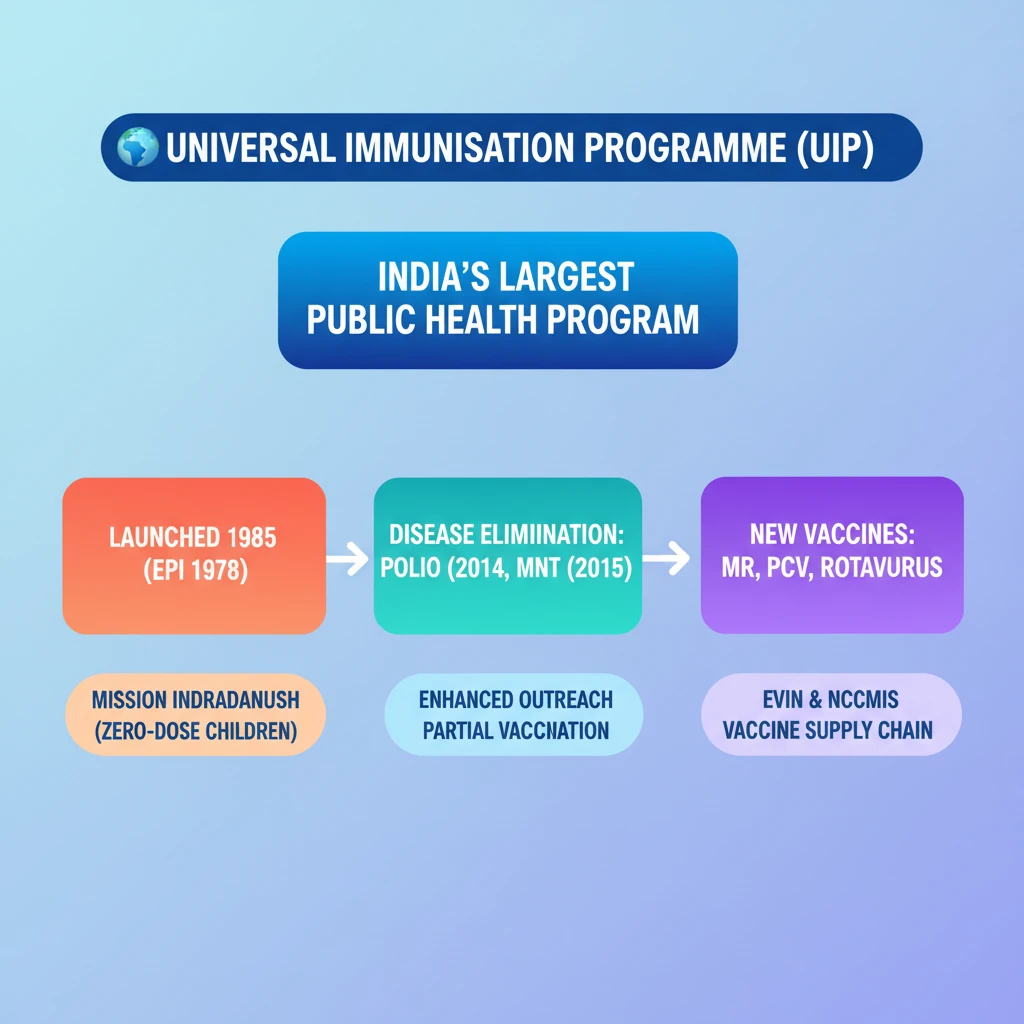
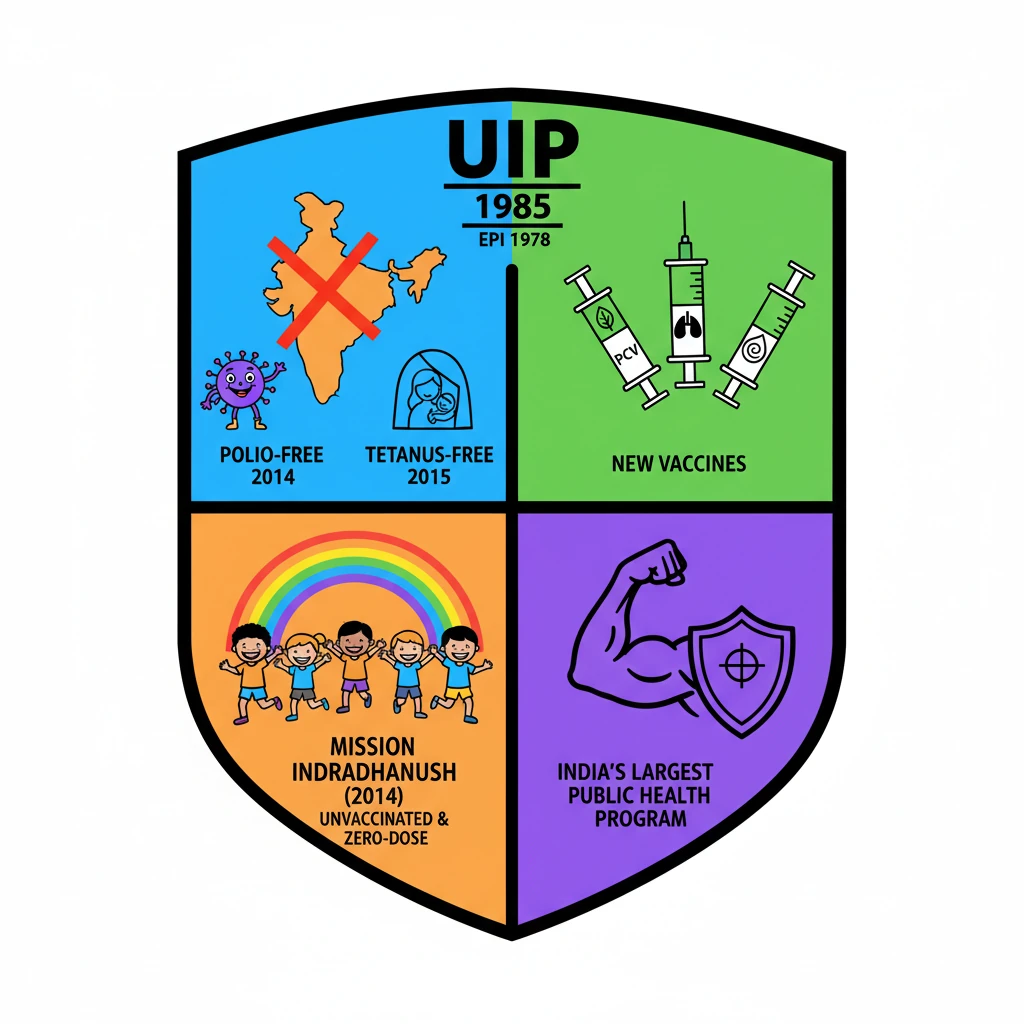
- •UIP is India's largest public health program for vaccine-preventable diseases, launched in 1985 (evolved from EPI 1978).
- •India achieved polio-free status in 2014 and eliminated maternal/neonatal tetanus in 2015.
- •New vaccines like Measles-Rubella, PCV, and Rotavirus Vaccine have been introduced.
- •Mission Indradhanush (2014) and Intensified Mission Indradhanush aim to vaccinate unvaccinated/partially vaccinated and zero-dose children.
- •Supporting measures include eVIN and NCCMIS for efficient vaccine delivery and cold chain management.
- •Despite progress, 65% full immunization coverage and concentration of zero-dose children in 5 states remain challenges.
🧠 Memory Techniques
95% Verified Content