What is India’s Approach to Tribal Development Policy? - Social Issues | UPSC Learning
Topics
0 topics • 0 completed
🔍
No topics match your search
What is India’s Approach to Tribal Development Policy?
Medium⏱️ 5 min read
social issues
📖 Introduction
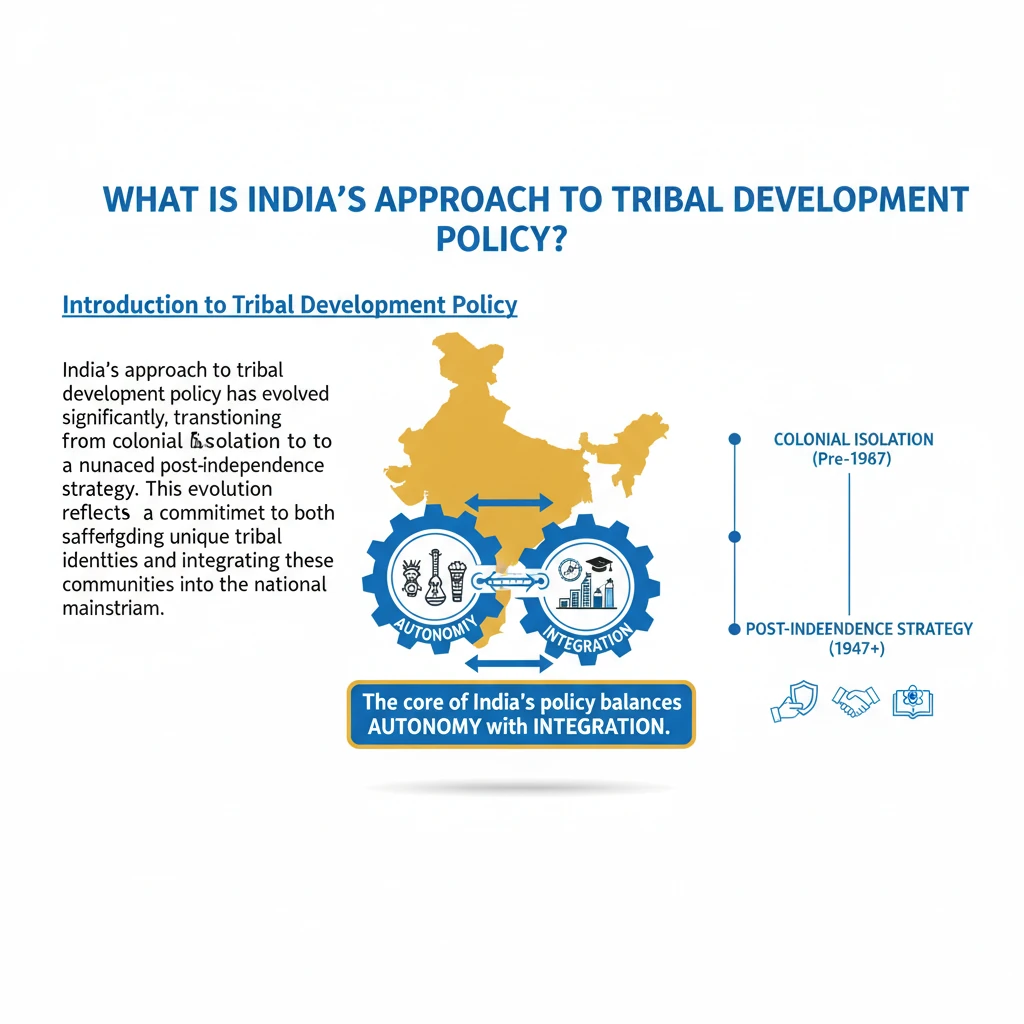
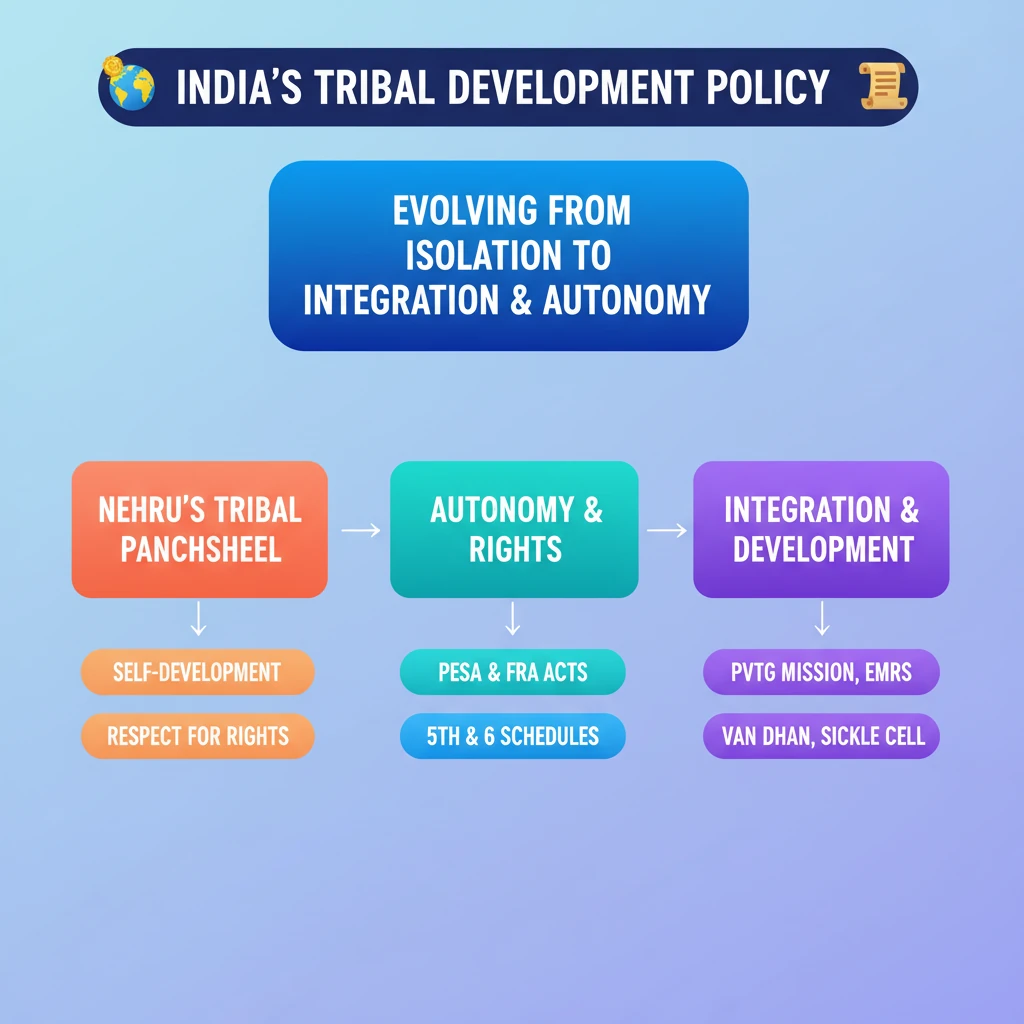
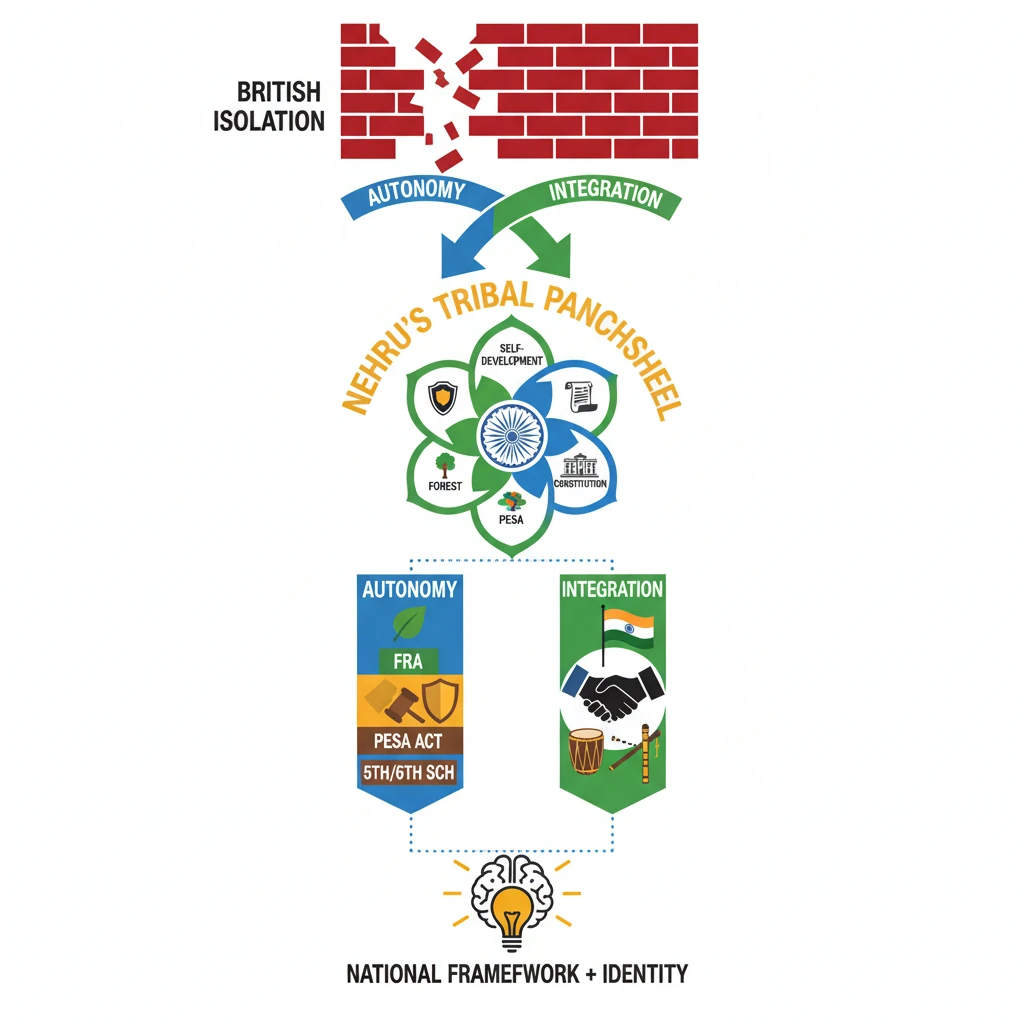
<h4>Introduction to Tribal Development Policy</h4><p>India's approach to <strong>tribal development policy</strong> has evolved significantly, transitioning from colonial isolation to a nuanced post-independence strategy.</p><p>This evolution reflects a commitment to both safeguarding unique tribal identities and integrating these communities into the national mainstream.</p><div class='key-point-box'><p>The core of India's policy balances <strong>autonomy</strong> with <strong>integration</strong>, recognizing the distinct cultural heritage and rights of tribal populations.</p></div><h4>Pre-Independence Approach: Isolation and Protection</h4><p>During the British colonial era, an <strong>isolationist approach</strong> was predominantly enforced for tribal areas.</p><p>These regions were often classified as <strong>“Excluded”</strong> or <strong>“Partially Excluded” zones</strong> to maintain law and order and minimize external interference.</p><div class='info-box'><ul><li><strong>Scheduled District Act, 1874 (Act XIV)</strong>: Introduced to exempt certain tribal areas from regular laws.</li><li><strong>Purpose</strong>: Primarily aimed at protecting tribal communities from exploitation by outsiders and preserving peace.</li></ul></div><h4>Post-Independence Paradigm: Autonomy and Integration</h4><p>After gaining independence, India's government adopted a dual strategy, focusing on both <strong>autonomy</strong> and <strong>integration</strong> for tribal communities.</p><p>This approach sought to empower tribals while ensuring their participation in national development.</p><h4>Policies Promoting Autonomy</h4><p>Several legislative and constitutional measures have been enacted to preserve <strong>tribal self-governance</strong> and cultural integrity.</p><p>These policies aim to ensure minimal interference in their traditional practices and affirm their rights over natural resources.</p><div class='key-point-box'><p>Key autonomy-oriented policies include the <strong>Panchayats (Extension to the Scheduled Areas) Act, 1996 (PESA)</strong> and the <strong>Forest Rights Act, 2006</strong>.</p></div><div class='info-box'><p><strong>Constitutional Safeguards</strong>:</p><ul><li><strong>Fifth Schedule</strong>: Deals with administration and control of Scheduled Areas and Scheduled Tribes in any state except Assam, Meghalaya, Tripura, and Mizoram.</li><li><strong>Sixth Schedule</strong>: Provides for the administration of tribal areas in Assam, Meghalaya, Tripura, and Mizoram, granting significant autonomy to District Councils.</li></ul></div><h4>Policies Fostering Integration</h4><p>The integration-oriented policy seeks to incorporate tribal communities into the broader national framework without eroding their distinct identity and autonomy.</p><p>This approach is deeply influenced by the vision of India's first Prime Minister.</p><div class='key-point-box'><p>The policy is guided by <strong>Jawaharlal Nehru’s Tribal Panchsheel policy</strong>, a five-point framework for tribal development.</p></div><div class='info-box'><p><strong>Nehru's Tribal Panchsheel Principles</strong>:</p><ol><li>Tribals should develop along the lines of their own genius.</li><li>Tribal rights in land and forests should be respected.</li><li>We should try to train and build up a team of their own people to do the work of administration and development.</li><li>We should not over-administer these areas or overwhelm them with a multiplicity of schemes.</li><li>We should judge results not by statistics or the amount of money spent, but by the quality of human character that is evolved.</li></ol></div><h4>Recent Initiatives for Integration and Development</h4><p>The government has launched several contemporary programs to further integrate and uplift tribal communities, addressing various aspects of their well-being.</p><p>These initiatives aim to bridge developmental gaps and improve quality of life.</p><div class='exam-tip-box'><p>Remember these recent initiatives for Mains answers, especially in <strong>GS Paper I (Social Issues)</strong> and <strong>GS Paper II (Governance)</strong>.</p></div><div class='info-box'><p><strong>Key Recent Initiatives</strong>:</p><ul><li><strong>Pradhan Mantri Particularly Vulnerable Tribal Group (PVTG) Development Mission</strong>: Focuses on the holistic development of the most vulnerable tribal groups.</li><li><strong>Eklavya Model Residential Schools (EMRS)</strong>: Aims to provide quality education to tribal children in remote areas.</li><li><strong>Pradhan Mantri Van Dhan Yojana</strong>: Promotes value addition, branding, and marketing of Minor Forest Produce (MFP) collected by tribals.</li><li><strong>Mission to eliminate sickle cell anaemia</strong>: A health initiative specifically targeting tribal populations who are disproportionately affected by the disease.</li></ul></div>
💡 Key Takeaways
- •India's tribal policy evolved from British isolation to a post-independence dual approach of autonomy and integration.
- •Post-independence policy is guided by Nehru's Tribal Panchsheel principles, emphasizing self-development and respect for rights.
- •Key autonomy measures include PESA Act, Forest Rights Act, and constitutional safeguards (Fifth & Sixth Schedules).
- •Integration aims to incorporate tribals into the national framework while preserving their identity.
- •Recent initiatives like PVTG Mission, EMRS, Van Dhan Yojana, and sickle cell anaemia mission address current developmental needs.
🧠 Memory Techniques
95% Verified Content