Rights Of Forest Dwellers and Thanthattai Periyar Sanctuary - Social Issues | UPSC Learning
Topics
0 topics • 0 completed
🔍
No topics match your search
Rights Of Forest Dwellers and Thanthattai Periyar Sanctuary
Medium⏱️ 8 min read
social issues
📖 Introduction
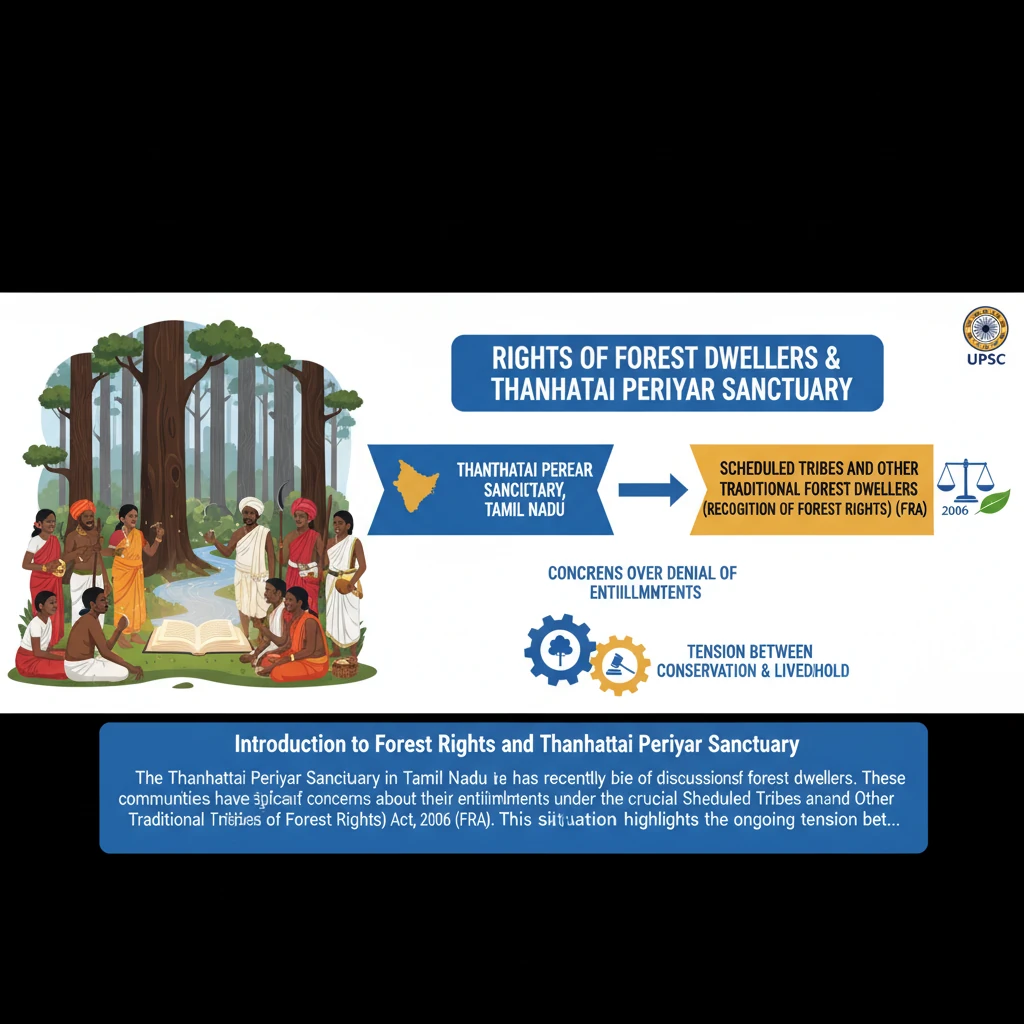
<h4>Introduction to Forest Rights and Thanthattai Periyar Sanctuary</h4><p>The **Thanthattai Periyar Sanctuary** in **Tamil Nadu** has recently been the focus of discussions concerning the **rights of forest dwellers**. These communities have voiced significant concerns about the potential denial of their entitlements under the crucial **Scheduled Tribes and Other Traditional Forest Dwellers (Recognition of Forest Rights) Act, 2006 (FRA)**.</p><p>This situation highlights the ongoing tension between conservation efforts and the recognition of indigenous rights. Understanding the **FRA** is vital for comprehending these complex social and environmental issues.</p><h4>The Forest Rights Act (FRA), 2006: An Overview</h4><div class='info-box'><p>The **FRA, 2006**, formally known as the **Scheduled Tribes and Other Traditional Forest Dwellers (Recognition of Forest Rights) Act**, is a landmark legislation in India. It aims to acknowledge and vest **forest rights** and **occupation** in **forest-dwelling Scheduled Tribes** and **other traditional forest dwellers** who have been residing in such forests for generations but whose rights could not be recorded.</p></div><p>The Act seeks to rectify the **historical injustice** faced by these communities. It recognizes their deep-rooted **symbiotic relationship** with forests, a connection often overlooked by previous forest management policies and laws.</p><h4>Key Rights Granted Under FRA, 2006</h4><p>The **FRA** provides a comprehensive framework for recognizing various types of rights. These are broadly categorized into **individual rights** and **collective or community rights**.</p><ul><li><strong>Individual Rights:</strong> These include the right to **self-cultivation** for livelihood and the right to **habitation** within forest lands.</li><li><strong>Collective or Community Rights:</strong> These are crucial for the sustenance of forest communities. They encompass rights such as **grazing**, **fishing**, and **access to water bodies**.</li><li><strong>Traditional Resource Access:</strong> The Act specifically acknowledges **traditional seasonal resource access** for **nomadic and pastoral communities**, ensuring their continued way of life.</li></ul><div class='key-point-box'><p>The **FRA** also extends recognition to the rights of **Particularly Vulnerable Tribal Groups (PVTGs)**. It safeguards their **intellectual property rights**, **customary rights**, and the vital **right to protect, regenerate, or manage community forest resources sustainably**.</p></div><p>Furthermore, the Act facilitates the allocation of **forest land for developmental purposes**. This ensures that the **basic infrastructural needs** of **forest-dwelling communities** can be met, promoting their overall well-being and progress.</p><h4>Legal Safeguards and Implementation</h4><p>The **FRA** works in conjunction with other significant legislation to provide robust protection. It complements the **Right to Fair Compensation and Transparency in Land Acquisition, Rehabilitation and Settlement Act of 2013**.</p><p>This synergy ensures that **forest dwellers** are safeguarded from **eviction** without proper **rehabilitation and settlement**, upholding their fundamental rights to land and livelihood.</p><h4>Central Role of the Gram Sabha</h4><p>A cornerstone of the **FRA** is the empowered role of the **Gram Sabha (village assembly)**. This body is central to the implementation of the Act, acting as the primary authority for decision-making at the local level.</p><p>The **Gram Sabha** is empowered to have a decisive say in determining **local policies and schemes** that directly impact tribal populations. This ensures a bottom-up approach to governance and resource management.</p><div class='exam-tip-box'><p>For **UPSC Mains**, understanding the **Gram Sabha's** role under **FRA** is crucial. It reflects **decentralization of power** and **participatory governance**, key themes in **GS-II**.</p></div><p>Crucially, the **FRA** requires and authorizes the **Gram Sabha** to determine and recognize **forest rights**. It also mandates the **Gram Sabha** to protect and preserve the forests, wildlife, and biodiversity within their customary and traditional boundaries, even inside **Protected Areas**.</p><h4>Legal Recourse for Violations</h4><p>Violations of the **FRA**, particularly concerning **Scheduled Tribes**, are taken seriously under Indian law. The **2016 amendment** to the **Scheduled Castes and the Scheduled Tribes (Prevention of Atrocities) Act of 1989** categorizes such violations as crimes.</p><p>This legal provision provides an additional layer of protection, ensuring that the rights of **forest dwellers** are not infringed upon with impunity.</p><h4>Forest Villages to Revenue Villages</h4><p>The **FRA** also includes a significant provision regarding land status. It states that converting **forest villages** into **revenue villages** is one of the recognized **forest rights** of **forest-dwelling Scheduled Tribes** and **other traditional forest dwellers**.</p>
💡 Key Takeaways
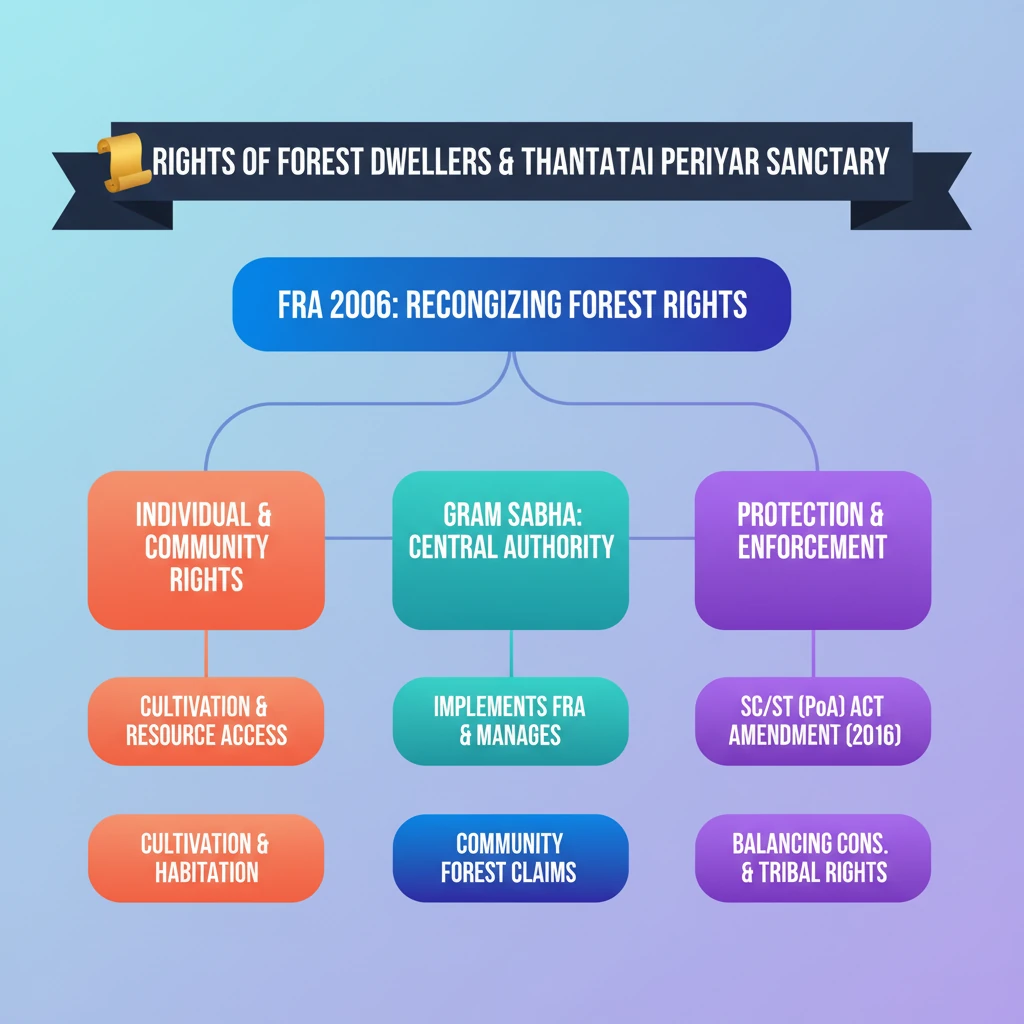
- •FRA 2006 recognizes and vests forest rights, rectifying historical injustice to forest dwellers.
- •Grants both individual (cultivation, habitation) and community rights (grazing, fishing, resource access).
- •Empowers Gram Sabha as the central authority for implementing FRA and managing forest resources.
- •Violations against Scheduled Tribes under FRA are criminalized by the 2016 SC/ST (PoA) Act amendment.
- •Ongoing challenges exist in balancing conservation (e.g., sanctuaries) with FRA implementation and tribal rights.
🧠 Memory Techniques

95% Verified Content
📚 Reference Sources
•The Scheduled Tribes and Other Traditional Forest Dwellers (Recognition of Forest Rights) Act, 2006
•Madras High Court Orders (March 2022 related to cattle grazing, as reported in news summaries)