Nicobarese Tribe - Social Issues | UPSC Learning
Topics
0 topics • 0 completed
🔍
No topics match your search
Nicobarese Tribe
Medium⏱️ 6 min read
social issues
📖 Introduction
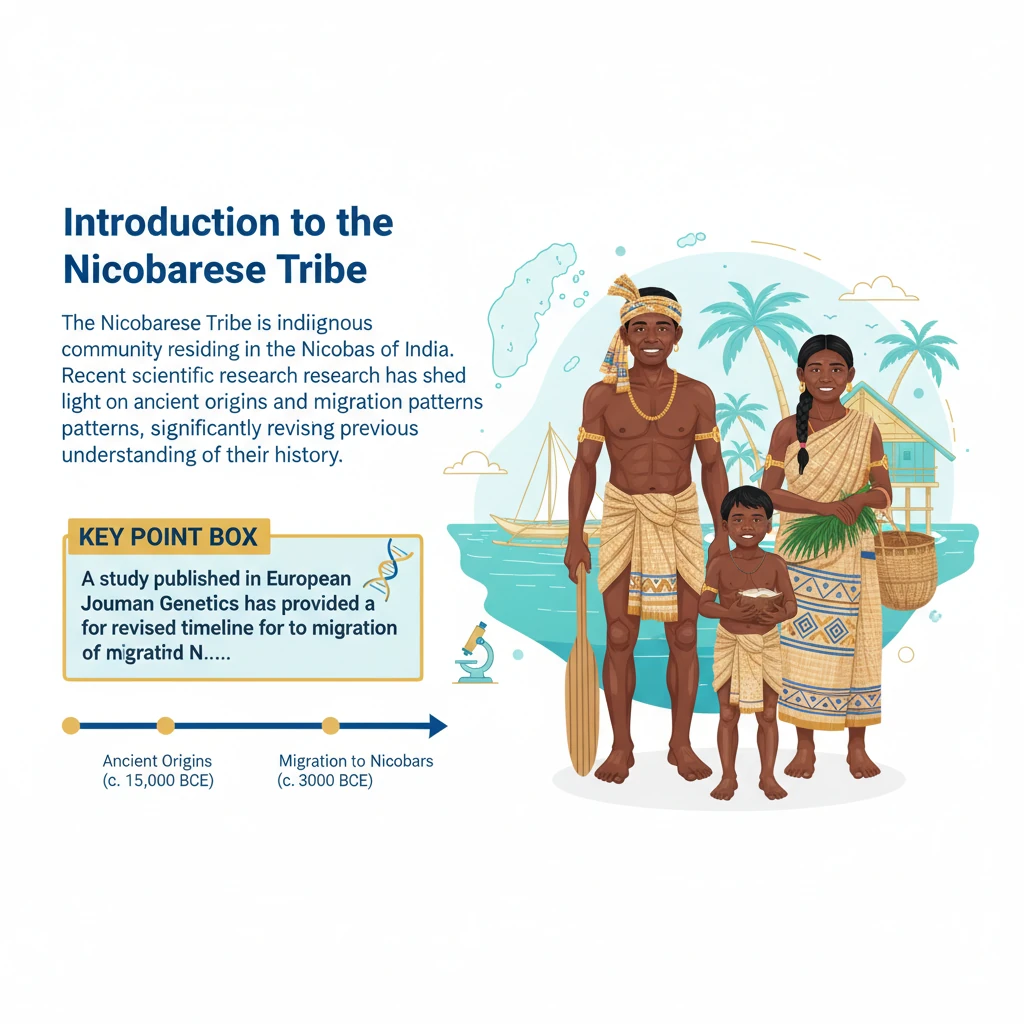
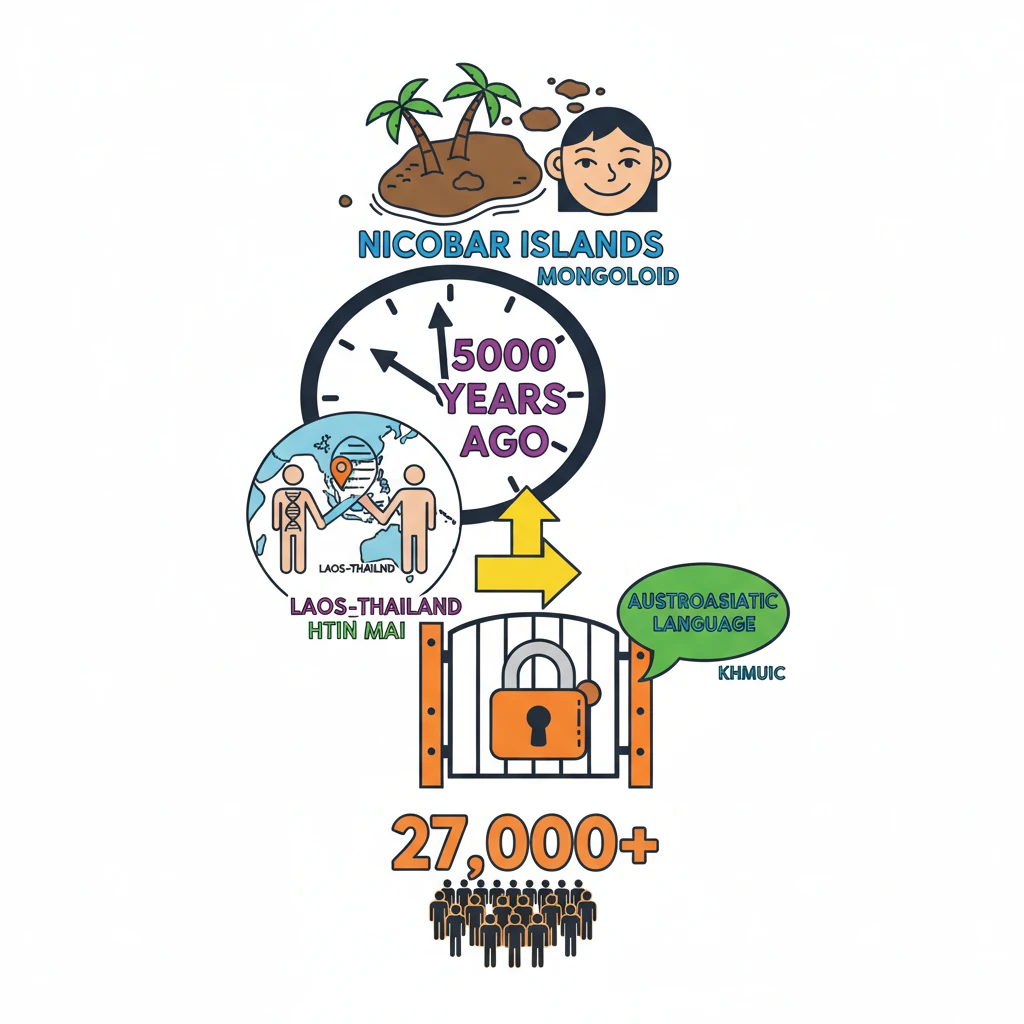
<h4>Introduction to the Nicobarese Tribe</h4><p>The <strong>Nicobarese Tribe</strong> is an indigenous community residing in the <strong>Nicobar Islands</strong> of India. Recent scientific research has shed new light on their ancient origins and migration patterns, significantly revising previous understandings of their history.</p><div class='key-point-box'><p>A study published in the <strong>European Journal of Human Genetics</strong> has provided a revised timeline for the migration of the Nicobarese to the islands, offering deeper insights into their genetic and linguistic heritage.</p></div><h4>Revised Migration Timeline</h4><p>Previous studies had estimated that the <strong>Austroasiatic</strong> ancestors of the Nicobarese arrived in the Nicobar Islands over <strong>11,000 years ago</strong>. This long-held belief has now been updated.</p><p>The new study, employing advanced <strong>deoxyribonucleic acid (DNA) analysis</strong>, has corrected this estimate. The revised timeline suggests their arrival was approximately <strong>5,000 years ago</strong>, a significant adjustment to their historical narrative.</p><h4>Genetic Link and Ancestral Ties</h4><p>The research established a clear <strong>genetic link</strong> for the Nicobarese. They share ancestral ties with the <strong>Htin Mai community</strong>, an ethnic group native to the <strong>Laos-Thailand region</strong>.</p><div class='info-box'><p>This finding strongly supports the hypothesis that the ancestors of the Nicobarese migrated from <strong>Southeast Asia</strong>, rather than the traditionally considered <strong>South Asia</strong>.</p></div><h4>Preservation of Genetic Identity</h4><p>Due to their significant <strong>geographical isolation</strong>, the Nicobarese have remarkably maintained their unique <strong>genetic identity</strong>. They have experienced minimal external influence over millennia.</p><p>This preservation has been crucial for researchers, enabling them to trace their ancestry with a high degree of precision and clarity.</p><h4>Linguistic Continuity</h4><p>Despite their deep genetic ties to Southeast Asia, the Nicobarese have also retained their original <strong>Austroasiatic language roots</strong>. Specifically, their language belongs to the <strong>Khmuic branch</strong>.</p><p>This linguistic continuity further reinforces their connection to other populations in <strong>Southeast Asia</strong>, highlighting a strong cultural and historical lineage.</p><h4>Geography of the Nicobarese Homeland</h4><p>The Nicobarese primarily inhabit the <strong>Nicobar Islands</strong>, which are situated in the <strong>Bay of Bengal</strong>. These islands form a crucial part of India’s <strong>Andaman and Nicobar Islands Union Territory</strong>.</p><div class='info-box'><p>The Nicobar Islands comprise <strong>19 islands</strong>. The major islands where the Nicobarese reside include <strong>Car Nicobar</strong>, <strong>Kamorta</strong>, <strong>Nancowrie</strong>, and <strong>Great Nicobar</strong>. These islands feature diverse terrains, encompassing both hilly and flat areas.</p></div><p><strong>Great Nicobar</strong> stands out as the southernmost and largest among the Nicobar Islands, playing a significant role in the tribe's habitat.</p><h4>Ethnic Classification and Population</h4><p>The Nicobarese belong to the <strong>Mongoloid ethnic group</strong>. Their population is substantial, numbering over <strong>27,000 individuals</strong>.</p><p>While they are not formally divided into distinct tribes, the Nicobarese are categorized into <strong>six territorial groups</strong> based on their island habitation:</p><ul><li><strong>Car Nicobar</strong></li><li><strong>Chowra</strong></li><li><strong>Teressa with Bompoka</strong></li><li><strong>Central Group</strong></li><li><strong>Southern Group</strong></li><li>The <strong>Shompen</strong> (an inland tribe primarily found on Great Nicobar)</li></ul><h4>Social Structure</h4><p>The social organization of the Nicobarese is characterized by a <strong>patriarchal joint family system</strong>. This traditional structure is known as <strong>Tuhet</strong>.</p>
💡 Key Takeaways
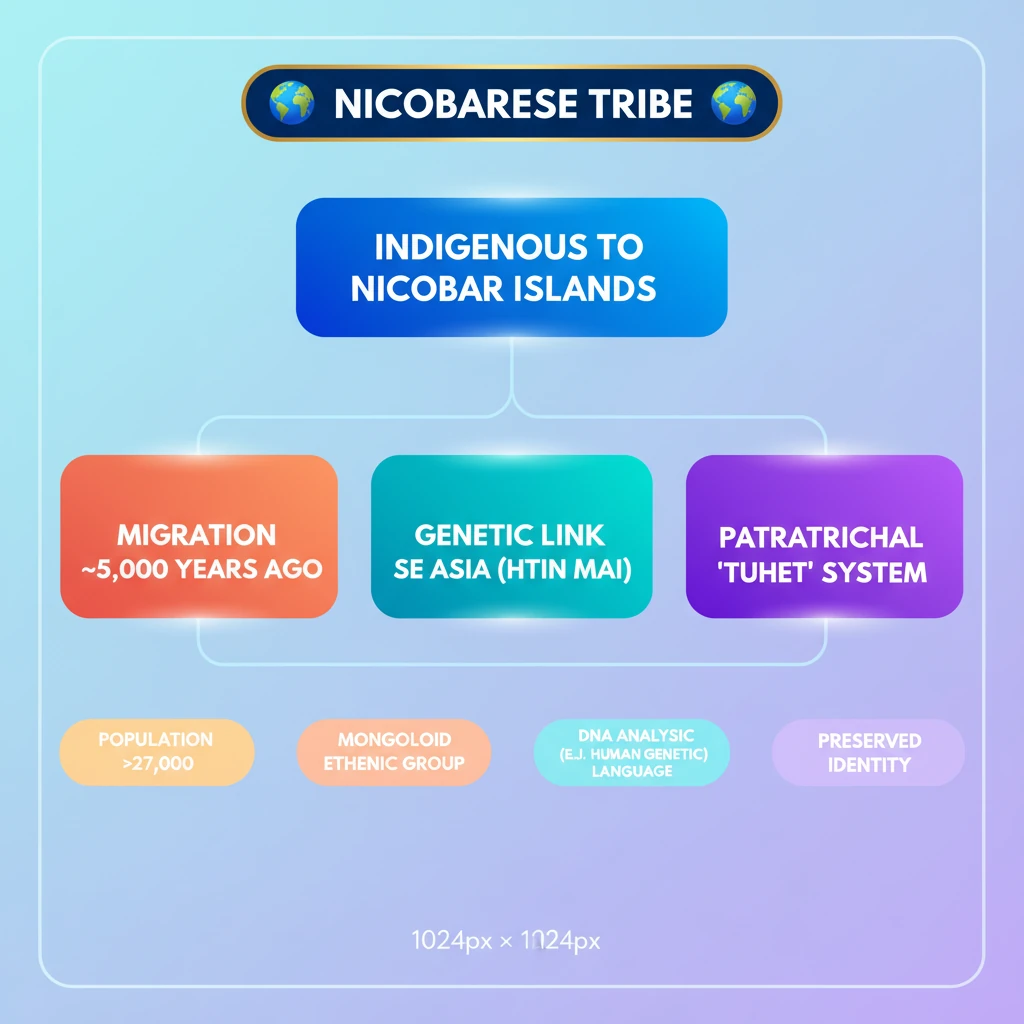
- •Nicobarese Tribe: Indigenous to Nicobar Islands, part of Mongoloid ethnic group, population over 27,000.
- •Recent study (European Journal of Human Genetics) revised their migration timeline from >11,000 years ago to ~5,000 years ago.
- •Genetic analysis (DNA) linked Nicobarese to Htin Mai community (Laos-Thailand), confirming Southeast Asian origin.
- •Geographical isolation helped preserve their distinct genetic and Austroasiatic linguistic identity (Khmuic branch).
- •Social structure is a patriarchal joint family system known as 'Tuhet'.
- •They are classified into six territorial groups across major islands like Car Nicobar, Great Nicobar (home to Shompen).
🧠 Memory Techniques
95% Verified Content
📚 Reference Sources
•European Journal of Human Genetics (as cited in the summary)