Global Polio Resurgence - Social Issues | UPSC Learning
Topics
0 topics • 0 completed
🔍
No topics match your search
Global Polio Resurgence
Medium⏱️ 8 min read
social issues
📖 Introduction
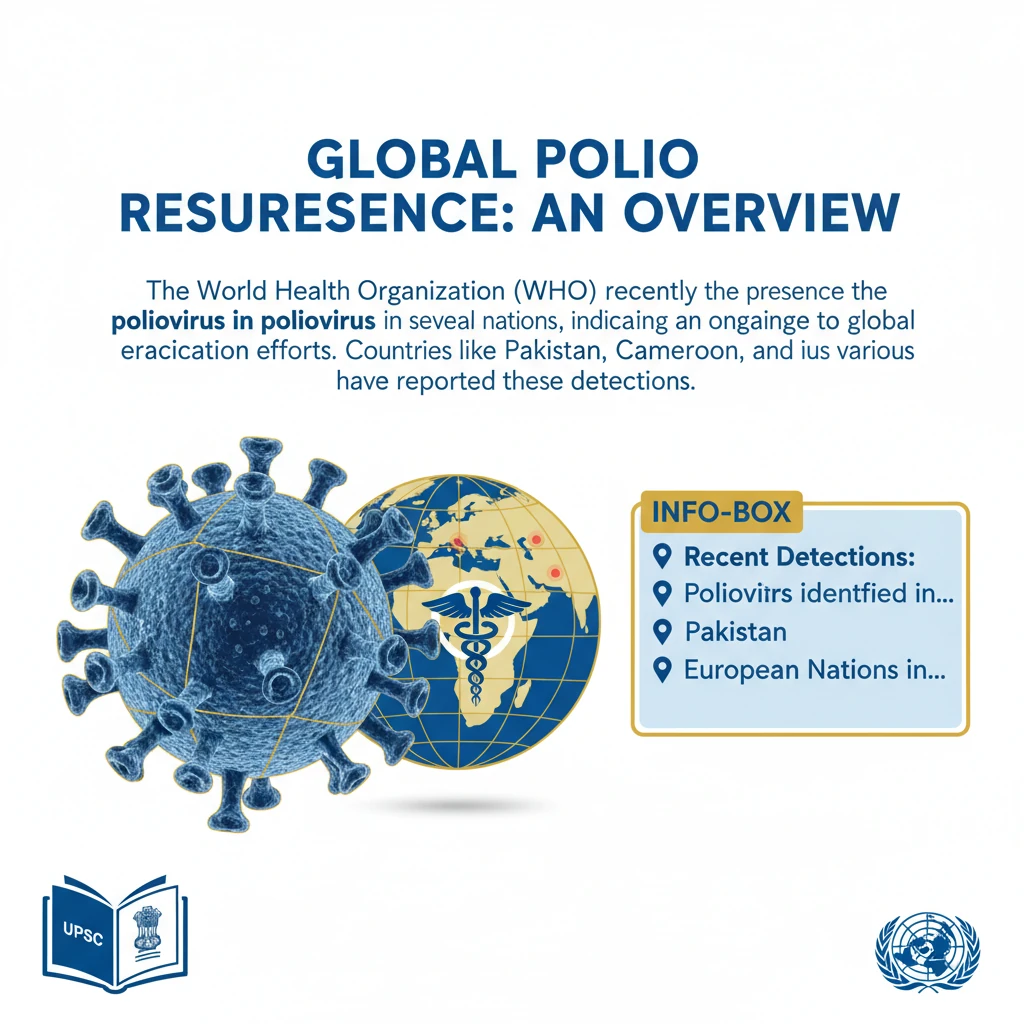
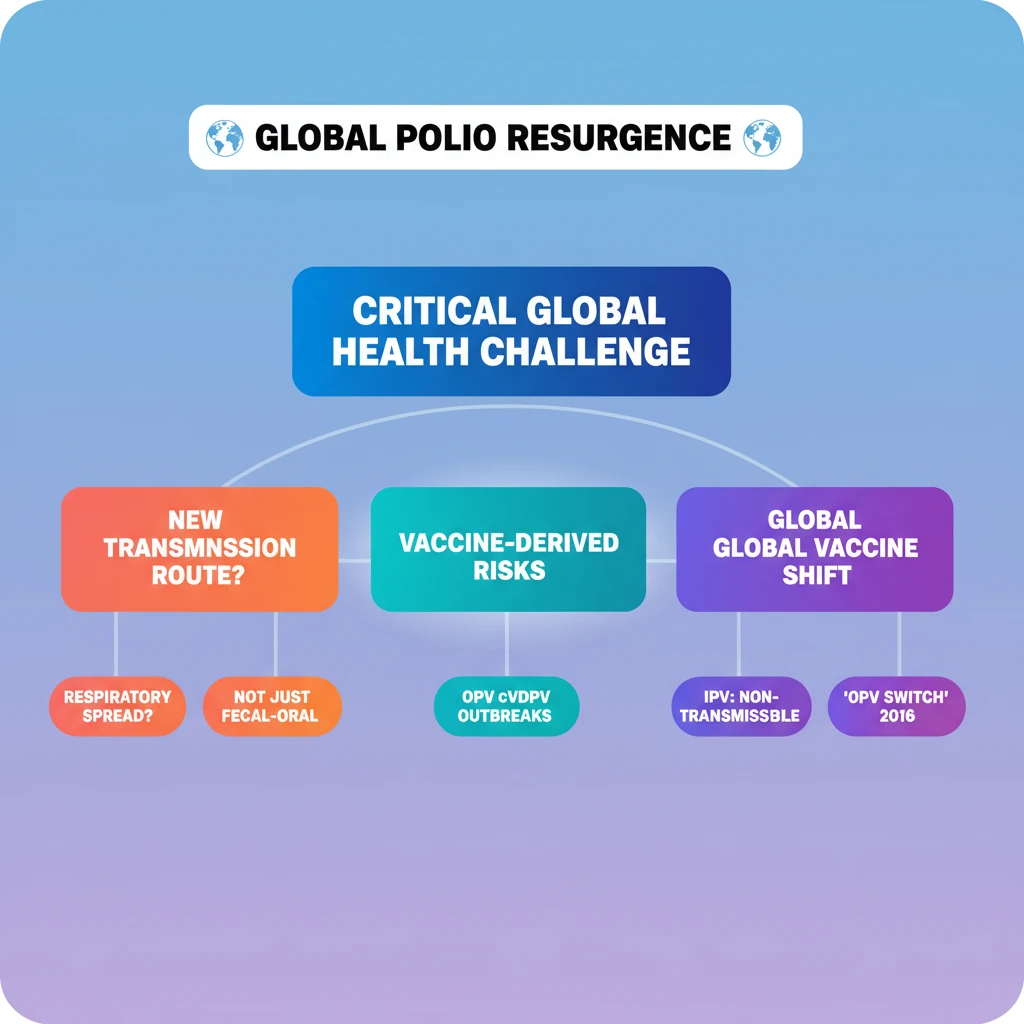
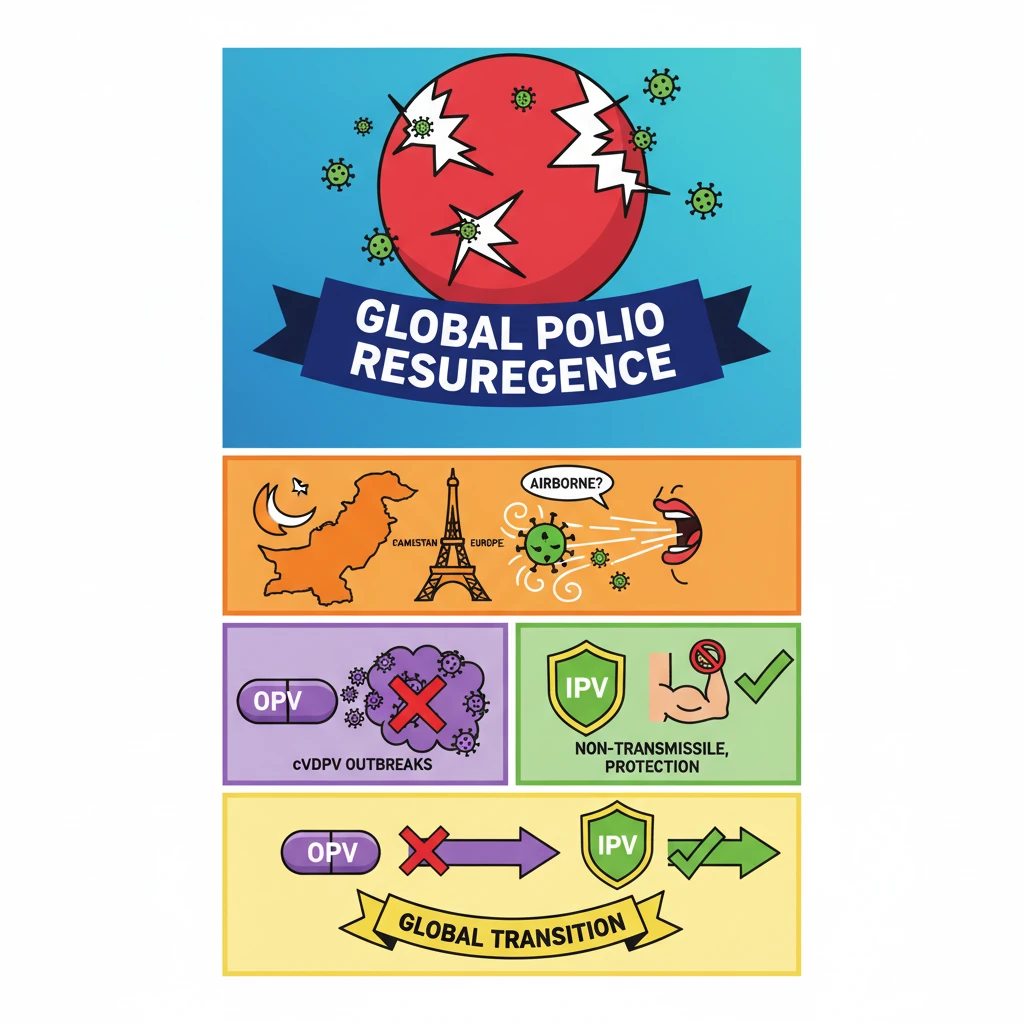
<h4>Global Polio Resurgence: An Overview</h4><p>The <strong>World Health Organization (WHO)</strong> recently confirmed the presence of <strong>poliovirus</strong> in several nations, indicating an ongoing challenge to global eradication efforts. Countries like <strong>Pakistan</strong>, <strong>Cameroon</strong>, and various <strong>European nations</strong> have reported these detections.</p><div class='info-box'><p>📍 <strong>Recent Detections:</strong> <strong>Poliovirus</strong> identified in <strong>Pakistan</strong>, <strong>Cameroon</strong>, and several <strong>European nations</strong> by <strong>WHO</strong>, highlighting persistent circulation.</p></div><h4>Evolving Understanding of Poliovirus Transmission</h4><p>Traditional understanding suggested <strong>poliovirus</strong> primarily spreads via the <strong>faecal-oral route</strong>. However, recent research indicates a potential shift in the primary mode of transmission.</p><p>New findings suggest that the virus may be predominantly transmitted through the <strong>respiratory route</strong>. This challenges long-held assumptions and has implications for public health strategies.</p><div class='key-point-box'><p>💡 <strong>Key Shift:</strong> <strong>Poliovirus</strong> transmission may be primarily via the <strong>respiratory route</strong>, not just the traditional <strong>faecal-oral route</strong>, impacting containment strategies.</p></div><h4>The Imperative for Vaccine Transition: IPV over OPV</h4><p>Recent assessments underscore the critical need to transition towards the <strong>Inactivated Polio Vaccine (IPV)</strong>. <strong>IPV</strong> is considered <strong>non-transmissible</strong> and offers robust protection against <strong>poliovirus-induced paralysis</strong>.</p><p>The <strong>Oral Polio Vaccine (OPV)</strong>, while effective, has been associated with outbreaks of <strong>vaccine-derived poliovirus cases (cVDPV)</strong>. These cases significantly complicate global eradication efforts by reintroducing the virus.</p><div class='exam-tip-box'><p>⚡ <strong>UPSC Insight:</strong> The shift from <strong>OPV</strong> to <strong>IPV</strong> and the challenges of <strong>cVDPV</strong> are crucial topics for <strong>GS Paper II (Health)</strong> and <strong>GS Paper III (Science & Technology)</strong>, often appearing in questions on public health policy.</p></div><h4>Understanding Polio (Poliomyelitis)</h4><p><strong>Polio</strong>, or <strong>poliomyelitis</strong>, is a highly contagious viral disease. It predominantly affects <strong>children under five years of age</strong>, making them particularly vulnerable.</p><p>The virus invades the <strong>nervous system</strong>, potentially leading to <strong>paralysis</strong>. It traditionally spreads through the <strong>faecal-oral route</strong> or via <strong>contaminated food and water</strong>.</p><div class='info-box'><p>🦠 <strong>Polio Definition:</strong> A highly contagious viral disease, mainly affecting <strong>children under five</strong>, capable of causing <strong>paralysis</strong> by invading the <strong>nervous system</strong>.</p></div><h4>Types of Wild Poliovirus Strains</h4><p>There are three distinct and immunologically individual <strong>wild poliovirus strains</strong>. These strains are categorized based on their antigenic properties.</p><ul><li><strong>Wild Poliovirus type 1 (WPV1)</strong></li><li><strong>Wild Poliovirus type 2 (WPV2)</strong></li><li><strong>Wild Poliovirus type 3 (WPV3)</strong></li></ul><h4>Types of Polio Vaccines</h4><p>Several types of vaccines have been developed to combat polio, each with different characteristics and applications in eradication strategies.</p><ul><li><strong>Inactivated Polio Vaccine (IPV):</strong> This vaccine protects against <strong>poliovirus types 1, 2, and 3</strong>. It uses an inactivated (killed) virus and is administered by injection.</li><li><strong>Trivalent Oral Polio Vaccine (tOPV):</strong> Historically, <strong>tOPV</strong> protected against <strong>poliovirus types 1, 2, and 3</strong>. It is <strong>no longer in use</strong> following the global <strong>“OPV Switch” in April 2016</strong>.</li><li><strong>Bivalent Oral Polio Vaccine (bOPV):</strong> This vaccine protects against <strong>poliovirus types 1 and 3</strong>. It replaced <strong>tOPV</strong> after the <strong>OPV Switch</strong> to reduce the risk of <strong>cVDPV2</strong>.</li><li><strong>Monovalent Oral Polio Vaccines (mOPV1, mOPV2, mOPV3):</strong> These vaccines protect against <strong>each individual type of poliovirus</strong> respectively. For example, <strong>mOPV1</strong> targets <strong>WPV1</strong>.</li></ul><div class='info-box'><p>📅 <strong>OPV Switch (April 2016):</strong> A global initiative to replace <strong>tOPV</strong> with <strong>bOPV</strong>. This was critical as <strong>WPV2</strong> had been eradicated, and <strong>tOPV’s</strong> Type 2 component was the source of most <strong>cVDPV2</strong> outbreaks.</p></div><h4>IPV vs. OPV: A Comparative Analysis</h4><table class='info-table'><tr><th>Feature</th><th>Inactivated Polio Vaccine (IPV)</th><th>Oral Polio Vaccine (OPV)</th></tr><tr><td><strong>Virus Type</strong></td><td>Contains <strong>inactivated (dead) virus particles</strong>.</td><td>Contains <strong>live, attenuated (weakened) poliovirus</strong>.</td></tr><tr><td><strong>Risk of Vaccine-derived Polio</strong></td><td><strong>No risk</strong> of causing vaccine-induced polio.</td><td><strong>Rare risk</strong> of reversion to a virulent form, causing <strong>cVDPV outbreaks</strong>.</td></tr><tr><td><strong>Safety for Immunocompromised</strong></td><td><strong>Safe</strong> for individuals with weakened immune systems.</td><td><strong>Not safe</strong> for immunocompromised individuals due to live virus.</td></tr><tr><td><strong>Immunity Duration</strong></td><td>Provides <strong>durable immunity</strong>, but requires <strong>multiple boosters</strong>.</td><td>Immunity may be <strong>shorter-lasting</strong>, potentially requiring additional doses.</td></tr><tr><td><strong>Mucosal Immunity</strong></td><td><strong>Limited mucosal immunity</strong>, less effective at preventing virus transmission.</td><td><strong>Strong mucosal immunity</strong> (especially in intestines), reducing virus transmission.</td></tr><tr><td><strong>Cost</strong></td><td><strong>Higher cost</strong> to produce and administer.</td><td><strong>Lower cost</strong> to produce and distribute, more accessible.</td></tr><tr><td><strong>Doses Required</strong></td><td>Typically requires <strong>2-4 shots</strong> for full immunity.</td><td>Usually requires <strong>one or a few doses</strong> for effective immunity.</td></tr></table>
💡 Key Takeaways
- •Global polio resurgence is a critical concern, with recent detections in Pakistan, Cameroon, and European nations.
- •New research suggests poliovirus may be primarily transmitted via the respiratory route, challenging traditional understanding.
- •Oral Polio Vaccine (OPV) can lead to vaccine-derived poliovirus (cVDPV) outbreaks, complicating eradication efforts.
- •Inactivated Polio Vaccine (IPV) is non-transmissible and provides effective protection against paralysis, driving a global transition.
- •The 'OPV Switch' in April 2016 replaced trivalent OPV (tOPV) with bivalent OPV (bOPV) to reduce cVDPV2 risks.
- •Polio eradication requires sustained global vaccination efforts, robust surveillance, and addressing vaccine hesitancy.
- •India's polio-free status highlights successful public health campaigns but also the need for continuous vigilance.
🧠 Memory Techniques
95% Verified Content
📚 Reference Sources
•World Health Organization (WHO) official reports and guidelines on Polio Eradication
•Global Polio Eradication Initiative (GPEI) publications