Rare Disease Day 2024 - Social Issues | UPSC Learning
Topics
0 topics • 0 completed
🔍
No topics match your search
Rare Disease Day 2024
Medium⏱️ 8 min read
social issues
📖 Introduction
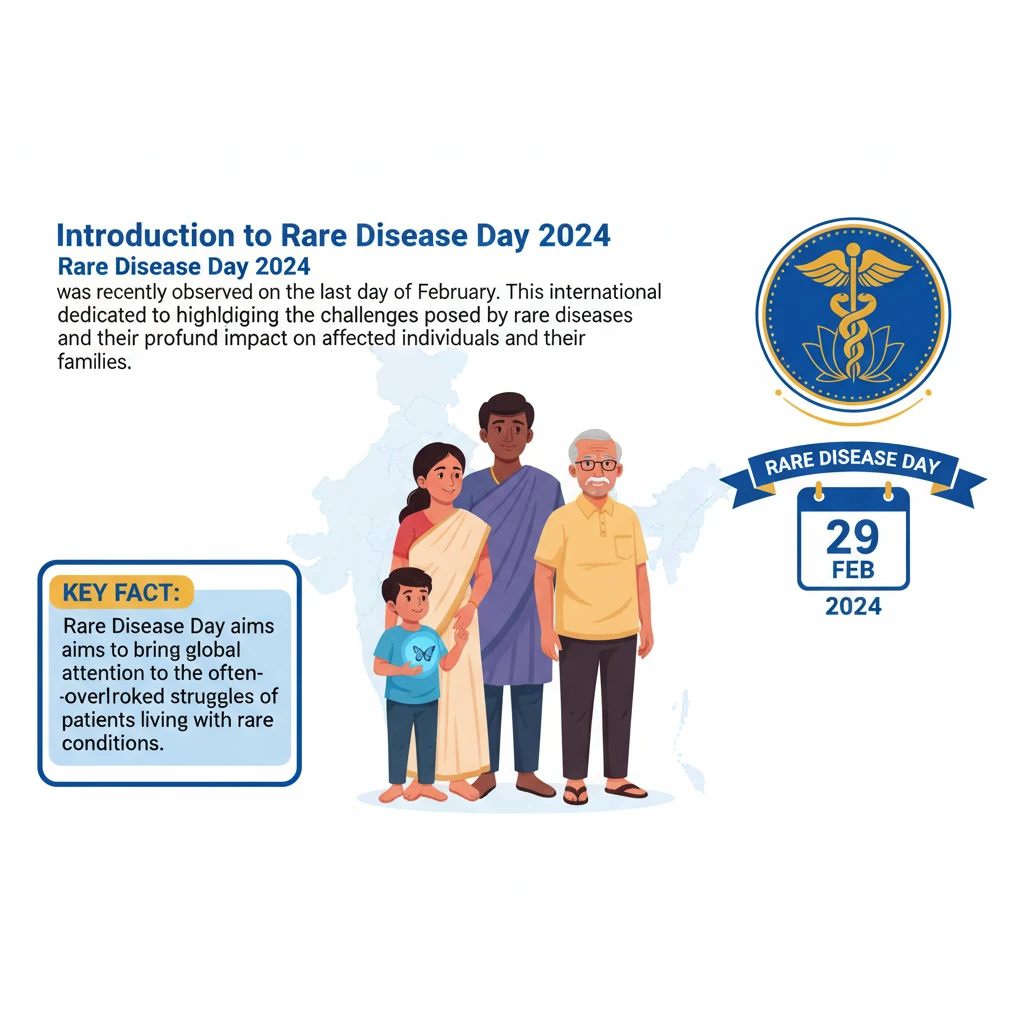
<h4>Introduction to Rare Disease Day 2024</h4><p><strong>Rare Disease Day 2024</strong> was recently observed on the <strong>last day of February</strong>. This international awareness day is dedicated to highlighting the challenges posed by <strong>rare diseases</strong> and their profound impact on affected individuals and their families.</p><div class='info-box'><p><strong>Key Fact:</strong> Rare Disease Day aims to bring global attention to the often-overlooked struggles of patients living with uncommon medical conditions.</p></div><h4>What is Rare Disease Day?</h4><p><strong>Rare Disease Day</strong> is a globally coordinated initiative focused on advocating for <strong>equity</strong>. This includes ensuring fair access to social opportunities, comprehensive healthcare, and timely diagnosis and therapies for those living with rare diseases.</p><div class='key-point-box'><p><strong>Core Mission:</strong> To champion equal rights and opportunities for individuals affected by rare conditions worldwide.</p></div><h4>Theme for Rare Disease Day 2024</h4><p>The designated theme for <strong>Rare Disease Day 2024</strong> is <strong>“Share Your Colours.”</strong> This theme strongly emphasizes the importance of <strong>collaboration</strong> and mutual <strong>support</strong> within the rare disease community and among all stakeholders.</p><h4>Establishment and Coordination</h4><p>The observance of <strong>Rare Disease Day</strong> was established in <strong>2008</strong>. It is annually celebrated on the <strong>28th or 29th of February</strong>, specifically on the 29th in leap years, symbolizing the 'rarity' of the date itself.</p><div class='info-box'><p><strong>Coordinating Bodies:</strong> The initiative is primarily coordinated by the <strong>European Organisation for Rare Diseases (EURORDIS)</strong>, in partnership with over <strong>65 national alliance patient organization partners</strong> globally.</p></div><h4>Role and Engagement</h4><p>This day serves as a crucial focal point for <strong>advocacy work</strong> across local, national, and international levels. It actively engages a wide spectrum of participants to further its cause.</p><ul><li><strong>Individuals and Families:</strong> Directly affected patients and their support networks.</li><li><strong>Caregivers:</strong> Those providing essential care and support.</li><li><strong>Healthcare Professionals:</strong> Doctors, nurses, and other medical staff.</li><li><strong>Researchers:</strong> Scientists working on understanding and treating rare diseases.</li><li><strong>Policymakers:</strong> Government officials influencing health policies.</li><li><strong>Industry Representatives:</strong> Pharmaceutical and biotech companies.</li><li><strong>General Public:</strong> Raising overall societal awareness.</li></ul><h4>Defining a Rare Disease</h4><p><strong>Rare diseases</strong> are generally characterized by their infrequent occurrence within the population. The exact prevalence threshold can vary significantly from one nation to another, reflecting diverse epidemiological contexts and healthcare systems.</p><div class='info-box'><p><strong>World Health Organization (WHO) Definition:</strong> The <strong>WHO</strong> defines rare diseases as often <strong>debilitating lifelong conditions</strong> with a prevalence of <strong>1 or less per 1000 population</strong>.</p></div><h4>Country-Specific Definitions</h4><p>Different countries have established their own specific criteria for defining a rare disease, which influences their national health policies and research priorities.</p><ul><li><strong>United States (US):</strong> Considers diseases affecting fewer than <strong>200,000 patients</strong> as rare.</li><li><strong>European Union (EU):</strong> Sets the limit at no more than <strong>5 in 10,000 people</strong>.</li></ul><div class='exam-tip-box'><p><strong>UPSC Insight:</strong> Understanding the varying definitions of <strong>rare diseases</strong> across different global bodies and nations is crucial for Mains answers, especially in <strong>GS-II (Social Justice)</strong> and <strong>GS-III (Science & Technology)</strong>, when discussing health policy and international comparisons.</p></div>
💡 Key Takeaways
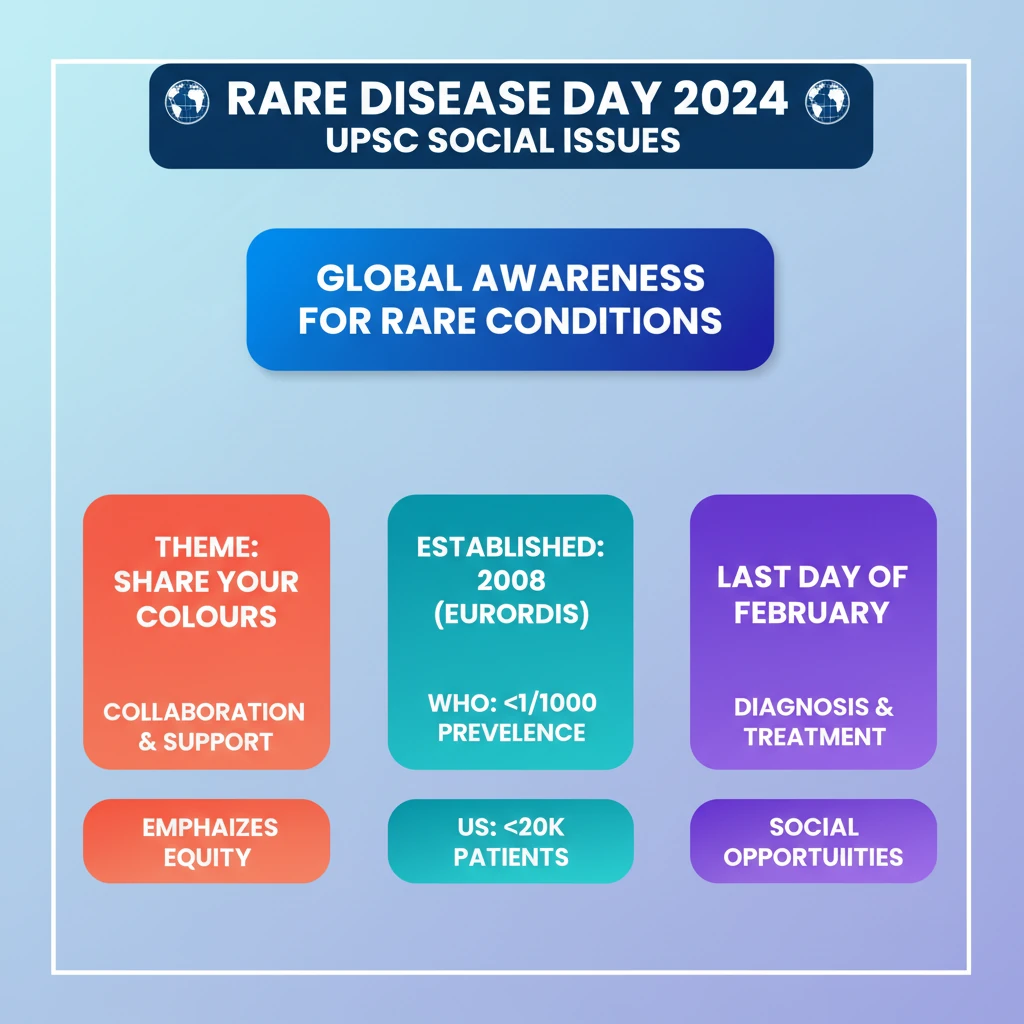
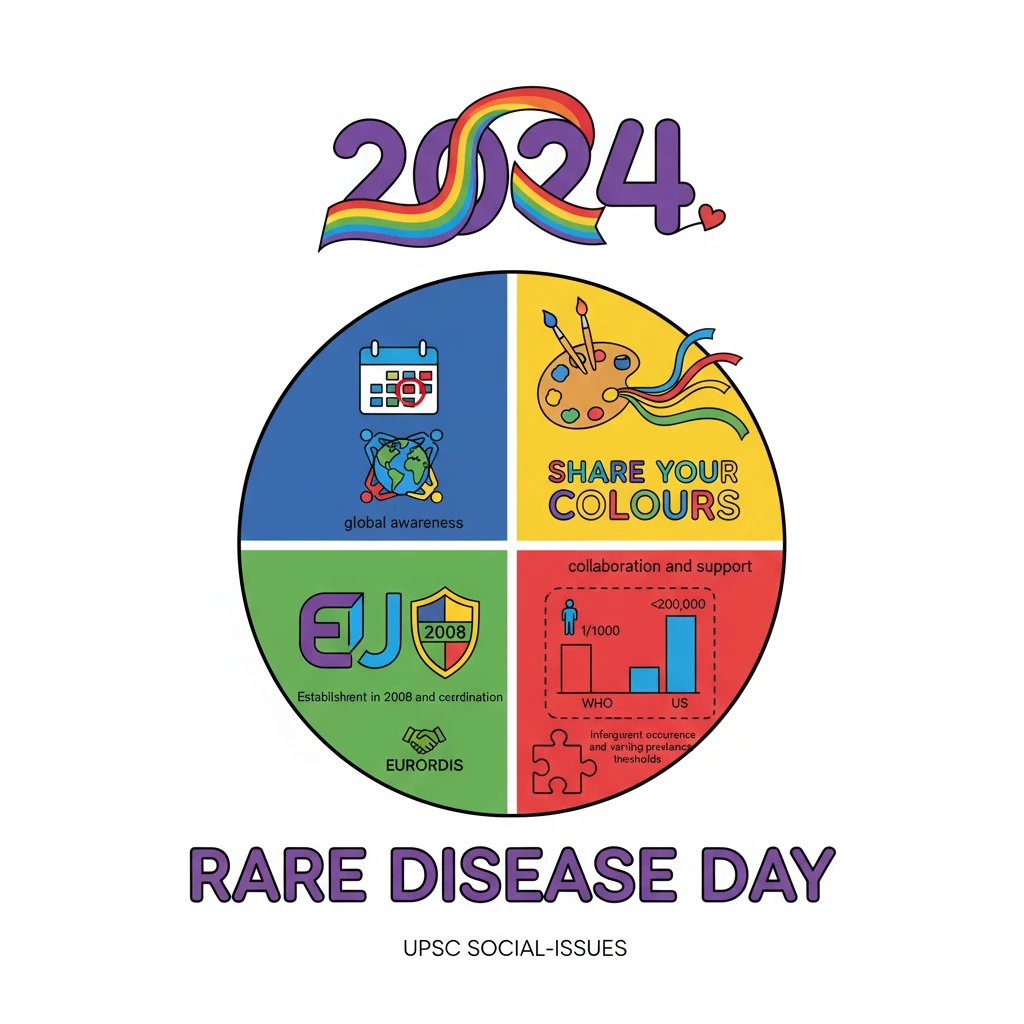
- •Rare Disease Day, observed on the last day of February, raises global awareness for rare diseases and their impact.
- •The 2024 theme, 'Share Your Colours,' emphasizes collaboration and support.
- •Established in 2008, it's coordinated by EURORDIS and partner organizations.
- •Rare diseases are defined by infrequent occurrence, with varying prevalence thresholds globally (e.g., WHO: <1/1000, US: <200,000 patients).
- •Advocacy focuses on equity in diagnosis, treatment, and social opportunities for affected individuals and families.
🧠 Memory Techniques
95% Verified Content
📚 Reference Sources
•European Organisation for Rare Diseases (EURORDIS) official website
•World Health Organization (WHO) publications on rare diseases
•Ministry of Health & Family Welfare, Government of India: National Policy for Rare Diseases 2021