WHO Response and Goals - Social Issues | UPSC Learning
Topics
0 topics • 0 completed
🔍
No topics match your search
WHO Response and Goals
Medium⏱️ 8 min read
social issues
📖 Introduction
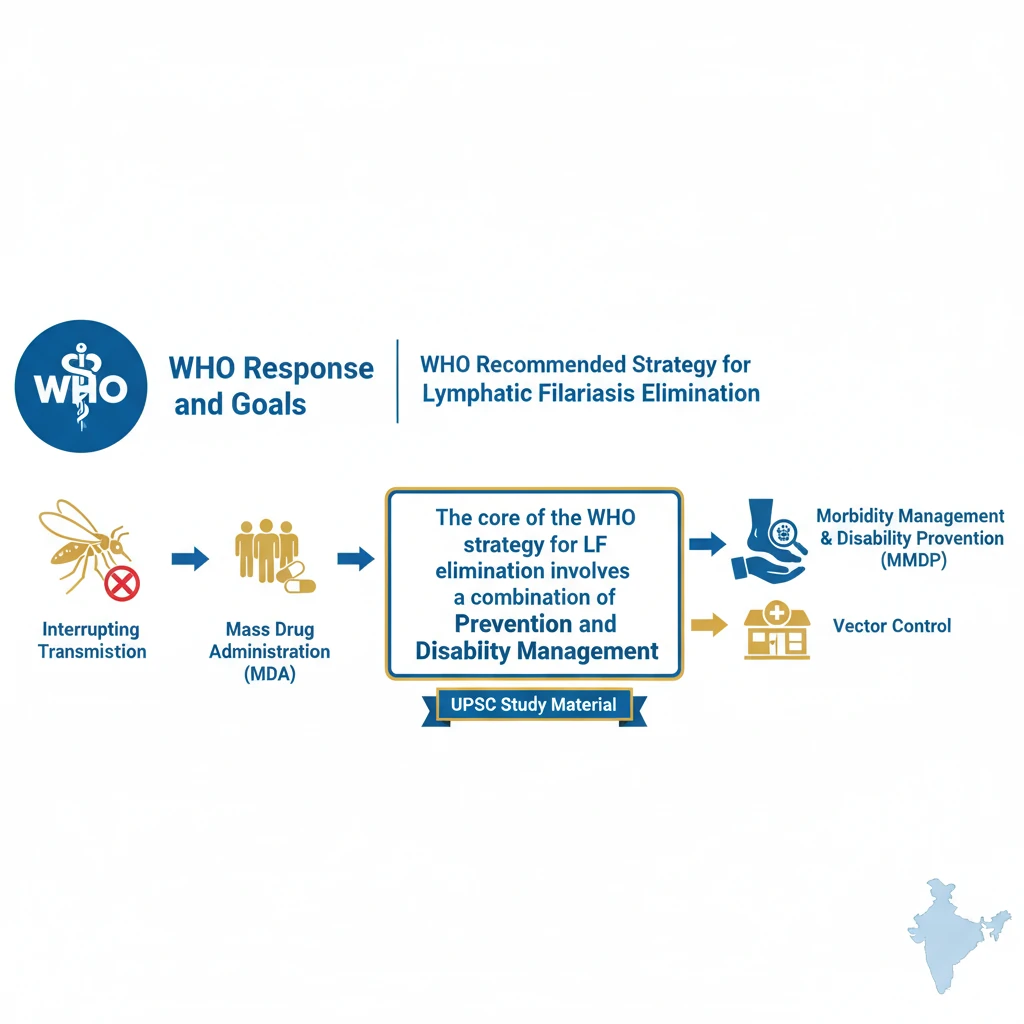
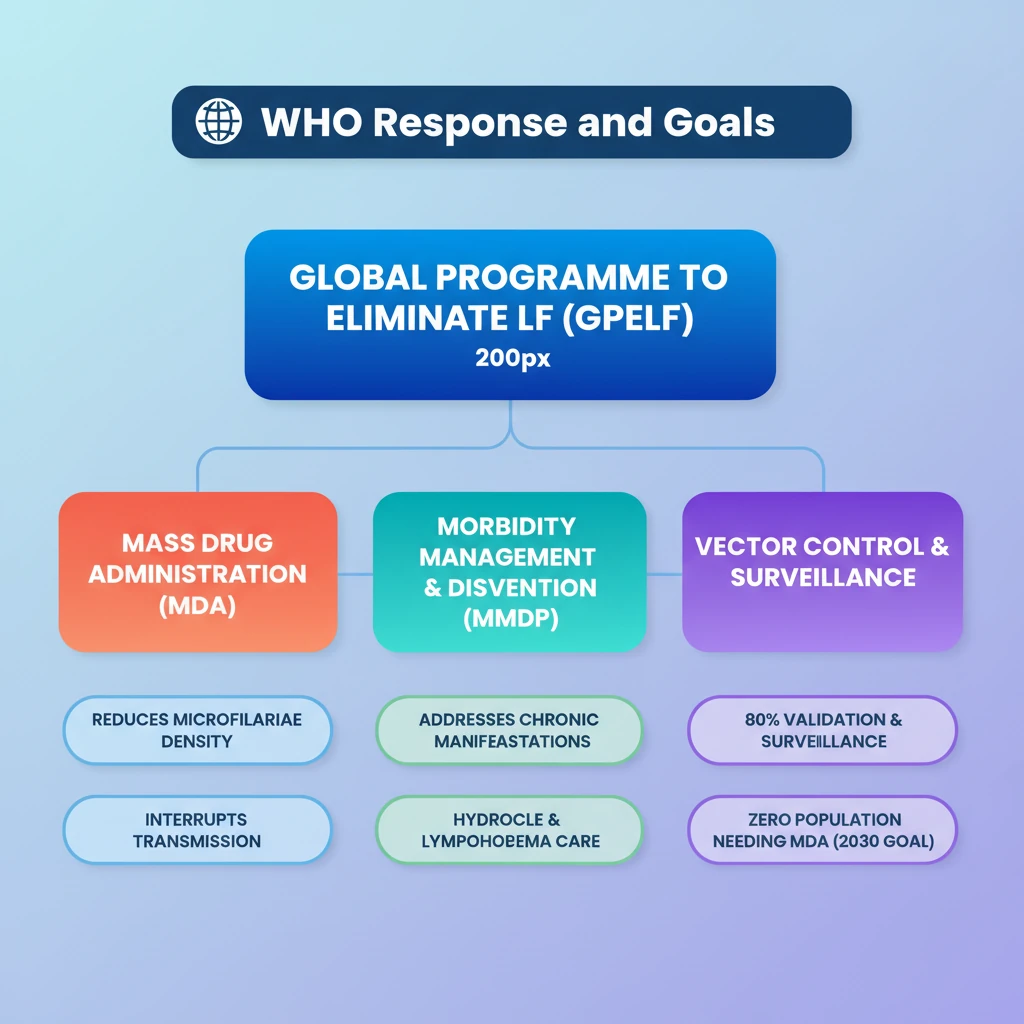
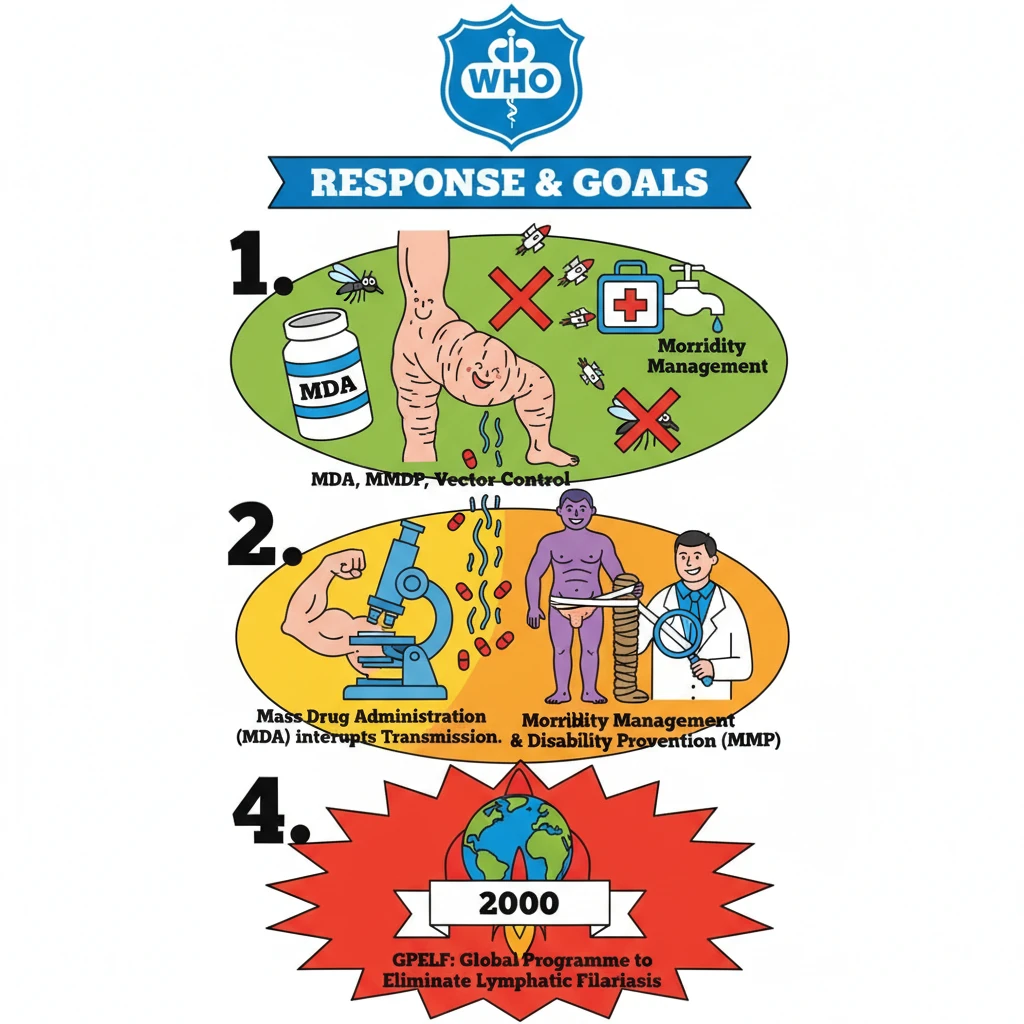
<h4>WHO Recommended Strategy for Lymphatic Filariasis Elimination</h4><p>The <strong>World Health Organization (WHO)</strong> has outlined a comprehensive strategy aimed at the elimination of <strong>Lymphatic Filariasis (LF)</strong>. This strategy is multi-pronged, focusing on interrupting transmission and managing the chronic manifestations of the disease.</p><div class='key-point-box'><p>The core of the WHO strategy for <strong>LF elimination</strong> involves a combination of <strong>Preventive Chemotherapy</strong>, <strong>Morbidity Management</strong>, and <strong>Vector Control</strong>.</p></div><h4>Mass Drug Administration (MDA) Regimens</h4><p><strong>Mass Drug Administration (MDA)</strong> is a cornerstone of the preventive chemotherapy efforts. It involves administering anti-filarial drugs to entire populations at risk to reduce the presence of <strong>microfilariae</strong> in the blood.</p><p>Different drug regimens are recommended by WHO. These recommendations are primarily based on the <strong>co-endemicity</strong> of <strong>Lymphatic Filariasis</strong> with other filarial diseases in a particular region.</p><div class='info-box'><p>The primary goal of <strong>MDA regimens</strong> is to significantly reduce the <strong>microfilariae density</strong> within the population. This reduction is crucial for interrupting the disease transmission cycle.</p></div><h4>Morbidity Management and Disability Prevention (MMDP)</h4><p>Beyond preventing new infections, managing the existing chronic manifestations of <strong>Lymphatic Filariasis</strong> is vital. This aspect of the strategy is known as <strong>Morbidity Management and Disability Prevention (MMDP)</strong>.</p><p>Effective <strong>MMDP</strong> includes a range of interventions. These are designed to alleviate suffering, prevent disease progression, and improve the quality of life for affected individuals.</p><ul><li><strong>Surgery:</strong> Essential for conditions like <strong>hydrocele</strong>, a common chronic manifestation of LF.</li><li><strong>Hygiene Measures:</strong> Crucial for preventing secondary bacterial infections in limbs affected by <strong>lymphoedema</strong>.</li><li><strong>Clinical Care:</strong> Provides ongoing support and management for various chronic symptoms.</li></ul><h4>Vector Control Strategies</h4><p><strong>Vector control</strong> serves as a supplementary but important strategy in the overall elimination efforts. It targets the mosquitoes responsible for transmitting the <strong>filarial parasites</strong>.</p><p>Strategies such as <strong>mosquito control</strong> help to reduce the population of disease-carrying vectors. This complements the primary preventive chemotherapy efforts by further reducing the chances of transmission.</p><h4>Global Programme to Eliminate Lymphatic Filariasis (GPELF)</h4><p>The <strong>Global Programme to Eliminate Lymphatic Filariasis (GPELF)</strong> is the overarching framework guiding global efforts. It was officially launched by WHO in <strong>2000</strong>.</p><div class='info-box'><p><strong>GPELF</strong> aims to eliminate <strong>Lymphatic Filariasis</strong> as a public health problem worldwide. Its twin pillars are <strong>preventive chemotherapy (MDA)</strong> and <strong>morbidity management</strong>.</p></div><h4>GPELF Goals for the New NTD Road Map (2021–2030)</h4><p>In <strong>2020</strong>, the <strong>GPELF</strong> established updated goals. These are part of the broader <strong>WHO NTD Road Map for 2021–2030</strong>, setting ambitious targets for the coming decade.</p><div class='exam-tip-box'><p>Understanding these specific targets is crucial for UPSC. They demonstrate WHO's commitment and the global public health agenda, relevant for <strong>GS Paper 2 (Health)</strong>.</p></div><ul><li><strong>Validation Target:</strong> To achieve validation of elimination in <strong>80% of endemic countries (58 countries)</strong>. This involves maintaining low infection rates even after stopping <strong>MDA</strong>.</li><li><strong>Surveillance Implementation:</strong> All <strong>72 endemic countries</strong> are targeted to implement robust surveillance systems. This is vital to prevent any resurgence of the disease post-elimination efforts.</li><li><strong>MDA Reduction Goal:</strong> The ultimate aim is to reach a point where <strong>zero population</strong> requires <strong>mass drug administration</strong> for <strong>Lymphatic Filariasis</strong>.</li></ul>
💡 Key Takeaways
- •WHO's LF elimination strategy focuses on MDA, Morbidity Management, and Vector Control.
- •Mass Drug Administration (MDA) reduces microfilariae density and interrupts transmission.
- •Morbidity Management and Disability Prevention (MMDP) addresses chronic LF manifestations like hydrocele and lymphoedema.
- •Global Programme to Eliminate Lymphatic Filariasis (GPELF) launched in 2000, leads global efforts.
- •New GPELF goals for 2021–2030 include 80% validation, universal surveillance, and zero population needing MDA.
🧠 Memory Techniques
98% Verified Content
📚 Reference Sources
•World Health Organization (WHO) official documents on Lymphatic Filariasis and Neglected Tropical Diseases (NTDs)
•WHO NTD Road Map 2021–2030