Immoral Traffic (Prevention) Act, 1956 - Social Issues | UPSC Learning
Topics
0 topics • 0 completed
🔍
No topics match your search
Immoral Traffic (Prevention) Act, 1956
Medium⏱️ 8 min read
social issues
📖 Introduction
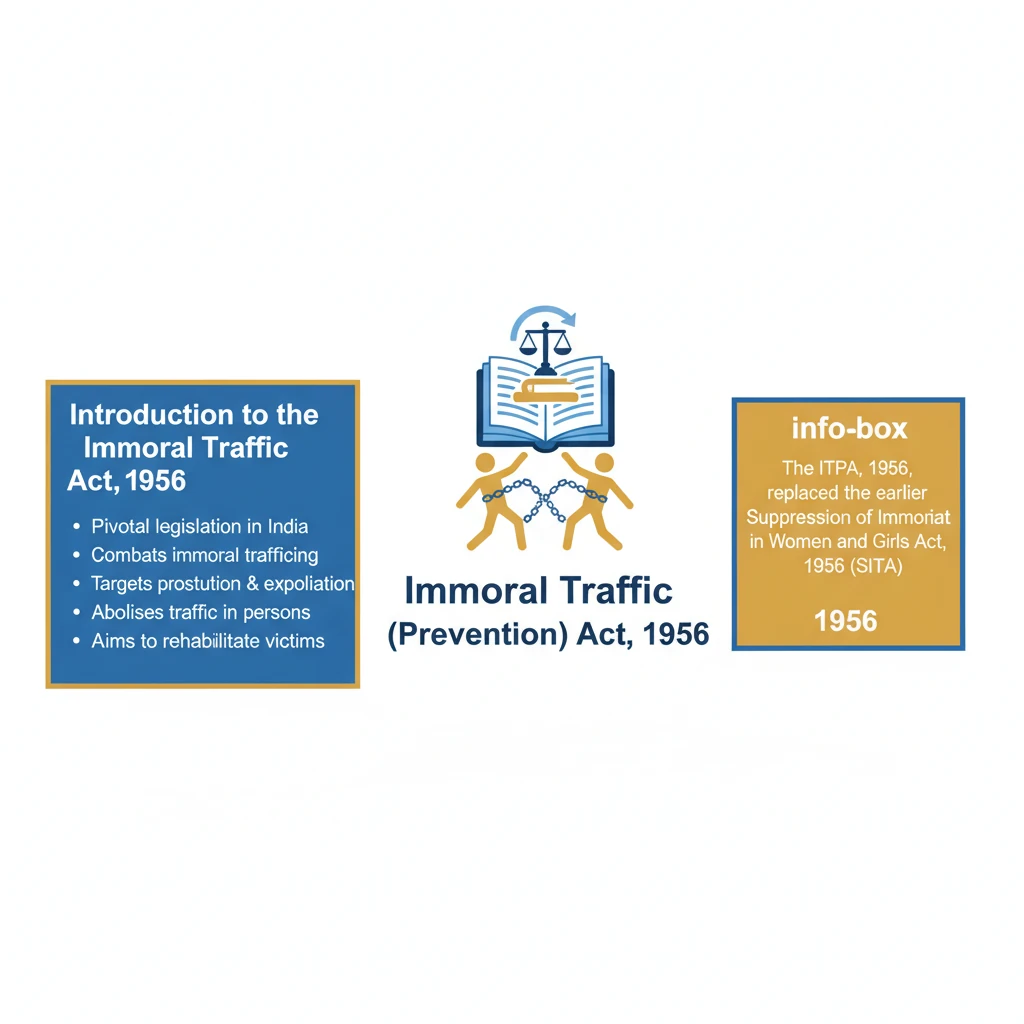
<h4>Introduction to the Immoral Traffic (Prevention) Act, 1956</h4><p>The <strong>Immoral Traffic (Prevention) Act, 1956 (ITPA)</strong> is a pivotal legislation in India. It was enacted to combat and prevent immoral trafficking, primarily concerning prostitution and the exploitation of individuals for commercial sexual purposes. The Act aims to abolish traffic in persons and rehabilitate victims.</p><div class='info-box'><p>The <strong>ITPA, 1956</strong>, replaced the earlier <strong>Suppression of Immoral Traffic in Women and Girls Act (SITA), 1956</strong>, broadening its scope to include all persons, not just women and girls.</p></div><h4>The Kerala High Court's Landmark Ruling</h4><p>Recently, the <strong>Kerala High Court</strong> delivered a significant interpretation that has expanded the ambit of the ITPA. This ruling specifically addresses the definition of the term <strong>'procure'</strong> as outlined in <strong>Section 5</strong> of the Act.</p><div class='info-box'><p>The <strong>Kerala High Court</strong> has <strong>widened the definition</strong> of <strong>'procure'</strong> in <strong>Section 5</strong> of the <strong>Immoral Traffic (Prevention) Act, 1956</strong>.</p></div><p>Crucially, this expanded definition now explicitly includes <strong>customers seeking the services of prostitutes</strong>. This interpretation marks a strategic shift towards addressing the <strong>demand side</strong> of immoral trafficking, which is often considered a key driver of the illicit trade.</p><div class='key-point-box'><p>By including customers, the ruling aims to hold individuals who fuel the demand for commercial sexual exploitation accountable, thereby strengthening efforts to prevent human trafficking.</p></div><div class='exam-tip-box'><p>This judicial interpretation is vital for <strong>UPSC Mains GS Paper II (Social Justice)</strong> and <strong>GS Paper I (Social Issues)</strong>, particularly when discussing women's rights, vulnerable sections, and the effectiveness of anti-trafficking laws.</p></div>
💡 Key Takeaways
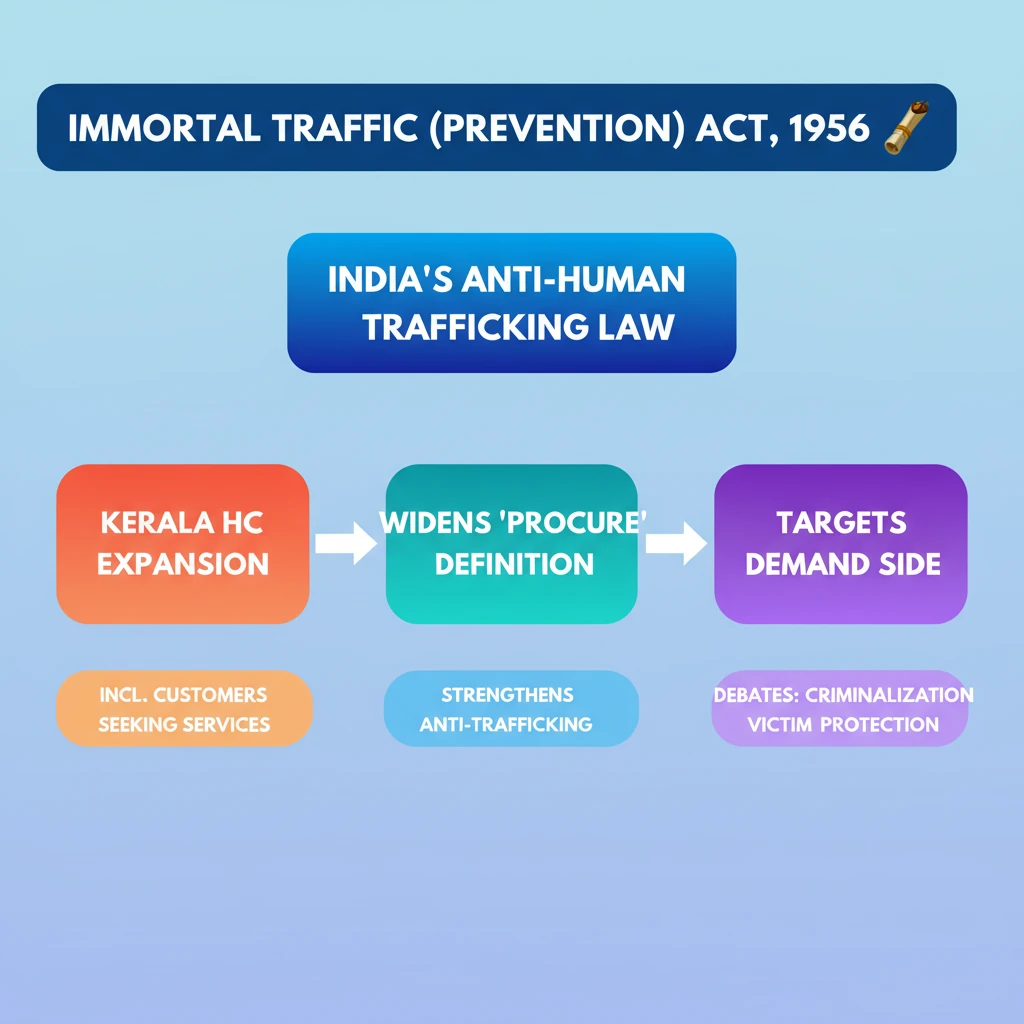
- •The Immoral Traffic (Prevention) Act, 1956 (ITPA) is India's primary law against human trafficking for commercial sexual exploitation.
- •The Kerala High Court recently widened the definition of 'procure' in Section 5 of ITPA.
- •This expansion now includes customers seeking the services of prostitutes, targeting the demand side of trafficking.
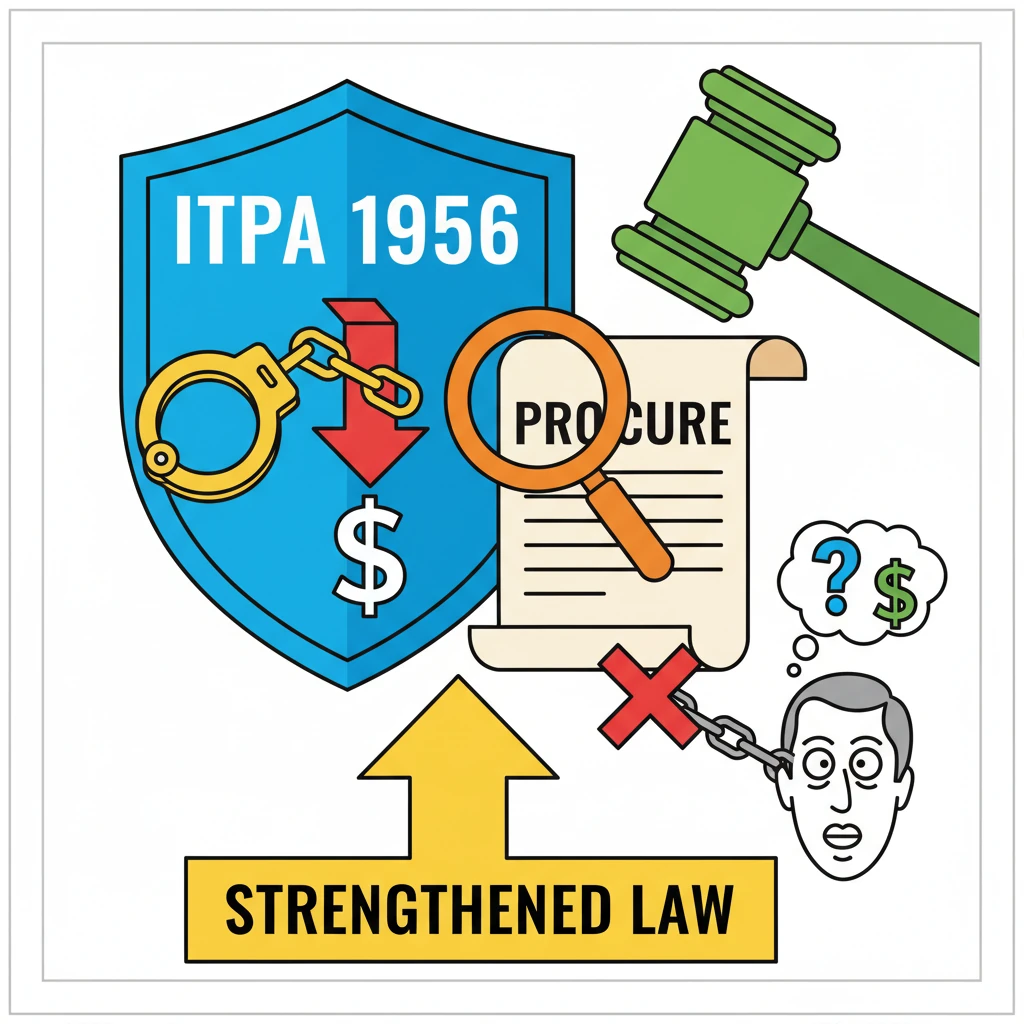
- •The ruling aims to strengthen anti-trafficking efforts by holding customers accountable and reducing demand.
- •It sparks debates on the criminalization of prostitution and the comprehensive approach to victim protection and rehabilitation.
🧠 Memory Techniques
95% Verified Content
📚 Reference Sources
•The Immoral Traffic (Prevention) Act, 1956 (Bare Act)
•Reports on Kerala High Court judgments (general knowledge of recent rulings on ITPA)