What are the Key Findings of the Study - Social Issues | UPSC Learning
Topics
0 topics • 0 completed
🔍
No topics match your search
What are the Key Findings of the Study
Medium⏱️ 8 min read
social issues
📖 Introduction
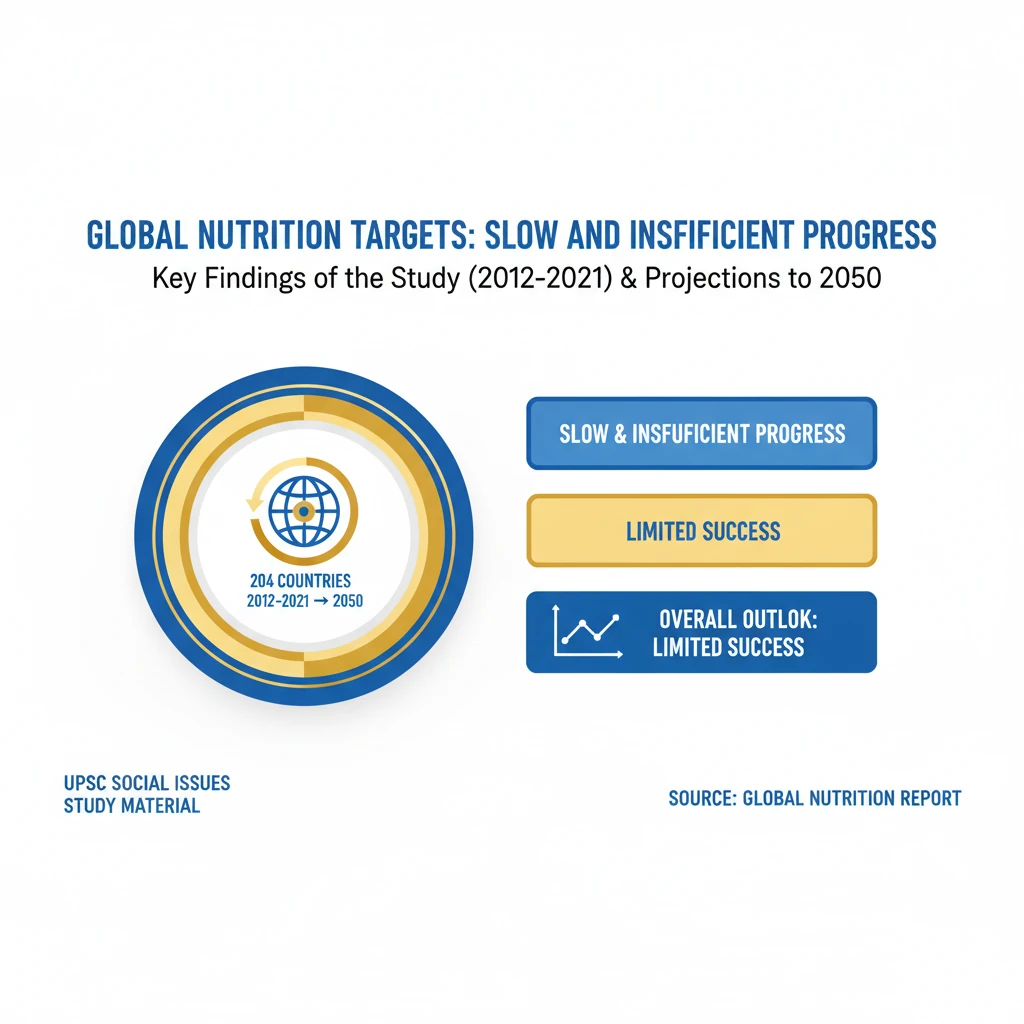
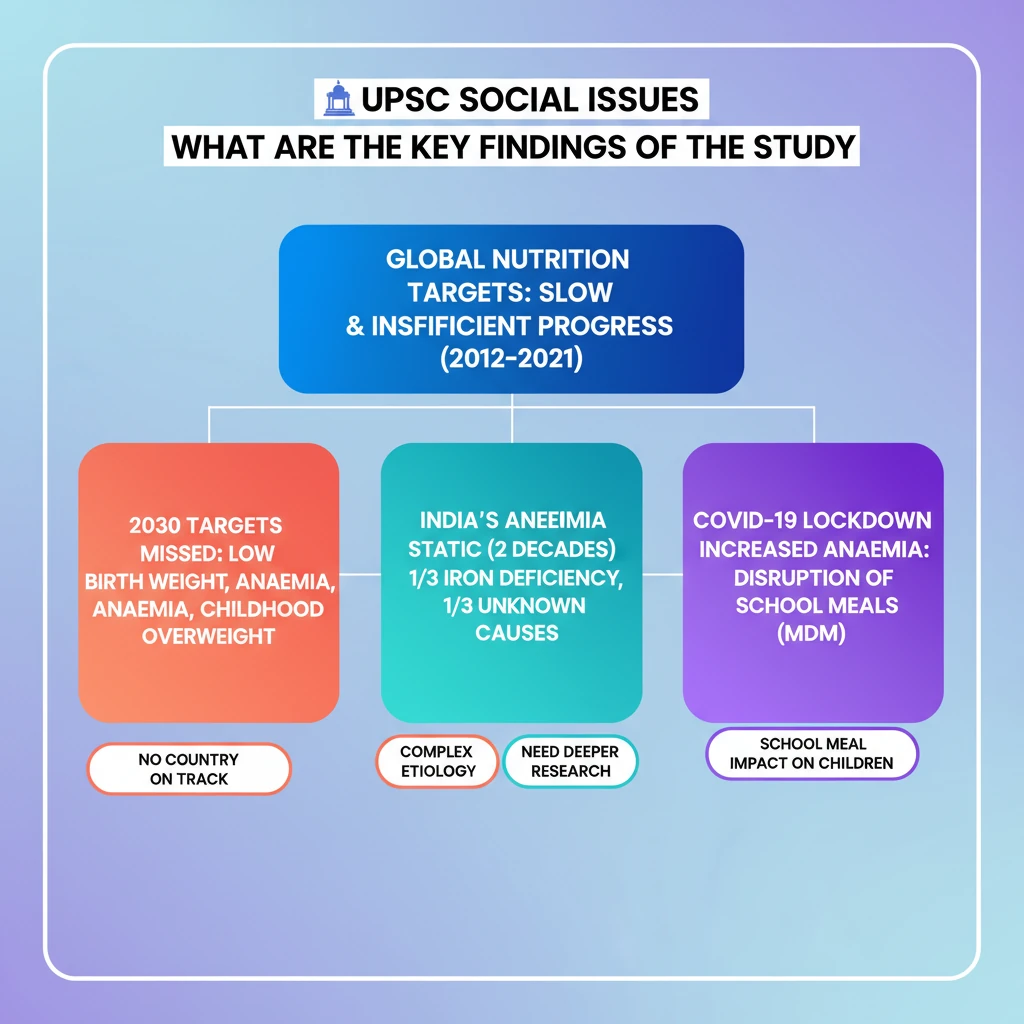
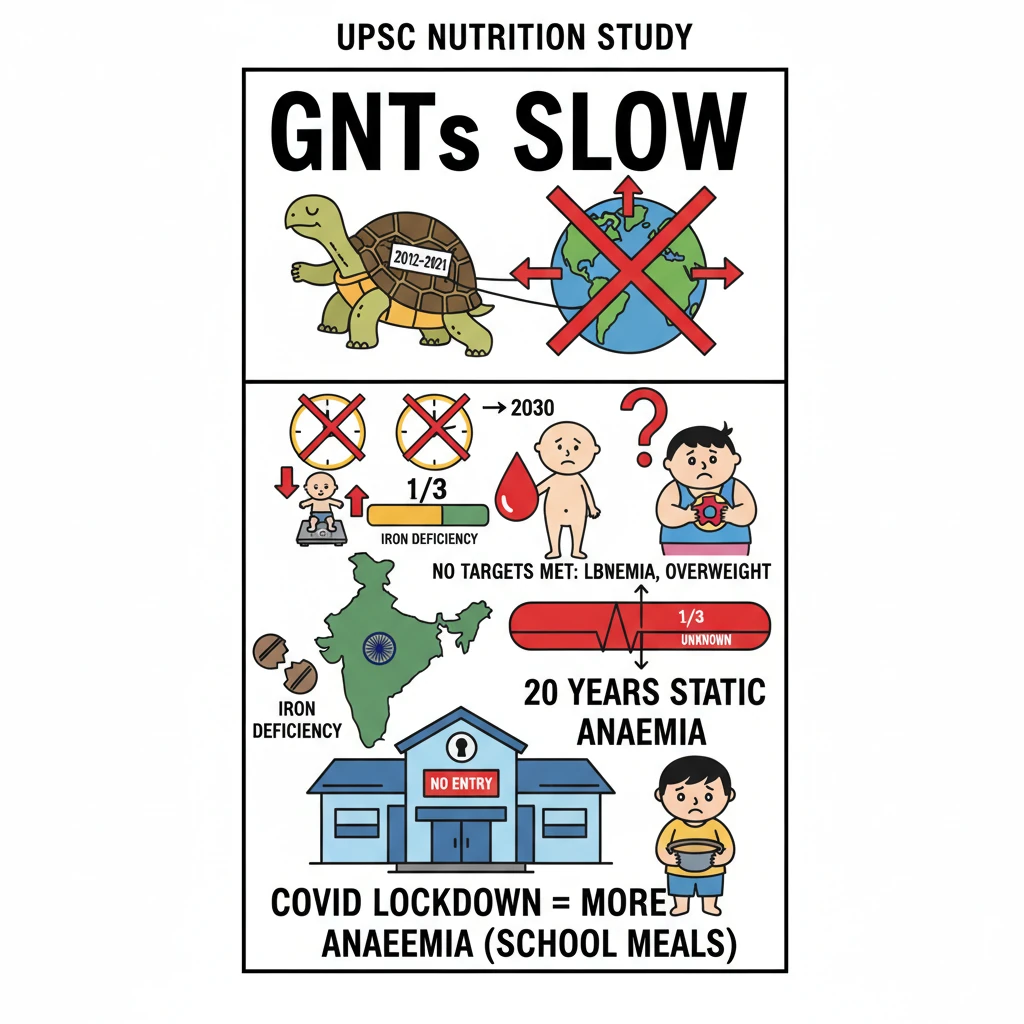
<h4>Global Nutrition Targets: Slow and Insufficient Progress</h4><p>A recent study highlights the concerning trend of <strong>slow</strong> and <strong>insufficient progress</strong> in achieving the <strong>Global Nutrition Targets (GNTs)</strong>. This assessment covers <strong>204 countries</strong> over the period from <strong>2012 to 2021</strong>, with projections extending to <strong>2050</strong>.</p><div class='key-point-box'><p>The overall outlook suggests limited success, indicating a significant global challenge in addressing malnutrition in its various forms.</p></div><h4>Specific Target Failures</h4><p>The study reveals critical areas where countries are falling short. Only a few nations are anticipated to meet the targets for reducing <strong>stunting</strong> in children under <strong>5 years of age</strong>.</p><p>Even more concerning is the projection that <strong>none</strong> of the surveyed countries are expected to achieve the targets for <strong>low birth weight</strong>, <strong>anaemia</strong>, and <strong>childhood overweight</strong> by the crucial deadline of <strong>2030</strong>.</p><div class='info-box'><p><strong>GNTs Not Met by 2030:</strong><ul><li><strong>Low birth weight</strong></li><li><strong>Anaemia</strong></li><li><strong>Childhood overweight</strong></li></ul></p></div><h4>Anaemia in India: A Persistent Challenge</h4><p>The study specifically points out that the prevalence of <strong>anaemia in India</strong> has remained largely <strong>static</strong> for the past <strong>two decades</strong>. This indicates a deep-rooted and complex public health issue that requires renewed focus.</p><p>Historically, <strong>iron deficiency</strong> has been widely assumed to be the primary cause of anaemia. However, the study's findings challenge this assumption, stating that iron deficiency accounts for only approximately <strong>one-third</strong> of all anaemia cases.</p><p>A significant proportion, another <strong>one-third</strong>, is attributed to <strong>unknown causes</strong>. This highlights the need for more comprehensive research into the multifactorial etiology of anaemia beyond just iron deficiency.</p><div class='exam-tip-box'><p><strong>UPSC Insight:</strong> Understanding the complex causes of anaemia (beyond just iron) is crucial for Mains answers on public health and nutrition, especially when discussing policy interventions.</p></div><h4>Impact of Covid-19 Lockdown on Nutrition</h4><p>The study also observed an increase in <strong>anaemia prevalence</strong> during the <strong>Covid-19 lockdown</strong> period. This surge is partly linked to the disruption of essential services, particularly the suspension of <strong>school meals</strong>.</p><p>The <strong>Midday Meal Scheme</strong> (now PM POSHAN) plays a vital role in providing nutritional support to millions of children. Its interruption had direct consequences on their dietary intake and overall health, contributing to rising anaemia rates.</p><div class='info-box'><p><strong>Key Observation:</strong> Increased <strong>anaemia</strong> during <strong>Covid-19 lockdown</strong> due to disruption of <strong>school meals</strong> (e.g., <strong>Midday Meal Scheme</strong>).</p></div>
💡 Key Takeaways
- •Global Nutrition Targets (GNTs) progress is slow and insufficient across 204 countries (2012-2021).
- •None of the countries are projected to meet targets for low birth weight, anaemia, and childhood overweight by 2030.
- •Anaemia in India has been static for two decades, with iron deficiency accounting for only one-third of cases; one-third are due to unknown causes.
- •Covid-19 lockdown increased anaemia prevalence due to disruption of school meal programs (Midday Meal Scheme).
- •There's a critical need for re-evaluation of nutritional interventions and deeper research into anaemia's complex etiology.
🧠 Memory Techniques
95% Verified Content
📚 Reference Sources
•World Health Organization (WHO) documents on Global Nutrition Targets (GNTs)
•National Family Health Survey (NFHS) reports (general knowledge of static anaemia trends)