What are the Supreme Court’s Observations on Inheritance? - Social Issues | UPSC Learning
Topics
0 topics • 0 completed
🔍
No topics match your search

What are the Supreme Court’s Observations on Inheritance?
Medium⏱️ 6 min read
social issues
📖 Introduction
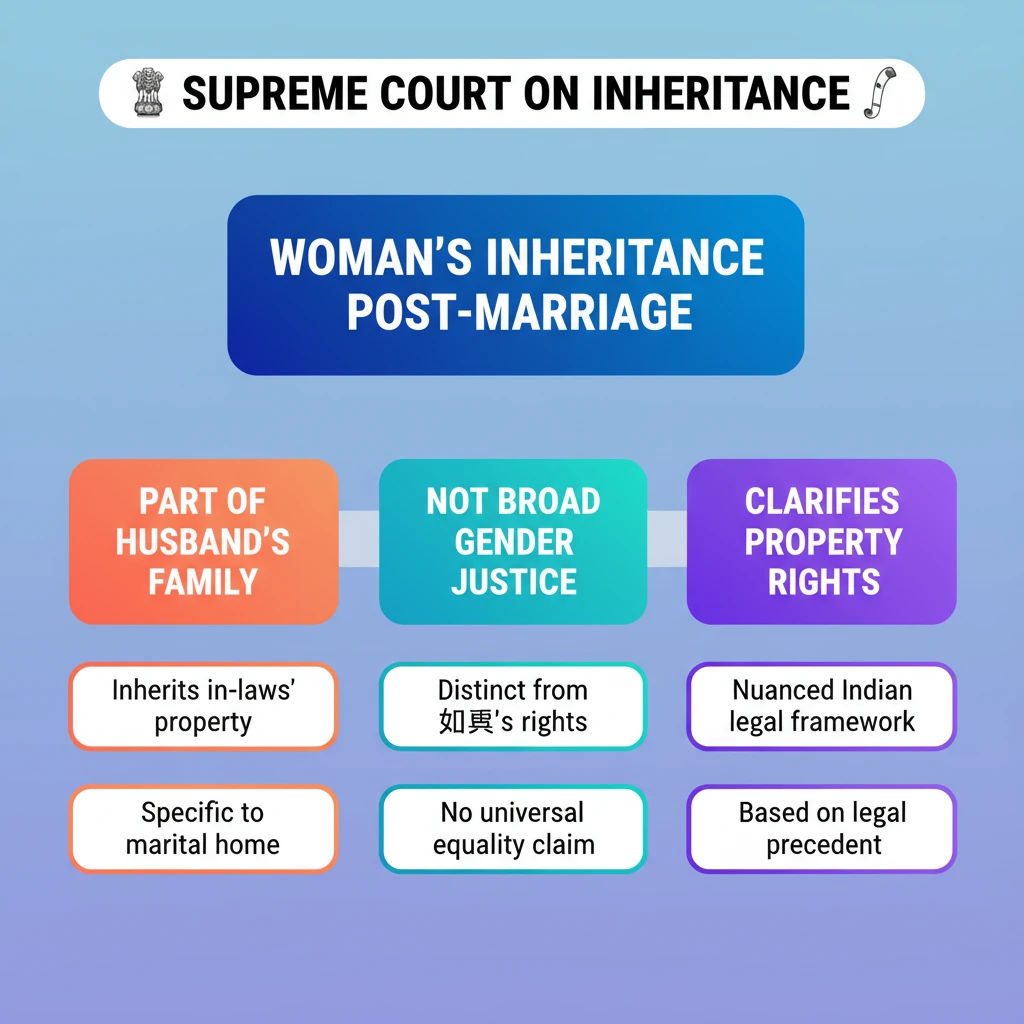
<h4>Understanding SC's Observation on Inheritance</h4><p>The <strong>Supreme Court</strong> of India recently made a significant observation concerning <strong>inheritance rights</strong> for women. This observation provides clarity on a specific aspect of property law within the Indian legal framework.</p><div class='key-point-box'><p>The <strong>Supreme Court judgment</strong> explicitly highlighted that its observation was <strong>"not about gender justice"</strong> in the broader sense of advocating for general equality in inheritance rights across all family contexts.</p></div><p>Instead, the ruling focused on the legal implications arising from a woman's marital status and her integration into a new family unit.</p><h4>Woman's Status Post-Marriage</h4><p>The Court emphasized the legal and social understanding that after <strong>marriage</strong>, a woman becomes an integral part of her <strong>husband's family</strong>. This transition carries specific legal consequences.</p><div class='info-box'><p>This legal integration means that her familial ties and associated rights shift, establishing her position within her marital home's lineage for certain purposes.</p></div><h4>Inheritance Rights in Husband's Family</h4><p>Consequently, the judgment stated that a woman acquires <strong>corresponding rights to inheritance</strong> within her <strong>husband's family</strong>. These rights are a direct result of her status as a member of that family unit.</p><div class='exam-tip-box'><p>UPSC aspirants should carefully note this distinction: the observation clarifies inheritance within the <strong>marital family</strong>, rather than broadly redefining <strong>gender equality</strong> in a woman's parental family property. This nuance is crucial for answer writing.</p></div>
💡 Key Takeaways
- •SC observed a woman becomes part of her husband's family post-marriage for inheritance.
- •The ruling was specifically stated as 'not about gender justice' in a broad sense.
- •It clarifies a woman's inheritance rights within her marital family.
- •This observation is distinct from broader judgments on daughters' equal coparcenary rights in parental property.
- •It highlights the nuanced nature of women's property rights in India's legal framework.
🧠 Memory Techniques

95% Verified Content
📚 Reference Sources
•General understanding of Hindu Succession Act, 1956 and its 2005 amendment
•Principles of Indian Family Law and Property Law