High Court Struck Down Bihar 65% Quota Rule - Social Issues | UPSC Learning
Topics
0 topics • 0 completed
🔍
No topics match your search
High Court Struck Down Bihar 65% Quota Rule
Medium⏱️ 7 min read
social issues
📖 Introduction
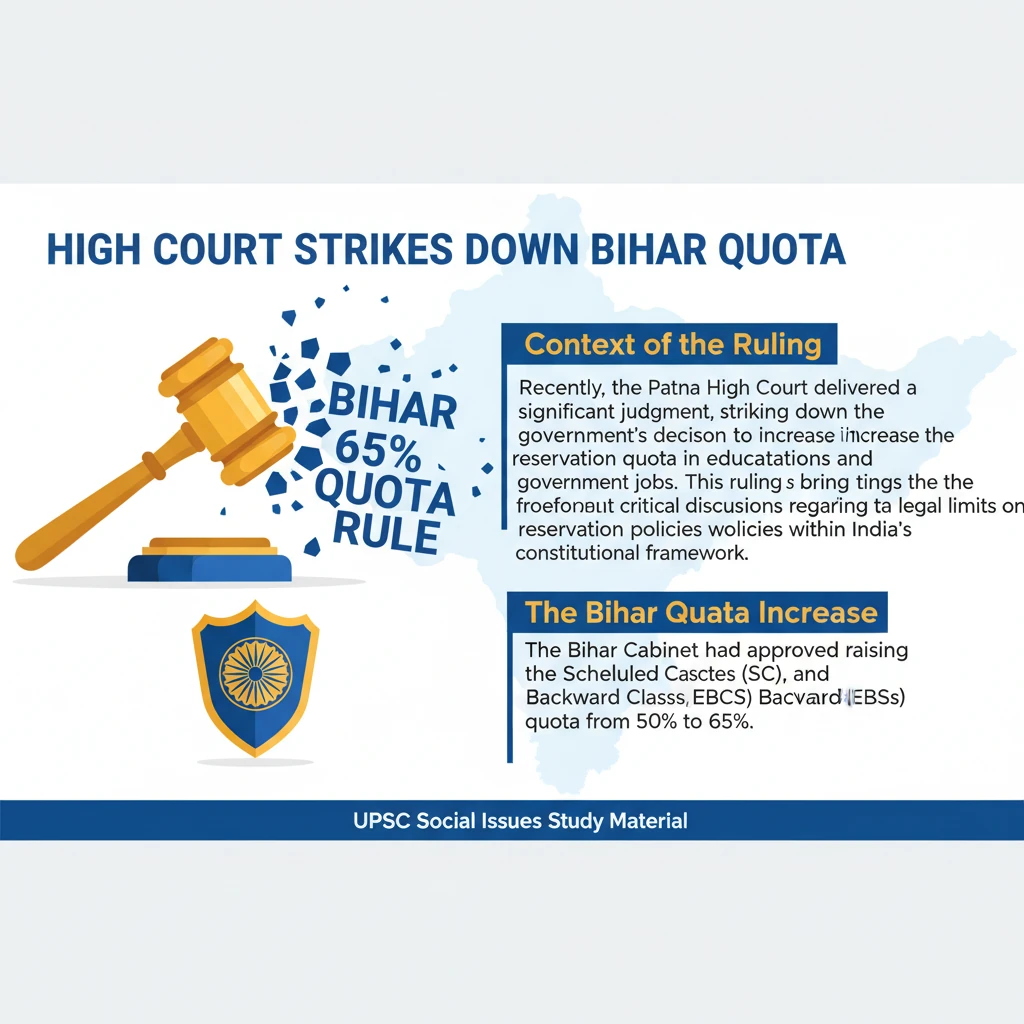
<h4>Context of the Ruling</h4><p>Recently, the <strong>Patna High Court</strong> delivered a significant judgment, striking down the <strong>Bihar government’s</strong> decision to increase the <strong>reservation quota</strong> in educational institutions and government jobs.</p><p>This ruling brings to the forefront critical discussions regarding the <strong>legal limits</strong> on <strong>reservation policies</strong> within India's constitutional framework.</p><h4>The Bihar Quota Increase</h4><p>The <strong>Bihar government</strong> had decided to raise the total reservation quota from the existing <strong>50%</strong> to <strong>65%</strong>. This increase was intended for various categories of beneficiaries.</p><div class='info-box'><p>The beneficiaries of the proposed <strong>65% quota</strong> included:</p><ul><li><strong>Backward Classes (BC)</strong></li><li><strong>Extremely Backward Classes (EBC)</strong></li><li><strong>Scheduled Castes (SC)</strong></li><li><strong>Scheduled Tribes (ST)</strong></li></ul></div><h4>Patna High Court's Decision</h4><p>The <strong>Patna High Court</strong> meticulously examined the legality of this increased quota. Its judgment concluded that the hike was unconstitutional, thereby striking down the government's notification.</p><div class='key-point-box'><p>The core issue revolved around whether states can exceed the <strong>50% ceiling on reservation</strong>, a principle established by the Supreme Court in landmark judgments.</p></div><h4>Implications and Legal Questions</h4><p>The High Court's decision underscores the judiciary's role in maintaining the constitutional balance regarding affirmative action policies. It reaffirms the existing legal precedents on reservation limits.</p><div class='exam-tip-box'><p>This ruling is crucial for understanding the interplay between <strong>social justice initiatives</strong> by states and the <strong>constitutional limitations</strong> set by the judiciary. It's a key topic for <strong>GS Paper II: Polity and Governance</strong>.</p></div>
💡 Key Takeaways
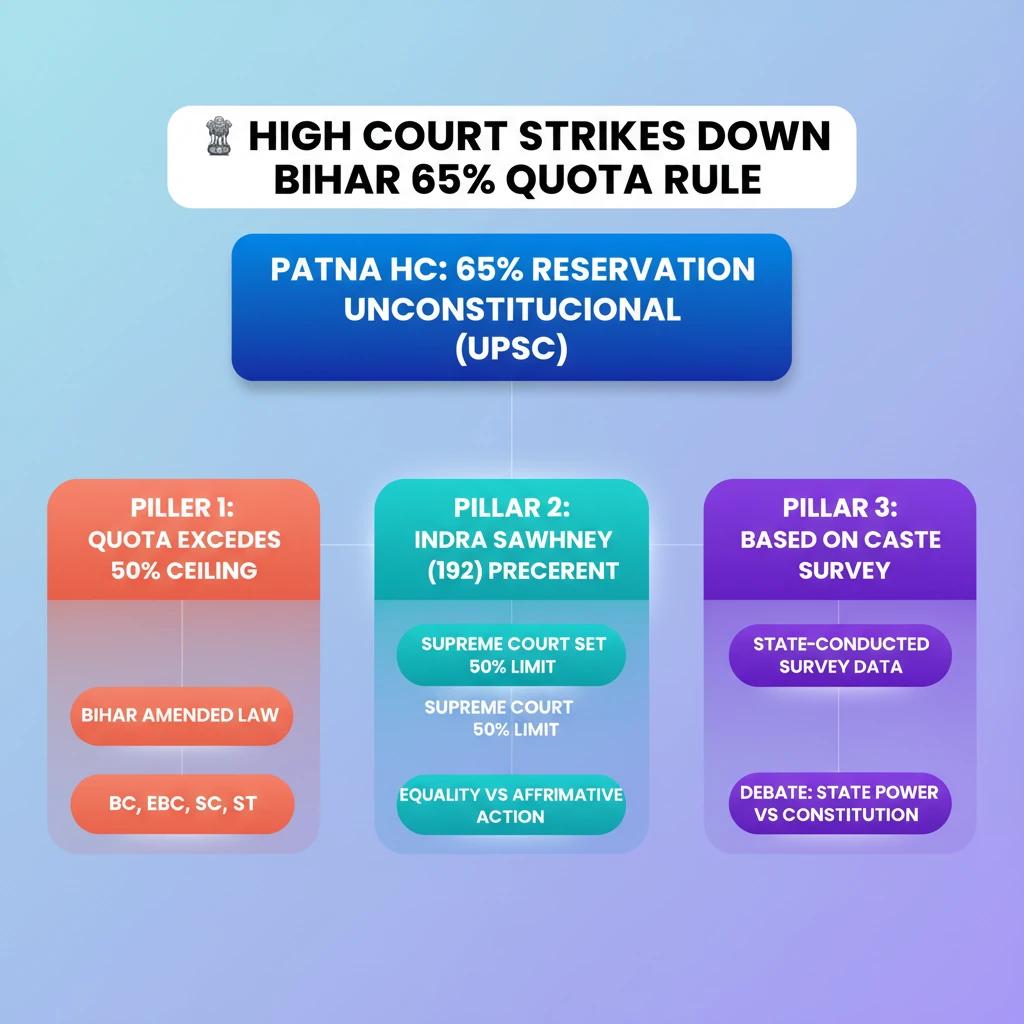
- •Patna High Court struck down Bihar's 65% reservation quota for BC, EBC, SC, ST.
- •The ruling reaffirms the 50% reservation ceiling established by the Supreme Court.
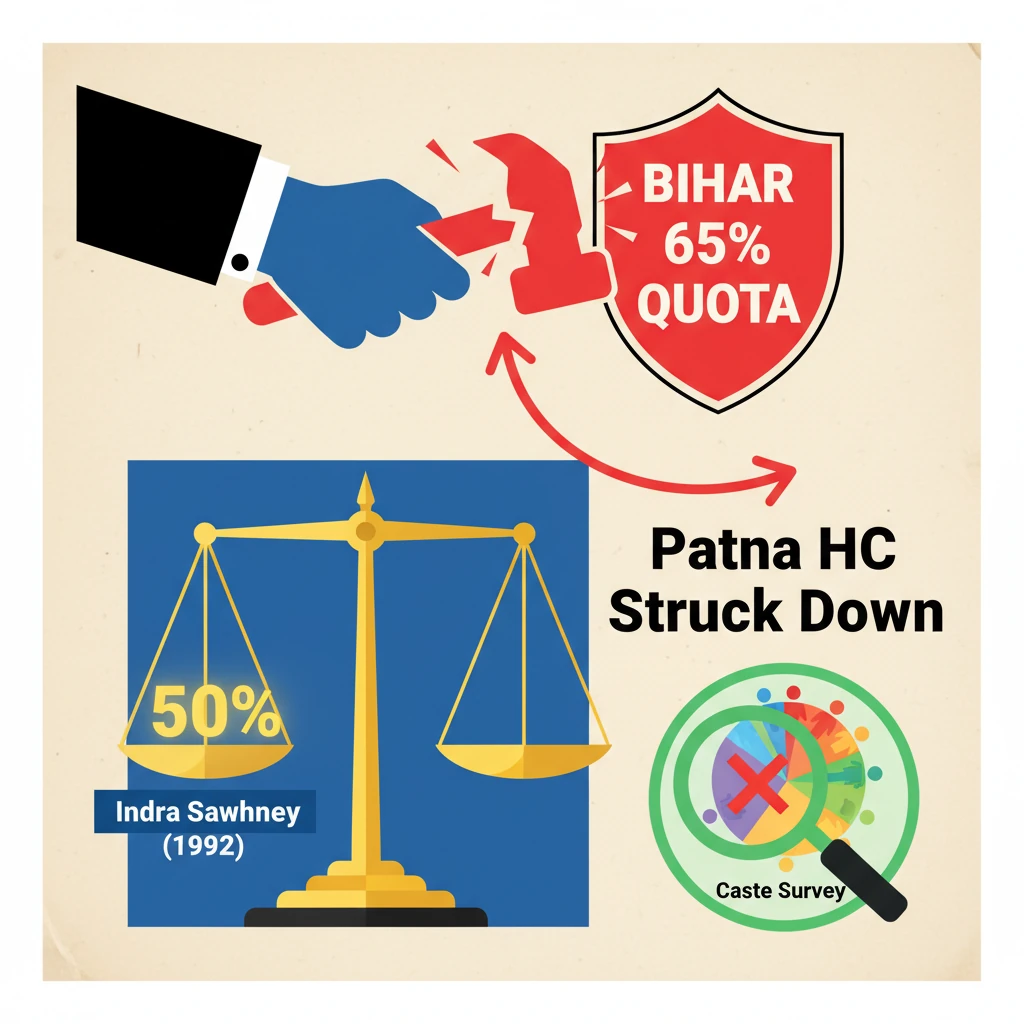
- •Indra Sawhney vs. Union of India (1992) is the landmark case setting the 50% limit.
- •Bihar's increase was based on a state-conducted caste-based survey.
- •The judgment highlights the ongoing debate between state policy and constitutional limits on reservation.
- •Reservation aims to ensure social justice and adequate representation for disadvantaged communities.
🧠 Memory Techniques
98% Verified Content
📚 Reference Sources
•The Constitution of India (Articles 15, 16)
•Supreme Court judgment: Indra Sawhney vs. Union of India (1992)
•News reports on Patna High Court's ruling on Bihar's reservation quota (e.g., The Hindu, Indian Express)
•103rd Constitutional Amendment Act (EWS Reservation)