Indian Initiatives to Reduce Gender Gap in Social, Economic and Political Life - Social Issues | UPSC Learning
Topics
0 topics • 0 completed
🔍
No topics match your search
Indian Initiatives to Reduce Gender Gap in Social, Economic and Political Life
Medium⏱️ 8 min read
social issues
📖 Introduction
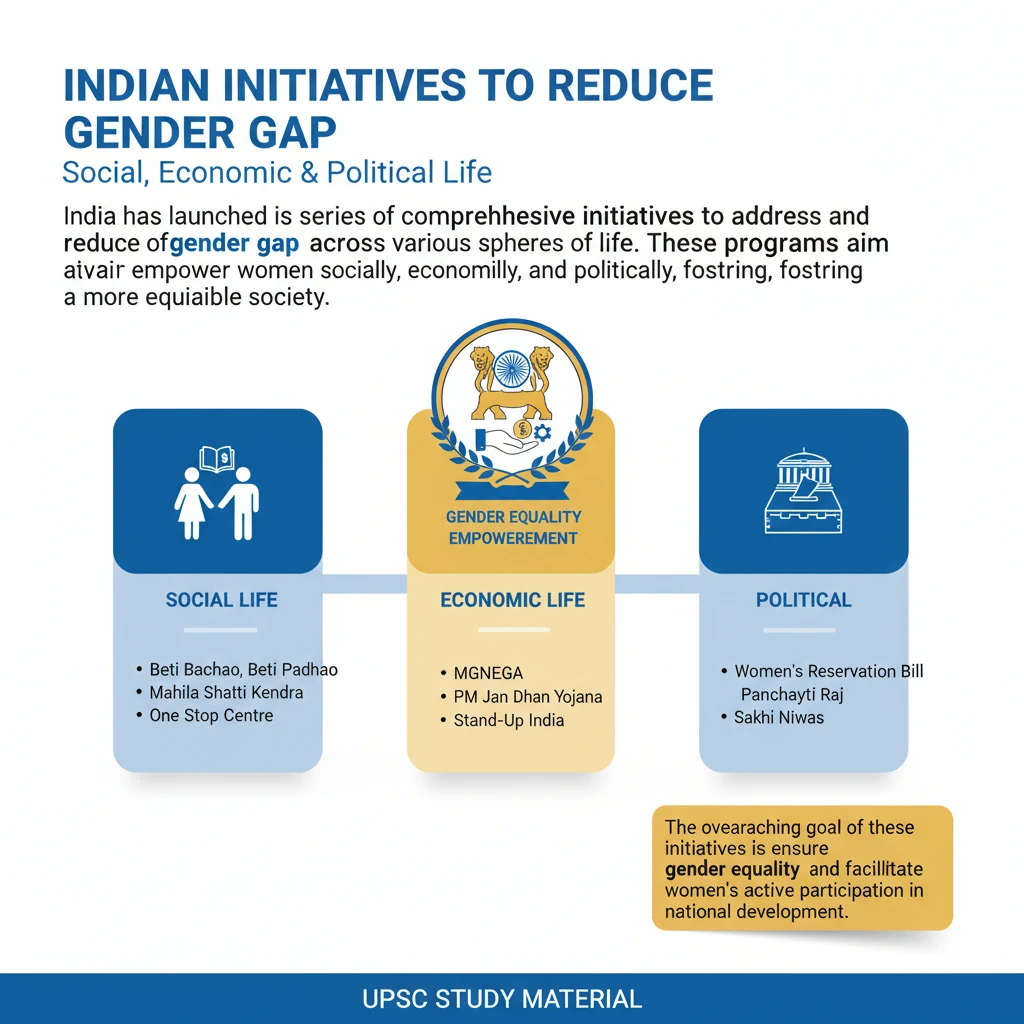
<h4>Introduction to Gender Gap Reduction Initiatives</h4><p>India has launched a series of comprehensive initiatives to address and reduce the persistent <strong>gender gap</strong> across various spheres of life. These programs aim to empower women socially, economically, and politically, fostering a more equitable society.</p><div class='key-point-box'><p>The overarching goal of these initiatives is to ensure <strong>gender equality</strong> and facilitate women's active participation in nation-building.</p></div><h4>Beti Bachao Beti Padhao (BBBP)</h4><p>The <strong>Beti Bachao Beti Padhao</strong> (BBBP) scheme is a flagship program launched by the Government of India. It focuses on addressing the declining Child Sex Ratio (CSR) and promoting the education of girl children.</p><div class='info-box'><p><strong>Objective:</strong> To prevent gender-biased sex selective elimination, ensure survival and protection of the girl child, and guarantee her education and participation.</p></div><h4>Mahila Shakti Kendra (MSK)</h4><p>The <strong>Mahila Shakti Kendra</strong> (MSK) scheme aims to empower rural women through community participation. It provides an interface for rural women to approach the government for availing their entitlements.</p><div class='info-box'><p><strong>Function:</strong> To provide skill development, employment, digital literacy, health, and nutrition services to women, facilitating their empowerment at the village level.</p></div><h4>Mahila Police Volunteers (MPV)</h4><p>The <strong>Mahila Police Volunteers</strong> (MPV) initiative involves engaging women volunteers in police stations. These volunteers act as a link between the police and the local community, especially women and girls.</p><div class='info-box'><p><strong>Role:</strong> To report incidents of violence against women, facilitate aid, and spread awareness about women's rights and safety measures.</p></div><h4>Rashtriya Mahila Kosh (RMK)</h4><p>The <strong>Rashtriya Mahila Kosh</strong> (RMK) is a national credit fund for women. It provides micro-credit to poor women for various livelihood and income-generating activities.</p><div class='info-box'><p><strong>Purpose:</strong> To promote socio-economic empowerment of women by providing financial services through Non-Governmental Organizations (NGOs) and other intermediaries.</p></div><h4>Sukanya Samriddhi Yojna (SSY)</h4><p>The <strong>Sukanya Samriddhi Yojna</strong> (SSY) is a small savings scheme aimed at securing the financial future of girl children. Parents can open an account in the name of their girl child from birth until she attains 10 years of age.</p><div class='info-box'><p><strong>Benefit:</strong> It offers attractive interest rates and tax benefits, encouraging families to save for their daughter's education and marriage.</p></div><h4>Kasturba Gandhi Balika Vidyalaya (KGBV)</h4><p>The <strong>Kasturba Gandhi Balika Vidyalaya</strong> (KGBV) scheme provides residential schools for girls belonging to disadvantaged groups. It focuses on girls from SC, ST, OBC, and minority communities in educationally backward blocks.</p><div class='info-box'><p><strong>Objective:</strong> To ensure access to quality education for girls who are out of school or dropouts, thereby reducing gender disparities in education.</p></div><h4>Political Reservation for Women</h4><p>India has taken significant steps to enhance women's representation in political life. This ensures their voice is heard in decision-making processes at various levels of governance.</p><div class='key-point-box'><p><strong>Political empowerment</strong> is crucial for addressing gender-specific issues and promoting inclusive development.</p></div><h5>Reservation in Panchayati Raj Institutions</h5><p>The government has mandated a <strong>33% reservation</strong> of seats for women in <strong>Panchayati Raj Institutions</strong> (PRIs). This has led to a substantial increase in women's participation at the grassroots level.</p><div class='info-box'><p>This reservation has empowered numerous women to take on leadership roles in local self-governance, bringing a unique perspective to local development.</p></div><h5>Reservation in Parliament and State Assemblies</h5><p>A landmark legislative step, the <strong>Constitution (106th Amendment) Act, 2023</strong>, has reserved <strong>one-third of all seats</strong> for women. This applies to the <strong>Lok Sabha</strong>, <strong>State legislative assemblies</strong>, and the legislative assembly of the <strong>National Capital Territory of Delhi</strong>.</p><div class='info-box'><p>This reservation includes seats already reserved for <strong>Scheduled Castes (SCs)</strong> and <strong>Scheduled Tribes (STs)</strong>, ensuring inclusive representation across categories.</p></div><div class='exam-tip-box'><p>The <strong>106th Constitutional Amendment Act</strong> is highly significant for <strong>UPSC Mains GS Paper 2 (Polity and Governance)</strong>. Candidates should understand its provisions, implications, and potential challenges in implementation.</p></div><h4>Promoting Female Entrepreneurship</h4><p>To foster economic independence and reduce the gender gap in the workforce, the government has initiated several programs aimed at promoting <strong>female entrepreneurship</strong>.</p><div class='key-point-box'><p>Economic empowerment through entrepreneurship provides women with financial autonomy and contributes to overall economic growth.</p></div><h5>Key Entrepreneurship Programs</h5><ul><li><p><strong>Stand-Up India:</strong> This scheme facilitates bank loans between <strong>₹10 lakh and ₹1 Crore</strong> to at least one <strong>Scheduled Caste (SC)</strong> or <strong>Scheduled Tribe (ST)</strong> borrower and at least one <strong>woman borrower</strong> per bank branch for setting up a greenfield enterprise.</p></li><li><p><strong>Mahila-e-Haat:</strong> An <strong>online marketing platform</strong> specifically designed to support <strong>women entrepreneurs</strong>, <strong>Self-Help Groups (SHGs)</strong>, and <strong>Non-Governmental Organizations (NGOs)</strong> to showcase and sell their products.</p></li><li><p><strong>Entrepreneurship and Skill Development Programme (ESDP):</strong> Aims to develop entrepreneurship and skills among various sections of society, including women, through training and support.</p></li></ul>
💡 Key Takeaways
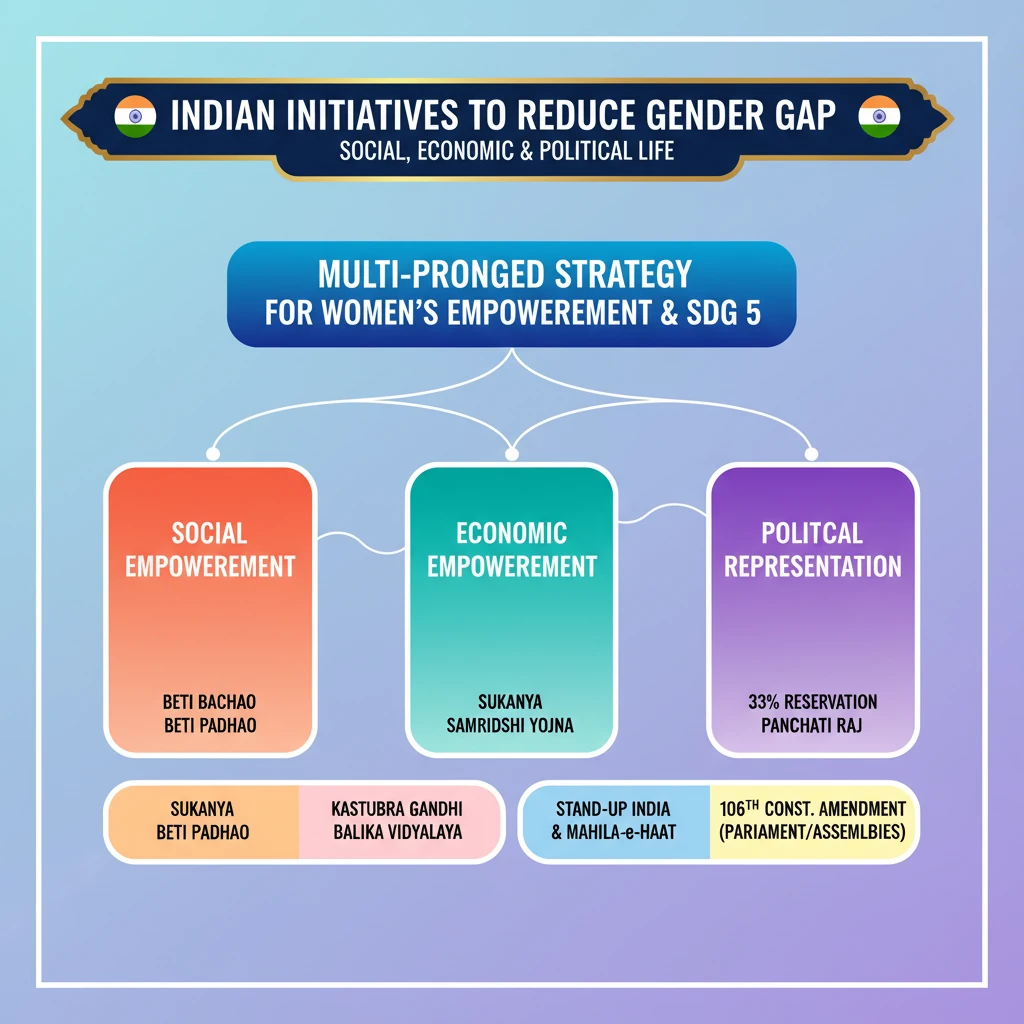
- •India employs a multi-pronged strategy to reduce the gender gap across social, economic, and political spheres.
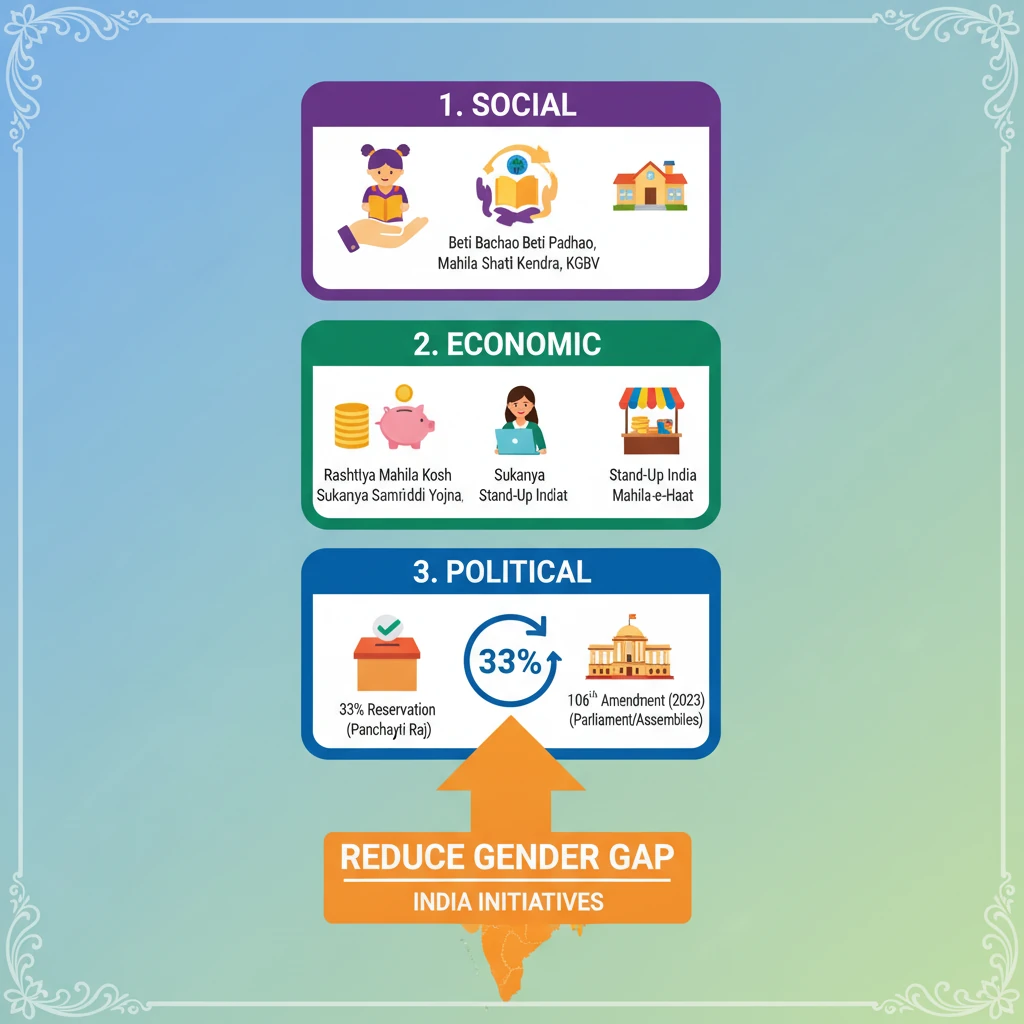
- •Key social initiatives include Beti Bachao Beti Padhao, Mahila Shakti Kendra, and Kasturba Gandhi Balika Vidyalaya, focusing on education, health, and protection.
- •Economic empowerment is fostered through schemes like Rashtriya Mahila Kosh, Sukanya Samriddhi Yojna, Stand-Up India, and Mahila-e-Haat.
- •Political representation is significantly boosted by 33% reservation in Panchayati Raj and the landmark 106th Constitutional Amendment Act, 2023, for Parliament and State Assemblies.
- •These initiatives collectively aim for holistic women's empowerment, crucial for India's inclusive growth and achieving SDG 5.
🧠 Memory Techniques
95% Verified Content
📚 Reference Sources
•Official websites of Ministry of Women and Child Development (MWCD), Ministry of Finance, Parliament of India for Constitutional Amendments