SBM Reduced Infant and Child Mortality - Social Issues | UPSC Learning
Topics
0 topics • 0 completed
🔍
No topics match your search
SBM Reduced Infant and Child Mortality
Medium⏱️ 5 min read
social issues
📖 Introduction
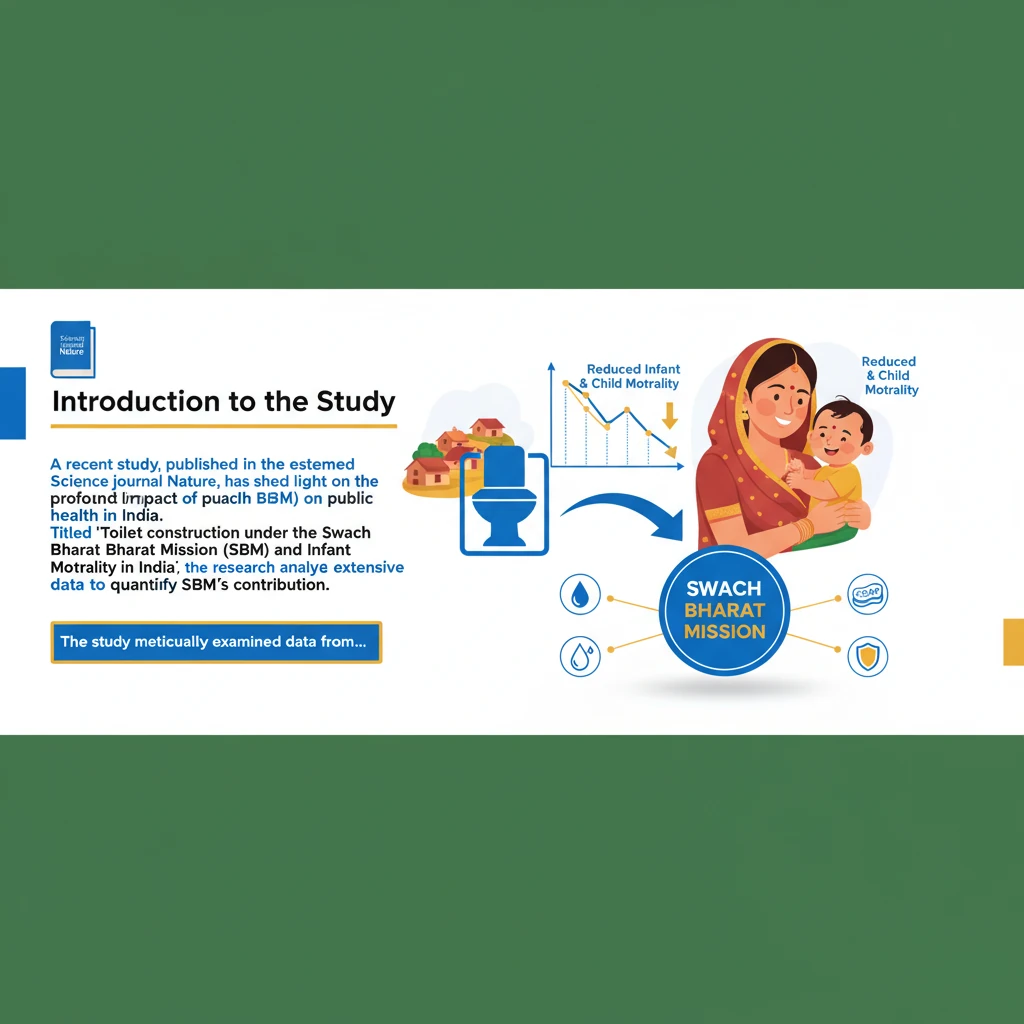
<h4>Introduction to the Study</h4><p>A recent study, published in the esteemed <strong>Science journal Nature</strong>, has shed light on the profound impact of the <strong>Swachh Bharat Mission (SBM)</strong> on public health in India.</p><p>Titled '<strong>Toilet construction under the Swachh Bharat Mission (SBM) and Infant Mortality in India</strong>', the research analyzed extensive data to quantify SBM's contribution.</p><div class='info-box'><p>The study meticulously examined data from <strong>35 states/Union territories</strong> and over <strong>600 districts</strong> across India, covering the period between <strong>2011 and 2020</strong>.</p></div><h4>Significant Reduction in Infant and Child Mortality</h4><p>The findings indicate a substantial positive correlation between <strong>SBM's initiatives</strong> and a reduction in mortality rates among infants and young children.</p><div class='key-point-box'><p>The <strong>Swachh Bharat Mission (SBM)</strong> is estimated to have potentially averted between <strong>60,000–70,000 infant deaths annually</strong> during the 2011–2020 period.</p></div><h4>Impact in High-Access Districts</h4><p>Specific areas that saw greater implementation of <strong>SBM's toilet construction</strong> efforts demonstrated even more pronounced health improvements.</p><div class='info-box'><p>Districts where over <strong>30% of toilets</strong> were constructed under <strong>SBM</strong> experienced <strong>5.3 fewer infant deaths</strong> and <strong>6.8 fewer child deaths</strong> per 1,000 live births.</p></div><h4>Correlation with Increased Toilet Access</h4><p>The study also established a clear quantitative relationship between improved toilet access and declining mortality rates.</p><div class='info-box'><p>Every <strong>10% increase</strong> in district-level toilet access post-SBM correlated with a reduction in the <strong>Infant Mortality Rate (IMR) by 0.9 points</strong> and the <strong>Under-Five Mortality Rate (U5MR) by 1.1 points</strong> on average.</p></div><h4>Accelerated Decline in Infant Mortality Rate (IMR)</h4><p>The period following the launch of <strong>SBM</strong> witnessed a significant acceleration in the rate of IMR reduction compared to previous years.</p><div class='info-box'><p>During the <strong>post-SBM period</strong>, <strong>IMR reductions accelerated</strong> to an <strong>8–9% annual decline</strong>, a stark contrast to the <strong>3% annual decline</strong> observed in the <strong>pre-SBM period (2000–2014)</strong>.</p></div><h4>Expansion of Toilet Availability and ODF Status</h4><p>The mission achieved remarkable success in expanding sanitation infrastructure across the country.</p><div class='info-box'><p>The availability of toilets increased <strong>twofold</strong>, and the practice of <strong>open defecation</strong> declined dramatically from <strong>60% to 19%</strong> within the first five years of <strong>SBM's implementation</strong>.</p><p>From <strong>2014 to 2020</strong>, the government constructed a staggering <strong>109 million household toilets</strong> and declared that more than <strong>600,000 villages</strong> are <strong>Open Defecation Free (ODF)</strong>.</p></div><h4>Swachh Bharat Mission's Holistic Approach</h4><p>The success of <strong>SBM</strong> is attributed not just to infrastructure development but also to its comprehensive strategy.</p><div class='key-point-box'><p><strong>SBM's unique approach</strong> combined large-scale <strong>toilet construction</strong> with substantial investments in <strong>IEC (Information, Education, and Communication)</strong> and robust <strong>community engagement</strong>, representing a holistic strategy to combat <strong>open defecation</strong>.</p></div>
💡 Key Takeaways
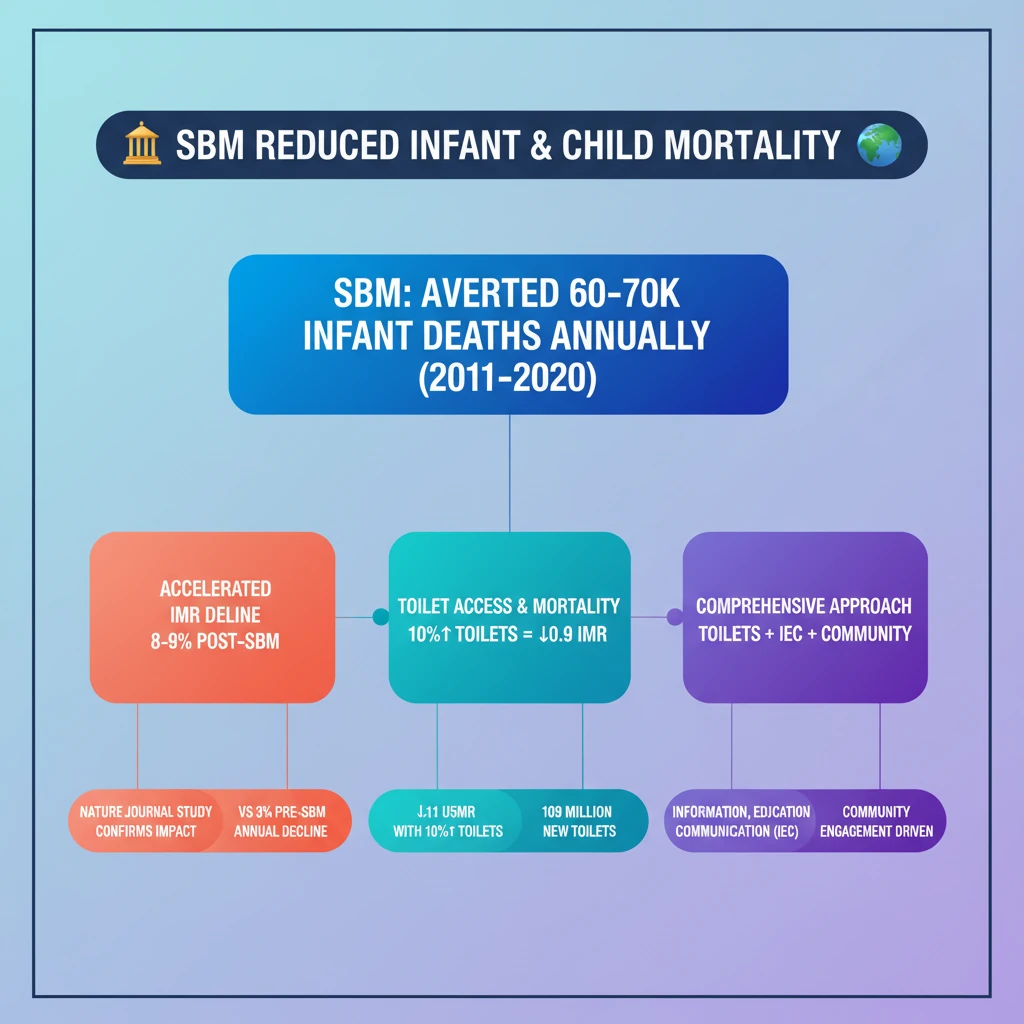
- •The Swachh Bharat Mission (SBM) potentially averted 60,000-70,000 infant deaths annually between 2011-2020.
- •A study in 'Nature' journal confirmed SBM's significant positive impact on Infant Mortality Rate (IMR) and Under-Five Mortality Rate (U5MR).
- •Post-SBM, India witnessed an accelerated IMR decline of 8-9% annually, compared to 3% pre-SBM.
- •Every 10% increase in toilet access correlated with a reduction of 0.9 points in IMR and 1.1 points in U5MR.
- •SBM's success was driven by a comprehensive approach combining toilet construction (109 million) with Information, Education, and Communication (IEC) and community engagement.
- •Open defecation significantly declined from 60% to 19% in the first five years of SBM.
🧠 Memory Techniques

95% Verified Content
📚 Reference Sources
•Nature journal study: 'Toilet construction under the Swachh Bharat Mission (SBM) and Infant Mortality in India'