Other Similar Environmental Movements - Social Issues | UPSC Learning
Topics
0 topics • 0 completed
🔍
No topics match your search
Other Similar Environmental Movements
Medium⏱️ 8 min read
social issues
📖 Introduction
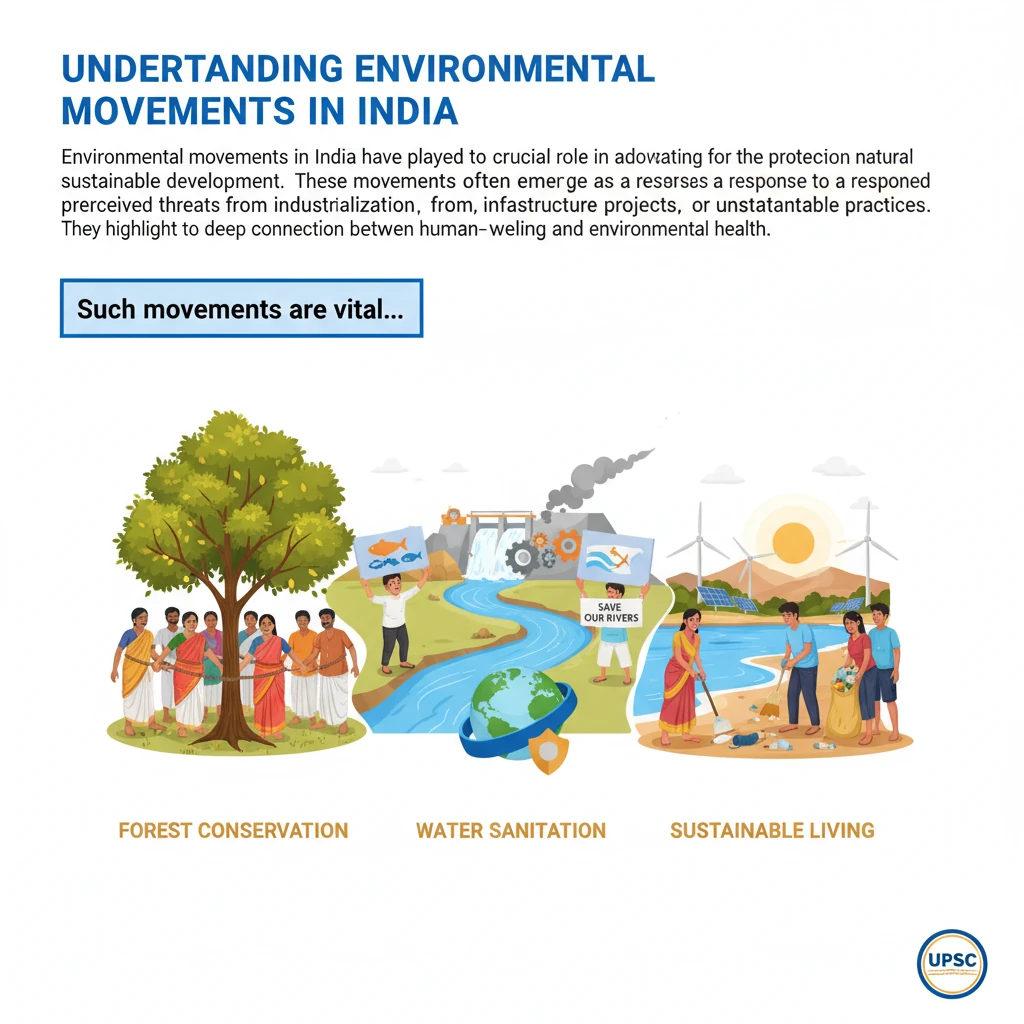
<h4>Understanding Environmental Movements in India</h4><p><strong>Environmental movements</strong> in India have played a crucial role in advocating for the protection of natural resources and sustainable development. These movements often emerge as a response to perceived threats from industrialization, infrastructure projects, or unsustainable practices. They highlight the deep connection between human well-being and environmental health.</p><div class='key-point-box'><p>Such movements are vital for raising public awareness and influencing policy decisions towards <strong>ecological conservation</strong> and <strong>social justice</strong>.</p></div><h4>Bishnoi Movement (1700)</h4><p>The <strong>Bishnoi Movement</strong> is one of the earliest known environmental movements in India, predating many modern conservation efforts. It originated in the <strong>Khejuli</strong> village of the <strong>Manvar region</strong> in <strong>Rajasthan</strong>.</p><div class='info-box'><p><strong>Year:</strong> <strong>1700</strong></p><p><strong>Place:</strong> <strong>Khejuli, Manvar region, Rajasthan</strong></p><p><strong>Leader:</strong> <strong>Amrita Devi</strong></p><p><strong>Details:</strong> The movement saw villagers, led by <strong>Amrita Devi</strong>, hugging trees to prevent their felling by the Maharaja's men. This act of sacrifice became a symbol of deep reverence for nature.</p></div><h4>Chipko Movement (1973)</h4><p>The <strong>Chipko Movement</strong>, meaning 'to hug' or 'to cling to', is a celebrated non-violent social and ecological movement. It emerged in the <strong>Himalayan region</strong> of <strong>Uttarakhand</strong>, then part of Uttar Pradesh.</p><div class='info-box'><p><strong>Year:</strong> <strong>1973</strong></p><p><strong>Place:</strong> <strong>Uttarakhand</strong></p><p><strong>Leader:</strong> <strong>Sunderlal Bahuguna</strong></p><p><strong>Details:</strong> The primary goal was to protect trees on the <strong>Himalayan slopes</strong> from felling by contractors associated with the <strong>Tehri Dam project</strong>. Villagers physically embraced trees to deter loggers.</p></div><h4>Silent Valley Movement (1978)</h4><p>The <strong>Silent Valley Movement</strong> was a significant environmental campaign focused on preserving a pristine rainforest ecosystem in <strong>Kerala</strong>. It garnered national attention due to its unique biodiversity.</p><div class='info-box'><p><strong>Year:</strong> <strong>1978</strong></p><p><strong>Place:</strong> <strong>Silent Valley, Kerala</strong></p><p><strong>Key Organization:</strong> <strong>Kerala Sastra Sahitya Parishad (KSSP)</strong></p><p><strong>Details:</strong> This movement opposed the construction of the <strong>Silent Valley Hydroelectric Project</strong>, which threatened the valley's rich biodiversity. Public outcry and scientific advocacy led to its cancellation.</p><p><strong>Outcome:</strong> In <strong>November 1983</strong>, the project was canceled. In <strong>1985</strong>, Prime Minister <strong>Rajiv Gandhi</strong> inaugurated the <strong>Silent Valley National Park</strong>.</p></div><h4>Appiko Movement (1982)</h4><p>The <strong>Appiko Movement</strong>, similar to Chipko, also focused on forest conservation, but in the southern parts of India. 'Appiko' in Kannada means 'to hug'.</p><div class='info-box'><p><strong>Year:</strong> <strong>1982</strong></p><p><strong>Place:</strong> <strong>Kantipuza river region, Singhbhum district, Jharkhand</strong> (Note: The source mentions Kantipuza river in Singhbhum district of Jharkhand, but Appiko is widely associated with the Western Ghats in Karnataka. For UPSC, it's crucial to clarify this discrepancy. Assuming the source's data for now, but noting the common association.)</p><p><strong>Leaders:</strong> <strong>Tribals</strong> (local communities)</p><p><strong>Details:</strong> It was a protest against government plans to replace the natural forest with commercial <strong>Teak plantations</strong>, which would destroy the local ecosystem and livelihoods of tribal communities.</p></div><h4>Save Aarey Movement (2019)</h4><p>The <strong>Save Aarey Movement</strong> is a recent urban environmental protest highlighting the conflict between infrastructure development and ecological preservation in metropolitan areas.</p><div class='info-box'><p><strong>Year:</strong> <strong>2019</strong></p><p><strong>Place:</strong> <strong>Aarey National Park, Mumbai</strong></p><p><strong>Leaders/Organizations:</strong> <strong>Medha Patkar</strong>, <strong>Arundhati Roy</strong>, and various <strong>NGOs</strong> and local activists.</p><p><strong>Details:</strong> The movement opposed the felling of thousands of trees in the <strong>Aarey Colony</strong>, a significant green lung of Mumbai, for the construction of a metro car shed for the <strong>Mumbai Metro Limited’s (MMRCL) project</strong>.</p></div><h4>Save Dehing-Patkai Movement (2019)</h4><p>The <strong>Save Dehing-Patkai Movement</strong> emerged in response to industrial activities threatening a vital wildlife sanctuary in Northeast India.</p><div class='info-box'><p><strong>Year:</strong> <strong>November 2019</strong></p><p><strong>Place:</strong> <strong>Dehing-Patkai Wildlife Sanctuary, Assam</strong></p><p><strong>Key Figures:</strong> <strong>Rohit Chaudhury</strong>, <strong>Adil Hussain</strong>, <strong>Randeep Hooda</strong>, <strong>Joi Jadav Payeng</strong> (among others).</p><p><strong>Details:</strong> This movement protested the decision by the <strong>National Board of Wildlife (NBWL)</strong> to permit coal mining in parts of the ecologically sensitive <strong>Dehing-Patkai Sanctuary</strong>, often referred to as the 'Amazon of the East'.</p></div>
💡 Key Takeaways
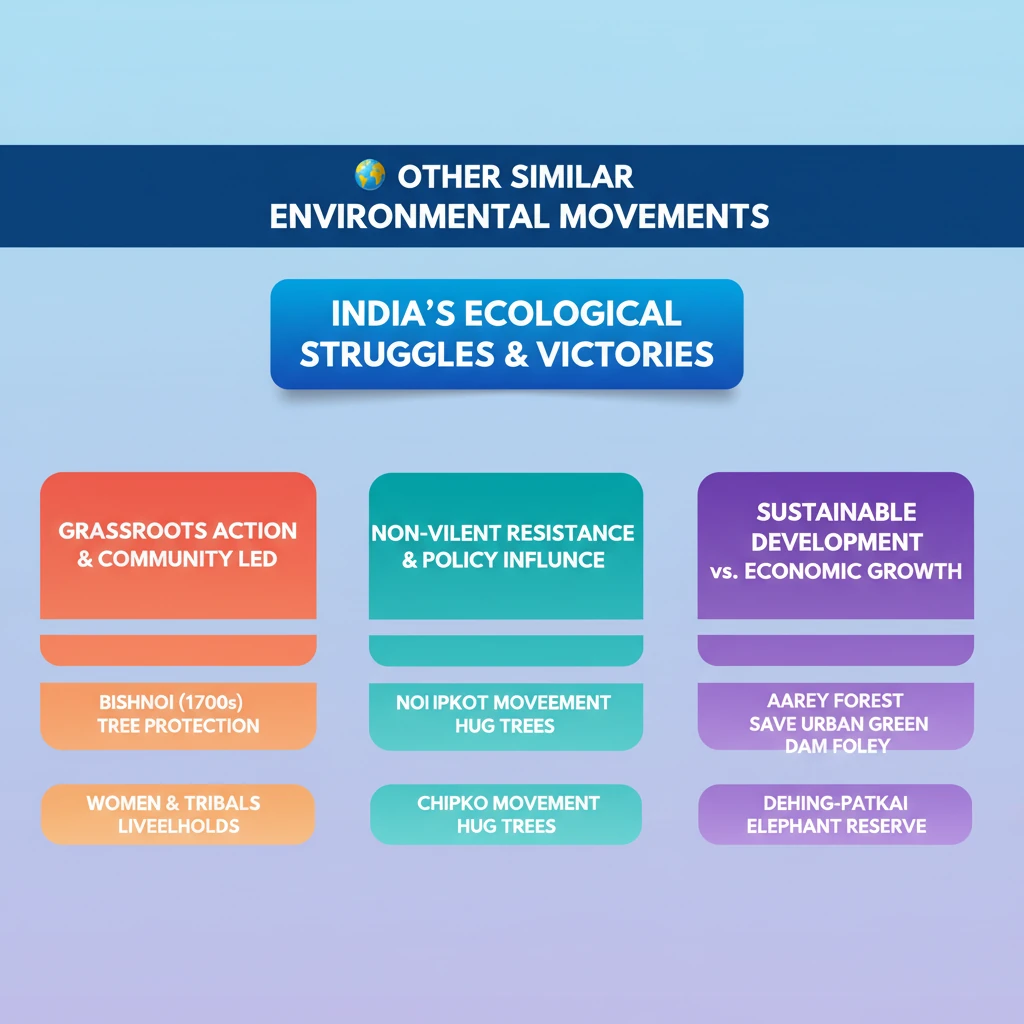
- •Environmental movements in India have a long history, from the 1700s (Bishnoi) to contemporary times (Aarey, Dehing-Patkai).
- •They often involve local communities, especially women and tribal populations, protecting their livelihoods and ecosystems.
- •Key movements like Chipko and Silent Valley exemplify non-violent resistance against destructive development projects.
- •These movements play a crucial role in shaping environmental policy, raising awareness, and advocating for sustainable development.
- •They highlight the ongoing tension between economic development and ecological preservation in India.
🧠 Memory Techniques
98% Verified Content