NAMASTE Scheme: Caste & Manual Scavenging Data - Social Issues | UPSC Learning
Topics
0 topics • 0 completed
🔍
No topics match your search
NAMASTE Scheme: Caste & Manual Scavenging Data
Medium⏱️ 7 min read
social issues
📖 Introduction
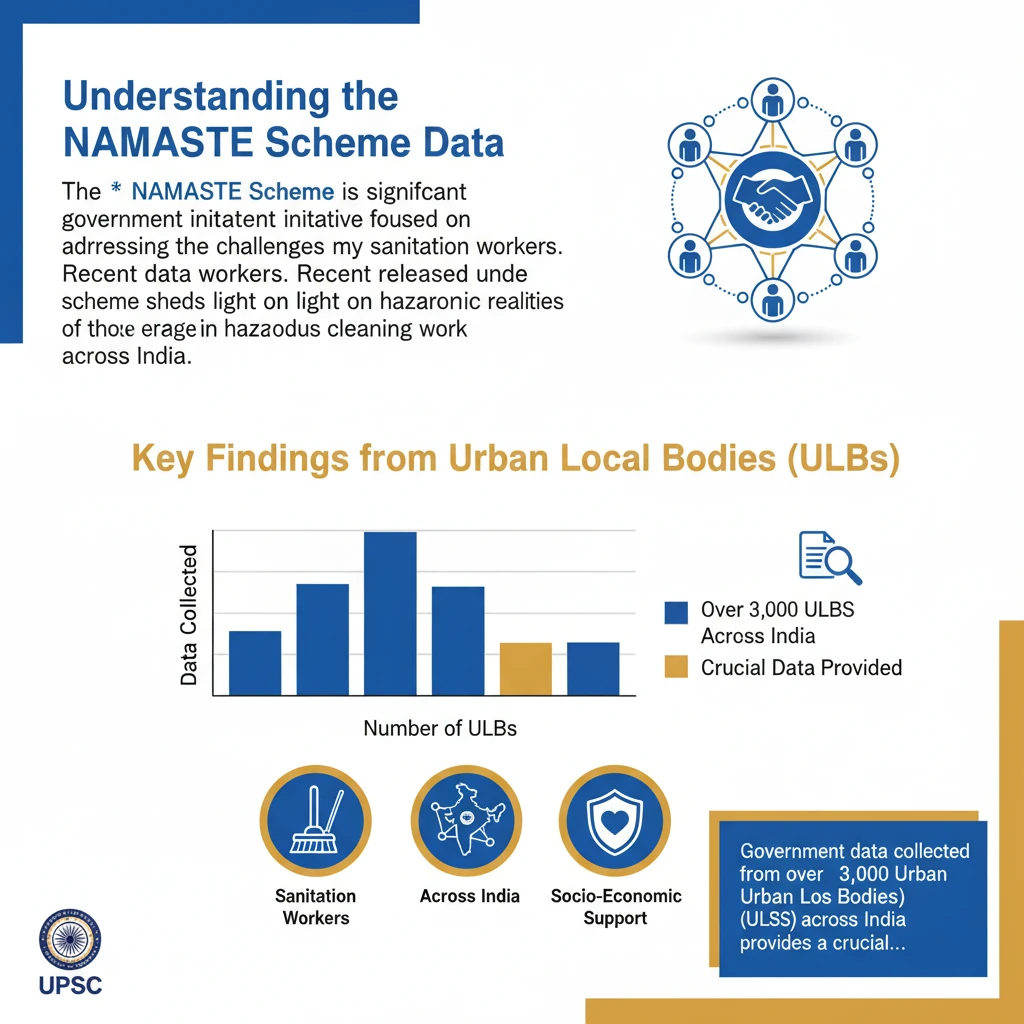
<h4>Understanding the NAMASTE Scheme Data</h4><p>The <strong>NAMASTE Scheme</strong> is a significant government initiative focused on addressing the challenges faced by sanitation workers. Recent data released under this scheme sheds light on the socio-economic realities of those engaged in hazardous cleaning work across India.</p><h4>Key Findings from Urban Local Bodies (ULBs)</h4><p>Government data collected from over <strong>3,000 Urban Local Bodies (ULBs)</strong> across India provides a critical insight into the demographic composition of sanitation workers. This extensive data collection effort underscores the scale and prevalence of manual scavenging.</p><div class='info-box'><p>The data covers approximately <strong>58,000 manual scavengers and workers</strong>. These individuals are primarily involved in the hazardous tasks of <strong>sewer and septic tank cleaning</strong> in various cities nationwide.</p></div><h4>Caste-Based Occupational Segregation</h4><p>A striking revelation from the <strong>NAMASTE Scheme</strong> data is the predominant representation of specific social groups. A significant majority of these workers belong to historically marginalized communities, highlighting deep-seated inequalities.</p><div class='key-point-box'><p>Specifically, <strong>92%</strong> of the identified <strong>manual scavengers and hazardous sanitation workers</strong> are from <strong>Scheduled Caste (SC)</strong>, <strong>Scheduled Tribe (ST)</strong>, or <strong>Other Backward Class (OBC)</strong> communities.</p></div><p>This statistic unequivocally highlights the deep-rooted issue of <strong>caste-based occupational segregation</strong> prevalent in India's urban sanitation sector. It points to a systemic problem where certain communities are disproportionately engaged in undignified and dangerous work.</p><h4>Dangers Faced by Sanitation Workers</h4><p>Beyond the social segregation, the data also implicitly underscores the severe <strong>dangers and health risks</strong> associated with <strong>manual scavenging</strong> and <strong>hazardous sewer and septic tank cleaning</strong>. These workers often operate without adequate safety gear or proper training, leading to high mortality rates.</p><div class='exam-tip-box'><p>This information is crucial for understanding social justice issues in <strong>GS-I (Society)</strong> and governance challenges in <strong>GS-II (Social Justice)</strong>. It provides concrete data points to substantiate arguments on inequality and human rights violations.</p></div>
💡 Key Takeaways
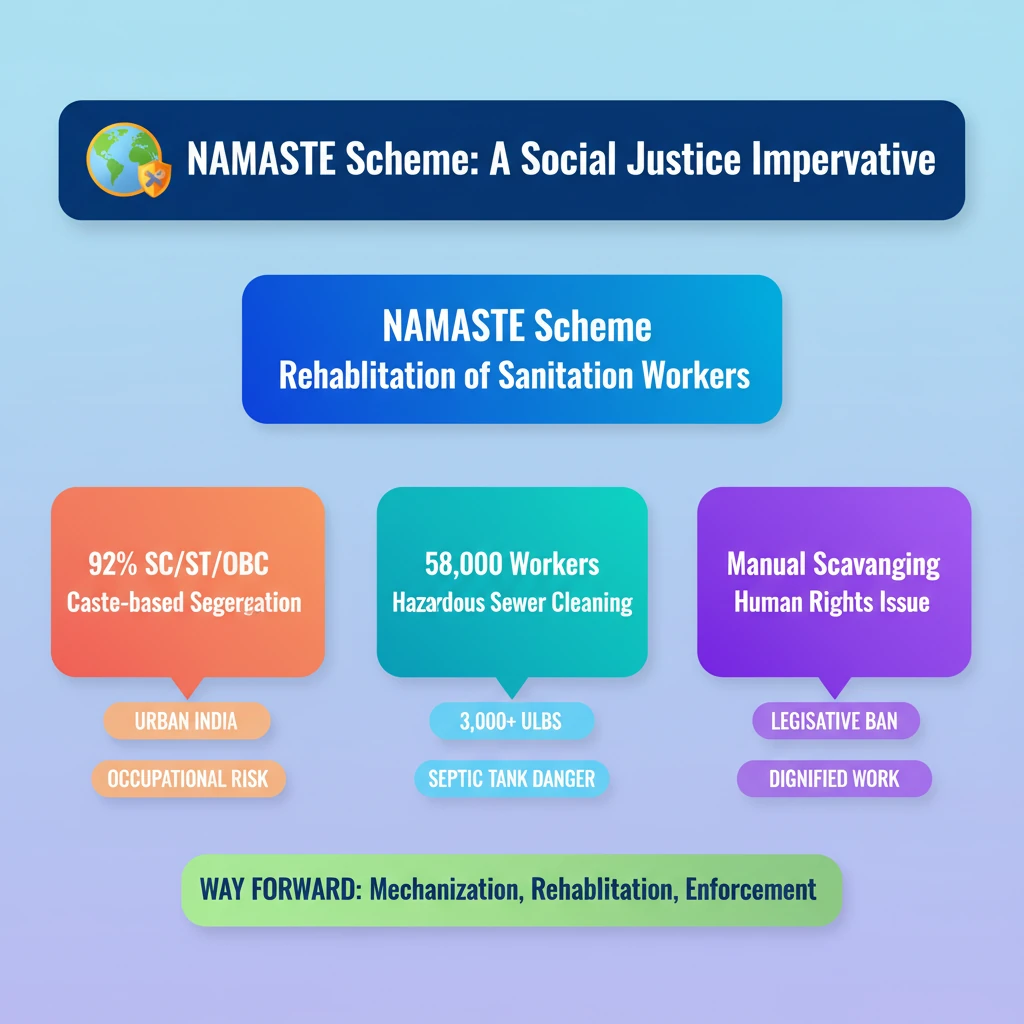
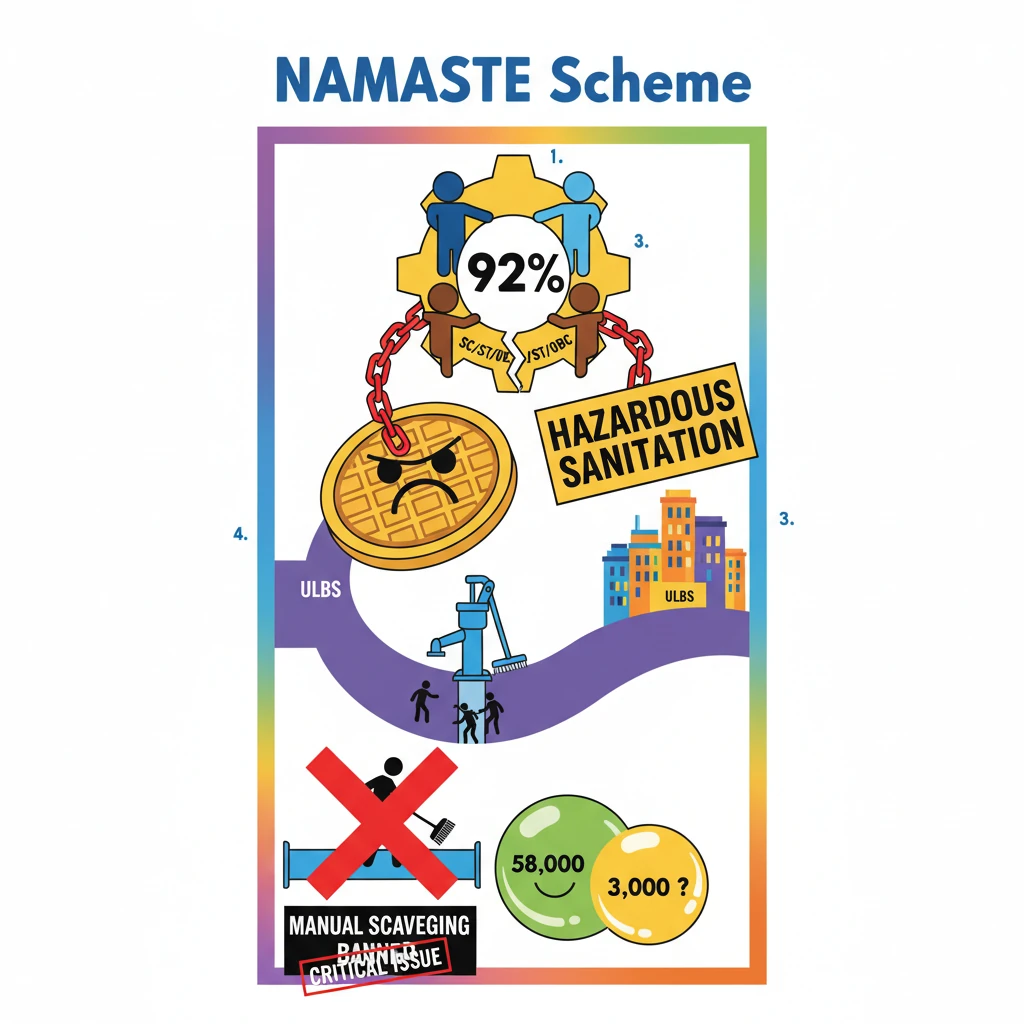
- •NAMASTE Scheme data reveals 92% of hazardous sanitation workers belong to SC/ST/OBC communities.
- •This highlights persistent caste-based occupational segregation in urban India's sanitation sector.
- •Approximately 58,000 workers in over 3,000 ULBs are involved in dangerous sewer and septic tank cleaning.
- •Manual scavenging remains a critical social justice and human rights issue despite legislative bans.
- •Urgent need for comprehensive mechanization, robust rehabilitation programs, and strict enforcement of existing laws to ensure dignified work.
🧠 Memory Techniques
95% Verified Content
📚 Reference Sources
•Government of India official reports (implied by 'government data' as cited by Drishti IAS)