Inheritance Norms in Hindu Succession Act, 1956 - Social Issues | UPSC Learning
Topics
0 topics • 0 completed
🔍
No topics match your search
Inheritance Norms in Hindu Succession Act, 1956
Medium⏱️ 10 min read
social issues
📖 Introduction
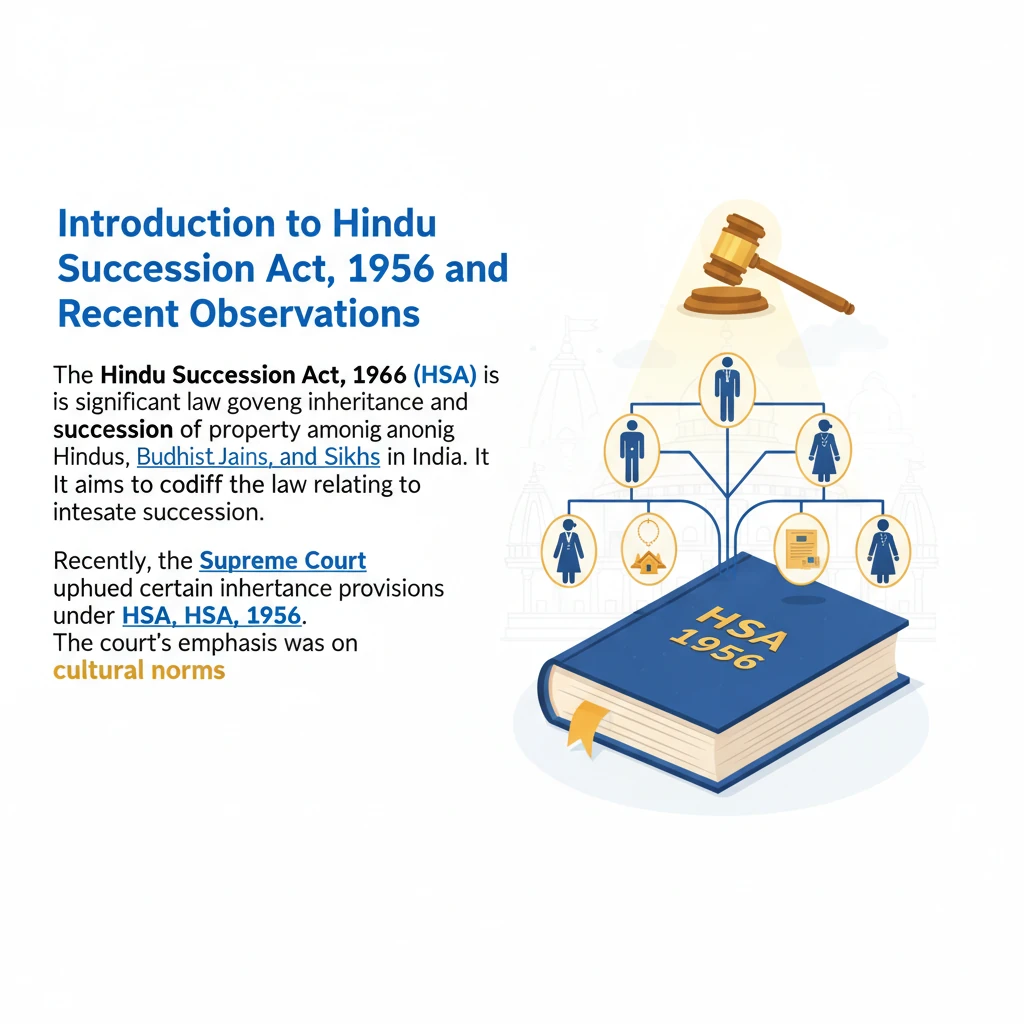
<h4>Supreme Court's Stance on Inheritance Norms</h4><p>The <strong>Supreme Court of India</strong> recently upheld the existing <strong>inheritance provisions</strong> under the <strong>Hindu Succession Act, 1956 (HSA)</strong>. This ruling emphasized the importance of <strong>cultural norms</strong> and <strong>legislative consistency</strong>.</p><p>The court clarified that inheritance should not be viewed solely through the lens of <strong>gender inequality</strong>. This stance came in response to several petitions challenging the Act's validity, which argued for more equitable treatment of men and women in inheritance matters.</p><div class='key-point-box'><p>The <strong>Supreme Court</strong> affirmed that <strong>inheritance laws</strong> reflect broader societal values and should not be framed exclusively as a <strong>gender equality issue</strong>, considering the deeply rooted cultural context.</p></div><h4>Cultural Context of Hindu Inheritance Practices</h4><p>The court highlighted that <strong>Hindu inheritance practices</strong> are deeply intertwined with <strong>cultural values</strong>. These values have traditionally influenced how property is inherited and devolved within families.</p><p>A significant aspect of these traditional sentiments is the notion that a <strong>married woman's parents</strong> typically do not interfere with or claim rights over her <strong>inherited properties</strong>. This reflects a specific societal understanding of marital and familial ties.</p><h4>Scientific and Logical Lineage Framework</h4><p>The <strong>Hindu Succession Act</strong> was upheld for its <strong>'scientific and logical' framework</strong> regarding property devolution. This framework ensures that property acquired by a woman from her <strong>parents</strong> or <strong>in-laws</strong> returns to the original source family.</p><div class='info-box'><p><strong>HSA's Devolution Principle:</strong> In the absence of <strong>direct heirs</strong> (children, husband), property inherited by a woman from her parents or in-laws reverts to the respective source family. This maintains an <strong>ancestral lineage-based approach</strong>.</p></div><h4>Need for Legislative Change by Parliament</h4><p>The <strong>Supreme Court</strong> reiterated that any modifications to <strong>inheritance laws</strong> must be initiated and enacted by <strong>Parliament</strong>, the legislative body. Judicial decisions are not the appropriate mechanism for such widespread societal changes.</p><p>This is because <strong>inheritance laws</strong> profoundly affect the entire society. Therefore, any amendments must reflect a <strong>broad societal agreement</strong> and collective values, rather than being influenced by the concerns of a few individuals or specific disputes.</p><div class='exam-tip-box'><p><strong>UPSC Insight:</strong> This ruling underscores the principle of <strong>separation of powers</strong>, particularly the distinction between the roles of the <strong>judiciary</strong> and the <strong>legislature</strong> in enacting social reforms. It's crucial for GS-II (Polity & Governance).</p></div>
💡 Key Takeaways
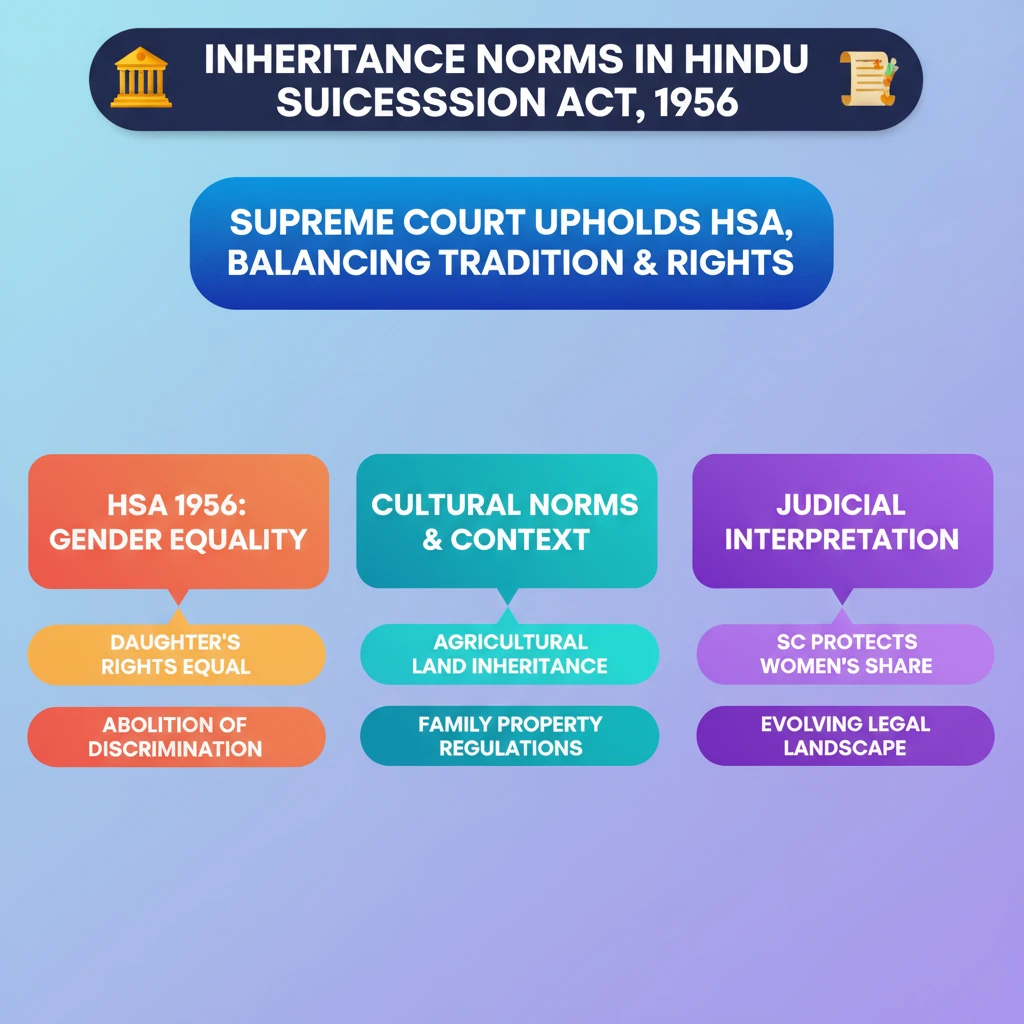
- •Supreme Court upheld Hindu Succession Act, 1956 (HSA) inheritance provisions, emphasizing cultural norms.
- •Court clarified inheritance laws are not solely a gender equality issue but reflect deep cultural values.
- •HSA's framework ensures property inherited by a woman from parents/in-laws returns to source family if no direct heirs.
- •Legislative changes to inheritance laws are Parliament's domain, not the judiciary's, due to societal impact.
- •The ruling highlights the balance between legal reform, cultural sentiments, and democratic legislative processes.
🧠 Memory Techniques
98% Verified Content
📚 Reference Sources
•Hindu Succession Act, 1956 (as amended)
•Supreme Court of India judgments (general understanding of recent pronouncements)