Rights Of Forest Dwellers and Thanthai Periyar Sanctuary - Social Issues | UPSC Learning
Topics
0 topics • 0 completed
🔍
No topics match your search
Rights Of Forest Dwellers and Thanthai Periyar Sanctuary
Medium⏱️ 8 min read
social issues
📖 Introduction
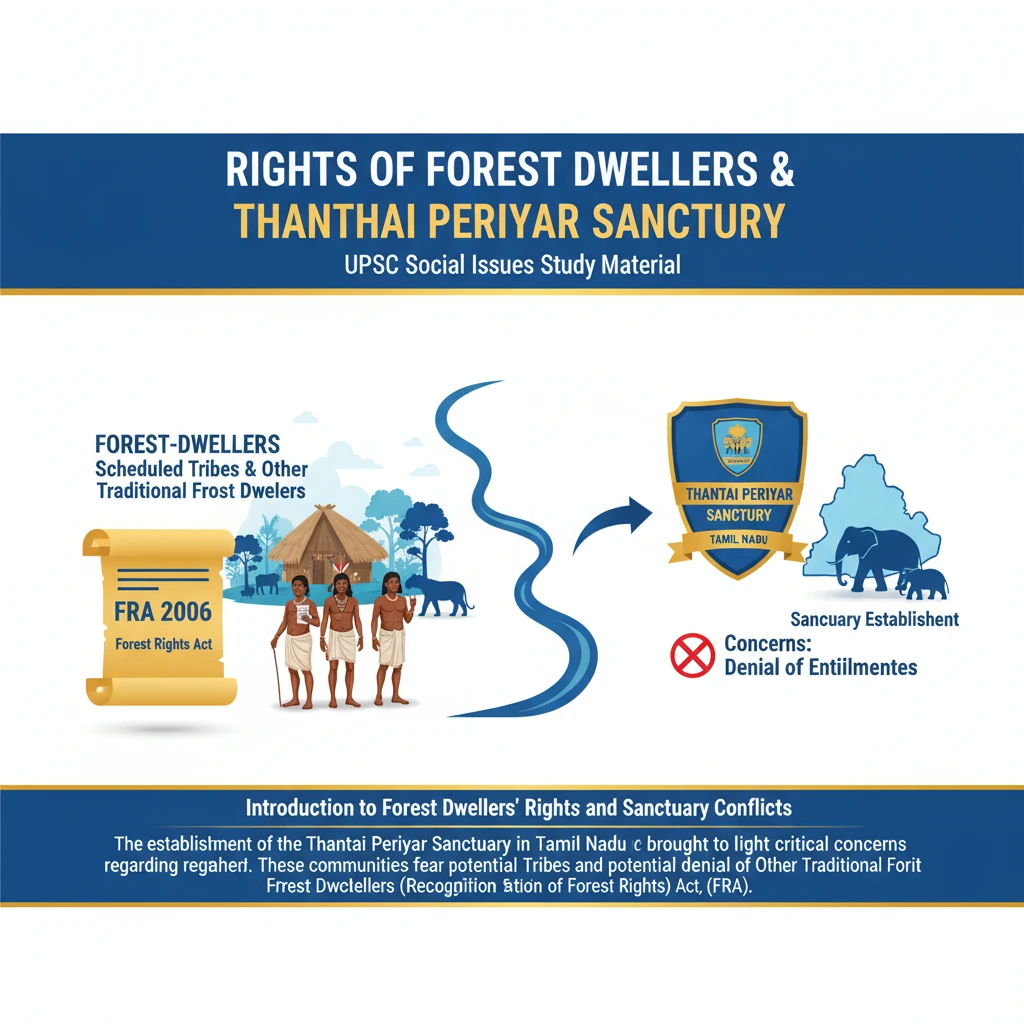
<h4>Introduction to Forest Dwellers' Rights and Sanctuary Conflicts</h4><p>The establishment of the <strong>Thanthai Periyar Sanctuary</strong> in <strong>Tamil Nadu</strong> brought to light critical concerns regarding the rights of <strong>forest-dwellers</strong>.</p><p>These communities fear potential denial of their entitlements under the crucial <strong>Scheduled Tribes and Other Traditional Forest Dwellers (Recognition of Forest Rights) Act, 2006 (FRA)</strong>.</p><div class='info-box'><p>The <strong>FRA, 2006</strong> is a landmark legislation that acknowledges the historical injustice faced by <strong>forest-dwelling tribal communities</strong> and <strong>traditional forest dwellers</strong>.</p></div><h4>The Forest Rights Act (FRA), 2006: Core Principles</h4><p>The <strong>FRA, 2006</strong>, formally known as the <strong>Scheduled Tribes and Other Traditional Forest Dwellers (Recognition of Forest Rights) Act</strong>, is pivotal for tribal welfare.</p><p>It aims to rectify the historical injustice by recognizing the symbiotic relationship between these communities and the forests they inhabit.</p><div class='key-point-box'><p>The Act secures rights over <strong>forest resources</strong> that are essential for their <strong>livelihoods, habitation, and socio-cultural needs</strong>.</p></div><h4>Rights Granted Under FRA, 2006</h4><p>The <strong>FRA</strong> provides a comprehensive set of rights, categorizing them into individual and community entitlements.</p><ul><li><strong>Individual Rights:</strong> Include rights to <strong>self-cultivation</strong> and <strong>habitation</strong>.</li><li><strong>Community Rights:</strong> Encompass <strong>grazing, fishing, access to water bodies</strong>, and <strong>traditional seasonal resource access</strong> for <strong>nomadic and pastoral communities</strong>.</li><li><strong>Special Recognitions:</strong> Rights of <strong>Particularly Vulnerable Tribal Groups (PVTGs)</strong>, <strong>intellectual property rights</strong>, and <strong>customary rights</strong> are also acknowledged.</li><li><strong>Conservation Rights:</strong> Communities gain the right to <strong>protect, regenerate, or manage community forest resources sustainably</strong>.</li><li><strong>Developmental Rights:</strong> Provision for allocation of <strong>forest land for developmental purposes</strong> to meet basic infrastructural needs.</li></ul><div class='info-box'><p>The <strong>FRA</strong> works in conjunction with the <strong>Right to Fair Compensation and Transparency in Land Acquisition, Rehabilitation and Settlement Act of 2013</strong>, preventing eviction without proper rehabilitation.</p></div><h4>Role of Gram Sabha in FRA Implementation</h4><p>The <strong>Gram Sabha (village assembly)</strong> is central to the implementation and enforcement of the <strong>FRA, 2006</strong>.</p><p>It is an highly empowered body, ensuring that the <strong>tribal population</strong> has a decisive say in local policies and schemes affecting them.</p><div class='key-point-box'><p>The <strong>Gram Sabha</strong> is authorized to <strong>determine and recognise forest rights</strong> and is responsible for <strong>protecting and preserving forests, wildlife, and biodiversity</strong> within their customary boundaries, even inside <strong>Protected Areas</strong>.</p></div><p>Violations of the <strong>FRA</strong>, especially concerning <strong>Scheduled Tribes</strong>, are considered crimes under the <strong>2016 amendment</strong> to the <strong>Scheduled Castes and the Scheduled Tribes (Prevention of Atrocities) Act of 1989</strong>.</p><p>The Act also states that converting <strong>forest villages into revenue villages</strong> is a recognized right for <strong>forest-dwelling Scheduled Tribes</strong> and other traditional forest dwellers.</p><h4>FRA and Protected Areas: A Legal Interplay</h4><p>When a <strong>Protected Area</strong> is notified under the <strong>Wild Life (Protection) Act (WLPA), 1972</strong>, the government must first assess rights under the <strong>FRA, 2006</strong>.</p><p>Crucially, <strong>consent from the Gram Sabhas</strong> is required before such notification.</p><div class='highlight-box'><p>The <strong>FRA 2006</strong>, being a later law, <strong>supersedes the WLPA, 1972</strong>. Any conflicting provisions in the <strong>WLPA</strong> are considered <strong>null and void</strong>.</p></div><h4>Madras High Court Order and Grazing Rights</h4><p>In <strong>March 2022</strong>, the <strong>Madras High Court</strong> revised an older order concerning <strong>cattle grazing</strong> in Tamil Nadu's forests.</p><p>The ban on grazing was restricted to <strong>National Parks, Sanctuaries, and Tiger Reserves</strong>, lifting the total ban across all forests.</p><div class='info-box'><p><strong>Tamil Nadu</strong> is currently the <strong>only state</strong> in India with such a specific ban on grazing in protected areas.</p></div><p>This order is notable as the <strong>FRA 2006</strong> explicitly acknowledges <strong>grazing rights</strong> and <strong>traditional resource access</strong> for <strong>nomadic or pastoralist communities</strong>.</p><p>These <strong>grazing rights</strong> are considered <strong>community rights</strong> at the habitation level and are to be regulated by their respective <strong>Gram Sabhas</strong>.</p><div class='exam-tip-box'><p>This conflict highlights the ongoing tension between <strong>conservation efforts</strong> and the <strong>rights of forest-dwelling communities</strong>, a frequent topic in <strong>UPSC Mains GS-III</strong>.</p></div><h4>Thanthai Periyar Wildlife Sanctuary: Key Features</h4><p>The <strong>Thanthai Periyar Wildlife Sanctuary</strong>, Tamil Nadu's <strong>18th wildlife sanctuary</strong>, covers <strong>80,114.80 hectares</strong> in the <strong>Bargur Hills</strong> of <strong>Erode district</strong>.</p><p>It strategically connects the <strong>Nilgiris Biosphere Reserve</strong> with the <strong>Cauvery South Wildlife Sanctuary</strong>.</p><ul><li><strong>Geographical Significance:</strong> Located at the junction of the <strong>Eastern Ghats</strong> and the <strong>Western Ghats</strong>, contributing to its rich <strong>biodiversity</strong>.</li><li><strong>Tiger Corridor:</strong> Forms a vital part of the <strong>tiger corridor</strong> linking <strong>Sathyamangalam Tiger Reserve, Male Mahadeshwara Hills Tiger Reserve</strong>, and <strong>Cauvery Wildlife Sanctuary</strong>.</li><li><strong>Conservation Importance:</strong> Recognized by the <strong>National Tiger Conservation Authority (NTCA)</strong> for supporting a viable <strong>tiger population</strong>.</li><li><strong>Elephant Reserve:</strong> A significant component of the <strong>Nilgiris Elephant Reserve</strong>, home to a healthy population of <strong>elephants</strong> and <strong>Indian Gaur</strong>.</li><li><strong>Hydrological Role:</strong> Serves as the <strong>catchment area</strong> for the <strong>Palar River</strong>, which flows into the <strong>Cauvery River</strong>, supporting agricultural activities downstream.</li></ul>
💡 Key Takeaways
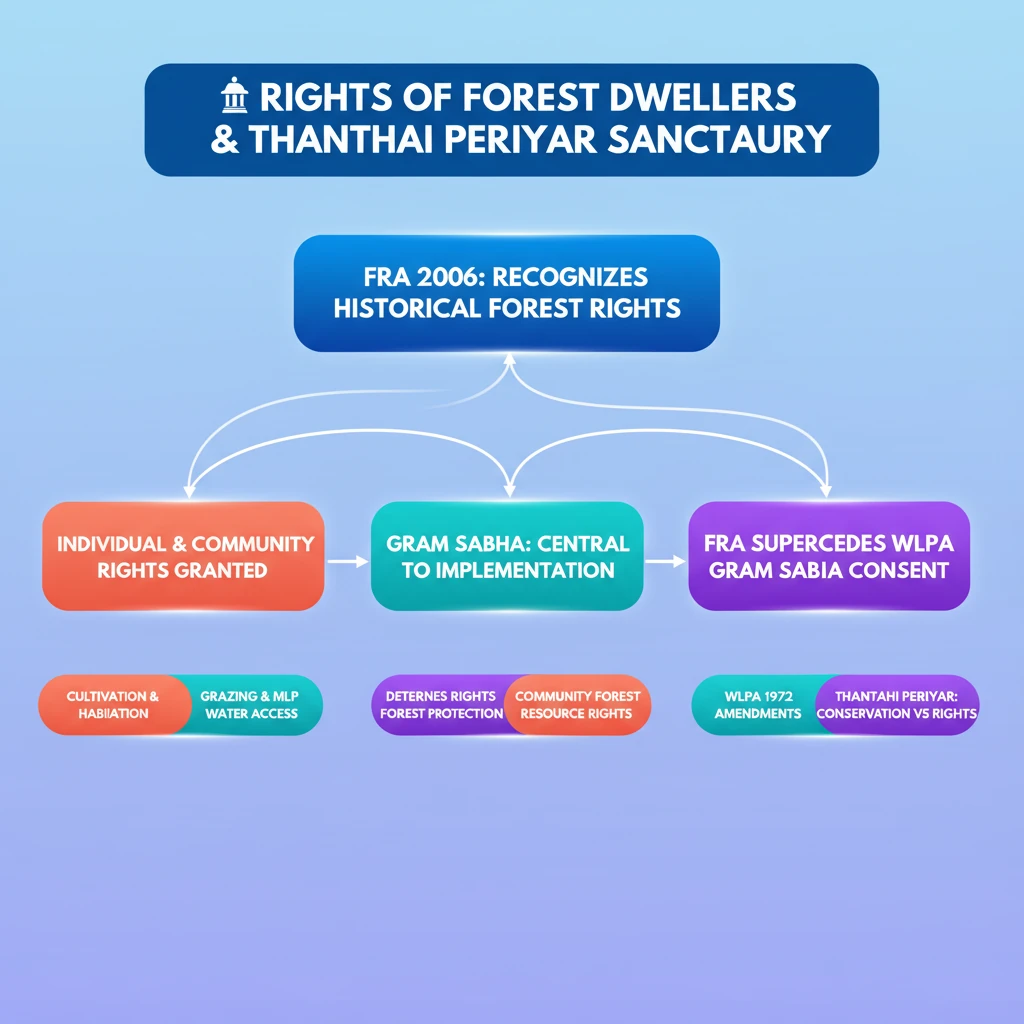
- •FRA 2006 recognizes historical rights of forest dwellers (tribals & traditional) over forest resources.
- •Grants individual rights (cultivation, habitation) and community rights (grazing, MFP, water access).
- •Gram Sabha is central to FRA implementation, determining rights and protecting forests.
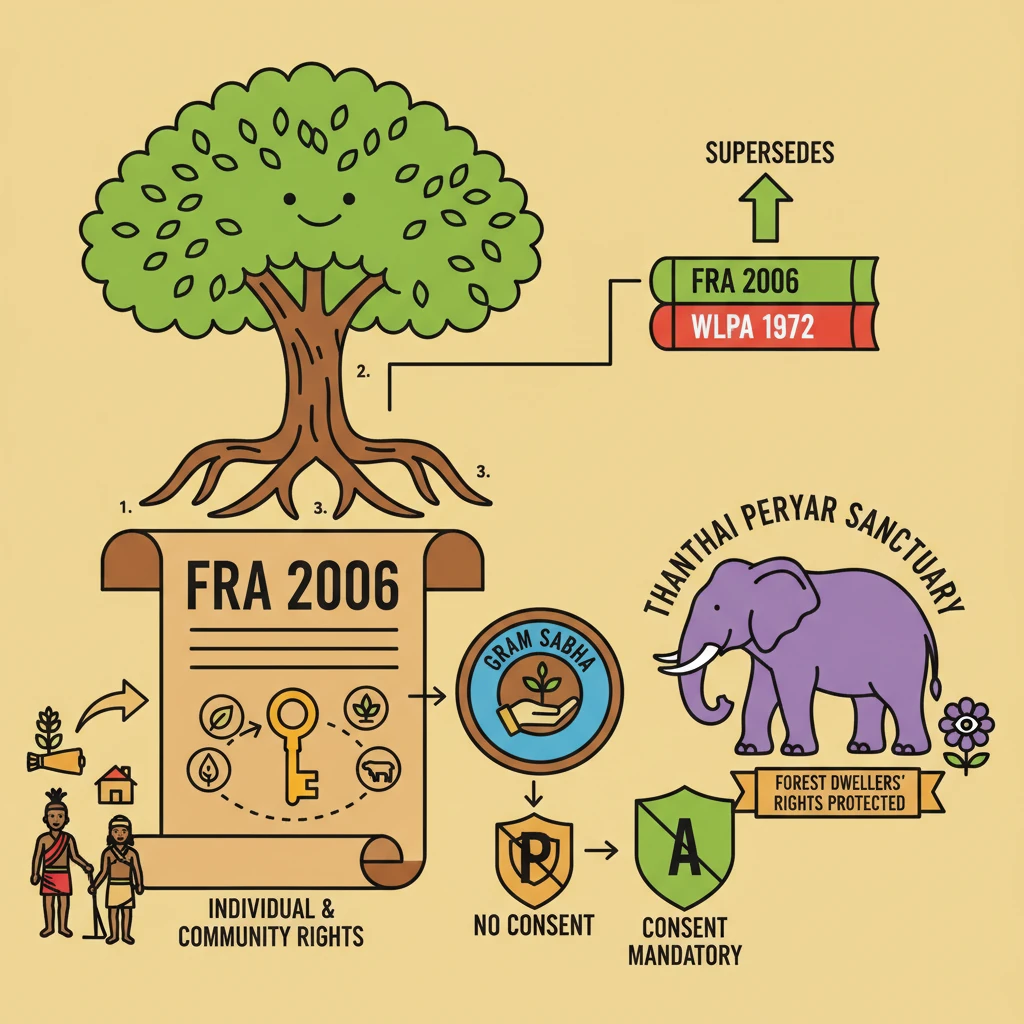
- •FRA 2006 supersedes WLPA 1972; Gram Sabha consent is mandatory for Protected Area notification.
- •Thanthai Periyar Sanctuary highlights ongoing conflict between conservation and forest rights.
- •Madras High Court grazing ban in protected areas conflicts with FRA provisions.
🧠 Memory Techniques
95% Verified Content
📚 Reference Sources
•The Scheduled Tribes and Other Traditional Forest Dwellers (Recognition of Forest Rights) Act, 2006
•Wild Life (Protection) Act, 1972
•Reports on Thanthai Periyar Wildlife Sanctuary notification
•Madras High Court orders related to cattle grazing