Abetment of Suicide: Key Supreme Court Judgments - Social Issues | UPSC Learning
Topics
0 topics • 0 completed
🔍
No topics match your search
Abetment of Suicide: Key Supreme Court Judgments
Medium⏱️ 4 min read
social issues
📖 Introduction
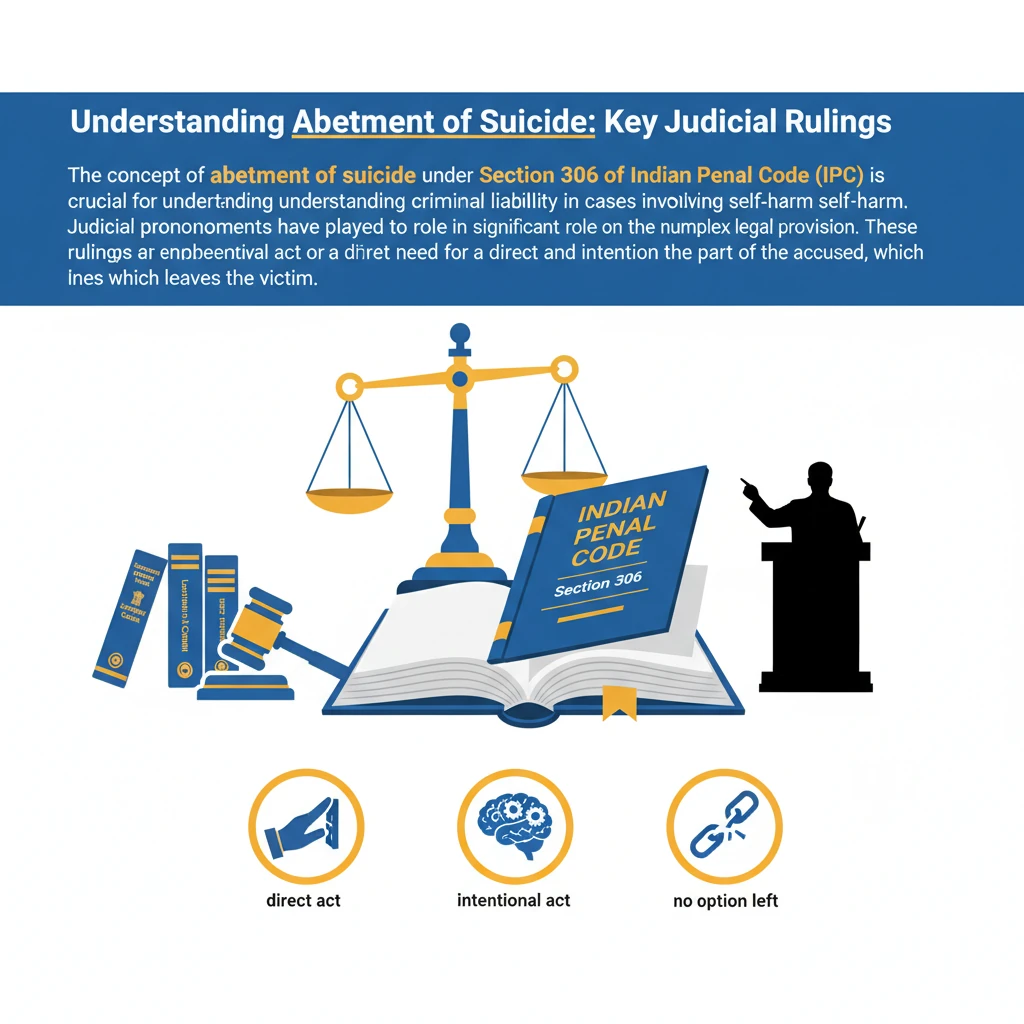
<h4>Understanding Abetment of Suicide: Key Judicial Rulings</h4><p>The concept of <strong>abetment of suicide</strong> under <strong>Section 306 of the Indian Penal Code (IPC)</strong> is crucial for understanding criminal liability in cases involving self-harm. Judicial pronouncements have played a significant role in clarifying the nuances of this complex legal provision.</p><p>These rulings emphasize the need for a direct and intentional act on the part of the accused, which leaves the victim with no viable alternative but to end their life.</p><h4>M. Mohan v. The State (2011)</h4><p>In the landmark case of <strong>M. Mohan v. The State (2011)</strong>, the <strong>Supreme Court (SC)</strong> laid down a fundamental principle regarding the proof required for abetment of suicide.</p><div class='info-box'><p>The <strong>SC</strong> ruled that proving <strong>abetment of suicide</strong> under <strong>Section 306 IPC</strong> necessitates a <strong>direct act</strong> by the accused, performed with clear <strong>intent</strong>, which leaves the victim with absolutely <strong>no option but suicide</strong>.</p></div><p>This judgment underscored the importance of a proximate and compelling link between the accused's actions and the victim's decision to commit suicide.</p><h4>Ude Singh v. State of Haryana (2019)</h4><p>Further elaborating on the complexities, the <strong>Supreme Court</strong> in <strong>Ude Singh v. State of Haryana (2019)</strong> reinforced the need for a case-specific approach to determining abetment.</p><div class='info-box'><p>The <strong>SC</strong> held that proving <strong>abetment of suicide</strong> is highly dependent on the <strong>specific facts and circumstances of each case</strong>. It requires evidence of <strong>direct or indirect incitement</strong> that effectively deprives the victim of any choice other than committing suicide.</p></div><p>This ruling highlighted that while a direct act is preferred, indirect incitement, if sufficiently potent and coercive, can also constitute abetment.</p><div class='exam-tip-box'><p><strong>UPSC Insight:</strong> These cases are vital for <strong>GS Paper II (Polity & Governance)</strong> and <strong>GS Paper IV (Ethics)</strong>. They demonstrate how judicial interpretation refines statutory provisions and addresses societal challenges. Understanding the 'direct act' and 'no option but suicide' criteria is key.</p></div>
💡 Key Takeaways
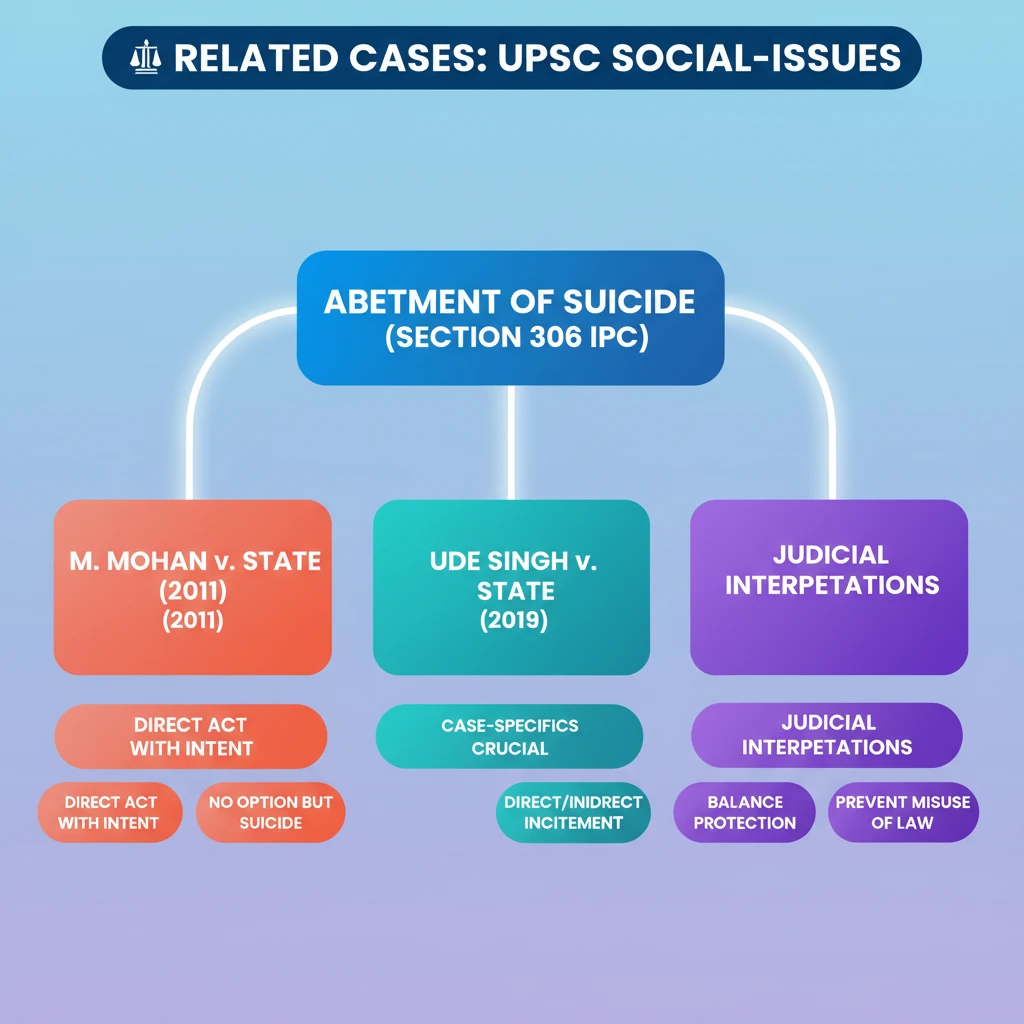
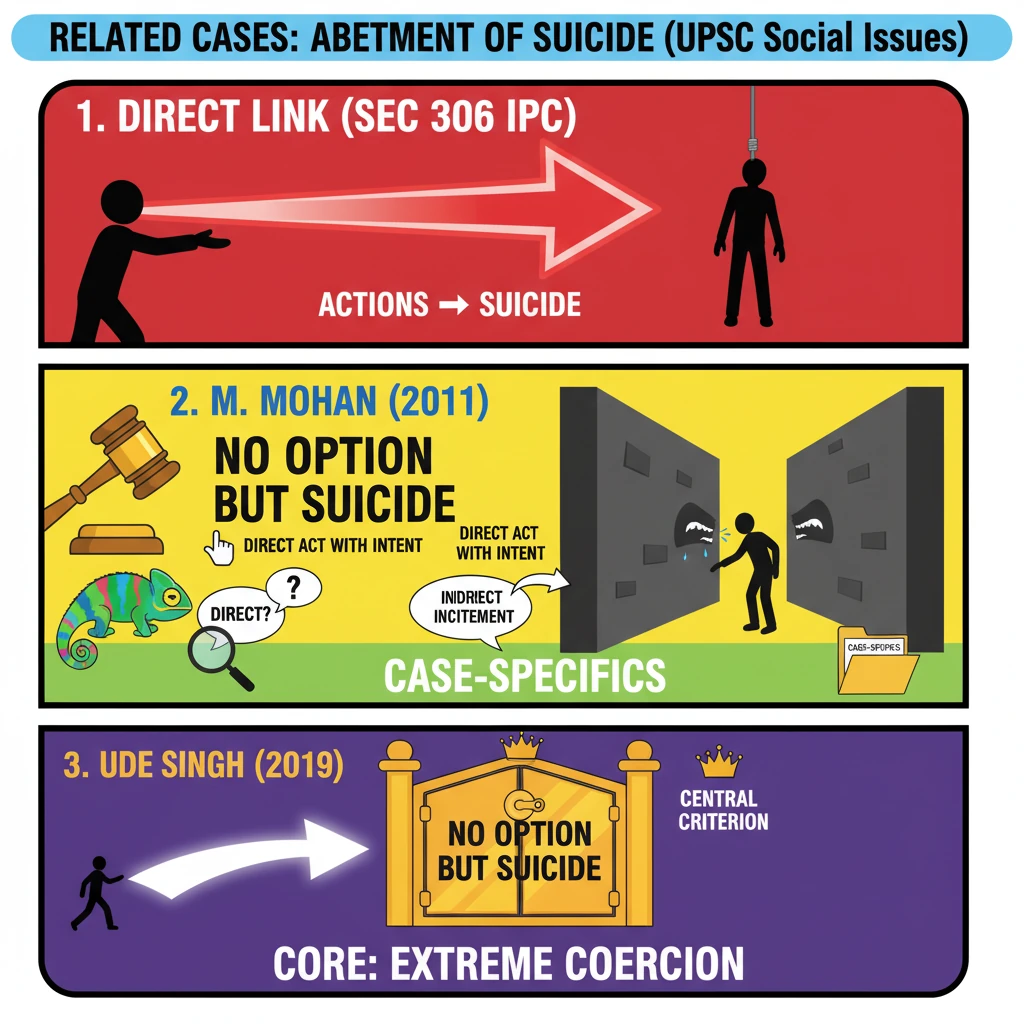
- •Abetment of suicide (Section 306 IPC) requires a direct link between the accused's actions and the victim's suicide.
- •M. Mohan v. The State (2011) emphasized a 'direct act with intent' leaving 'no option but suicide'.
- •Ude Singh v. State of Haryana (2019) clarified that abetment depends on 'case-specifics' and 'direct or indirect incitement'.
- •The 'no option but suicide' criterion is central to proving abetment, indicating extreme coercion.
- •Judicial interpretations aim to balance protecting individuals with preventing misuse of the law.
🧠 Memory Techniques
98% Verified Content
📚 Reference Sources
•Indian Penal Code, 1860 (Section 306)
•Supreme Court of India judgment: M. Mohan v. The State, (2011) 3 SCC 626
•Supreme Court of India judgment: Ude Singh v. State of Haryana, (2019) 12 SCC 301